
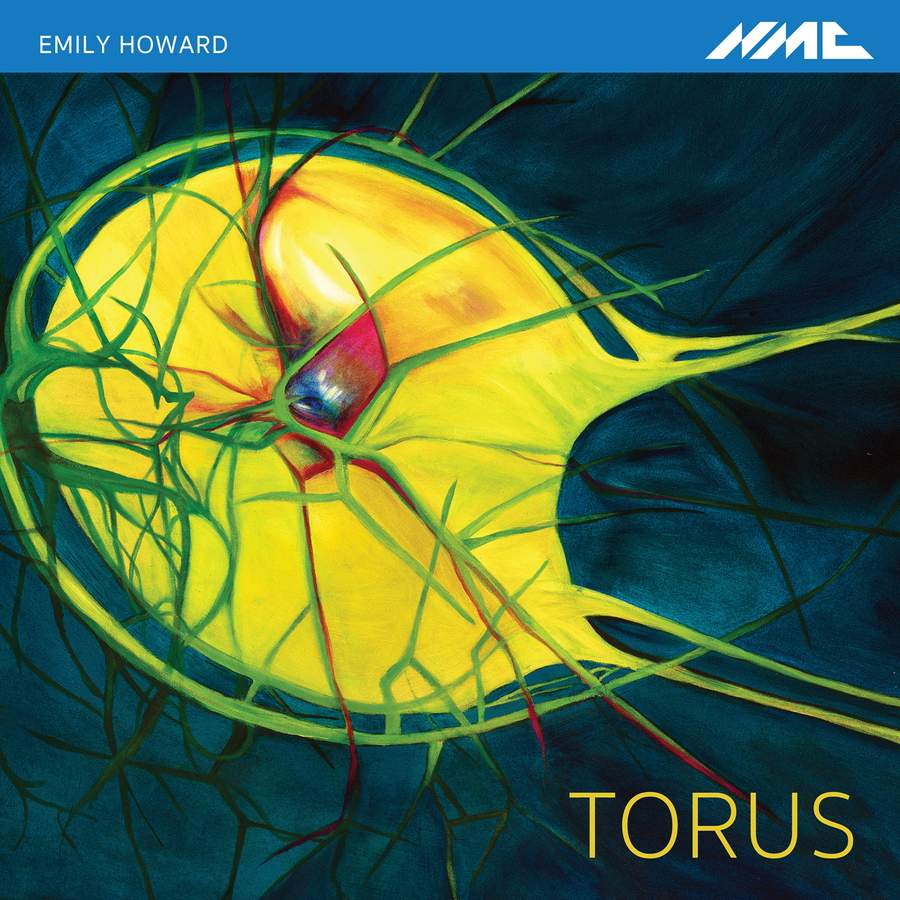
Emily Howard
Antisphere (BBC Philharmonic Orchestra / Vimbayi Kaziboni)
Producer Matthew Bennett, Engineer Stephen Rinker
Recorded 29 November 2022, Bridgewater Hall, Manchester
sphere (BBC National Orchestra of Wales / Mark Wigglesworth)
Producer Dean Craven, Engineer Stephen Rinker
Recorded at the Aldeburgh Festival, 23 June 2018, The Maltings, Snape
Compass (Julian Warburton (percussion), Birmingham Contemporary Music Group / Gabrielle Taychenné)
Producer & Engineer David Lefeber
Recorded 4 December 2022, Royal Northern College of Music, Manchester
Torus (BBC Symphony Orchestra / Martyn Brabbins)
Producer Ann McKay, Engineer Christopher Rouse
Recorded 11 November 2019, Barbican Hall, London
NMC Recordings D274 [68’58″]
Reviewed by Richard Whitehouse
What’s the story?
NMC releases a second collection of music by Emily Howard – now in her early forties and established among the most distinctive while forward-looking composers of her generation, heard in scrupulous performances by a notable line-up of British orchestras and ensembles.
What’s the music like?
Few world premieres from recent years have left an impression comparable to that of Taurus at the Proms in 2016. Its appearance, moreover, marked a further stage in an evolution which had commenced just over a decade earlier and has continued apace, with major commissions from British and European organizations. This has been paralleled by Howard’s commitment into researching the intrinsic properties of sound, most recently via the Centre for Practice & Research in Science and Music (PRiSM) at Manchester’s Royal Northern College of Music.
As it now stands, Torus is the first part in an informal trilogy of pieces collectively entitled Orchestral Geometries. It evolves along the perceived trajectory of a doughnut-shaped ball whose central void is crucial to music evoking absence as much as presence. Not that a work subtitled Concerto for Orchestra could be found lacking in either immediacy of content or virtuosity of gesture, which qualities come demonstrably to the fore as it unfolds and make for a composition involving in its expressive profile and fascinating in its formal process.
By contrast, Sphere is a succinct yet eventful journey through and around the global shape in question and which, in this context, might reasonably be thought an extra-terrestrial interlude – its ideas pithy while exuding enough potential for their development in subsequent pieces.
This is what happens in Antisphere which forms its conceptual opposite though also its aural continuation, the piece gradually encompassing the ‘sound-space’ through an engrossing and imaginative demonstration of orchestral prowess. Evident too is an increased focus upon the visceral nature of the musical content, likely reflecting a form which can precisely be defined in mathematical terms but remains all but intangible as regards human perception. Fortunate, then, that Howard has been able to render this concept as an emotional and affective whole.
Hardly less absorbing is Compass, the most recent of these pieces. This takes the spatial and nautical connotations of its title as the basis for music which unfolds as a cohesive dialogue between string septet and percussion that complements it and offers contrasts at every turn.
Does it all work?
It does, not least for providing an arresting take on that interplay of ‘heart and brain’ that has been a mainstay of Western music. The cerebral basis of all these pieces may be undeniable, though equally so is the precision of their forms and, above all, the allure of their expression judged intrinsically as sound. Much the same could be said of the music of Iannis Xenakis, the centenary of whose birth was commemorated last year, and whose thinking is continued by Howard from a vantage that is inherently personal while being decisively of the present.
Is it recommended?
It is, not least for its excellent performances by three of the BBC orchestras and Birmingham Contemporary Music Group, with booklet notes by Paul Griffiths and mathematician Marcus du Sautoy. This impressive release reinforces Howard’s significance in no uncertain terms.
Listen & Buy
Torus is released on Friday 28 April. You can explore buying options at the NMC Recordings website, and listen to clips from the album at the Presto Music site. You can read Arcana’s interview with Emily Howard by clicking on the link, and click on the names for more on the composer Emily Howard, plus performers Vimbayi Kaziboni, Mark Wigglesworth, Julian Warburton, Gabrielle Teychenné and Martyn Brabbins

 Arcana.fm