
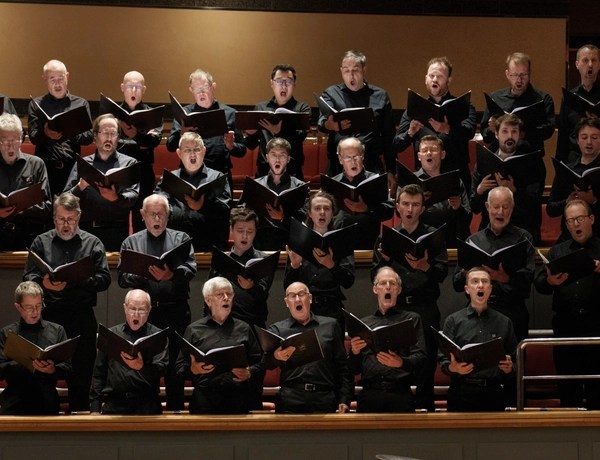
Sir Stephen Hough (piano, below), Lauren Urquhart (soprano), Georgia Mae Ellis (mezzo-soprano), Luis Gomes (tenor), Alexander Grassauer (bass), CBSO Chorus (above), City of Birmingham Symphony Orchestra / Omer Meir Wellber (conductor & harpsichord/director)
Beethoven (/Hough) Piano Concerto no.3 in C minor Op.37 (1800, rev. 1803)
Haydn Missa in Angustiis, Hob.XXII/11 (‘Nelson Mass’) (1798)
Symphony Hall, Birmingham
Thursday 19 February 2026
Reviewed by Richard Whitehouse
That tonight’s concert from the City of Birmingham Symphony Orchestra featured music by Beethoven and Haydn might have been indicative of a straight-ahead or mainstream concert but, as things turned out, neither programme nor music-making could be deemed predictable.
Sir Stephen Hough has no doubt played Beethoven’s Third Concerto many times with, moreover, his take on the outer movements not far removed from his much-praised Hyperion recording. The initial Allegro was lithe and impetuous if at times a touch hectoring (and Matthew Hardy was uncharacteristically reticent in that spellbinding passage after the cadenza), with the final Rondo treading a fine line between humour and irony at its most distinctive in the modulatory transition to the main theme, or that improvisatory solo flourish prior to the nonchalant coda.

Interest naturally centred on the slow movement – a Largo designated Con gran espressione in its ‘re-imagining’ by Hough (above). Itself part of a project instigated by this evening’s conductor, Omer Meir Wellber, to re-examine works in the core repertoire, this duly retains Beethoven’s instrumentation but renders the main theme, introduced by the soloist, as a hushed chorale for strings which pervades what follows. All well and good had that chorale become more than a static backdrop, against which Hough’s welter of skittish figuration sounded overly confined to the upper register. Neither was the climactic return of the first movement’s principal theme other than an affectation, nor the upsurge leading directly into the finale without contrivance. One respected Hough’s following of his muse, even if the outcome felt less than convincing.
Having not unreasonably given Hough the benefit of any doubt, the audience was nonplussed with his encore – the last of Schoenberg’s Six Little Pieces that, written after Mahler’s funeral on 17th June 1911, yields a rapt eloquence even at less than the ‘very slow’ tempo prescribed.
As searching products of his late maturity, the six ‘name day’ Masses that Haydn wrote around the turn of the 19th century remain too little heard at orchestral concerts; save for the ‘Nelson Mass’ whose actual title, Mass in Troubled Times, makes explicit the cultural turmoil from of which it arose. This must also have occasioned its unyielding orchestration with trumpets and timpani but no woodwind, plus a dextrous continuo part allotted here to harpsichord and from which Wellber directed with a sure sense of where this most combative of masses was headed.
Vocally the solo writing favours soprano and bass, with Alexander Grassauer making the most of his mellifluous contributions and those of Lauren Urquhart impassioned yet tonally uneven in more animated passages. Georgia Mae Ellis and Luis Gomes handled their secondary roles with real finesse, while chorus-master David Young drew a laudable response from the CBSO Chorus (arrayed on stage with what might be felt the choral equivalent of ‘free bowing’). Taut and incisive, the epithet ‘symphonic’ as applied to this work can rarely have been so apposite.
The performance certainly set the seal on a concert which rightly encouraged a reassessment of both works and, by so doing, underlined Wellber’s own interpretative convictions. Having last appeared with the CBSO almost six years before, his return should be so long in coming.
To read more about the CBSO’s 2025/26 season, visit the CBSO website. Click on the names for more on conductor Omar Meir Wellber, pianist Sir Stephen Hough and soloists Lauren Urquhart, Georgia Mae Ellis, Luis Gomes and Alexander Grassauer.
Published post no.2,804 – Friday 20 February 2026
 Arcana.fm