
On record: James Taylor – The Rochester Mass (Cherry Red)

james-taylor

Ever felt the need for a ‘funk mass’? Well James Taylor has, and this year The Rochester Mass received its premiere at the Queen Elizabeth Hall in April, before a performance in the cathedral of its home city in June. It was the South Bank who commissioned the work, which James wrote in memory of his late father Clive. The recording features choristers from Rochester Cathedral, as well as the fulsome organ.

What’s the music like?

Rather curiously, Taylor opts to present the mass in reverse order, so we begin with the jerky motif of the Sanctus, working through the Agnus Dei (complete with flute cadenza) to the Benedictus, Gloria and finally the Kyrie.

There is more than a passing reference to Leonard Bernstein’s setting of the Mass, a much bigger work but one that also operates with a policy of musical freedom. James Taylor doesn’t let his music go in quite the same way Bernstein did, preferring to opt for a little more ecclesiastical control. This means he is not self-indulgent in the way so many of these adaptations can be (remember Rick Wakeman’s The Gospels?!) but that he still pushes a boundary or two.

Part two of the Sanctus shows that Taylor can achieve a really grand sound with choir and organ – there is an impressive climax – and the response is a kind of joyous wig-out that sounds a lot better than it reads on paper.

Does it all work?

More or less. It is quite difficult to work out what gives this piece a special connection with Rochester, other than the performers being from the Kent town – and it is not quite clear why Taylor felt the need to reverse the order of the movements. But these are perhaps over-fussy points, because the music itself is meaningful and direct, and achieves the difficult balance of bringing funk into more classical structures without losing its identity. It also has the obvious emotion generated by the passing of Taylor’s father.

On occasion the music can sound forced – the Agnus Dei Duet being a good example – but that is balanced by music of fresh spontaneity, such as the unexpectedly gorgeous Flute Cadenza linking Parts One and Two of the Agnus Dei. In the closing Kyrie you get the feeling Taylor has mastered the unusual blend of cathedral choir and funk group. A unique sound indeed!

Is it recommended?

Yes, if you want to hear something different – and if you want to hear a creative way of taking on one of music’s most traditional forms.

Listen

The Rochester Mass can be heard on Spotify here:
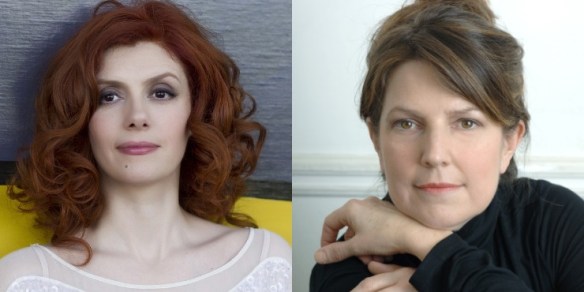
Patricia Petibon and Susan Manoff at the Wigmore Hall – La Belle Excentrique

petibon-manoff

Patricia Petibon (soprano) and Susan Manoff (piano) – La Belle Excentrique, Wigmore Hall, Wednesday 16 December 2015

Review by Ben Hogwood

It isn’t often you see a rubber chicken as part of a song recital, and I would wager one has not been seen on the Wigmore Hall stage for quite some time. If ever! But this wasn’t just any song recital, this was a concert where soprano Patricia Petibon and pianist Susan Manoff asked questions of their audience, expanding the format but making them laugh and cry in the process.

The concert, a memorable Wigmore debut for Petibon, reminded us how regimented and serious some song recitals can be. Not a criticism you understand, for sometimes it is only right and proper to sit and listen to a singer and pianist making music of raw emotion. It can be one of the very best live experiences in classical music. But this was so very different, Petibon and Manoff marrying humourous music with songs of deep emotion, punctuated with well-chosen piano pieces.

La Belle Excentrique was the title given to the recital, which fell neatly into two parts. Part one began with understated beauty, the crystalline music of one of Reynaldo Hahn’s finest songs A Chloris a daring way to start, especially when sung so quietly. Yet gradually it became clear Petibon was here to have some fun, the actions at the end of the third Hahn song Quand je fus pris au pavillon a notice of intent. Soon the soprano was barking (Manuel Rosenthal’s Fido, Fido) and then Manoff donned a trunk for the same composer’s story of L’éléphant du Jardin des Plantes, both brilliantly done. Hats were donned for songs by Satie and Poulenc, while charm and heart-rending emotion took hold in two wonderful songs by Fauré.

The second half also moved between extremes. France, Spain and the Swiss Alps dovetailed beautifully for songs of powerful impact from lesser-known composers such as Henri Collet and Fernando Obradors, as well as underrated song composers Joaquín Turina and Joseph Canteloube, whose Chants d’Auvergne have fallen out of fashion in the last few decades. Petibon’s performance of La delaïssádo (The forsaken girl) proved this to be an oversight, matched by exceptional playing from Manoff who effortlessly deconstructed the orchestral parts. Then we moved back to farce, and an exaggerated performance of Leonard Bernstein’s song cycle La Bonne Cuisine. For this, Petibon and Manoff went the whole hog by dressing up as chefs and using props relating to the food they were describing. It was hilarious! The recital ended with a no holds barred performance of Lara’s popular song Granada, before two encores – the popular French song Parlez-moi d’amour and a short excerpt, The Cat, from Ravel’s opera L’enfant et les sortileges.

These two performers were a breath of fresh air on the Wigmore Hall stage, heightening our appreciation for 20th century song while questioning the conventional format of the song recital. The strongest possible recommendation I can give lies in the fact I have since purchased two of Petibon’s albums on Deutsche Grammophon, La Belle Excentrique and Melancolia (see Spotify below!) – and would wholeheartedly recommend and Susan Banoff as a concert experience to completely blow away the cobwebs.