Listening to Beethoven #6 – Piano Sonata in F minor (‘Electoral’ no.2)


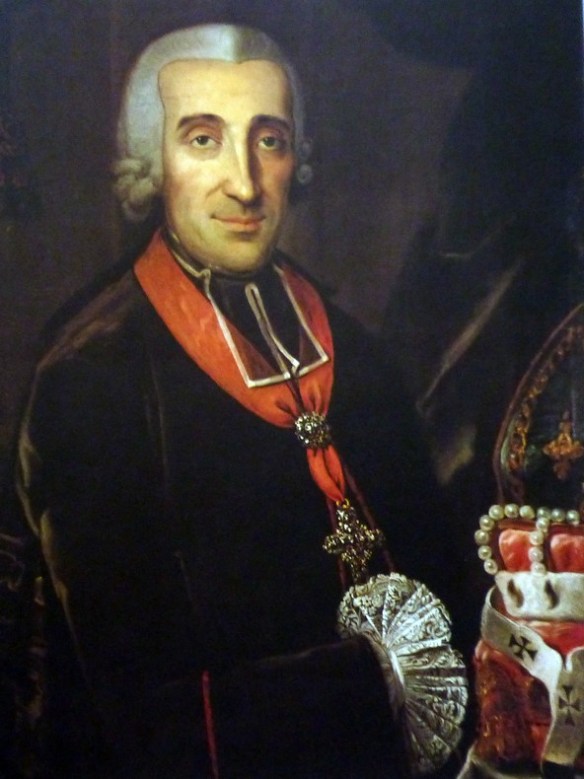
Portrait of Maximilian Friedrich von Königsegg-Rothenfels, Archbishop-Elector of Cologne. Artist unknown

Piano Sonata in F minor WoO 47/2 ‘Electoral’ for piano (1783, Beethoven aged 12)

Dedication Maximilian Friedrich, Elector of Cologne
Duration 11’20

Listen

Background and Critical Reception

The three Electoral sonatas divide opinion among Beethoven scholars. While you can read largely complimentary thoughts in the background to no.1 – as appraised yesterday – Lewis Lockwood‘s biography decides that the three works are ‘short, undeveloped and crowded with stereotyped figures. He does however go on to concede that ‘still, these three little works show that the barely adolescent Beethoven could spin coherent phrases and short paragraphs as capably as many an adult professional.’

Charles Rosen‘s observation that Beethoven’s three Electoral Sonatas ‘start clearly from Haydn’s work of the late 1760s’ appears to have greatest traction with the second work in F minor. This key was important to Beethoven’s contemporary, and accounts for two of his most profound works – the Symphony no.49 (‘La Passione’) and the Variations in F minor for piano.

Beethoven too made use of F minor for important works, and it was a relatively brave choice to use it early on in his career as here. For Barry Cooper, writing in the complete edition as released on Deutsche Grammophon, this second sonata is ‘the most strongly emotional in the set, with powerful gestures that anticipate some of Beethoven’s later minor-key sonatas such as the Pathétique and the Moonlight.’

Thoughts

The first movement starts deep in thought, but Beethoven snaps out of that mood with a flash the music suddenly tearing forward. However it doesn’t completely throw off the mood of the sombre opening, which leaves its striking mark and brings to mind the writing of C.P.E. Bach in the process – not to mention the aforementioned La passione symphony from Haydn.

In spite of this the slow movement is the emotional heart of this sonata – and it is probably the most meaningful music we have heard so far. Time really does slow as Beethoven’s thoughts unfurl, a method with which we will become increasingly familiar as time moves on. Here it feels like we have a private audience with him as the music becomes more freeform.

The third movement, marked Presto, throws off the shackles, with a heavily ornamented melody which must be tricky to play. It means the music retains some tension despite its much quicker delivery.

Recordings used

There is a terrific account of this piece from Emil Gilels, whose playing gets to the heart of the emotion in the second movement but also catches the devil-may-care freedom of the third. Jenő Jandó also gives a fine performance, if slightly trailing in the wake of the Russian.

Spotify links

The playlist below is for all three Electoral Sonatas, and includes the two recordings discussed above – Emil Gilels and Jenő Jandó:

You can chart the Arcana Beethoven playlist as it grows, with one recommended version of each piece we listen to. Catch up here!

Also written in 1783 Mozart Mass in C minor, K427 (the Great Mass) .

Next up Piano Sonata in D major, ‘Electoral’

Routes to Beethoven – Mozart

by Ben Hogwood

It has often been speculated that Beethoven met Mozart in Vienna when he was 17. What a meeting that would have been, with a musician and composer at the peak of his powers and the man seen by many as his successor-in-waiting.

There were many contacts to link the two – not least Archduke Maximilian, elector and archbishop of Cologne. Mozart enjoyed good relations with him, and Beethoven was sent out with his strong recommendation. However not much is known about the outcome of their proposed meeting, nor even if it took place at all, given the conflicting tales afterwards. Yet what cannot be doubted is that the music of Mozart exerted a considerable influence on Beethoven for years – more so even than Haydn.

In his biography of the composer Lewis Lockwood writes of how Beethoven played Mozart piano concertos with the orchestra in Bonn. Beethoven’s good friend Reicha recounts of how, ‘after hearing an aria from Mozart’s Idomeneo (Electra’s passionate D minor aria), he talked of nothing else day and night for weeks thereafter.’ He also treasured Mozart’s Piano Concerto no.20, written in the same key, and wrote two cadenzas for it to be performed by his student Ferdinand Ries.

Lockwood goes on to examine the 14-year old Beethoven’s prodigious Piano Quartets, found after his death and posthumously published. So accomplished was the writing in these pieces that contemporaries doubted if Beethoven could have written them at all, but an autograph score survives to confirm their authenticity.

Lockwood notes them as ‘the first and clearest examples of the teenage Beethoven’s dependence on Mozart. They mark the beginning of a relationship to Mozart that remained a steady anchor for Beethoven over the next ten years as he moved into his first artistic maturity. Just as Mozart himself had once told his father that he was ‘soaked in music’ so Beethoven was soaked in Mozart. His invention of new ideas sometimes began with his asking himself if what he was writing was his own, or something he might have heard or seen in a work by Mozart, or partly both.

https://www.youtube.com/watch?v=cNsPXwkTWEw

Several sources note that Beethoven copied out two of Mozart’s string quartets when the time came for his first forays into the form. Both form part of the set of six dedicated to Haydn – in G major (K387) and A major (K464), and the latter became a model for the fifth of the set published as Beethoven’s Op.18. He was also deeply impressed and affected by the otherworldly way in which Mozart begins another ‘Haydn’ quartet, the one known as the Dissonance in C major, K465. The introduction to this work is remarkable, removed almost completely from tonality and – at the time – regarded as deeply unattractive. Beethoven took it on board, however, and imitated it twice in subsequent slow introductions, the string quartets Op.18/6 and Op.59/3.

https://www.youtube.com/watch?v=6zbNgyJkzdw

In his early work Beethoven used a number of titles and forms common to Mozart. A Serenade, a Quintet for piano and wind instruments, and he built several pieces of variations on Mozart themes. Some of Mozart’s forays into C minor – often seen as a ‘tragic’ key – are precedents for Beethoven’s own thoughts. The Piano Concerto no.24 is an especially vivid example, its mood and musical arguments emulated in Beethoven’s Piano Concerto no.3.

As I mentioned, Beethoven had to check a theme he had written was not a Mozart original, so concerned was he about marking his own path. As Lewis Lockwood writes, ‘Nothing could be more revealing of his anxiety about Mozart, his musical god and artistic father, whose music he knew and heard in his mind so well and clearly that he must have felt he had to work his way through the Mozartian landscape to find his own voice.’

The playlist includes all the works mentioned above and closes with Mozart’s crowning orchestral glory – the final Symphony no.41 in C major, known as the Jupiter:

Next we’ll briefly examine Beethoven’s relationship with the music of Clementi, one of the piano-playing stars of the time…and then it’s a look at the music of 1770, Beethoven’s birth year!

Routes to Beethoven – Joseph Haydn

by Ben Hogwood

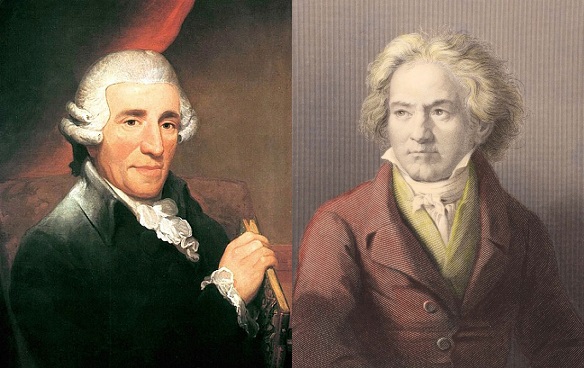
November, 1792. The 21-year old Beethoven was planning to leave his home town of Bonn for Vienna, and he left with a ringing endorsement from Count Waldstein, his most important patron. Mozart had died the previous year at the age of thirty-five, and Waldstein sensed the stage was clear. “Dear Beethoven!”, he wrote. “You are going to Vienna in fulfillment of a wish that has long been frustrated. Mozart’s genius is still in mourning and weeps for the death of its pupil. It found a refuge with the inexhaustible Haydn but no occupation; through him it wishes to form a union with another. With the help of unceasing diligence you will receive the spirit of Mozart from the hands of Haydn.”

This was of course rather fanciful. To suggest Haydn as a channel for Mozart’s inspiration did the older composer – now sixty and in the prime of his musical life – little recognition. Haydn was aware of Beethoven, the younger composer having sent him his ambitious choral Cantata on the Death of Emperor Joseph II – and was willing to take him on. Thus Beethoven left Bonn in early November 1792 and travelled for ten days until arriving in Vienna.

All appeared to be going well for him there, but when Haydn sent a letter to Elector Maximilian dated just over a year later he included a clutch of works that Beethoven had already written in Bonn. Most were sadly lost – including an Oboe Concerto – but an Octet-Partita for wind ensemble has survived. The covering letter expressed the conviction that ‘On the basis of these pieces, expert and amateur alike must admit that Beethoven in time will attain the rank of one of the greatest musical artists in Europe, and I shall be proud to call myself his teacher. I only wish that he might remain with me for some time yet.’

The reply was curt, since Maximilian was receiving music he had already seen – and could not see any discernible progress to finance Beethoven further. As Lewis Lockwood points out in his Beethoven biography, Haydn’s priorities as a composer were stacked up. He had made a pioneering and highly successful visit to London in 1792, and a sequel was on the cards, for which he would need new string quartets and symphonies. Beethoven, too, given his ability and individuality, was not to be the perfect match. Lockwood talks of ‘the same stubborn personal resistance’…which ‘seems to have troubled his relationship to Haydn, though here it was mingled with reverence for authentic genius.’

With Haydn’s focus abroad, Beethoven looked elsewhere for his teaching and found counterpoint studies with Johann Schenk. Haydn returned to London and the brief relationship was at an end. Before he left Vienna, however, he was privy to Beethoven’s Op.1 – three trios for piano, violin and cello – and Op.2, a set of three piano sonatas dedicated to Haydn.

The trios contained a problem, in the explosive form of the third piece in C minor. Haydn advised withholding this from publication, calculating the impact on the Viennese audience might damage Beethoven’s reputation. It was, as Michael Steinberg in The Beethoven Quartet Companion points out, ‘a surprising attitude from a composer who was himself so bold. An observer went further, noting ‘a kind of apprehension, because he realised that he had struck out on a path for himself of which Haydn did not approve.

Jan Swafford holds the conviction that Beethoven took far more from Haydn than he himself declared at the time. ‘There is no record of what transpired in their lessons’, he writes. But it can be said that at least by his Op.2 Piano Sonatas, composed in 1794-5, Beethoven was showing the fruits of his studies in a startlingly mature way. After his months with Haydn, Beethoven emerged a far more sophisticated composer. To mention only one issue: Before Haydn, Beethoven had a shaky idea of proportion, might write an introduction to an aria that was a quarter of its length. After he finished the lessons with Haydn, he had one of the most refined senses of proportion of any composer – a sense of it, in other words, at the level of Haydn.’

Haydn’s influence on Beethoven can be gauged at this stage by listening to some of the works he was writing while teaching the younger composer. The three string quartets published as Op.74 are a case in point. The slow movement of no.3 in G minor finds the sort of spaciousness we became accustomed to from Beethoven in his equivalent slow movements. Meanwhile in the slow movement of no.1 in C major Haydn goes on all sorts of unusual tonal routes, seeming to travel far from home but only so he can show his dexterity as a composer, bringing the music ‘home’ with a single, deft switch. Beethoven was to acquire that quality too.

The Piano Sonatas offer some clues, too. The playful opening of the Sonata in C major has a wit Beethoven was only too keen to take forward. So too the grand gestures of the Sonata in E flat major, a key that was to assume great importance for Beethoven over the years. Haydn’s Masses were well known to Beethoven too, and the Nelson Mass – closely associated with Nelson’s victory over Napoleon – cast quite an influence on the younger composer’s Mass in C major.

The later symphonies acquire a dramatic instinct which must have appealed to Beethoven too. Like C.P.E. Bach, who we have already heard from, Haydn had a Sturm und Drang period that marked his music forever, and the last twelve symphonies, written for use in London, are even more vivid in their stories. The introduction to the relatively unsung Symphony no.98 in B flat major has a dark edge, and these works, now laden with timpani, have more emotive and dynamic contrasts, straining at the leash of the conventions of form and harmony. The final, London symphony – no.104 in D major – demonstrates best of all how far Haydn had taken the form. Its dramatic slow introduction reaching towards the 19th century and beyond, while the slightly rustic finale is brilliantly written.

There is much speculation on how Beethoven and Haydn’s relationship developed, if it did at all, beyond that of a prodigious pupil and a seasoned master of his craft in his early sixties. Certainly a healthy mutual respect existed, Haydn spotting the gifts Beethoven had in abundance, while Beethoven himself found his early works bearing clear influence of Haydn even more than Mozart. We will explore those in greater depth, as Beethoven takes on the forms of symphony, string quartet, piano trio and piano sonata and bears them into the 19th century.

You can listen to selections from Haydn’s enormous output, including the works discussed above, on the playlist below:

Routes to Beethoven – J.S. Bach

by Ben Hogwood

As we plot a course towards listening to the complete works of Beethoven, I thought a good way to start would be by listening to composers who have helped shape his output.

While I am sure we will ultimately find Beethoven out to be one of the most original composers of all, every artist will have had their grounding somewhere, which is bound to have had a say in their eventual direction. The first composer to appear under the microscope is J.S. Bach.

There are some fascinating and very different viewpoints among Beethoven scholars on the extent of Bach’s influence. In his famous book The Classical Style, dissecting the music of Haydn, Mozart and Beethoven, Charles Rosen is not convinced of much common ground. “It is worth noting, in this respect”, he says, “the extremely limited influence of the music of Bach in Beethoven’s works, in spite of the fact that his knowledge of Bach was considerable.”

Rosen goes on to note the facts – that Beethoven played both volumes of Bach’s The Well-Tempered Clavier in their entirety as a child, continuing to play it all his life, and that he copied out passages of Bach when approaching composition for the Hammerklavier Sonata. He had a copy of the Inventions for keyboard, two copies of The Art of Fugue, and was familiar with the Goldberg Variations. For Rosen, though, “…except for an obvious and touching reference to the Goldberg in the conception of the final variations of the Diabelli set, the use he (Beethoven) made of all his familiarity is very small, almost negligible in comparison to the continuous reference to Bach in the music of Mendelssohn, Chopin and Schumann. The classical style had already absorbed all that it could of Bach as seen through the eyes of Mozart in the early 1780s, and as Beethoven continued to work within these limits, his love for Bach remained always in the margin of his creative activity.”

Lewis Lockwood’s book Beethoven: The Music and the Life sees things very differently. On several occasions Lockwood highlights Beethoven’s desire to seek out the music of Bach for himself, specifically the Mass in B minor, as he approached the period of composition for the Missa Solemnis. He also focuses on Beethoven’s use of fugue throughout his later period. For in this ‘late’ period (with Beethoven still in his 40s!) it would appear he looked back at Bach for further inspiration, writing complicated but incredibly expressive fugues at key points in his music. The Grosse Fuge (the finale of his Op.130 string quartet), the Hammerklavier and several other piano sonatas, the Ninth Symphony – these are all works where we will no doubt come back to this article and consider its implications.

To build up a basic impression of Bach, I listened to the pieces referenced above and some well-worn favourites of my own. Listening to The Well-Tempered Clavier, then The Art of Fugue, it is possible to marvel at the sheer inevitability of Bach’s music, its structure and lines – but also its profound emotion and moments of humour, joy and even despair. Despite his rigorous working methods Bach pours his heart into this music, including the Goldberg Variations, which are simply sublime – and as Rosen says point towards Beethoven’s massive, late Diabelli Variations, not to mention many other works in the variation form.

Bach’s music has an incredibly sure direction, its workings are so logical and secure, each note and melodic figure seems very closely related, and the end goal – when reached – is unbelievably satisfying. Listen to the Prelude no.1 in C major from The Well-Tempered Clavier (the first item of music on this broadcast) and see if a single note is out of place or could be changed:

https://www.youtube.com/watch?v=Ugc5FZsycAw

By contrast the forward thrust of the Fantasia and Fugue in G minor for organ is especially notable. Although Beethoven wrote virtually nothing for the organ, he surely will have picked up the discipline, application and adventure of J.S. Bach’s keyboard works. That sense of adventure can be heard in a work like the joyous Fugue in E flat major from The Well-Tempered Clavier, or even more in the standalone Toccata in C minor, below:

This shows how Bach can be unpredictable. His music is so sure of its own destiny, but that doesn’t stop it having a few emotional wobbles and flights of fancy along the way.

A work like the Brandenburg Concerto no.1 is a great example of this, where the beautifully argued lines of the first movement (above) are thrown into doubt by the extremely emotional second (below), the oboe floating above chords that are riddled with anxiety:

Moving to the larger scale works, Bach’s dramatic impetus becomes clearer. Whether Beethoven encountered the Mass in B minor is not known, but had he done so the contrasting solemnity of the Kyrie and outright exultation of the Gloria would surely have made a strong impression. Within the Credo section, when Bach reaches the moment of the Crucifixus, there is almost inaudible contemplation – after which the resurrection itself (Et resurrexit) literally bursts from the grave! The splendour of the Dona nobis pacem would seem to anticipate Beethoven’s Missa Solemnis, also in the same key of D major.

It is interesting to note Beethoven did not take up Bach’s lead in writing for solo instruments, with no sonatas for solo violin or cello in his output. Nor did he write extensively for the church as Bach did – no realms of cantatas here. Yet that is perhaps a sign of where the commissioned work now originated in music, and Beethoven’s beliefs too, which remain largely unknown. But the two composers have much in common, being innovators and inventors in so many different musical disciplines. We look forward to spending much more time with their music!

Listen

Follow our route to Beethoven by listening along with this Spotify playlist, including the works by Bach discussed in the feature above. Please do follow Arcana here for further playlists in the series!

Next up

Routes to Beethoven moves swiftly on to the music of the ‘next generation’ Bach, Carl Philipp Emanuel – Johann Sebastian’s second surviving son. Expect some fireworks!