
In concert – London Sinfonietta / Edmon Colomer: A Catalan Celebration

london-sinfonietta-catalan

Gerhard Libra (1968)
Figuera
Faula (2017)
García-Tomás
Aequae (2012)
Illean
Januaries (2017)
Gerhard
Leo (1969)

London Sinfonietta / Edmon Colomer

Queen Elizabeth Hall, London
Wednesday 1 December 2021

Written by Richard Whitehouse

A celebration of Catalan music, this concert by the London Sinfonietta also commemorated the fiftieth anniversary of the death of Roberto Gerhard – which, falling in January last year, had augured a number of events substantially curtailed by the COVID-19 pandemic and its attendant lockdowns. At least it had been possible to reschedule this programme – Gerhard’s work framing three recent pieces by contemporary composers whose music, if by no means beholden to that of their predecessor, was demonstrably influenced and even enhanced by it.
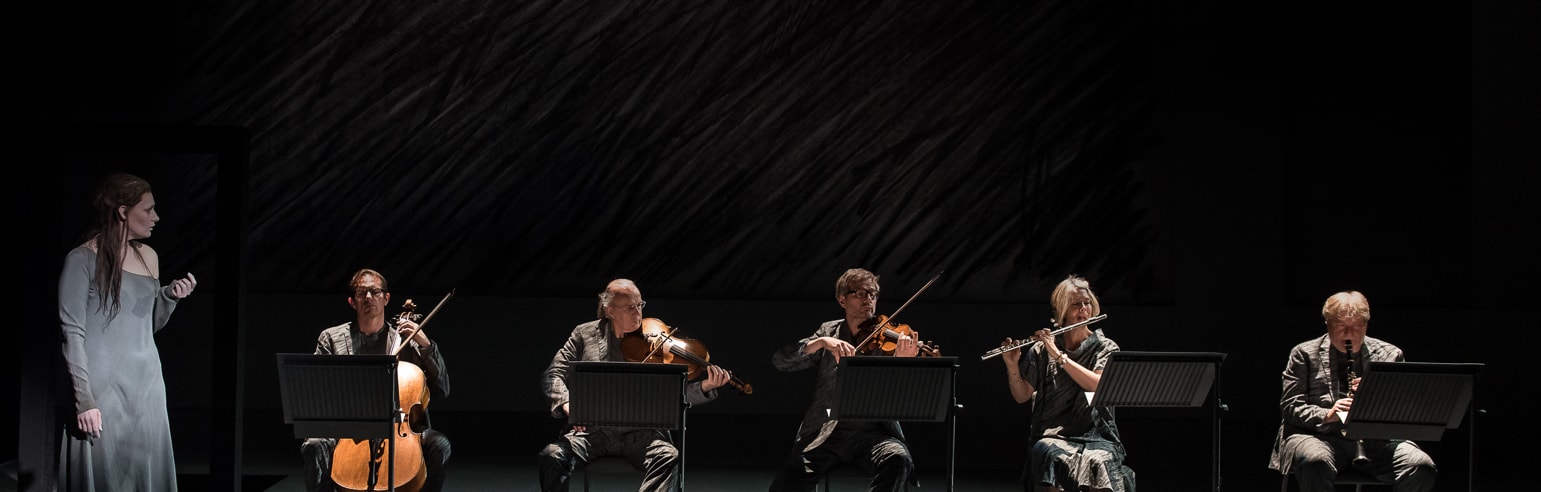
Of these three composers, Joan Magrané Figuera (b1988) was most audibly in the modernist lineage. Faula (Fable) unfolds continuously, its four strands of material being akin to levels of activity – exuding a nervous anticipation, ferocious interaction, static intoning, and a deft animation – present in varying combinations for a process which did not so much evolve as play out across its allotted time-span. More arresting was Aequae (Equal) by Raquel García-Tomás (b1984) – its ‘equality’ embodied in six parts, each of two-minute duration, that drew variety as well as ingenuity of response from its ensemble – with a subtle emphasis on those similarities arising unbidden from the emergence of identical motifs in differing contexts. By comparison, Januaries by Lisa Illean (b1983) felt relatively moribund with its concentration on a continuity that, if not static in its timbre or texture, evoked an atmosphere which started then ceased as though a photographic image not susceptible to real change or intensification. The phrase ‘monotonously beautiful or beautifully monotonous’ inescapably came to mind.

Qualities that could never be applied to Gerhard’s output in general or that of his final decade in particular. Works for ensemble are numerous from this time, yet it made sense to focus on those Astrological pieces which, written in the wake of his masterly Fourth Symphony, were also the last he completed. Both are structured as continuous entities alternating between the extreme of stillness and movement common to the music from his maturity. In the case of the ‘chamber concerto’ that is Libra, the concept of balance feels everywhere apparent – not least its six players interlocking in a range of sub-groups that attain equilibrium on both formal and expressive levels. While it pursues a similar trajectory, the ‘chamber symphony’ that is Leo is intentionally less cohesive in design – the confrontation within its larger forces pushing such constraints to, but never beyond their limits. Both works, moreover, feature an epilogue that, with their gently undulating motion and focus on a folk-inflected melody of exquisite poise, bring into accord their musical concerns as surely as those star-signs of Gerhard and his wife.

Music which has lost none of its affective capacity during the more than half-century since it appeared, and how apposite they should be played by the ensemble that gave their world and European premieres respectively. The London Sinfonietta sounded no less committed than its forebears on pioneering accounts with David Atherton – for which Edmon Colomer, his long-time advocacy heard in numerous performances and recordings, can take due credit. One can only hope it does not take another 50 years for this music’s intrinsic worth to be recognized.

For further information on the concert, click here For more information on the composers, click respectively for Roberto Gerhard, Joan Magrané Figuera, Raquel García-Tomás and Lisa Ilean. For more on Edmon Colomer, click here

London Sinfonietta 50th Anniversary Concert

Tamara Stefanovich (piano), Simon Haram (saxophone), London Sinfonietta , London Sinfonietta Academy Alumni / David Atherton, George Benjamin, Vladimir Jurowski

Birtwistle The Message (2007)
Stravinsky Octet (1923)
Ligeti Chamber Concerto (1970)
Deborah Pritchard River Above (2018) (World premiere)
Samantha Fernando Formations (2018) (World premiere)
Abrahamsen Left, alone for piano (left hand) & orchestra (2015) (London premiere)
Various Encore! (14 Variations on a Hornpipe by Purcell) (2018) (World premiere)

Royal Festival Hall, London; Wednesday 24 January 2018

Written by Ben Hogwood

You can listen to this concert on the BBC iPlayer by clicking here (available until 22 February 2018)

With a bold slogan Unfinished Business – We’re 50, the London Sinfonietta illustrated at their birthday concert exactly why the ensemble remains such a vital cog in the musical life of the capital and the UK.

Their relentless drive for the new, the original, and the game-changing, is coupled with a level of musicianship that remains at the very highest in all they do. This concert reminded us of those things, while a couple of tactful presentations drew attention to the inspirations behind the music, as well as highlighting those who were sadly not able to experience the half-centenary birthday.

To the music – and a short fanfare to begin in the form of The Message, written for the Sinfonietta’s 40th birthday by one of the composers to help shape the ensemble, Sir Harrison Birtwistle (from 4:43 on the broadcast link above). It began proceedings with appropriate ceremony, brilliantly played and controlled by the spotlit trio of clarinettist Mark van der Wiel, trumpeter Alistair Mackie and percussionist David Hockings.

Stravinsky’s Octet followed (from 7:43-23:19), conducted by one of the ensemble’s founders, Sir David Atherton. This was a colourful account, enjoying the outdoorsy and often playful writing for the less-than-usual combination of flute, two clarinets, two bassoons, two trumpets, trombone and bass trombone.

The short introduction ushered in the perky main theme of the first movement (from 9:12), but it was in the second movement (12:01) where the Sinfonietta really excelled, the flurries of notes brilliantly delivered by clarinets and bassoons. The third movement (12:10) enjoyed Stravinsky’s pointed interactions between the instruments, bassoons again dictating the rhythmic impetus.

The first half ended with Ligeti’s Chamber Concerto, written in 1970 and continuing to dazzle with its innovations in tone and sonority (from 27:35-47:05). Atherton worked with the composer on the score, so this ‘first hand’ performance had real authority. It was a performance of exceptional detail, the atmospheric effects hushing the audience almost in to a stage of hypnosis in the quieter moments.

By complete contrast the harsher interventions had the power to make the listener jump, meaning a return to the state of hypnosis was needed for some nerves to be kept intact! The players were terrifically alive to the changes in mood and colour, and in those loud moments (e.g. 38:54) Clive Williamson’s piano added an edge of visceral power.

If the first half was a summation of the London Sinfonietta’s expertise with established 20th century repertoire, the second reaffirmed their commitment to the very new.

Deborah Pritchard’s commission River Above, a world premiere, gave us a marked change in sonority as we turned to the solo saxophone of Simon Haram. This was a brilliantly played piece, exploring the timbre of the instrument to good effect through long-breathed phrases (1:28:00-1:36:49 on the broadcast).

This was followed by a second world premiere, Samantha Fernando’s Formations (1:40:41-1:49:17) for an ensemble of 15 players. This was much more immediate in its impact, beginning with imposing block chords before moving to a section with sharp, barbed wire edges to the texture. Throughout there were fascinating and colourful sonorities and strong tonal associations, before the piece began to move forward with greater purpose towards the end, which if anything came too soon.

Danish composer Hans Abrahamsen has enjoyed a close association with the ensemble since the late 1960s, so the inclusion – and London premiere – of Left, alone, a Concerto for piano (left hand) and orchestra (1:58:30-2:19:00), conducted by George Benjamin, was wholly appropriate. The much larger orchestra and piano required a considerable break while the heroic front of house team expanded the, but the wait was worth it – for this was an apt choice.

Starting with a real show of strength, soloist Tamara Stefanovich had terrific energy, the piano outlining a bold rhythmic profile in the lower register but then moving higher, accompanied by the large ensemble. As Abrahamsen says in the interesting interview with Sara Mohr-Pietsch on the radio broadcast, the wiry tones of the large ensemble are essential to the overall sound, preferable to the fuller symphony orchestra approach. This was clear as the piece progressed, becoming less of a battle between left hand and orchestra; more an integration of the two different sound worlds, so that when twinned with the bassoons at the end the sound palette burbled like a hot spring.

Finally there was a collaborative commission, a collage of Variations on a Hornpipe by Henry Purcell (from 2:24:31-2:42:46 on the broadcast link), conducted by Vladimir Jurowski. The variations were written by 14 composers with Sinfonietta connections, and were followed by an altered statement of the hornpipe itself written by 10 more. All contributions were woven together under the direction of John Woolrich, who composed the beginning and end.

The best advice here is to listen to the introduction on the radio, then to guess who might be the composer of each fragment as the piece proceeds! A stately, ceremonial air surrounded the piece at its start but gradually the variations moved it further from the source. Perhaps inevitably the fragmented approach led to a disjointed whole at times, with a short attention span – due to the number of composers involved rather than Woolrich’s sterling work in getting the music together.

It was however a suitable showcase for the Sinfonietta as an ensemble, proving beyond doubt once again that their virtuosity knows no bounds, and ended with a flourish – as though to say, “Here’s to another 50 years, at the very least”. And so say all of us!

A 50th anniversary tribute will follow on these pages soon.

Further listening

You can listen to an album of Hans Abrahamsen’s music made by the London Sinfonietta in 1997 on Spotify: