Listening to Beethoven #172 – 6 Lieder von Gellert Op.48

songs-op48
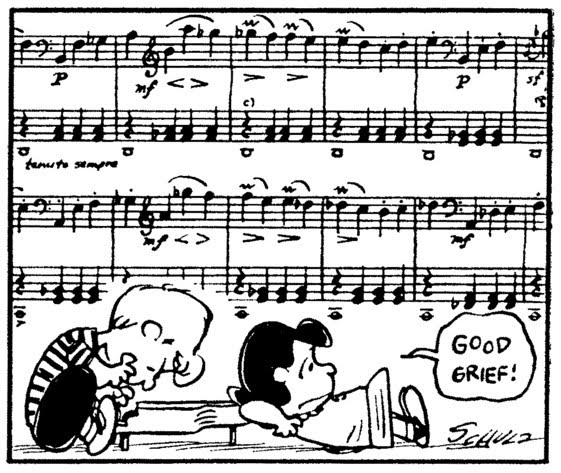
Peanuts comic strip, drawn by Charles M. Schulz (c)PNTS

6 Lieder von Gellert Op.48 for voice and piano (1801, Beethoven aged 30)

1 Bitten
2 Die Liebe des Nächsten
3 Vom Tode
4 Die Ehre Gottes aus der Natur
5 Gottes Macht und Vorsehung
6 Busslied

Dedication not known
Text Christian Fürchtegott Gellert
Duration 14′

Listen

Background and Critical Reception

Although Beethoven was enjoying a fierce period of creativity in his compositions, his health was suffering – and in particular his hearing. This cycle of six Gellert settings captured his state of mind at the realisation that his loss of hearing may well be temporary.

Jan Swafford feels the anguish in songs whose roots go back several years. ‘That Beethoven turned to the artless North German piety of these poems, and set them in a style more interested in declaiming the words than in waxing lyrical, is another indication of his state of mind’, he writes. ‘If doctors could not help him, maybe God could, at least in giving him consolation. These song come from the heart of his anguish and incipient depression.

The texts are revealing, perhaps nowhere more so than the third song Vom Tode, with its line ‘Meine Lebenszeit verstreicht, Stündlich eil ich zu dem Grabe (My life is ending and with each hour I move swiftly to the grave)’.

This is followed by two hymns of praise, before an expansive final song Busslied which explores both sides of the ‘argument’.

Thoughts

The deeper emotion Beethoven has been investing in his instrumental pieces can also be keenly felt in these six settings.

The music of Bitten, in a pure C major, offers a kind of cold and rather downcast consolation, the poet (and composer) contemplating their fate. The tone of Die Liebe des Nächsten, however, is upward looking, and more than a little operatic, the piano answering the voice as a Handel orchestra might have done.

Vom Tode itself has a very hollow ring, and is a sombre affair indeed, one of Beethoven’s most moving songs – and we can surely allow him the exploration of his fate. In the wake of such an empty song, deep in the minor key, Die Here Gott also sounds a little hollow in spite of its status as a genuine hymn of praise. The musical language remains stern, but when Beethoven switches to the major key it becomes genuinely exultant, with massive peals from the piano at the close. Gottes Macht is very much in the same vein, all about strength and power – and here the stance is a Handelian one too.

Busslied is an epic in comparison to these shorter settings, as long as the previous three songs put together. It starts in very withdrawn fashion but moves to a more positive outlook, with a hymnlike melody in the voice. The piano scampers to keep up, turning in some particularly athletic counterpoint.

This is a side of Beethoven we have not yet seen in the vocal music, a deeper and more personal expression which seems more suited to the world of the Lied than the stage. It is a private and rather moving 15 minutes spent with a composer whose physical ailments were destined to challenge him greatly, but ultimately not to overcome his fierce will to compose.

Recordings used

Dietrich Fischer-Dieskau (baritone), Hartmut Höll (piano) (Warner Classics)
Hermann Prey (baritone), Leonard Hokanson (piano) (Capriccio)
Roderick Williams (baritone), Iain Burnside (piano) (Signum Classics)
Matthias Goerne (baritone), Jan Lisiecki (piano) (Deutsche Grammophon)

These are four really excellent versions, from the ‘old-school’ and imperious approach from Hermann Prey and Dietrich Fischer-Dieskau to the newer versions from Roderick Williams and Matthias Goerne. Goerne is especially fine here in his new recording with Jan Lisiecki, finding a moving and reverent stillness in the slower songs and tempering the exuberance of the hymns of praise. Roderick Williams phrases Vom Tode beautifully, with a deliberately flatter tone (not pitch) to the voice.

Spotify links

A playlist of four different versions of the Op.48 Lieder can be found here:

Also written in 1801 Haydn The Spirit’s Song Hob.XXVIa:41

Next up 7 Variations on ‘Bei Männern, welche Liebe fühlen’

Listening to Beethoven #171 – String Quintet in C major Op.29

Carl_Schütz_Wien_Michaelerplatz

Der Michaelerplatz, die Kirche, die KK Reitschule und das KK National Theater, Wien, by Carl Schütz (late 18th century)

String Quintet in C major Op.29 (1801, Beethoven aged 30)

Dedication Count Moritz Fries
Duration 33′

1. Allegro moderato
2. Adagio molto espressivo
3. Scherzo: Allegro – Trio
4. Presto – Andante con moto e scherzoso – Tempo I

Listen

written by Ben Hogwood

Background and Critical Reception

Beethoven’s only original String Quintet was commissioned by Count Moritz Fries, and was completed towards the end of 1801. It gained immediate respect, with brother Carl describing it as ‘one of Beethoven’s most excellent’, placing it above the other works he was promoting, the Second Symphony and Third Piano Concerto.

Richard Wigmore is similarly convinced, declaring the quintet to be ‘the final phase of his so-called ‘first period’. This strangely neglected masterpiece is Janus-headed, at once retrospective and prophetic’. Special praise is reserved for the second movement, where Beethoven ‘never wrote a more voluptuously Mozartian slow movement than the Adagio molto espressivo. On the other hand, the tranquil expansiveness and harmonic breadth of the quintet’s first movement prefigure later masterpieces like the first Razumovsky string quartet and the Archduke trio.’

Jan Swafford also holds the quintet in high regard, describing it as ‘a warmly songful work that for all its lightness of spirit has a singular voice and some startling experiments – it amounts to a covertly radical outing’.

The finale has been nicknamed ‘The Storm’ in German speaking countries, due to its ‘tremolo shiver plus falling swoops in the violins’. ‘Twice in the course of the finale’, says Swafford, ‘a new piece of music turns up like an unknown guest at a wedding: a jaunty minuettish tune marked ‘Andante con moto e scherzoso’, the last word indicating ‘jokingly’.’

Thoughts

The String Quintet is indeed a very impressive and mature piece, and as commentators have noted it bears very little resemblance to the works of Mozart for the same instrumental combination. There is a lot going on in the course of its 33 minutes, and the listener is continually engaged and often impressed by the speed of Beethoven’s thoughts.

The first movement unfolds very naturally, with a flowing melody that expands into a substantial structure. The second theme is shared around all the parts and works its way into a lot of the musical arguments.

The beautiful slow movement has a passionate heart, glimpsed especially towards the end with a fiery episode in the minor key. Indeed during his development of the main material Beethoven moves to some very distant tonal areas, the piece losing sight of its centre ground for a while as though having taken a wrong turn. The return to the main theme features pizzicato – increasingly a part of Beethoven’s writing – and some rich, quasi-orchestral textures.

After two lengthy, quite dense movements a quick Scherzo is just the ticket, and this one knows where it wants to go – but has time to show off some witty musical dialogue. The last movement does indeed have a stormy façade, showing how Beethoven is increasingly bringing drama into his chamber music. The tremolos assigned to the strings as part of the ‘storm sequence’ create a few chills, while Beethoven’s part writing is impeccably worked out – and the big surprise, where the minuet-like music appears, is brilliantly stage-managed.

Recordings used and Spotify links

Nash Ensemble [Marianne Thorsen, Malin Broman (violins), Lawrence Power, Philip Dukes (violas), Paul Watkins (cello)] (Hyperion)
Endellion String Quartet, David Adams (viola) (Warner Classics)
Fine Arts Quartet, Gil Sharon (viola) (Naxos)
Academy of St. Martin-in-the-Fields Chamber Ensemble [Kenneth Sillito, Malcolm Latchem (violins), Robert Smissen, Stephen Tees (violas), Stephen Orton (cello)] (Chandos, 1998)
Academy of St. Martin-in-the-Fields Chamber Ensemble [Kenneth Sillito, Malcolm Latchem (violins), Robert Smissen, Stephen Tees (violas), Stephen Orton (cello)] (Philips, 1991)
WDR Symphony Orchestra Cologne Chamber Players (Alpha)
Amadeus String Quartet, Cecil Aronowitz (Deutsche Grammophon)

There is a very impressive set of recordings of Beethoven’s String Quintet – and the listener cannot really go wrong with any of the above, from a classic and slightly luxurious Amadeus Quartet recording on Deutsche Grammophon to the most recent version, from the WDR Symphony Orchestra Cologne Chamber Players on Alpha, released in 2020.

Arguably the pick of the recordings comes from the Nash Ensemble, coupled with the Op.4 quintet.

The Nash Ensemble version on Hyperion can be heard here

You can chart the Arcana Beethoven playlist as it grows, with one recommended version of each piece we listen to. Catch up here!

Also written in 1801 Wranitzky 3 String Quintets Op.8

Next up tbc

In concert – Alina Ibragimova, CBSO / Joshua Weilerstein: Weir, Prokofiev & Beethoven

Joshua Weilerstein 58_credit Sim Canetty-Clark

Alina Ibragimova (violin, below), City of Birmingham Symphony Orchestra / Joshua Weilerstein

Weir Heroic Strokes of the Bow (1992)
Prokofiev
Violin Concerto no.1 in D major Op.19 (1915-17)
Beethoven
Symphony no.7 in A major Op.92 (1811-12)

Symphony Hall, Birmingham
Wednesday 7 July 2021 (6.30pm)

Written by Richard Whitehouse Photo of Joshua Weilerstein courtesy of Sim Canetty-Clark; Alina Ibragimova courtesy of Giorgia Bertazzi

While not the centenary season as had been anticipated, the City of Birmingham Symphony Orchestra’s current run of live concerts has nevertheless found the orchestra in great shape, reinforced by the final event that marked an equally unexpected if auspicious debut for Joshua Weilerstein.

He may have substituted the planned account of Schubert’s Fourth Symphony, but Weilerstein retained Judith Weir’s Heroic Strokes of the Bow to begin the programme. Although written before her spell as the CBSO’s Composer-in-Residence (1995-8), the present piece is among her most characteristic larger works – taking its cue from Paul Klee’s similarly titled painting for a 15-minute study in frustrated momentum, whereby violins pursue an eventful trajectory constantly undermined by rhythmic discontinuity. A belated coming to the fore of woodwind propels this music towards a peroration which never quite materializes prior to its subsiding then terse pay-off. Not a straightforward or necessarily rewarding piece to tackle, the CBSO strings still sounded engaged throughout a piece typical in its sense of ultimate anti-climax.

Alina Ibragimova then joined the orchestra for Prokofiev’s First Violin Concerto, its modest scale and prevailing inwardness only partly belying technical demands that were confidently surmounted here. The partnership with Weilerstein, moreover, was a good one – whether in the first movement’s gradual expressive opening-out from, then retreating-back to sustained lyricism, or the Scherzo’s cavorting high-jinx and playful nonchalance. Ibragimova’s tempo for the finale seemed initially a little too deliberate, but the panache of those brief orchestral tuttis then stealthy intensification to the rapturous return of the opening theme left no doubt as to either soloist’s or conductor’s sense of exactly where the music was going – the violin’s airy arabesques melding into the deftest of orchestral textures for the spellbinding final bars.

The inclusion of Beethoven’s Seventh Symphony made for a near full-length concert which, being given twice, says much for the CBSO’s collective stamina. Ensemble faltered slightly in the first movement’s introduction, relatively weighty as Weilerstein heard it, but the main Vivace proved unanimous in response as it was trenchant in conception – highlights being an uninhibited transition to the reprise, then inexorable build-up toward a coda whose clinching of the overall design felt more potent through a slight if perceptible acceleration at the close.

Weilerstein (rightly) went directly into the Allegretto, its alternation of pathos and sanguinity ideally gauged, then the scherzo exuded a joyous animation and its trio an eloquence which was no less apposite. The finale may have lacked its exposition repeat, but the seamlessness with which this movement unfolded left no feeling of its being sold short – not least through an astute judging of dynamic contrasts then a final peroration which, if it lacked for a degree of visceral excitement, none the less concluded this symphony with unwavering affirmation. Hopefully, Weilerstein will soon be returning to this orchestra. Next month, though, the CBSO heads to the Proms for a programme featuring Ruth Gipps’s Second Symphony and Brahms’s Third, along with a delayed premiere for Thomas Adès’s The Exterminating Angel Symphony.

You can find information on the CBSO’s appearance at the Proms at the festival’s website.

Listening to Beethoven #170 – Piano Sonata no.15 in D major Op.28 ‘Pastoral’

Der Sommer (Landschaft mit Liebespaar) The summer (Landscape with lovers) by Caspar David Friedrich (1807)

Piano Sonata no.15 in D major Op.28 ‘Pastoral’ for piano (1801, Beethoven aged 30)

1. Allegro
2. Andante in D minor
3. Scherzo: Allegro vivace
4. Rondo: Allegro ma non troppo

Dedication Count Joseph von Sonnenfels
Duration 25′

Listen

written by Ben Hogwood

Background and Critical Reception

The fourth piano sonata from Beethoven in the year 1801 is every bit as remarkable as the other three. Having experimented with free forms in the two three-movement works labelled ‘quasi una fantasia’, Beethoven reverts to what initially seems a traditional four-movement format.

In spite of the quiet beginning to the Pastoral, however, commentators are quick to note its poetic qualities and the more radical aspects of its design. Angela Hewitt calls it ‘one of the most beautiful of all beginnings’, observing that the work gained its nickname through a publisher’s reference to the bagpipe-like drones from the start.

‘In the first movement, though it is outwardly so tranquil and friendly, Beethoven is still concerned with construction and conciseness’, writes Hewitt. The contemporary composer Carl Czerny described it as one of Beethoven’s own favourite pieces – and especially the second movement Andante, a solemn march-like movement.

András Schiff is also fulsome in his praise. ‘This is a work that pulsates, it’s full of inner voices, opens up huge spaces of sound, and yet does without any dramatic outbursts throughout’. He draws out several anticipations of Schubert in the third movement, particularly in the way ‘the trio wavers between major and minor’.

On the finale, he writes, ‘To me, the finale has traces of a barcarolle, even though it’s constructed as a genuine sonata-rondo’. Hewitt says how Beethoven ‘preferred a bravura ending…it’s as if he can’t contain his joy’. In conclusion she writes, ‘Beethoven’s love of nature is well documented, and it was his most comforting source of nourishment. In this Pastoral sonata he seems to express his thankfulness for all it gave him’.

Thoughts

If anyone asks you for a definition of serenity in music you could easily play them the first minute of Beethoven’s Pastoral sonata. This is a lovely passage of music, every bit as calm as the close of the Moonlight sonata was turbulent. Yet as the first movement progresses it is clear this is not light music, for as Angela Hewitt observes Beethoven brings in several motifs that contrast with the flowing main subject, helping us appreciate it all the more.

The second movement switches to the minor key and spends more time in the shadows as a result, a slow-ish dance with a steady, march-like tread that gradually reels the listener in. The third movement throws off the shackles and also shows off how Beethoven could make musical motifs out of almost nothing. It is simply a set of repeated F# notes in different octaves of the piano, but is made into a humourous phrase that carries a true scherzo.

The finale brings in reminders of the opening with its flowing discourse, almost like running water, with music of pure exuberance. Again the tune is deceptively simple, but it travels through some impressive and pretty complex development, which can be seen if the listener examines closely – but is not essential to enjoyment.

Small wonder that the Pastoral is one of Beethoven’s most popular piano works. It has an enduring happiness made all the more remarkable given the composer’s health issues at the time, but it shows – as all the sonatas of 1801 do – a renewed mastery of the piano and its power to express.

Recordings used and Spotify links

Emil Gilels (Deutsche Grammophon)
Alfred Brendel (Philips)
András Schiff (ECM)
Angela Hewitt (Hyperion)
Paul Badura-Skoda (Arcana)
Stephen Kovacevich (EMI)
Igor Levit (Sony Classical)
Claudio Arrau (Philips)
Daniel Barenboim (Deutsche Grammophon)

Pianists clearly love this work, and among the very fine versions it was difficult to deviate from the versions by Gilels, Brendel, Schiff and Daniel Barenboim. Paul Badura-Skoda also radiates pure enjoyment in his version using a Viennese piano of the time.

You can hear clips of Hewitt’s recording at the Hyperion website

You can chart the Arcana Beethoven playlist as it grows, with one recommended version of each piece we listen to. Catch up here!

Also written in 1801 Cramer Piano Sonatas Op.25

Next up String Quintet in C major Op.29

Listening to Beethoven #169 – Piano Sonata no.14 in C sharp minor Op.27/2 ‘Sonata Quasi una fantasia’ (‘Moonlight’)

Seascape by Moonlight) by Caspar David Friedrich (c1835)

Piano Sonata no.14 in C sharp minor Op.27/2 ‘Quasi una fantasia’ (‘Moonlight’) for piano (1801, Beethoven aged 30)

1. Adagio sostenuto
2. Allegretto
3. Presto agitato

Dedication Countess Giulietta Guicciardi
Duration 16′

Listen

written by Ben Hogwood

Background and Critical Reception

And so we reach one of the most famous pieces in classical music. The second of Beethoven’s Op.27 sonatas, the Moonlight is the second piece to be published with the qualifying title of Sonata quasi una fantasia, reminding us of Beethoven’s intention to move away from the conventional sonata form.

He did not provide the Moonlight nickname, which was suggested by poet and critic Ludwig Rellstab. For him the first movement represented ‘a boat, visiting, by moonlight, the primitive landscapes of Lake Lucerne’. The dedication, to Countess Giulietta Guicciardi, has prompted much speculation – but although Beethoven was in love with her at the time, the dedication, as Angela Hewitt writes, was ‘an afterthought when another piece he had dedicated to her had to be given to somebody else’.

Critics and musicologists note the power of Beethoven’s writing, from the restraint of the first movement to the turbulent storm of the finale. In between these two lies a balletic central movement set in the major key, described by Liszt as ‘a flower between two abysses’. When it comes to the famous opening movement, Hewitt writes about the importance of refreshing the sustain pedal with each bass note on a modern piano, to avoid clouding the harmonies. On an older instrument this would not be necessary, but ‘the most important thing’, she says, ‘is to capture a magical mood’. But then, ‘all hell breaks loose in the final Presto agitato’.

It was not long before Beethoven was tiring of the airtime his most famous piece was getting. ‘People are always talking about the C sharp minor Sonata’, he said. ‘Really, I have written better things!’

Thoughts

What is there left to say about the Moonlight sonata that hasn’t been said already? It is surely one of the most written-about pieces in musical history, and certainly one of the most famous piano pieces there is – made all the more accessible because the relative beginner can play its most famous theme.

Yet the Moonlight sonata is a vital cog in the 32-strong output of Beethoven’s published piano sonatas. It is another step away from the classical tradition towards a free and much more emotive approach, and it could even be said to contain the first notes of the so-called ‘Romantic’ period in classical music.

It is Beethoven’s first published piece in C sharp minor, a key Mozart did not use for a single published work, and Haydn very little. That is perhaps part of why the music sounds so striking from the start, when the bare arpeggios set the nocturnal scene. No matter how slowly this passage is played it is laden with feeling, and the enchanted atmosphere only deepens as the music progresses.

The second movement is a beautiful contrast, a poised and relatively carefree dance with an attractive lilt. It is the light to the first movement’s shade and points towards something more positive…until we arrive at the gates of the last movement. What an incredible passage of music this is, especially in concert, where you get to witness the pianists’ arms whirring up and down the keyboard as the whirlwind arpeggios take effect. With the suddenly loud interjections from the first movement it must have had an alarming impact on its first audience, by far the most dramatic sonata they had seen. The enchantment of the first movement had been swapped for something altogether more terrifying.

How remarkable that Beethoven could write such music as part of a piano sonata, scaling emotions and technical feats that were out of bounds. Yet it all works within those confines, with music of great tension and drama that is somehow wrapped up in 15 minutes. The composer has scaled new heights.

Recordings used and Spotify links

Emil Gilels (Deutsche Grammophon)
Alfred Brendel (Philips)
András Schiff (ECM)
Angela Hewitt (Hyperion)
Paul Badura-Skoda (Arcana)
Stephen Kovacevich (EMI)
Igor Levit (Sony Classical)
Claudio Arrau (Philips)
Rudolf Serkin (Sony)

Paul Badura-Skoda is very subdued in the first movement but gets the level of sustain just right, helped by his 1790 Viennese instrument. The second movement is a bit laboured, but the third tears along. Sir András Schiff, playing a dfgd, is a full 100 seconds quicker than Emil Gilels in the first movement, a little rushed for some tastes – while Gilels creates an atmosphere where the listener hangs on every note.

Angela Hewitt finds a really nice turn of phrase in the second movement, with a balletic poise, while interpretations of the third movement range from a race to the finish to a stark evocation of terror. Both Hewitt and Schiff are terrific with the dynamic contrasts.

You can hear clips of Hewitt’s recording at the Hyperion website

You can chart the Arcana Beethoven playlist as it grows, with one recommended version of each piece we listen to. Catch up here!

Also written in 1801 Field Piano Sonata in C minor Op.1/3

Next up Piano Sonata no.15 in D major Op.28 ‘Pastoral’