Listening to Beethoven #150 – 5 Pieces for musical clock, WoO 33

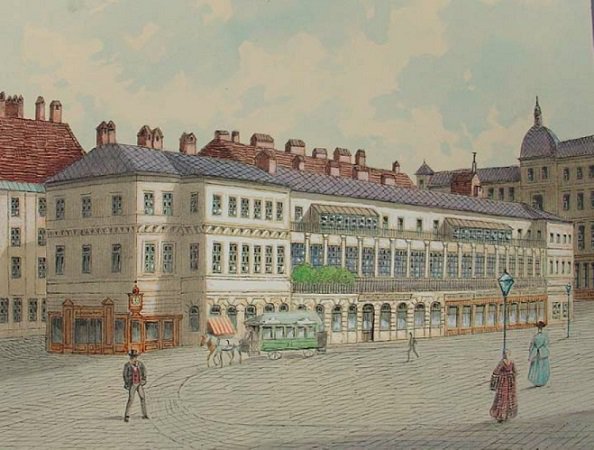
Müller’sches Gebäudehe by F. Sager. This was the art gallery where Joseph Count Deym von Střítež exhibited

5 Pieces for musical clock, WoO 33 (1799, Beethoven aged 28)

Dedication Joseph Count Deym von Střítež

Duration 16′

  1. Adagio. Adagio assai in F major
  2. Scherzo. Allegro in G major
  3. Allegro in G major
  4. Allegro non più molto in C major
  5. Minuet. Allegretto in C major

written by Ben Hogwood

Background and Critical Reception

Keith Anderson, in his extensive booklet notes for a collection of Beethoven chamber rarities on Naxos, writes about the Five Pieces for Musical Clock. The first two date possibly from 1794, but Anderson says the last three ‘were completed by 1800 for the exhibition of waxworks and musical automata displayed by Count Josef Deym, under the name of Müller, having returned to Vienna, after self-imposed exile caused by the death of an opponent in a duel.’

A gruesome state of affairs, but apparently, in a need to resurrect his reputation, the Count ‘had commissioned music from Haydn and Mozart, among others. He died in 1804, leaving his widow Josephine, the apparent object of Beethoven’s amorous inclinations, with four children and social problems to surmount from the fact that her husband had been déclassé, a result of his choice to embark on commercial ventures. The pieces for musical clock are transcribed for organ, an instrument the higher range of which corresponded to the higher register of the clock musical apparatus.’

Thoughts

There is a strange and slightly eerie quality to these five pieces when played on the organ. The first piece is a free spirit and quite ghoulish. Although it is marked Adagio there is a fantasy-like quality and a restless movement throughout its six minutes.

The second piece is a cheery triple-time dance played on a whistle, light as a feather. The third is cut from similar cloth, a twirl in the right hand used as a basis for a short piece that sparkles.

These two shorter pieces are given perspective by the longer fourth, a full blown sonata Allegro of jaunty persuasion. Beethoven enjoys moving between the parts, though the melodies are less obvious. The fifth piece, a Minuet, is a natural companion, and carries the same slight amusement level, the composer with tongue in cheek.

Recordings used and Spotify Links

Simon Preston (Deutsche Grammophon)
Janette Fishell (Naxos)

Simon Preston enjoys the unpredictable movements of these pieces, and chooses the ideal light registration for them. Janette Fishell is perhaps better recorded, and enjoys the humourous opportunities Beethoven offers.

You can chart the Arcana Beethoven playlist as it grows, with one recommended version of each piece we listen to. Catch up here!

Also written in 1799 Haydn String Quartet in F major Op. 77/2

Next up Piano Concerto no.1 in C major Op.15

Listening to Beethoven #149 – Septet in E flat major Op.20

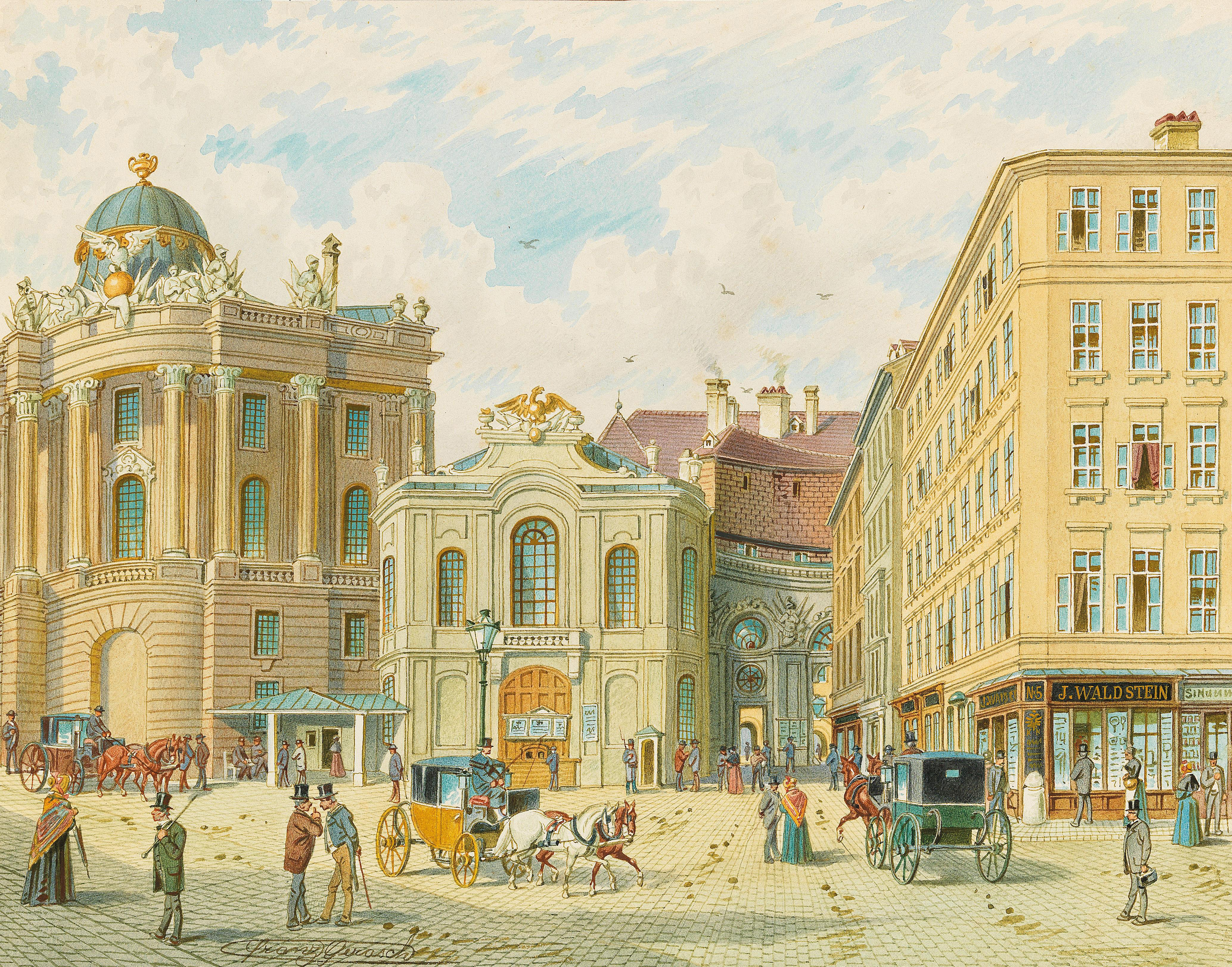
The old Burgtheater in Vienna by Franz Gerasch (before 1906)

Septet in E flat major Op.20 for clarinet, horn, bassoon, violin, viola, cello and double bass (1799, Beethoven aged 28)

  1. Adagio – Allegro con brio
  2. Adagio cantabile
  3. Tempo di menuetto
  4. Tema con variazioni: Andante
  5. Scherzo: Allegro molto e vivace
  6. Andante con moto alla marcia – Presto

written by Ben Hogwood

Background and Critical Reception

Beethoven’s Septet was a novelty work when it first appeared at the Burgtheater in Vienna on 2 April, 1800. The piece, completed by the composer over the winter beforehand, was not breaking any new musical ground particularly. Indeed, Beethoven biographer Lewis Lockwood speaks of it almost dismissively in finding an ‘ambition to please…written all over his Septet, Opus 20, a divertimento companion to the First Symphony intended for salon performance.’

The First Symphony appeared on the same bill at the Burgtheater, but to cast the Septet off as a trifle would be a mistake. Certainly it stays true to the Mozart models used in serenades and divertimenti for wind and strings, in its use of six movements and in the choice of not one but two dance-themed faster movements.

It is the instrumentation where Beethoven’s thoughts are new, the string quartet consisting of violin, viola, cello and now double bass. This adds depth to the scoring, but also frees the bassoon and cello up for more melodic roles. Peter Holman, writing for Hyperion, notes how ‘the relationship between strings and winds is more flexible and varied than before’. He enjoys the ‘mixture of grandeur and intimacy, virtuosity and informality’, while also noting a prominent part for virtuoso violinist Ignaz Schuppanzigh.

Elsewhere it seems almost unfashionable for commentators to give the Septet too much room, as though it is not forward-thinking enough – but its public appeal is clear. Philip Reed, writing in a booklet note for Chandos, makes up for that shortfall, discussing how ‘Beethoven contrives to give the work a quasi-orchestral atmosphere. This quality is most apparent in the tuttis; elsewhere subtle use is made of different instrumental groupings to achieve maximum variety of texture. Nowhere is this more apparent than in the central Theme and Variations’.

Thoughts

It is surely impossible to dislike Beethoven’s Septet. This is a piece full to the brim with good tunes, attractive scoring, persuasive rhythms and a very strong sense of community between all seven players. The scoring is a treat, working to bolster the sound to a small orchestra, in a model that was to be replicated by contemporaries Kreutzer and Berwald, as Holman points out.

The tunes are catchy enough for audiences to be humming them hours after a performance, which I can admit to first hand! The two best in this respect are the first Minuet, a delightfully cheeky tune that just refuses to go away, and the finale,

The first movement has some frothy exchanges when the faster sections arrives, while the slow movement, placed second, has some lovely sonorities, the clarinet coming to the fore in the tune and then the violin given some space to prove its virtuosity.

Placed fourth of the six movements is the Theme and Variations, where Beethoven’s invention is twofold – development of the theme and inclusion for each of the seven instruments, with solos for cello and then a lovely moment where clarinet and bassoon come to the fore. The doleful tones of the woodwind look on in the minor-key fourth variation, with a restless violin, while there are some ghostly timbres towards the end, the double bass growling low in the texture.

The second ‘dance’ movement is next, the horn coming to the front to lead a brisk march, then the cello asserting its new-found prominence as a melody instrument in the ‘trio’ section. Communal fun is the name of the game here, as it is in the finale, Beethoven ensuring all seven protagonists have fun with the abundance of melodic material.

The Septet is a tonic to the most subdued of moods, a true ray of sunshine – and one of Beethoven’s crowning early works.

Recordings used and Spotify Links

Academy of St. Martin-in-the-Fields Chamber Ensemble (Chandos)
Members of the Berlin Philharmonic Octet (Philips)
Nash Ensemble (ASV)
The Melos Ensemble(Eloquence)
Soloists of the Lucerne Festival Orchestra
(Accentus)
Wiener Oktett (Deutsche Grammophon)

There are some lovely versions here, particularly a new release of a live performance from the Soloists of the Lucerne Festival Orchestra. The Wiener Oktett are enjoyably ‘old school’ and full bodied, while versions from the Nash Ensemble, the Melos Ensemble and the Gaudier Ensemble on Hyperion all hold their own. A mention, too, for a recording currently not on streaming services from the Academy of Ancient Music Chamber Ensemble, likely to be the only period instrument recording currently available.

You can chart the Arcana Beethoven playlist as it grows, with one recommended version of each piece we listen to. Catch up here!

Also written in 1799 Haydn String Quartet in G major Op. 77/1

Next up Piano Concerto no.1 in C major Op.15

Listening to Beethoven #148 – 7 Ländler for piano WoO 11 (1799)

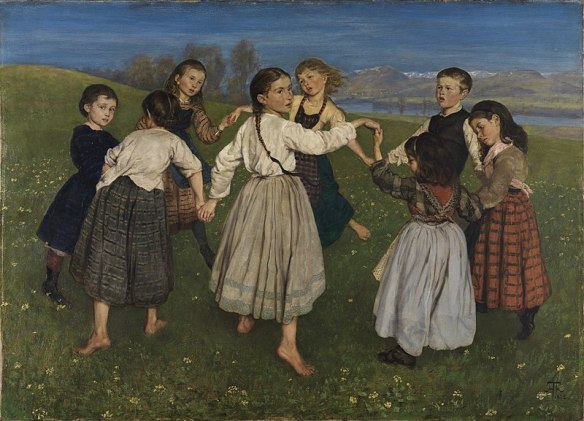
Der Kinderreigen (1872) by Hans Thoma

7 Ländler WoO 11 (1799) for piano (1799, Beethoven aged 28)

Dedication unknown
Duration 4’30”

written by Ben Hogwood

Listen

Background and Critical Reception

As part of his composing role in Vienna Beethoven did on occasion write dance music for the ball. We have already encountered sets of Minuets, written for the annual Redoutensaal balls, a discipline the composer seemed to warm to. This set of Ländler (a folk dance in 3/4 time) is thought to originate for 1798, and, writes Keith Anderson in booklet notes for Naxos, was presumably scored for two violins and bass.

That version is missing, but a piano version was published in Vienna the year after. All seven dances are in the same key, with a short coda added on the end.

Thoughts

The dances are charming and simple in their construction. Beethoven warms to the form with easy, hummable melodies and basic accompaniments often resembling drones. Harmonies are safe, and the rhythms have a nice lilt – ideal for moving easily around a crowded dancefloor. The seventh dance goes slightly offbeat, putting the emphasis on the second rather than the first beat in the bar, before a coda reinforces the drone and ends the dance with a trill.

Recordings used and Spotify links

Olli Mustonen (piano) (Decca)
Jenő Jandó (piano) (Naxos)

Olli Mustonen gives ideal account of these short, winsome pieces – and Jandó, a little faster, is enjoyable too.

Also written in 1799 Benjamin Carr Dead March and Monody

Next up tbc

Listening to Beethoven #147 – 10 Variations on ‘La stessa, la stessissima’, WoO 73

beethoven-salieriLudwig van Beethoven and Antonio Salieri (right)

8 Variations on ‘Tändeln und Scherzen’ WoO 76 for piano (1799, Beethoven aged 28)

Dedication unknown
Duration 9′

written by Ben Hogwood

Listen

What’s the theme like?

The theme is taken from a duet in Salieri‘s opera Falstaff, premiered on 3 January 1799 in Vienna’s Theater am Kärntnertor.

Background and Critical Reception

The variations that Beethoven dashed off after hearing Salieri’s Falstaff in January 1799 earned him a drubbing from critics, writes Jean-Charles Hoffelé. ‘Herr Beethoven may know how to improvise, but he is unable to create good variations’, wrote the Allgemeine musikalische Zeitung.

Hoffelé speculates on the cause of the journalist’s irritation, suggesting it might be ‘the tone of pure entertainment, the impertinent giocoso manner’. He notes however that Beethoven is enjoying himself, citing ‘the distilled Adagio in the top register of the keyboard’.

Thoughts

A strident theme sets out its stall, before Beethoven takes it for a walk in the first variation and then a quicker, propulsive jog in variation two. Again this is a composer working instinctively, the feeling being this composition may well have been written in one sitting at the keyboard.

Beethoven has fun with the offbeat comments of the third variation, while things take a sombre tone in the minor key with the fifth. The music springs out of this with an upright gait, and a fugal episode, then a terrific flurry of notes in the seventh and tenth variations, which no doubt impressed or infuriated the Viennese audience!

The final variation, the tenth, is a tour de force of athletic prowess in the right hand before adding on a coda, as so many of Beethoven’s variation sets do. This one, however, is by turns violent, amusing and touching, channelling the spirit of C.P.E. Bach as it changes mood almost by the bar. Final resolution is forcefully achieved.

Recordings used and Spotify links

Gianluca Cascioli (piano) (Deutsche Grammophon)
Cécile Ousset (piano) (Eloquence)
Ronald Brautigam (fortepiano) (BIS)

If you are happy to listen to the relatively taut sound of Ronald Brautigam’s fortepiano, you will find much to enjoy in his version, a thoroughly entertaining and dramatic reading of Beethoven’s mood changes. Cécile Ousset, perhaps inevitably, has greater elegance but also enjoys the playful aspects, not to mention the outrageous final variation.

Also written in 1799 Benjamin Carr Dead March and Monody

Next up 10 Variations on ‘La stessa, la stessissima’ WoO 73

Listening to Beethoven #146 – 8 Variations on ‘Tändeln und Scherzen’, WoO 76

beethoven-sussmayrLudwig van Beethoven and Franz Xaver Süssmayr  (right)

8 Variations on ‘Tändeln und Scherzen’ WoO 76 for piano (1799, Beethoven aged 28)

Dedication unknown
Duration 9′

written by Ben Hogwood

Listen

What’s the theme like?

The theme is taken from a trio in the opera by Soliman oder die drei Sultaninnen by Franz Xaver Süssmayr. A popular Austrian composer at the time of composition, Süssmayr is not a familiar name in the concert hall nowadays, except for his completion of Mozart’s Requiem.

Background and Critical Reception

Thoughts

This is pure, instinctive inspiration – and is quite stop-start as a result. Yet just as Beethoven has a lot of fun with these variations, so does his listener. The fourth variation is especially brilliant, the hands tumbling down the keyboard like a waterfall.

An elegant seventh variation, the one about which Hoffelé writes, leads to a run of trills, like the end of a cadenza, which look set to complete the set – until a twist in the tale appears in the form of a fugue, crisply executed in the form of a Bach invention.

Beethoven switches unexpectedly to D major near the end, yet this is wholly in keeping with the free running approach throughout this entertaining set.

Recordings used and Spotify links

Alfred Brendel (piano) (Vox)
Cécile Ousset (piano) (Eloquence)
Ronald Brautigam (fortepiano) (BIS)

Cécile Ousset is a model performer in these variations, with enviable dexterity and a good deal of humour. Ronald Brautigam enjoys the more brash, unscripted moments and the piece sounds great on the fortepiano. Brendel is excellent too.

Also written in 1799 Benjamin Carr Dead March and Monody

Next up 10 Variations on ‘La stessa, la stessissima’ WoO 73