7 Ländler WoO 11 (1799) for piano (1799, Beethoven aged 28)
Dedication unknown
Duration 4’30”
written by Ben Hogwood
Listen
Background and Critical Reception
As part of his composing role in Vienna Beethoven did on occasion write dance music for the ball. We have already encountered sets of Minuets, written for the annual Redoutensaal balls, a discipline the composer seemed to warm to. This set of Ländler (a folk dance in 3/4 time) is thought to originate for 1798, and, writes Keith Anderson in booklet notes for Naxos, was presumably scored for two violins and bass.
That version is missing, but a piano version was published in Vienna the year after. All seven dances are in the same key, with a short coda added on the end.
Thoughts
The dances are charming and simple in their construction. Beethoven warms to the form with easy, hummable melodies and basic accompaniments often resembling drones. Harmonies are safe, and the rhythms have a nice lilt – ideal for moving easily around a crowded dancefloor. The seventh dance goes slightly offbeat, putting the emphasis on the second rather than the first beat in the bar, before a coda reinforces the drone and ends the dance with a trill.
Recordings used and Spotify links
Olli Mustonen (piano) (Decca) Jenő Jandó (piano) (Naxos)
Olli Mustonen gives ideal account of these short, winsome pieces – and Jandó, a little faster, is enjoyable too.
Also written in 1799Benjamin Carr Dead March and Monody
8 Variations on ‘Tändeln und Scherzen’ WoO 76 for piano (1799, Beethoven aged 28)
Dedication unknown
Duration 9′
written by Ben Hogwood
Listen
What’s the theme like?
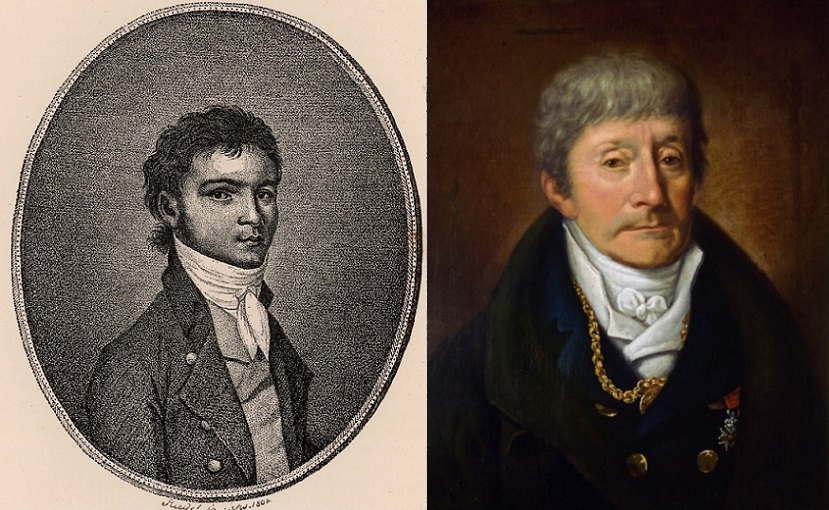
The theme is taken from a duet in Salieri‘s opera Falstaff, premiered on 3 January 1799 in Vienna’s Theater am Kärntnertor.
Background and Critical Reception
The variations that Beethoven dashed off after hearing Salieri’s Falstaff in January 1799 earned him a drubbing from critics, writes Jean-Charles Hoffelé. ‘Herr Beethoven may know how to improvise, but he is unable to create good variations’, wrote the Allgemeine musikalische Zeitung.
Hoffelé speculates on the cause of the journalist’s irritation, suggesting it might be ‘the tone of pure entertainment, the impertinent giocoso manner’. He notes however that Beethoven is enjoying himself, citing ‘the distilled Adagio in the top register of the keyboard’.
Thoughts
A strident theme sets out its stall, before Beethoven takes it for a walk in the first variation and then a quicker, propulsive jog in variation two. Again this is a composer working instinctively, the feeling being this composition may well have been written in one sitting at the keyboard.
Beethoven has fun with the offbeat comments of the third variation, while things take a sombre tone in the minor key with the fifth. The music springs out of this with an upright gait, and a fugal episode, then a terrific flurry of notes in the seventh and tenth variations, which no doubt impressed or infuriated the Viennese audience!
The final variation, the tenth, is a tour de force of athletic prowess in the right hand before adding on a coda, as so many of Beethoven’s variation sets do. This one, however, is by turns violent, amusing and touching, channelling the spirit of C.P.E. Bach as it changes mood almost by the bar. Final resolution is forcefully achieved.
If you are happy to listen to the relatively taut sound of Ronald Brautigam’s fortepiano, you will find much to enjoy in his version, a thoroughly entertaining and dramatic reading of Beethoven’s mood changes. Cécile Ousset, perhaps inevitably, has greater elegance but also enjoys the playful aspects, not to mention the outrageous final variation.
Also written in 1799Benjamin Carr Dead March and Monody
Next up 10 Variations on ‘La stessa, la stessissima’ WoO 73
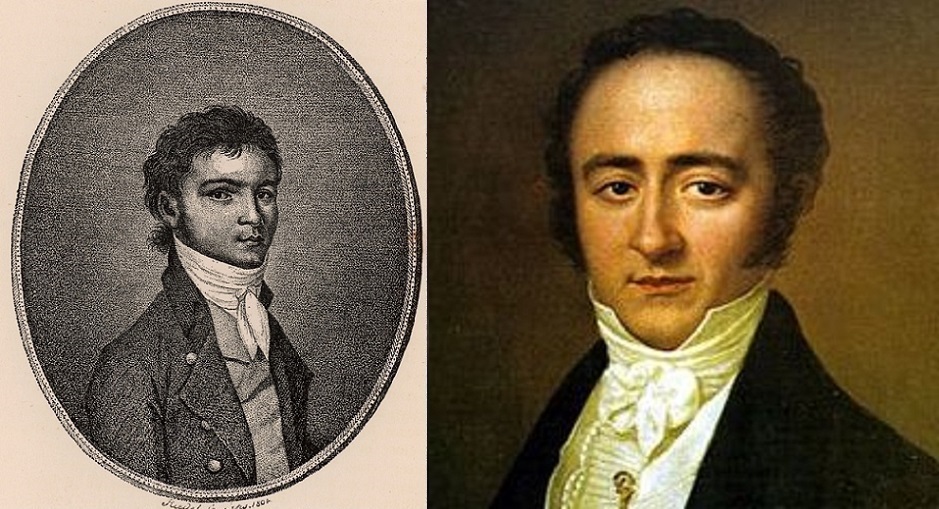
Ludwig van Beethoven and Franz Xaver Süssmayr(right)
8 Variations on ‘Tändeln und Scherzen’ WoO 76 for piano (1799, Beethoven aged 28)
Dedication unknown
Duration 9′
written by Ben Hogwood
Listen
What’s the theme like?
The theme is taken from a trio in the opera by Soliman oder die drei Sultaninnen by Franz Xaver Süssmayr. A popular Austrian composer at the time of composition, Süssmayr is not a familiar name in the concert hall nowadays, except for his completion of Mozart’s Requiem.
Background and Critical Reception
Thoughts
This is pure, instinctive inspiration – and is quite stop-start as a result. Yet just as Beethoven has a lot of fun with these variations, so does his listener. The fourth variation is especially brilliant, the hands tumbling down the keyboard like a waterfall.
An elegant seventh variation, the one about which Hoffelé writes, leads to a run of trills, like the end of a cadenza, which look set to complete the set – until a twist in the tale appears in the form of a fugue, crisply executed in the form of a Bach invention.
Beethoven switches unexpectedly to D major near the end, yet this is wholly in keeping with the free running approach throughout this entertaining set.
Recordings used and Spotify links
Alfred Brendel (piano) (Vox) Cécile Ousset (piano) (Eloquence) Ronald Brautigam (fortepiano) (BIS)
Cécile Ousset is a model performer in these variations, with enviable dexterity and a good deal of humour. Ronald Brautigam enjoys the more brash, unscripted moments and the piece sounds great on the fortepiano. Brendel is excellent too.
Also written in 1799Benjamin Carr Dead March and Monody
Next up 10 Variations on ‘La stessa, la stessissima’ WoO 73
Woman at a Window by Caspar David Friedrich (1822) The woman in question is the artist’s wife
Piano Sonata no.10 in G major Op.14/2 for piano (1798-99, Beethoven aged 28)
1 Allegro 2 Andante 3 Scherzo: Allegro assai
Dedication Baroness Josephine von Braun Duration 17′
Listen
written by Ben Hogwood
Background and Critical Reception
‘An exquisite little work’. The verdict of esteemed musicologist Donald Tovey, proving that in the lesser-known piano sonatas of Beethoven, there are gems to be discovered.
Lewis Lockwood writes of this piece as a ‘paired opposite’ to Op.14/1, encountered yesterday, describing it as ‘a foray into the smaller-sonata world; it is almost a sonatina…with a charming first movement…a slow, simple C major variation movement and a curt finale marked Scherzo that is actually a Rondo.
Thoughts
This piece has an innocuous beginning, floating in as though from the outside with a dreamy melody on the right hand. Beethoven settles immediately into an easy flowing style, bringing Bach to mind at the very end as the piece resolves in the manner of one of his keyboard preludes.
The second movement is a lightly playful march, slow but resolute – and with an offbeat emphasis that makes you feel Beethoven is not quite walking in a straight line. The silences keep the listener on the edge, though, as though Beethoven intends to make you jump sooner or later! He does exactly that at the end, having proceeded through just three charming variations.
The third movement is stop-start, phrased like an irregular story. When it flows it is incessant and brimming with enthusiasm, but often Beethoven will stop the flow for a shorter phrase, an aside to the listener, emphasising the human aspect of how the piano phrases work. Any parallels this time would be more with C.P.E. Bach in his free, ‘fantasia’ way of thinking.
Recordings used and Spotify links
Emil Gilels (Deutsche Grammophon) Alfred Brendel (Philips) András Schiff (ECM) Angela Hewitt (Hyperion) Paul Badura-Skoda (Arcana) Stephen Kovacevich (EMI) Igor Levit (Sony Classical) Claudio Arrau (Philips)
The sense of enjoyment coarses through each of the selected readings of this sonata. Some, like András Schiff or Emil Gilels, take their time with the first movement but retain a special intimacy throughout. Paul Badura-Skoda enjoys the surprise element at the end of the second movement, as does Angela Hewitt, while the throwaway nature of the final bars of the piece are relished by the likes of Claudio Arrau.
You can hear clips of Hewitt’s recording at the Hyperion website
You can chart the Arcana Beethoven playlist as it grows, with one recommended version of each piece we listen to. Catch up here!
Also written in 1799 Ferdinando Paer La Camila ossia il Sotteraneo
Next up8 Variations on ‘Tändeln und Scherzen’ WoO 76
Tageszeitenzyklus: Der Morgen (The times of day: The morning) by Caspar David Friedrich
Piano Sonata no.9 in E major Op.14/1 for piano (1798-99, Beethoven aged 28)
1 Allegro 2 Allegretto 3 Allegro comodo
Dedication Baroness Josephine von Braun Duration 14′
Listen
written by Ben Hogwood
Background and Critical Reception
Beethoven made a rapid return to the piano sonata in 1799, publishing another two works as his Op.14 – moving on quickly from the Pathétique sonata. These pieces are slighter than that particular work, leading Angela Hewitt to speculate that they may originally have been intended for publication together, but were kept apart because of their musical differences.
Hewitt also notes the suitability of Beethoven’s writing for a string quartet – as does Lewis Lockwood, who suggests the piece may have begun life in that way before becoming a piano sonata. That suspicion would be confirmed three years later when Beethoven himself arranged the sonata as a quartet, transposing it up a tone to F major. This, says Lockwood, allowed him ‘to take advantage of the viola’s and cello’s open C strings while adjusting sonorities and dynamics to fit the medium and make the work idiomatic for quartet’.
As Lockwood reports, this was a matter of some importance, confirmed by Beethoven himself in a letter: ‘I firmly maintain that only Mozart himself could translate his works from the keyboard to other instruments, and Haydn could do this too – and without wishing to compare myself to these two great men, I claim the same about my keyboard sonatas.’
Thoughts
There is an attractive rocking motion in play at the start of this work, and an intimacy giving the listener a one-on-one experience. It is set in a relatively unusual key for Beethoven until now, E major – which gives it an open sound. Often the right hand is left alone as a sole melody, with a wandering phrase giving it the profile of a Baroque invention.
The second movement is inward looking, with a gentle lilt to the rhythm as Beethoven switches to the minor key. This is a small but decisive shift, the music attractive but more thoughtful.
By contrast, the third movement throws off these preoccupations with a lovely, flowing triple time theme. Reverting back to the major key, Beethoven uses a figuration he would revisit a whole lot later for his Piano Sonata no.30, also in the same key. Again the suggestion, with the stripped back parts, is that Beethoven has been immersing himself in music of the Baroque period, Bach and Handel in particular.
Recordings used and Spotify links
Emil Gilels (Deutsche Grammophon) Alfred Brendel (Philips) András Schiff (ECM) Angela Hewitt (Hyperion) Paul Badura-Skoda (Arcana) Stephen Kovacevich (EMI) Igor Levit (Sony Classical)
Once again some fine versions are on offer. Alfred Brendel is perhaps the most eloquent, and Hewitt herself is fluent too. Paul Badura-Skoda, playing a Broadwood piano from around the time this piece was written, appears to be in something of a rush, with quick tempi for the outer movements and no repeats. His version is fun, however.
You can hear clips of Hewitt’s recording at the Hyperion website
You can chart the Arcana Beethoven playlist as it grows, with one recommended version of each piece we listen to. Catch up here!