Listening to Beethoven #224 – Leonore Overture no.3 Op.72b

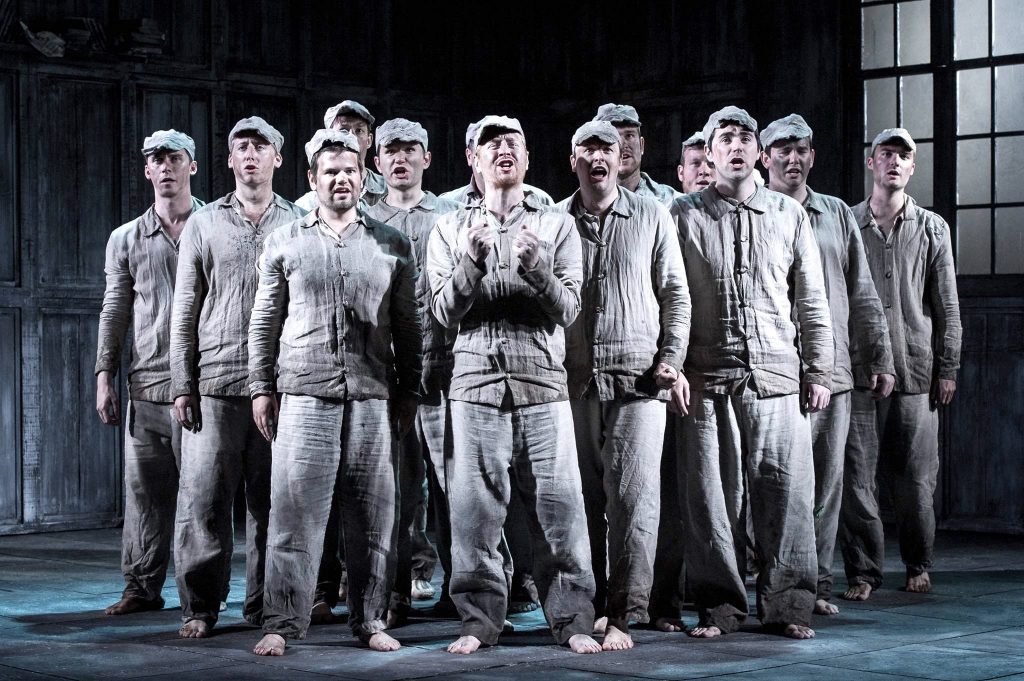
Beethoven’s Leonore as seen in a production by Buxton Opera, 2016

Leonore Overture no.2 Op.72b, used by Beethoven for a revision of his opera in three acts (1804-05, Beethoven aged 34)

Duration 14’30”

by Ben Hogwood

Background and Critical Reception

As the writer Herbert Glass points out, in program notes written for a concert by the Los Angeles Philharmonic, “Beethoven spent more time writing the overture to Fidelio than Rossini and Donizetti spent on entire operas, overture included”! He goes on to qualify this investment of time, asserting that “No. 3…distils the essence of the opera itself, transmitting its power in less than a quarter-hour’s playing time’.

No.3 – confusingly – is the second in order of composition, following no.2 which was used in the first performance of the opera. No.1 – a heavily trimmed version – would follow later, with the Fidelio overture itself a reinvented prelude to the finalised opera.

Robert Simpson, in an essay about Leonore and the resultant Fidelio, points out that the advantage of this overture over its predecessor is “its very accurate delineation of all these key relationships” – by which he means the conflict between the opera’s ‘home’ key of ‘C’ and the ‘prison’ key of B flat major, where the malevolent character Pizarro is found. He describes Beethoven using C major as “an open sky”, and B flat as “the oppressive atmosphere of the jail”, then discussing at length the key of Florestan (A flat major) and Leonore herself (E major). His conclusion is that “no-one will ever exhaust all this great music, surely the greatest ever written for the theatre”.

Thoughts

While listening to the Leonore Overture no.2 I noted that the orchestral dialogue ‘operates on the scope more of a symphonic poem than an overture’ – and that is even more a case in point with the third overture. As an orchestral piece it may be longer but it is a thrilling listen, especially when Beethoven’s ‘open sky’, as Simpson calls it, is found.

To get there we have to traverse the awful claustrophobia of the prison, but there are always shafts of light – the flute solo in Florestan’s key around two-thirds of the way through, and the offstage trumpets that set an incredibly vivid scene. After the uncertain groping in the dark, the blazing light of C major. On the way there we experience some trials, most noticeably a striking dischord right before the end – a wonderful dramatic touch that carries the deepest possible impact.

Recordings used

Berliner Philharmoniker / Herbert von Karajan (DG)
Cleveland Orchestra / George Szell (Sony)
Orchestre Lamoureux, Igor Markevitch (DG)
Chamber Orchestra of Europe / Nikolaus Harnoncourt (Teldec)
Philadelphia Orchestra / Riccardo Muti (EMI)

Once again Herbert von Karajan, with the silvery strings of his Berliner Philharmoniker machine, comes up trumps with a wholly satisfying version. Yet Igor Markevitch is arguably more dramatic still, his final pages a terrific release of tension built up earlier, in a reading that undercuts most others by a minute. Any of the other three serve as ideal guides, too.

You can listen on the links below:

Also written in 1805 Carafa Il Fantasma

Next up 32 Variations in C minor, WoO80

Listening to Beethoven #223 – Leonore Overture no.2 Op.72a

Beethoven’s Leonore as seen in a production by Buxton Opera, 2016

Leonore Overture no.2 Op.72a, used by Beethoven for the first edition of his opera in three acts (1804-05, Beethoven aged 34)

Duration 13′

by Ben Hogwood

Background and Critical Reception

Beethoven’s struggles with writing his first opera extended to finding the right overture. In all he composed four overtures for Leonore / Fidelio – three for the former, and one for the latter.

Lindsay Kemp, writing booklet notes for LSO Live, explains how the problem was not one of musical quality, but one of function. Originally his idea was ‘to provide a programmatic prelude that would foreshadow the ensuing drama and its music in the manner of the overtures of contemporary French opera.’ He describes the results as ‘grand but architecturally loose’.

Confusingly this is known as ‘no.2’ – which was followed the next year by ‘no.3’, then a heavily trimmed ‘no.1’ and finally Fidelio.

Thoughts

Drama is to the fore in this overture, and it is immediately clear that Beethoven’s efforts to find a suitable prelude led to a great deal of invention.

The opening pages are redolent of a French overture; also more than a little reminiscent of the Representation of Chaos that begins Haydn’s Creation oratorio. The tension barely lets up, save for a softer episode where a tender love theme is aired. All too soon, though, we are back in stormy C minor – Fifth symphony territory – from which Beethoven navigates to the major key for an episode of power and precision.

This is a serious orchestral dialogue that operates on the scope more of a symphonic poem than an overture, and the final arguments are thrilling in their execution. The trumpet fanfares towards the end are a case in point, setting the scene perfectly for a triumphant final coda – and also for the action to follow.

Recordings used

Berliner Philharmoniker / Herbert von Karajan (DG)
Cleveland Orchestra / George Szell (Sony)
Chamber Orchestra of Europe / Nikolaus Harnoncourt (Teldec)
Orchestre Révolutionnaire et Romantique / Sir John Eliot Gardiner (DG Archiv)
Freiburger Barockorchester / René Jacobs (Harmonia Mundi)

There are some terrific versions of this overture. Maximum theatricality can be achieved by listening to any of Karajan, Szell, Harnoncourt and Gardiner – though the silky strings of Karajan’s version really do set the tension. René Jacobs, too, in his version of the complete opera, starts with high stakes.

You can listen on the links below:

Also written in 1805 James HookThe Soldier’s Return

Next up Leonore Overture no.2 Op.72a

Listening to Beethoven #222 – Leonore

Beethoven’s Leonore as designed for the Wiener Staatsoper, 2020

Leonore, opera in three acts (1804-05, Beethoven aged 34)

Libretto Jean Nicolas Bouilly, trans. Joseph Sonnleithner

Duration 138′

by Ben Hogwood

Background, Synopsis and Critical Reception

“Probably nothing has caused Beethoven so much grief as this work, whose value will be fully appreciated only in the future”.

The words of Stephan von Breuning to Franz Wegeler in Bonn, talking about Beethoven’s first opera Leonore, which did indeed bring a great deal of strife for its composer in the lead-up to the premiere in November 1805.

The libretto was relatively new, written in the late 1790s by Jean Nicolas Bouilly, the administrator of a French department near Tours during the Reign of Terror. Lewis Lockwood gives an excellent back story to Leonore’s construction. He writes that ‘it was widely accepted that during Bouilly’s governance an episode resembling that of the opera plot had actually taken place’…where ‘a woman disguised as a young man had worked her way into her husband’s prison and freed him from his unjust captivity. Thus, if the take were true, Bouilly himself would have been the minister who liberated the prisoner, and so the libretto seemed to commemorate not only actual heroism but the author’s own benevolence amid the frightening atmosphere of France in those years.’

The opera is set in the prison. The first act is conducted at ground level, where the prisoners take in the rarified air on their rare visits above ground, and where Leonore, disguised as Fidelio, has arrived to try and rescue her beloved Florestan. Immediately she becomes the object of Marcellina’s affections, which she eventually repels. In this process we are introduced to Rocco, a peasant voiced by a fulsome baritone who helps Leonore greatly.

The two levels below ground are reserved for the prisoners, The second act brings them to the fore, as Leonore gets closer to freeing her beloved, with memorable moments including the quartet Mir ist so wunderbar and the Prisoners’ Chorus. The third and final act begins in the dungeon where Florestan has been chained to the wall for two years, freezing and starving. He takes centre stage at the start, his pain all too evident for the audience in the aria Gott, welch Dunkel hier. Liberation is at hand, however – Florestan seeing Leonore as an angel sent to rescue him. The finale celebrates her bravery.

Rather confusingly, Beethoven wrote four overtures for Leonore / Fidelio. The first one to be used was Leonore no.2, which was used for this version of Leonore. The subsequent three versions work in different introductions for Florestan’s aria, while the Fidelio overture itself – written for the 1814 staging – is wholly different.

Two composers had already set the libretto to music. The second, Ferdinando Paer, aroused Beethoven’s interest and competitive edge. Because Paer had already named his version Leonore, Beethoven titled his Fidelio, or Conjugal Love. He hooked up with Joseph Sonnleithner, a prominent musical figure in Vienna, who translated the libretto – on which Beethoven began work in January 1804. At that point he only wanted the ‘poetical part’ of the libretto to be translated, and an exchange between the two reveals that his plans were already in place to stage the work in June 1804. leading up to the premiere in November 1805, which took place under the shadow of Napoleon’s anticipated invasion of Vienna – and was indeed attended by a large number of French army officers. Further attempts at staging in Berlin and Prague were unsuccessful, before Beethoven revised the opera for a production in Vienna in 1814, renaming it Fidelio.

As Jan Swafford explains in an absorbing biography chapter about Leonore, writing vocal music could be a struggle for Beethoven. “He always had more trouble writing vocal music than instrumental”, Swafford writes, referring to the sketchbook for Leonore where there are 18 different beginnings to Florestan’s aria In des Lebens Frühlingstagen and a mere ten for the chorus Wer ein holdes Weib. That didn’t mean Beethoven wasn’t any good at it, but the process of getting the right notes on the page was a painful experience.

The results, however, have been revelatory. Lewis Lockwood describes a work that “has resonated through two centuries as a celebration of female heroism”. In a candid booklet note for his recording of Leonore on Deutsche Grammophon, John Eliot Gardiner notes how “for sheer simplicity and directness of utterance, and for the way he imbues his orchestral set-pieces and accompaniments with dramatic life and emotional intensity, Beethoven has no peer. His single opera has a unique appeal, and a magic very much of its own – especially in its first version, the Leonore of 1804-05, where his ideas, while sometimes crude, are at their most radical.” Later, he declares that “while as a musician I can easily succumb to the sheer beauty of the new music written for Fidelio, nothing, I find, can compare with Beethoven’s original response to his material in 1805.”

Thoughts

In spite of Beethoven’s difficulties, and a compositional practice where he had to grind out many of the results, Leonore is a thoroughly absorbing drama from start to finish. Right from the call to arms of the overture the listener is gripped, the stark outlines immediately setting a tense atmosphere which only occasionally lets up when more tender love is expressed.

The use of a narrator between scenes does not check the flow of the drama – if anything it provides helpful points of context. Without the information provided by Beethoven scholars, would we have known of the difficulties he experienced in composing? As John Eliot Gardiner says, the ‘dramatic life and emotional intensity’ are always there, with relatively little padding in the plot.

What helps, too, is how easily Beethoven moves between solo arias, duets, trios and quartets – and even in the latter the use of many voices does not stop him from getting clarity. The first quartet in Act 1, Mir ist so wunderbar, is beautifully woven in together – while on the solo front, Ha! Welch is a brisk aria, led from the front by Pizarro who is in jubilant mood. Beethoven is certainly not afraid of putting his foot on the accelerator when needed.

Interestingly the operatic influences – to this ear at least – are less from his vocal training with Salieri but more from study of Handel. This is the case especially where recitatives and arias are paired, as in the finale to Act 2.

There are some genuinely thrilling moments in Leonore. The flurry of activity through the Act 2 duet between Pizarro and Rocco (Jetzt, Alter, hat es Eile!) shows the urgency of which Beethoven is capable. Auf Euch nur will ich bauen, led by Pizarro is an exhilarating trio, punchy and red blooded with a shiny brass coating. Countering this is the bleak, vivid word painting at the start of Gott! Welch dunkel, the extended scene where Florestan is down in the dungeon. It is a stark piece of writing and incredibly affecting with orchestra and emotion stripped bare, Florestan’s pain revealed for all to hear in F minor, one of Beethoven’s ‘tragic’ keys. Consolation, however, is found in the love for Leonora, expressed in a tender theme whose radiance is all the more revealing in this setting. High drama follows in the quartet, the exclamations brilliantly managed, and the top ‘C’ soprano near end of Ich Kann mich noch nicht fassen carries maximum impact.

The opera flows very naturally from one section to the next. Although this is an opera with a female hero there are a lot of steely lines for men at the start of Act 2 – none more so than the explosive arrival of Pizarro with his declamation that Ha! Welch ein Augenblück (Ha, the moment has come when I can wreak my vengeance!) Marcellina and Leonora arrive to redress the balance in a brightly cast C major. Ach brich noch is a standout aria, with sonorous horns for company, written in a higher register that looks forward to Weber and beyond. While Act 1 is described as more ‘domestic’ is it nonetheless a satisfying experience, with the arias for Marcellina and Rocco hardly throwaway. The latter’s first aria, where “if you haven’t gold as well, happiness is hard to find” is memorable.

Yet while these moments are high points, nothing quite carries the impact of The Prisoners’ Chorus. This is the dramatic apex of the work, wide-eyed wonder spreading from the jailed forces as their strength comes to the fore. Then, as Leonore learns of the likelihood of marriage, there is a breathless joy. The other many high points are the prisoners, ‘filled with loyalty and courage’ at the rousing end to Act 2, and the reveal of Leonore to Florestan, with the oboe’s involvement especially poignant. The finale is full of incident, the music eventually shifting to a pumped-up C major for a triumphant finish.

Beethoven experienced a great deal of bad fortune in the realisation of Leonore, and the opera has since proceeded under a cloud. In fact, it is only in the last 30 years or so that it has regained anything of its stature, thanks to notable recordings from John Eliot Gardiner and René Jacobs. Both these esteemed conductors have seen the qualities in the music, and how Beethoven – contrary to the opinion of some – has proved to be a great opera composer.

Recordings used

Hillevi Martinpelto (Leonore), Kim Begley (Florestan), Franz Hawlata (Rocco), Matthew Best (Don Pizarro), Christian Oelze (Marzelline), The Monteverdi Choir, Orchestre Révolutionnaire et Romantique / John Eliot Gardiner (DG Archiv)

Marlis Petersen (Leonore), Maximilian Schmitt (Florestan), Dimitry Ivashchenko (Rocco), Johannes Weisser (Pizarro), Robin Johannsen (Marzelline), Freiburg Baroque Orchestra / René Jacobs (Harmonia Mundi)

Those two recordings I mentioned are both cut and thrust experiences. René Jacobs provides a leaner orchestra and much faster tempo choices, which plays to the speed of Beethoven’s creativity. For John Eliot Gardiner Matthew Best is a superbly malevolent Pizarro. Both have superb soloists – and rather than choose a favourite I would merely opt for both! You can listen on the links below:

Also written in 1805 Cherubini Faniska

Next up Leonore Overture no.2 Op.72a

Happy New Year – the year ahead on Arcana

by Ben Hogwood, editor

As this is our first post of the year, let me take the opportunity to wish all readers of Arcana a very Happy New Year! Thanks for taking the time to visit the site, I hope you will find much of interest.

In a musical sense, 2024 promises much – and offers a great opportunity to celebrate the music of some classical composers whose anniversaries fall this year. Keep visiting for more on Gustav Holst (above, his statue in Cheltenham), Gabriel Fauré, Darius Milhaud and Nick Drake – as well as the continuation of our Beethoven 200 series, which will pick up the composer’s work where we left off, with the opera Lenore. There will also be the usual reviews of concerts and new music, playlists and interviews. The aim is to add a post each day, so if you come back to the site on a daily basis you should find something new to read – and something new to listen to.

We aim to do what Manfred Mann’s Earth Band did to Holst – and bring some joy to our readers. Wishing you a wonderful 2024!

In concert – Eduardo Vassallo, Chris Yates, CBSO / Kazuki Yamada: Richard Strauss – Don Quixote; Beethoven ‘Eroica’ Symphony

Eduardo Vassallo (cello), Chris Yates (viola), City of Birmingham Symphony Orchestra / Kazuki Yamada

Richard Strauss Don Quixote Op.35 (1897)
Beethoven Symphony no.3 in E flat major Op.55 ‘Eroica’ (1803-4)

Kazuki Yamada and Tom Morris (concept), Rod Maclachlan (video design), Zeynep Kepekli, lighting design), Gustave Doré (illustrations)

Symphony Hall, Birmingham
Wednesday 13 December 2023

Reviewed by Richard Whitehouse. Photos (c) Hannah Fathers

Tonight’s concert from the City of Birmingham Symphony Orchestra was not only the orchestra’s final concert before its Christmas season, but also the first to feature a new concept of presentation with a view to reimagining just what the concertgoing experience might be like in the future.

Not that this concept was uniformly applied to the pair of works in question. In the first half, Richard Strauss’s Don Quixote was accompanied by rehearsal and live footage relayed via screens as placed to the left, above and to the right of the platform. They gave passing insight into cellist Eduardo Vassallo’s preparing to take the stage, then kept a close watch on his interaction with violist Chris Yates – their musical repartee informing much of what follows. Less convincing was the selection from Gustave Doré who, while he died over a decade before Strauss’s work, still anticipated its concerns in his illustrations for an 1863 edition of Cervantes. These were rather generally applied over the work’s course with few references to Dulcinea who, while she does not appear in the novel, is yet a pervasive influence on the latter stages of the score.

The performance was a notable one in terms of Kazuki Yamada’s surveying this piece as a cumulatively unfolding whole – its 10 variations, each keenly characterized, framed by an increasingly ominous introduction and warmly resigned epilogue. Vassallo had the measure of what, for all its virtuosity, is essentially a concertante rather than solo part and, for which reason, tends to come off best when taken by a section-leader. Not all those frequently dense textures emerged with ideal clarity and motivic unity, which ensures formal and expressive focus as the work proceeds, could have been clearer in its climactic stages, but an essential humanity was always to the fore as Yamada perceived it. Those hearing it for the first time could hardly have failed to be impressed with Strauss’s ambition or moved by his response.

Less so, perhaps, by Beethoven’s Eroica Symphony after the interval. Here the visual element centred largely on the musicians as the account took place – except during the first movement, when a photographic roll-call of the CBSO’s ‘heroes’ (musical and otherwise) was laminated onto the music – thus robbing it of the means to transcend time and place as surely as had the composer those of revolution or Bonaparte. Elsewhere, the standing-up of individual players and sections to highlight salient aspects of the piece was rather inconsistently applied – why, for instance, did the horns not do so with their unison statement of the ‘Prometheus’ theme in the finale (Thomas Beecham did this decades ago) – while the emerging photos of orchestral members mid-way through that movement risked seeming an awkwardly sentimental gesture.

All of this might have mattered less had the reading carried consistent conviction. As it was, the opening Allegro stuck doggedly to a tempo that felt more than a little stolid – its climactic moments undermined by pauses that impeded the musical flow, though the coda yielded the right emotional frisson. The highlight was a Funeral March whose fatalism was leavened by acute pathos at its climax, with a coda whose disintegration audibly left its mark. If the outer sections of the Scherzo seemed just a little deadpan, its trio was rousingly despatched by the three horns, and the initial stages of the finale had a welcome spontaneity as the ‘Prometheus’ theme is put through its paces. A pity Yamada slowed right down for its restatement midway through, resulting in a serious loss of momentum that not even an incisive coda could regain.

Tonight’s concert was a concerted and not unsuccessful attempt to confront the issue of how to attract a younger and more inclusive audience to classical music. Where it foundered was on a misguided premise that bombarding those present with images somehow makes them listen more intently. For this to come about, they need to be encouraged to focus collective attention aurally rather than just visually – a challenge such as Symphony Hall, with its all-round excellence and its many acoustical resources, would seem ideally equipped to fulfil.

This is evidently an experimental phase for the CBSO, as various possibilities are tried out, but an emphasis on sonic enhancement, allied to the subtle if pervasive presence of lighting, is arguably one way forward and could ultimately blaze a trail for the concert of the future.

You can read all about the 2023/24 season and book tickets at the CBSO website. Click on the names for more information on conductor Kazuki Yamada, cellist Eduardo Vassallo, violist Chris Yates – and also on the names for more on Tom Morris, Rod Maclachlan, Zeynep Kepekli and Gustave Doré

Published post no.2,044 – Tuesday 19 December 2023