In concert – Matthew Taylor 60th birthday concert @ Smith Square Hall

Poppy Beddoe (clarinet), Mira Marton, Viviane Plekhotkine (violins), Sinfonia Perdita / Daniel Hogan

Arnold Serenade Op.26 (1950)
Taylor Clarinet Concertino Op.63 (2021)
Taylor Violin Concertino Op.52 (2016)
Arnold Double Violin Concerto Op.77 (1962)
Arnold Clarinet Concerto no.2 Op.115 (1974)
Taylor Symphony No. 6 Op.62 (2021)

Smith Square Hall, London
Friday 22 November 2024

Reviewed by Richard Whitehouse

It was good to see that not a few of those in the audience for Matthew Taylor’s 60th Birthday Concert had been at such events 10, 20 and even 30 years before – deserved recognition, if such were needed, of this composer’s contribution to new music across recent decades.

Malcolm Arnold has been a notable influence on Taylor’s latter-day work, so that hearing his music in this context seemed more than apposite – not least with a sparkling account of Arnold’s airily ambivalent Serenade to set proceedings in motion.

The first half featured two of Taylor’s recent concertante pieces, a genre where he is always at home. As was Poppy Beddoe in the Clarinet Concertino written for her – whether its pensive but not necessarily serene Andante, its unsettling intermezzo, or its genial Allegretto that rounds off a work demonstrably more than the sum of its parts. Mira Marton then took the stage for the Violin Concertino, less unpredictable while always engaging – whether in the not undue deliberation of its opening Hornpipe, the poetic delicacy of its central Aria or the heady syncopation of its energetic Finale. Once again, there could be no mistaking Taylor’s identity with the instrument at hand, nor that judicious marshalling of his ideas into a format the more communicative for its brevity and understatement.

Arnold came into focus with two comparable works either side of the interval. Marton was partnered by Viviane Plekhotkine for the Double Violin Concerto from his more settled years which finds due outlet in the methodical incisiveness of its opening movement and unbridled panache of its finale: the central Andantino yet leaves the most enduring impression, a ‘duet without words’ whose melting pathos never feels overly emotive. This could hardly be said of the Second Clarinet Concerto, a product of Arnold’s troubled Dublin period, though Beddoe found cohesion in its Allegro through the ingenuity of her cadenza, while its ominously unsettled Lento had soloist and conductor in enviable accord, before she threw caution to the wind with a Pre-Goodman Rag finale that enthused her admirers even more second-time around.
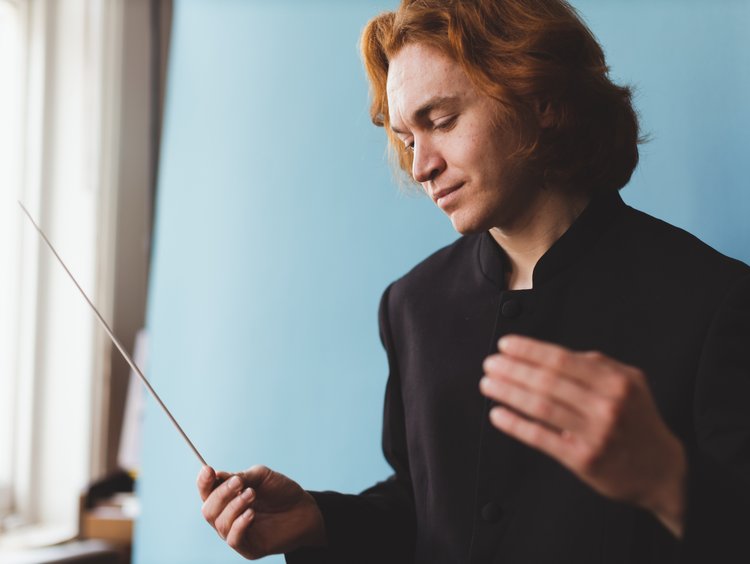
Astute in support, Daniel Hogan (above), came into his own with Taylor’s Sixth Symphony that ended this concert. Commissioned by the Malcolm Arnold Trust and dedicated to Arnold’s daughter Katherine, it complements its celebratory and fatalistic predecessors via an affirmation kept in check until the very last. Premiered by Martyn Brabbins then recorded by the composer, this was arguably its finest performance yet – Hogan unfolding the first movement’s introduction as a cumulative arc of intensity, before infusing the main Allegro with an impetus abetted by its translucency of scoring. This is even more apparent in the Andante, its writing for harp and piano just the most arresting aspect of its calmly fugal textures, before the final Vivo evoked an authentic Arnoldian spirit with its capricious humour and its deftly sardonic payoff.

Music that provokes as surely as it pleases is an ability shared by few composers of Taylor’s generation, and Sinfonia Perdita did it proud as the climax of an evening that reaffirmed this composer at its forefront. One looks forward to further symphonies…and future anniversaries.

For details on the 2024-25 season, head to the Sinfonia Smith Square website. Click on the names to read more about composers Matthew Taylor and Malcolm Arnold, conductor Daniel Hogan and soloists Poppy Bedoe, Mira Marton and Viviane Plekhotkine

Published post no.2,373 – Monday 25 November 2024
The 19th Malcolm Arnold Festival, 2024

posted by Ben Hogwood – text copied from the festival’s press release:

One of England’s most colourful and charismatic composers – Sir Malcolm Arnold (1921-2006) – is to be celebrated at the 19th International Malcolm Arnold Festival; an annual programme of events centred around the multi-faceted composer and his music. The composer’s hometown of Northampton will host a day of live music-making on Saturday 19 October, and a specially procured programme to attract listeners from around the world will live-stream on Sunday 27 October.

SATURDAY 19 OCTOBER – LIVE MUSIC CONTINUNES ALL DAY

Continuing his successful presentations in both live and digital formats, Festival Director Paul Harris is extending the reach of Malcolm Arnold’s music to listeners everywhere, with live concerts and a Symposium hosted in the composer’s hometown, and a specially conceived live-stream day, presenting recorded performances and talks, this year with a particular focus on Arnold’s songs and choral works – a relatively little-known area of the composer’s output.

Paul Harris says: “This year we are offering three concerts within central Northampton (Malcolm’s birthplace), all in walkable distances from each other. We are delighted that Saturday’s launch concert will take place at St Peter’s, marking the reopening of the church as a performance space.”

Launched by composer, Matthew Taylor, listeners will be able to enjoy a programme of rousing music for brass, one of Malcolm Arnold’s most popular genres as a renowned trumpet player himself, performed by Spectacle Brass Quintet lead by Nick Budd. Following this there will be a performance of the composer’s second String Quartet performed by students from the Royal Birmingham Conservatoire.

Live music continues throughout the day, transferring to All Saints’ Church, just a short walk away, with music for choir and organ to include the composer’s psalms and part songs, his John Clare Cantata, and Turtle Drum; familiar to many from school days. Also featured will be Arnold’s Organ Variations: five variations by living composers and one new variation written especially by Jonathan Whiting for this year’s Festival.

Demonstrating the exuberance of Arnold’s works and some of his finest and most popular tunes, the Festival’s Gala Concert takes place at Northampton Guildhall and will be performed by the  Northamptonshire County Youth Concert Band and Orchestra (NMPAT) who are regular guests at the Festival. The Festival will end with a short Symposium hosted by Matthew Taylor discussing all things Arnold.

HOW TO BOOK
Tickets are £10 per concert or £25 for a day ticket, available at the door or book in advance online. Students and under 18s are admitted FREE of charge.
www.malcolmarnoldfestival.com

ONLINE DAY (FREE live-stream) – SUNDAY 27 OCTOBER

FREE-to-view and presented live by Director Paul Harris, the Festival’s complimentary digital live-stream day will take place on Sunday 27 October and features performances of some of Malcolm Arnold’s greatest solo, chamber and orchestral music as well as talks, lectures and exclusive interviews.

Paul Harris says, “The day is structured around the years that have their anniversary this year; 1934, 1944, 54, 64, 74 …etc. and what Malcolm was writing and doing in those years. We are also featuring all of his wonderful songs as the central theme performed by Claire Thompson and Scott Mitchell – Malcolm is not well-known for his vocal writing and our programme will give a fascinating insight into this genre. Also a host of Arnold specialists will be contributing through their knowledge and enthusiasm to bring together another fascinating and engaging day of music making.”

Harris himself will give a talk on Malcolm Arnold at the Royal College of Music, and there are further talks by Arnold authorities including Dr. Timothy Bowers, Dimitri Scarlato, Eleanor Fox, Gus Woodward, and BBC Radio 3 broadcaster and long-time Arnold enthusiast, Martin Handley.

Amongst the assortment of Malcolm Arnold’s chamber works will be historic recordings and specially recorded performances by students from Chethams’ School and the Royal College of Music. Soloists taking part, who will also introduce their pieces, include soprano, Claire Thompson, pianists Scott Mitchell and Lynn Arnold, and oboist Ewen Millar.

Amongst those pieces featured will be Kensington Gardens for Oboe, a piece by Arnold’s fellow composer at the Royal College of Music, Ruth Gipps, known affectionally to Malcolm as ‘Widdy’. Written for Gipps’ own instrument and piano, this is an engaging short suite of three pieces named Elfin Oak, Fat Pigeon and Chestnut Trees.  Alongside Arnold’s songs from his own Kensington Gardens are his William Blake Songs, which were hailed by Gipps as “the real Malcolm”.

Both dramatic and playful in tone, the Sinfonietta No. 3, Arnold’s third “Little Symphony” completed in September 1964, extends the scope of his two earlier essays in this form and is scored for a classical chamber orchestra, demonstrating all the usual hallmarks of the composer’s inventiveness in smaller scale.

From the same year, the celebratory Water Music was commissioned by the National Trust for the opening of the Stratford Canal. In three movements, the piece was written for wind and percussion to be played on a raft moored on the River Avon, and later transcribed by the composer for full orchestra.

HOW TO VIEW
Live-stream FREE to view. Refer to the website for further information including the full programme: www.malcolmarnoldfestival.com

Published post no.2,290 – Tuesday 3 September 2024

In concert – Ian Bostridge, CBSO / Michael Seal: Britten Nocturne & Malcolm Arnold Symphony no.5

michael-seal

Ian Bostridge (tenor), City of Birmingham Symphony Orchestra / Michael Seal (above)

Britten Nocturne Op.60 (1958)
Arnold Symphony no.5 Op.74 (1961)

Symphony Hall, Birmingham
Wednesday 9 June 2pm

Written by Richard Whitehouse

It may have been centred on ‘England’s dreaming’, but there is surely a future for such astute juxtapositions of works by British composers as that heard in this latest concert by the City of Birmingham Symphony Orchestra; two pieces separated by just three years but poles apart stylistically.

The fourth and last of Britten’s orchestral song-cycles, Nocturne is a sequence with emphasis very much on the cyclical aspect. Its eight settings each features an obbligato instrument heard alongside string orchestra, the tenor adopting a flexible arioso manner with which to deliver a range of texts across centuries of English poetry. After a somnolent initial setting of Shelley – strings introducing a spectral rhythmic figure acting as a ritornello across the work – the bassoon emerges for an ominous setting of Tennyson, then the harp for a jejune rendering of Coleridge.

Notably restrained with his characterization thus far, Ian Bostridge upped the expressive ante when horn came to the fore in an evocative treatment of Middleton; the more so as timpani entered for Wordsworth’s troubled verses on the aftermath of revolution. Accrued tension spilled over to a plangent setting of Owen with cor anglais in attendance, then flute and clarinet joined the voice in a rapt take on Keats. All seven instruments duly reappeared for the final setting of Shakespeare – complementing tenor and strings when they arrived at a barely tangible repose.

Throughout, Michael Seal was typically alert and sensitive in accompaniment – before letting the CBSO off its collective leash for Malcolm Arnold’s Fifth Symphony. If not the finest of his cycle (which accolade would likely go to the Seventh), the Fifth is the most representative in its disjunct contrasts and fraught emotions – not least in an opening Tempestuoso whose pivoting between stark irony and consoling empathy results in several assaultive climaxes as were fearlessly delivered. In his pointedly succinct note for the premiere, Arnold confessed himself ‘‘unable to distinguish between sentiment and sentimentality’’ – a disingenuity that made possible the Andante with its aching main melody and soulful secondary theme which between them engender a baleful culmination before the earlier raptness is fitfully regained.

In his unequalled 1973 recording with this orchestra, Arnold secured playing of transcendent poise from the strings in this movement, but Seal was not far behind in the sustained intensity he drew from the present-day CBSO. Nor was there any lack of sarcasm in the scherzo which follows – wind and brass exchanging gestures either side of the clarinets’ freewheeling tune in the trio, then an abrasively confrontational coda. It remains for the Risoluto finale to attempt a summation with elements from the earlier movements thrown together in an atmosphere of martial volatility; climaxing in a restatement of the slow movement’s main theme resplendent but, ultimately, futile – the music collapsing into a void in which bells echo forlornly against fading lower strings. The CBSO imbued these closing minutes with truly graphic immediacy.

This instructive and cathartic programme brought a (rightly) enthusiastic response from those present. Next week features another British symphony, the first by Thomas Adès, alongside music by Purcell and Mozart for what should be a no less provocative and absorbing concert.

For further information about the CBSO’s current series of concerts, head to the orchestra’s website

For further information about the next concert of Purcell, Mozart and Adès on Wednesday 16 June, click here, and for more on Sir Malcolm Arnold you can visit the website dedicated to the composer.

The Peterloo Massacre: Sir Malcolm Arnold’s response

On the 200th anniversary of the Peterloo Massacre in St Peter’s Field, Manchester, this vivid musical interpretation of events on that day comes from Sir Malcolm Arnold.

Arnold completed the overture in 1968, when it was published as his Op.97. In his description of the piece for Faber Music, he described the events and his response in some detail:

Peterloo is the derisive name given to an incident that happened on August 16th, 1819 in St Peter’s Fields Manchester, when an orderly crowd of some 80,000 people met to hear a speech on political reform. On the orders of the magistrates they were interrupted by the yeomanry attempting to seize the banners they carried, and to arrest their speaker, Henry Hunt. Cavalry were sent in, and eleven people were killed and four hundred injured in the ensuing panic.

This overture attempts to portray these happenings musically, but after a lament for the killed and injured, it ends in triumph, in the firm belief that all those who have suffered and died in the cause of unity amongst mankind, will not have died so in vain.”

The extraordinary piece – which really should be better known – can be heard below, with the City of Birmingham Symphony Orchestra conducted by the composer:

It may start with a regal theme but soon the cavalry approach, and the music is thrown into disarray and discord. Ominous brass and squealing woodwind signal the onset of violence, before a description of the outright chaos on what has become a battlefield gets ever louder, like the climax of a Shostakovich symphony.

Then suddenly all is emptiness, the horrors fully revealed…but from the depths comes a beautiful lament from oboe and a repeat of the main theme from the strings, now held higher – before a salute from full orchestra ends the overture in triumph. The piece is a powerful and moving response to the tragedy, a musical portrayal of courage in the face of terror – and it proves every bit as relevant to today’s political climate as it would to the victims of the massacre.

If you want to hear more Arnold, the album from which this piece is taken includes three fine examples of his nine symphonies (nos.1, 2 & 5), and two more entertaining overtures, Tam O’Shanter and Beckus the Dandipratt:

As you will gather from those titles alone, the composer was not without a sense of humour!

The picture is a coloured print of the Peterloo Massacre, published by Richard Carlile.

Live review – English Music Festival opening night: BBC Concert Orchestra & Martin Yates play Robin Milford, Stanford, Vaughan Williams & Arnold

Sergey Livitin (violin), BBC Concert Orchestra / Martin Yates

Dorchester Abbey, Dorchester-on-Thames
Friday 24 May 2019

Berners Portsmouth Point (1918) [World premiere]
Arnold Serenade Op.26 (1950)
Stanford Violin Concerto in D major (1875) [First public performance]
Vaughan Williams orch. Yates The Blue Bird (1913) [First public performance]
Delius A Song before Sunrise (1918)
Milford Symphony no.2 Op.34 (1933) [World premiere]

Written by Richard Whitehouse
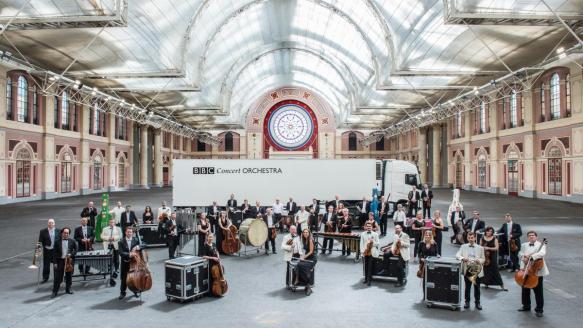
Picture of BBC Concert Orchestra (c) Sim Canetty-Clarke

The 13th English Music Festival got off to an impressive start this evening, with Martin Yates presiding over the BBC Concert Orchestra for a substantial and wide-ranging programme that brought together the hitherto unknown and the relatively familiar in appropriate EMF fashion.

Who else would provide a platform for a first public performance of the Violin Concerto in D major that Stanford wrote at Leipzig in his mid-20s but which, despite the seeming approval of Joachim, remained unheard before being recorded two years ago. Admittedly the first movement rather outstays its welcome, the themes lacking memorability and a solo part not ideally contrasted with the orchestra, but the slow Intermezzo has an appealing poise; its cadenza artfully made an extended transition into the final Rondo (a procedure likely taken over from Wieniawski’s Second Concerto – the model in several respects), its winsome second theme brought back as a lingering coda prior to the closing flourish. Sergey Levitin proved an able and sympathetic soloist in a piece which, whatever its stylistic limitations, was certainly worth rehabilitating.

As too was the incidental music Vaughan Williams devised for Maurice Maeterlinck’s play The Blue Bird, idiomatically orchestrated from the piano score by Yates. This is essentially a ballet (or rather mime) sequence for the end of the first act, its series of thematically related dances striking a fantastical note such as the composer tellingly (if unexpectedly?) conveys. It may well have proved too ambitious in its original context though makes for a lively and imaginative suite, into whose whimsical spirit the BBCCO entered with evident enjoyment.

Malcolm Arnold’s Serenade exemplifies this composer’s early maturity with its pert melodic writing, harmonic ambiguity and rhythmic impetus. A Song before Sunrise is less often heard than other Delius miniatures, but its ruminative mood – barely ruffled by passing shadows, is no less characteristic. It could not have been more different from Lord Berners’s Portsmouth Point, redolent of early Prokofiev in its mechanistic aggression that, if it lacks the ebullience of Walton’s later overture, still packs an uninhibited punch when presented as a curtain-raiser.

The concert ended with its most intriguing item. Long considered a miniaturist (at least in his expressive scope), Robin Milford was not lacking in ambition – as reinforced by his Second Symphony (so designated following the rediscovery of its predecessor from six years earlier), admired by Vaughan Williams but only now receiving its first complete performance. Its four movements ostensibly reflect classical archetypes, but the first of these modulates ever more stealthily as it unfolds, while the scherzo’s latter trio unexpectedly opens-out the expressive range. The highlight is undoubtedly a slow movement of sustained and cumulative emotional depth, closer to Nielsen than Sibelius in tonal follow-through; after which, the (intentionally?) concise finale barely manages to provide a decisive resolution without seeming perfunctory.

Not in doubt was the commitment of the BBCCO and Yates in realizing this dark horse among British inter-war symphonies. A fitting end to an absorbing event: good to hear that orchestra and conductor will be returning for the 14th EMF – scheduled for May 20th–22nd next year.

Further listening

This concert will be broadcast on BBC Radio 3 on a date as yet unknown. Much of the music is not currently available in recorded versions on Spotify. However EM Records, the label who run the festival, made this enterprising release of Stanford‘s Violin Concerto no.2, coupled with Robin Milford‘s Violin Concerto no.2, both with soloist Rupert Marshall-Luck:

For more Robin Milford this album on Toccata Classics provides great insight into his writing for chamber music forces:

Meanwhile the following playlist includes the Malcolm Arnold and Delius works, the more familiar version of Portsmouth Point by Sir William Walton, and Arnold’s Symphony no.1: