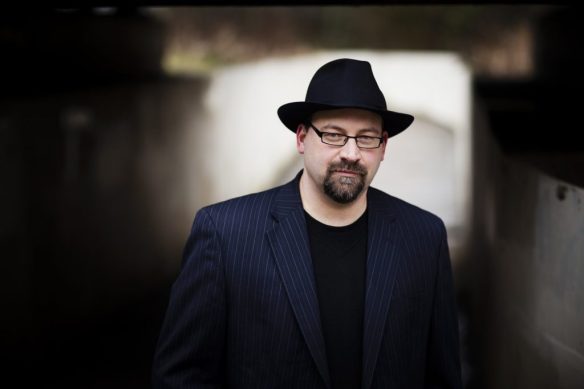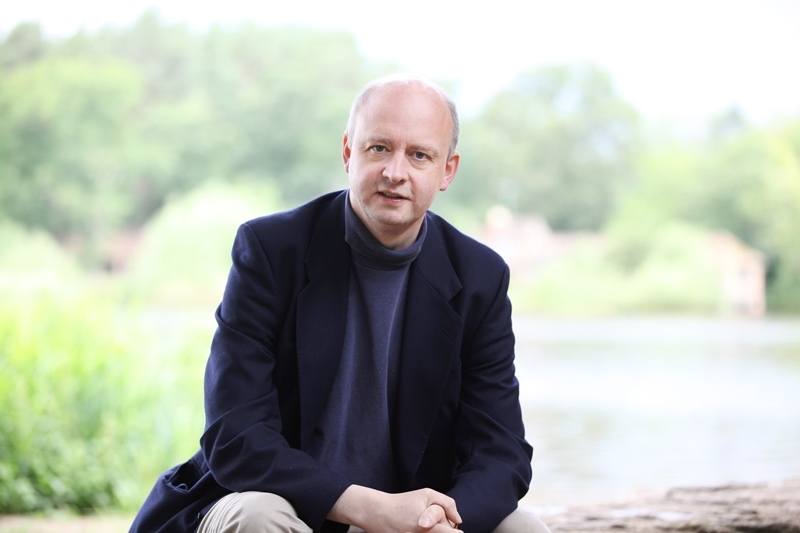
In concert – Matthew Taylor 60th birthday concert @ Smith Square Hall

Poppy Beddoe (clarinet), Mira Marton, Viviane Plekhotkine (violins), Sinfonia Perdita / Daniel Hogan

Arnold Serenade Op.26 (1950)
Taylor Clarinet Concertino Op.63 (2021)
Taylor Violin Concertino Op.52 (2016)
Arnold Double Violin Concerto Op.77 (1962)
Arnold Clarinet Concerto no.2 Op.115 (1974)
Taylor Symphony No. 6 Op.62 (2021)

Smith Square Hall, London
Friday 22 November 2024

Reviewed by Richard Whitehouse

It was good to see that not a few of those in the audience for Matthew Taylor’s 60th Birthday Concert had been at such events 10, 20 and even 30 years before – deserved recognition, if such were needed, of this composer’s contribution to new music across recent decades.

Malcolm Arnold has been a notable influence on Taylor’s latter-day work, so that hearing his music in this context seemed more than apposite – not least with a sparkling account of Arnold’s airily ambivalent Serenade to set proceedings in motion.

The first half featured two of Taylor’s recent concertante pieces, a genre where he is always at home. As was Poppy Beddoe in the Clarinet Concertino written for her – whether its pensive but not necessarily serene Andante, its unsettling intermezzo, or its genial Allegretto that rounds off a work demonstrably more than the sum of its parts. Mira Marton then took the stage for the Violin Concertino, less unpredictable while always engaging – whether in the not undue deliberation of its opening Hornpipe, the poetic delicacy of its central Aria or the heady syncopation of its energetic Finale. Once again, there could be no mistaking Taylor’s identity with the instrument at hand, nor that judicious marshalling of his ideas into a format the more communicative for its brevity and understatement.

Arnold came into focus with two comparable works either side of the interval. Marton was partnered by Viviane Plekhotkine for the Double Violin Concerto from his more settled years which finds due outlet in the methodical incisiveness of its opening movement and unbridled panache of its finale: the central Andantino yet leaves the most enduring impression, a ‘duet without words’ whose melting pathos never feels overly emotive. This could hardly be said of the Second Clarinet Concerto, a product of Arnold’s troubled Dublin period, though Beddoe found cohesion in its Allegro through the ingenuity of her cadenza, while its ominously unsettled Lento had soloist and conductor in enviable accord, before she threw caution to the wind with a Pre-Goodman Rag finale that enthused her admirers even more second-time around.
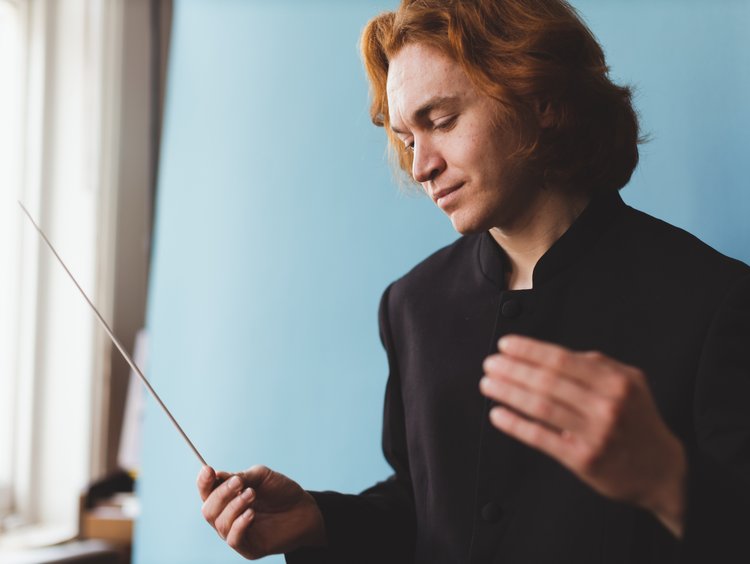
Astute in support, Daniel Hogan (above), came into his own with Taylor’s Sixth Symphony that ended this concert. Commissioned by the Malcolm Arnold Trust and dedicated to Arnold’s daughter Katherine, it complements its celebratory and fatalistic predecessors via an affirmation kept in check until the very last. Premiered by Martyn Brabbins then recorded by the composer, this was arguably its finest performance yet – Hogan unfolding the first movement’s introduction as a cumulative arc of intensity, before infusing the main Allegro with an impetus abetted by its translucency of scoring. This is even more apparent in the Andante, its writing for harp and piano just the most arresting aspect of its calmly fugal textures, before the final Vivo evoked an authentic Arnoldian spirit with its capricious humour and its deftly sardonic payoff.

Music that provokes as surely as it pleases is an ability shared by few composers of Taylor’s generation, and Sinfonia Perdita did it proud as the climax of an evening that reaffirmed this composer at its forefront. One looks forward to further symphonies…and future anniversaries.

For details on the 2024-25 season, head to the Sinfonia Smith Square website. Click on the names to read more about composers Matthew Taylor and Malcolm Arnold, conductor Daniel Hogan and soloists Poppy Bedoe, Mira Marton and Viviane Plekhotkine

Published post no.2,373 – Monday 25 November 2024
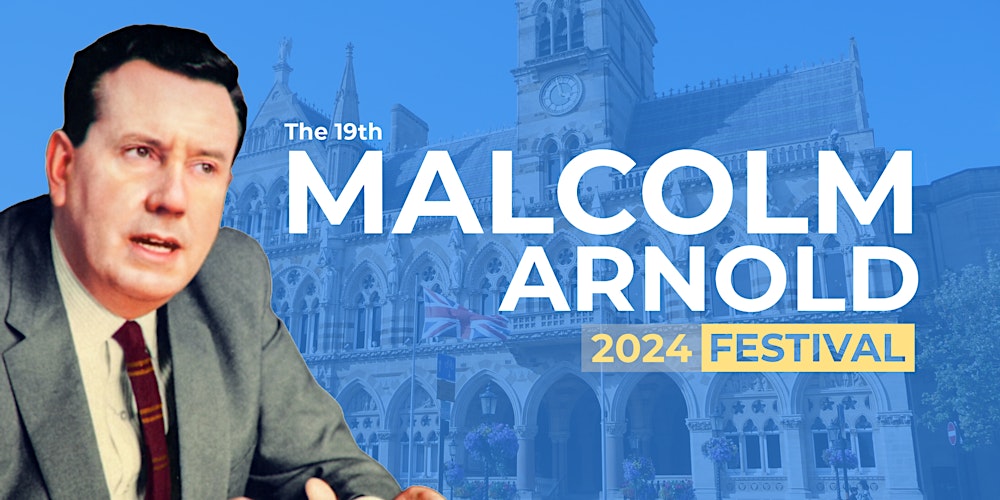
The 19th Malcolm Arnold Festival, 2024

posted by Ben Hogwood – text copied from the festival’s press release:

One of England’s most colourful and charismatic composers – Sir Malcolm Arnold (1921-2006) – is to be celebrated at the 19th International Malcolm Arnold Festival; an annual programme of events centred around the multi-faceted composer and his music. The composer’s hometown of Northampton will host a day of live music-making on Saturday 19 October, and a specially procured programme to attract listeners from around the world will live-stream on Sunday 27 October.

SATURDAY 19 OCTOBER – LIVE MUSIC CONTINUNES ALL DAY

Continuing his successful presentations in both live and digital formats, Festival Director Paul Harris is extending the reach of Malcolm Arnold’s music to listeners everywhere, with live concerts and a Symposium hosted in the composer’s hometown, and a specially conceived live-stream day, presenting recorded performances and talks, this year with a particular focus on Arnold’s songs and choral works – a relatively little-known area of the composer’s output.

Paul Harris says: “This year we are offering three concerts within central Northampton (Malcolm’s birthplace), all in walkable distances from each other. We are delighted that Saturday’s launch concert will take place at St Peter’s, marking the reopening of the church as a performance space.”

Launched by composer, Matthew Taylor, listeners will be able to enjoy a programme of rousing music for brass, one of Malcolm Arnold’s most popular genres as a renowned trumpet player himself, performed by Spectacle Brass Quintet lead by Nick Budd. Following this there will be a performance of the composer’s second String Quartet performed by students from the Royal Birmingham Conservatoire.

Live music continues throughout the day, transferring to All Saints’ Church, just a short walk away, with music for choir and organ to include the composer’s psalms and part songs, his John Clare Cantata, and Turtle Drum; familiar to many from school days. Also featured will be Arnold’s Organ Variations: five variations by living composers and one new variation written especially by Jonathan Whiting for this year’s Festival.

Demonstrating the exuberance of Arnold’s works and some of his finest and most popular tunes, the Festival’s Gala Concert takes place at Northampton Guildhall and will be performed by the  Northamptonshire County Youth Concert Band and Orchestra (NMPAT) who are regular guests at the Festival. The Festival will end with a short Symposium hosted by Matthew Taylor discussing all things Arnold.

HOW TO BOOK
Tickets are £10 per concert or £25 for a day ticket, available at the door or book in advance online. Students and under 18s are admitted FREE of charge.
www.malcolmarnoldfestival.com

ONLINE DAY (FREE live-stream) – SUNDAY 27 OCTOBER

FREE-to-view and presented live by Director Paul Harris, the Festival’s complimentary digital live-stream day will take place on Sunday 27 October and features performances of some of Malcolm Arnold’s greatest solo, chamber and orchestral music as well as talks, lectures and exclusive interviews.

Paul Harris says, “The day is structured around the years that have their anniversary this year; 1934, 1944, 54, 64, 74 …etc. and what Malcolm was writing and doing in those years. We are also featuring all of his wonderful songs as the central theme performed by Claire Thompson and Scott Mitchell – Malcolm is not well-known for his vocal writing and our programme will give a fascinating insight into this genre. Also a host of Arnold specialists will be contributing through their knowledge and enthusiasm to bring together another fascinating and engaging day of music making.”

Harris himself will give a talk on Malcolm Arnold at the Royal College of Music, and there are further talks by Arnold authorities including Dr. Timothy Bowers, Dimitri Scarlato, Eleanor Fox, Gus Woodward, and BBC Radio 3 broadcaster and long-time Arnold enthusiast, Martin Handley.

Amongst the assortment of Malcolm Arnold’s chamber works will be historic recordings and specially recorded performances by students from Chethams’ School and the Royal College of Music. Soloists taking part, who will also introduce their pieces, include soprano, Claire Thompson, pianists Scott Mitchell and Lynn Arnold, and oboist Ewen Millar.

Amongst those pieces featured will be Kensington Gardens for Oboe, a piece by Arnold’s fellow composer at the Royal College of Music, Ruth Gipps, known affectionally to Malcolm as ‘Widdy’. Written for Gipps’ own instrument and piano, this is an engaging short suite of three pieces named Elfin Oak, Fat Pigeon and Chestnut Trees.  Alongside Arnold’s songs from his own Kensington Gardens are his William Blake Songs, which were hailed by Gipps as “the real Malcolm”.

Both dramatic and playful in tone, the Sinfonietta No. 3, Arnold’s third “Little Symphony” completed in September 1964, extends the scope of his two earlier essays in this form and is scored for a classical chamber orchestra, demonstrating all the usual hallmarks of the composer’s inventiveness in smaller scale.

From the same year, the celebratory Water Music was commissioned by the National Trust for the opening of the Stratford Canal. In three movements, the piece was written for wind and percussion to be played on a raft moored on the River Avon, and later transcribed by the composer for full orchestra.

HOW TO VIEW
Live-stream FREE to view. Refer to the website for further information including the full programme: www.malcolmarnoldfestival.com

Published post no.2,290 – Tuesday 3 September 2024

On Record – James Turnbull, Poppy Beddoe, Mira Marton, BBC NoW / Matthew Taylor: Matthew Taylor: Orchestral Music Vol.2 (Toccata Classics)

James Turnbull (oboe), Poppy Beddoe (clarinet), Mira Marton (violin), BBC National Orchestra of Wales / Matthew Taylor

Matthew Taylor
Symphony no.6 Op.62 (2021)
Oboe Concerto Op.60 (2020-21)
Clarinet Concertino Op.63 (2021)
Violin Concertino Op.52 (2016)

Toccata Classics TOCC0708 [69’32’’]
Producer Andrew Keener Engineer Andrew Smillie
Recorded 17 & 18 December 2022 in Hoddinott Hall, Millennium Centre, Cardiff

Reviewed by Richard Whitehouse

What’s the story?

Toccata Classics continues its now extensive coverage of Matthew Taylor (b.1964) with this coupling of his most recent symphony alongside three of his concertante pieces, two of them here played by the soloists for whom they were written and all with the composer conducting.

What’s the music like?

Those familiar with Taylor’s symphonic output will recall that the Fifth ended with an adagio of powerfully inward emotion, and the Sixth Symphony picks up on this directly. Dedicated to the memory of Malcolm Arnold in the year of his centenary, it is his contemporary Robert Simpson (a pervasive influence on Taylor’s formative years) who comes most to mind in an opening movement whose alternation between relative darkness and lightness is informed by a gradually cumulative momentum the more striking given this music’s textural transparency.

The second of three continuous movements centres on a fugal theme of affecting poise, one whose transformation is made more so by orchestration where piano and harp confirm their substantive rather than merely colouristic roles. Only with the finale does Arnold’s presence assert itself – the jazzy cast of its clarinet theme facilitating allusions to, if not quotations of, several of this composer’s salient works prior to a culmination that, launched by a crescendo of mounting anticipation, rounds off the whole work with a decidedly no-nonsense terseness.

Of the other pieces, the Oboe Concerto is most substantial. Imaginatively scored for Haydn-esque forces, with cors anglais instead of oboes, it inverts the expected order of movements with the first of these featuring a central section whose intermezzo-like deftness offsets the sombreness either side. There follows a Scherzo which further develops the primary motifs with dextrous virtuosity, before an Adagio affords not just closure but a sense of fulfilment   through the emotional raptness such as pervades this most eloquent among Taylor’s finales.

Taylor having earlier written concertos for clarinet and violin, the present works are lighter in their overall mood but not slighter in actual content. Thus, the Violin Concertino intersperses respectively trenchant and lively outer sections with an ‘aria’ of wistful elegance, whereas the Clarinet Concertino frames its pert amalgam of slow movement and scherzo with an Andante of autumnal repose then a finale of artless naivety. Brahms is mentioned in the latter instance, though the late woodwind sonatas of Saint-Saëns and Poulenc might be felt equally apposite.

Does it all work?

It does, and not only because of Taylor’s sill in writing from a soloistic or orchestral vantage. Each of the concertante pieces confirms his feeling for the instrument in question, while the symphony reaffirms his status among the leading exponents of this genre from the past half-century. The three soloists are audibly attuned to his music, and the BBC National Orchestra of Wales continues the favourable impression it made with his Fourth Symphony (recorded by Kenneth Woods on Nimbus NI6406) by similarly responding to the composer’s direction.

Is it recommended?

It is, and not least when the booklet features informative notes by Taylor himself. This release is dedicated to the memory of Tom Hammond (1974-2021), trombonist and conductor whose untimely death deprived the musical world of a gifted musician and exemplary human being.

Listen & Buy

You can listen to samples and explore purchase options on the Toccata Classics website Click on the names for more on artists James Turnbull, Poppy Beddoe and Mira Marton, the BBC National Orchestra of Wales and composer / conductor Matthew Taylor

Published post no.2,219 – Monday 24 June 2024

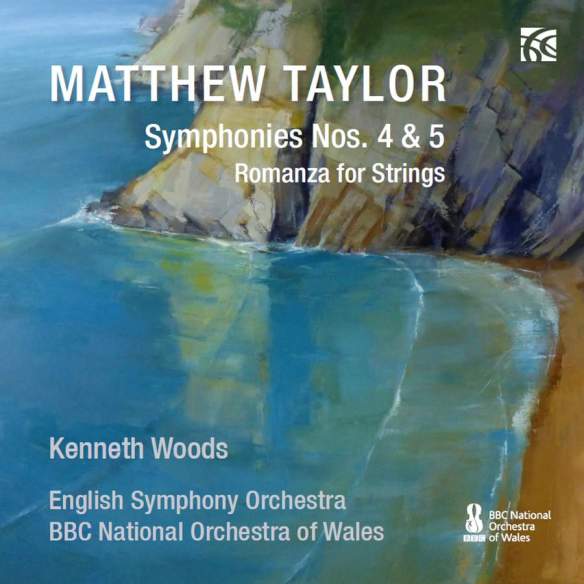
On record – Matthew Taylor: Symphonies nos.4 & 5 (BBC NOW / Woods) (Nimbus)

Matthew Taylor
Symphony no.4 Op.54 (2015-6)
Symphony no.5 Op.59 (2017-8)
Romanza for strings Op.36a (2006-7)

BBC National Orchestra of Wales (Symphonies), English Symphony Orchestra / Kenneth Woods

Nimbus Alliance NI6406 [63’56”]

Producer Simon Fox-Gál
Engineers Simon Smith, Mike Cox (Symphony no.4)

Recorded 8 June 2019 at St. Jude-on-the-Hill, London (Romanza); 14 January 2020 at Hoddinott Hall, Cardiff (Symphonies)

Written by Richard Whitehouse

What’s the story?

A new release of music by Matthew Taylor, including the Fourth and Fifth Symphonies, that means all of the composer’s works in this genre have now been commercially recorded (the First and Third on Dutton Epoch CDLX7178; the Second on Toccata Classics TOCC0175).

What’s the music like?

Symphonism goes back almost to the start of Taylor’s composing, his Sinfonia Brevis having been finished when he was 21, and symphonies have continued to appear at regular intervals across his output. Written respectively to mark the 50th anniversary of Kensington Symphony Orchestra, and as the third instalment within the English Symphony Orchestra’s 21st Century Symphony Project, these two pieces feel typical not least as regards their absolute contrasts of form and expression; while being equally unmistakable as the music of just one composer.

An in memoriam to composer John McCabe – dedicated to his widow Monica – the Fourth Symphony falls into three continuous movements. The first, marked Giubiloso, maintains its energy across distinct shifts of dynamics and activity (the evocative writing for woodwind and harp redolent of Tippett); subsiding from its impassioned climax into an Adagio where strings take the foreground in music of textural richness and emotional depth. Beginning at a decided remove from what has gone before, the Finale buffa exudes a nonchalant humour (reminiscent of Arnold), complemented by a deftly scored episode that cannily prepares for the denouement. This is purposefully controlled through to a climax that recalls the work’s opening theme before an ending as feels the more decisive for its literally coming to a halt.

Heard as an interlude between two imposing statements, the Romanza could hardly be better placed. An arrangement of the second movement of Taylor’s Sixth Quartet (Toccata Classics TOCC0144), it testifies to the suffused lyricism evident in this composer’s writing for strings.

The Fifth Symphony is only Taylor’s second such work in four movements, but its formal and expressive emphasis differs greatly. Indeed, the initial Allegro is unprecedented in his output for sheer volatility (not unlike that of Beethoven’s ‘Serioso’ Quartet), its driving impetus and explosive culmination creating a momentum which is pointedly left unfulfilled by the ensuing intermezzo-like Allegrettos. The first (a tribute to composer and teacher Cy Lloyd) is as terse and equivocal as the second (a tribute to Angela Simpson, wife of composer Robert Simpson) is poised and wistful. It thus remains for the final Adagio (a tribute to the composer’s mother Brigid) to secure that eloquent apotheosis towards which the whole work had been headed, as this moves with sustained power toward its plangent twin climaxes then on to a resigned coda.

Does it all work?

Indeed. In all three pieces, Kenneth Woods secures a dedicated response from the players so Taylor’s exacting yet practicable writing is heard to advantage, not least in acoustics whose immediacy emphasizes this music’s rapt inwardness as keenly as its untrammelled energy.

Is it recommended?

Yes, and not least for a booklet that features informative commentaries by both composer and conductor, and striking artwork by Andrea Kelland. An introductory portrait by James Francis Brown mentions Taylor as having written six symphonies: hopefully, no mere slip of the pen!

Listen & Buy

You can listen to clips from the recording and purchase, either in physical or digital form, at the Presto website

Read

You can discover more about Matthew Taylor by heading to his own website

Live review – English Symphony Orchestra / Kenneth Woods: Matthew Taylor Symphony no.5, Mendelssohn & Beethoven

Pavel Šporcl (violin), English Symphony Orchestra / Kenneth Woods (above)

Cadogan Hall, London
Sunday 9 June 2019 (3pm)

Taylor Symphony no.5 Op.59 (2018)
Mendelssohn Violin Concerto in E minor Op.64 (1844)
Beethoven Symphony no.5 in C minor Op.67 (1808)

Written by Richard Whitehouse, who also introduced the concert with Matthew from the Cadogan Hall platform

This debut at Cadogan Hall by the English Symphony Orchestra was also the third in its 21st Century Symphony Project, having previously included the Third by Philip Sawyers and the Ninth from David Matthews. This afternoon brought the Fifth Symphony of Matthew Taylor (below).

Symphonism goes back to the start of Taylor’s composing career, his Sinfonia Brevis having been completed at just 21. The present work is only his second such piece in four movements, but here the formal and expressive emphasis feels very different. Indeed, the opening Allegro is unprecedented in his output for its tensile volatility (not unlike that of Beethoven’s Serioso Quartet), its driving impetus and explosive culmination creating a momentum pointedly left unfulfilled by the ensuing intermezzi: the first (a tribute to composer and teacher Cy Lloyd) as terse and equivocal as the second (a tribute to Angela Simpson, wife of composer Robert Simpson) is poised and wistful. It remains for the final Adagio (a tribute to Taylor’s mother Brigid) to secure that eloquent apotheosis towards which the whole work had been headed.

The ESO responded with playing of sustained emotional power such as carried through this movement’s plangent twin climaxes and on to its resigned coda. Not that there was any lack of commitment earlier – Kenneth Woods having set a suitably headlong tempo for the first movement as left his players unfazed, then characterizing the central intermezzi with regard for their subtly different auras. A fine rendering of a piece which amply reinforces Taylor’s standing as a symphonist of stature. Hopefully further hearings will not be long in coming.

The rest of this concert consisted of standard repertoire, but there was nothing routine about the performances. Pavel Šporcl (above) was soloist in Mendelssohn’s Violin Concerto, notable for the trenchancy and forward impetus of its opening movement – not least the structurally crucial cadenza placed between development and reprise, then the alternately easeful and searching Andante. The finale had no lack of wit or insouciance – Šporcl duly returning for a dynamic account of the Fifth Caprice by Paganini, its coruscating passagework delivered with aplomb.

After the interval, Beethoven’s Fifth Symphony received a reading as attentive to the smaller detail as to its overall trajectory. The initial Allegro was incisive though never inflexible, not least in delineating the myriad variants on its indelible four-note ‘motto’, and if the Andante evinced a marginal lack of grandeur at its relatively swift tempo, those teasing asides which open-out its expressive course were deftly underlined.

Using the Clive Brown edition of this piece, Woods (rightly) opted to include the second-time repeat of scherzo and trio – giving it an enhanced presence as ideally complemented the finale’s ensuing majesty. There was little to fault in the latter’s uninhibited course: whether, or not, this edition places greater emphasis on the piccolo part, the clarity with which it emerged itself proved something of a revelation.

A memorable conclusion to a concert which also underlined the importance of this project in bringing together past and present of the symphony as a genre of ongoing and vital relevance. Next year sees a third instalment in the guise of the First Symphony by James Francis Brown.

Further listening

Toccata Classics have previously issued an album of Matthew Taylor orchestral music, recorded with the BBC Symphony Orchestra and Garry Walker. The composer’s Second Symphony and Viola Concerto can be heard here:

Pavel Šporcl can be heard in violin concertos by Richard Strauss and Korngold on the album below:

For more information on Matthew Taylor, visit the composer’s website Meanwhile Kenneth Woods has a detailed website of writing and engagements here, and you can read more about the English Symphony Orchestra here