
In Concert – BBC Singers @ St Giles’ Cripplegate & St Paul’s Knightsbridge

by John Earls

It has been quite a time for the BBC Singers recently. As this world-renowned choir approaches its 100th anniversary, the past few weeks have seen the BBC announce their closure, and magnificent campaign against it in response (including more than 700 composers writing to the BBC director general in condemnation) Here on Arcana you can get a glimpse of their recorded worth, with an appreciation and a BBC Singers playlist.

Thankfully a temporary reprieve has since been issued, with the BBC issuing a statement on an “alternative funding solution”.

All of this was book-ended by two concerts of sacred music broadcast on BBC Radio 3 for Holy Week, both demonstrating what a unique and valuable choir they are.

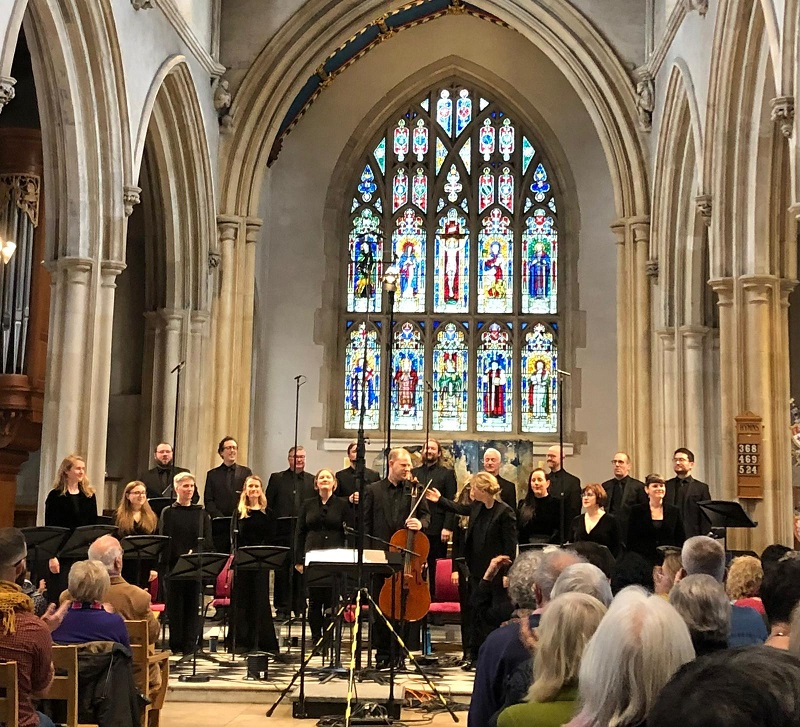
On 17th March they gave their first concert following the BBC’s shameful axing announcement at St Giles’ Cripplegate in London. It was inevitably a special and emotional occasion. The programme of choral and cello music went under the bitterly ironic title of All Will Be Well (after Roxanna Panufnik’s piece of the same name which concluded the programme). “I’m still the producer of the BBC Singers” said Jonathan Manners in his introduction to much applause.

The concert was a fitting example of the range and depth of the choir’s repertoire in terms of time (it opened with Hildegard von Bingen’s O cruor sanguinis from the 12th Century) and style. It displayed impressively their ability to convey a sense of comfort and balm such as in Lesia Dychko’s short piece Blessed be the name (Emma Tring a beautiful solo soprano) as well something more unsettling like Fac me tecum pie flere by Sven-David Sandström.

But this was a programme of choral and cello music and cellist Benjamin Hughes was individually expressive as well as combining powerfully with the choir, both in evidence in Knut Nystedt’s Stabat Mater.

A magnificent encore of Maurice Duruflé’s motet Ubi Caritas was followed by a rapturous and moving ovation (below)

The concert was broadcast on BBC Radio 3 on Palm Sunday and is available online for a limited period.

Less than three weeks later, and following the BBC statement announcing a suspension of the closure, the group performed a Music for Maundy Thursday concert of sacred pieces on the theme of ‘contemplation, sorrow and reflection’ for live broadcast on BBC Radio 3 at St Paul’s Church, Knightsbridge, London (above).

Yet again the programme highlighted the sweep of their repertoire opening with a meditative motet from the 1590s, Vittoria Aleotti’s Miserere mei, Deus (from the first published book of sacred music by a woman) and also featuring sacred pieces from the 21st Century (Karin Rehnqvist’s I raise my hands and Judith Bingham’s Watch with Me), as well as William Byrd’s 14th Century The Lamentations of Jeremiah.

But there were two pieces where the group really shone to spectacular effect. Domenico Scarlatti’s Stabat Mater à 10, with Richard Pearce on chamber organ, was stunning and utterly compelling in its detailed delivery. Francis Poulenc’s Quatre motets pour un temps de penitence made a glorious finale.

One must also acknowledge the key role of Chief Conductor, Sofi Jeannin, always assured yet empathetic. To watch her conduct is a mesmerising experience in itself.

The extent to which the BBC Singers and Jeannin develop and promote a diverse repertoire (they have a 50:50 gender policy for composers whose music they perform), engage in learning and community work, regularly perform commissions and broadcast on Radio 3 (making their phenomenal output available to such a wide audience) is all part of what makes them so unique.

I have seen them many times over many years and they never fail to move me. These two concerts only served to prove just why they are irreplaceable.

John Earls is Director of Research at Unite the Union and tweets at @john_earls
Click on this text to find out more about the Musicians’ Union campaign to protect the BBC Singers after September and action to stop job cuts at BBC Orchestras

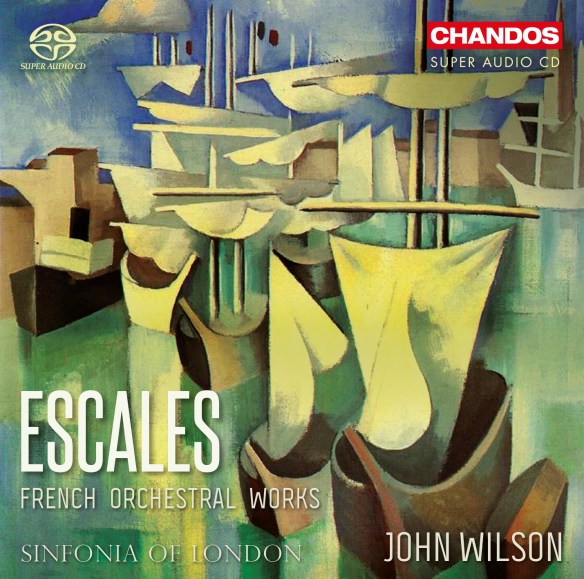
On record – Sinfonia of London / John Wilson – Escales: French Orchestral Works (Chandos)

Escales – French Orchestral Works

Chabrier España (1883)
Duruflé Trois Danses (1932)
Saint-Saëns Le Rouet d’Omphale Op.31 (1871)
Debussy Prélude a l’apres-midi d’un faune (1891-94)
Ibert Escales (1922)
Massenet Meditation from Thaïs (1894)
Ravel Rapsodie espagnole (1907-08)

Adam Walker (Debussy), Andrew Haveron (Massenet), Sinfonia of London / John Wilson

Chandos CHAN 5252 [78’19”]

Producer Brian Pidgeon
Engineer Ralph Couzens

Recorded 6-7 September 2019 (Trois Danses nos.1 & 3), 16-18 January 2019 (other works), Church of St. Augustine, Kilburn, London

Written by Ben Hogwood

What’s the story?

The Sinfonia of London, an orchestra from the 20th century given a new lease of life by conductor John Wilson, makes its second release for Chandos.

In fact we could term it as a series of Sinfonia of London buses, for you wait two decades and then two come along at once! The orchestra’s renaissance began with a stunning account of Korngold’s Symphony in F sharp last year, but now they turn their attention to France, and an imaginatively chosen program celebrating the elusive but immediately recognisable French orchestral sound.

What’s the music like?

A complete pleasure. Although irresistibly French, the music in the collection does remind us of the close bond between France and Spain, thanks to classics of the repertoire from Chabrier and Ravel and a relative rarity from Ibert.

Chabrier‘s España begins the collection and it is an absolute delight, a feel good piece given even more of a lift in this brilliant account. Wilson’s instincts for the stage come to the fore immediately, the bouncy rhythms and cheeky asides proving irresistible when presented with this much colour and warmth.

At the other end Ravel’s Rapsodie Espagnole is no less characterful. The atmospheric Prélude à la nuit ghosts in from silence, Wilson delighting in the orchestral textures and Ravel’s masterly sense of line. The persuasive rhythms of the Feria are expertly judged, the silky strings giving way as the music surges forward with terrific momentum.

Between these two gateposts are works of colour and élan. It is so good to see the inclusion of relative rarities in Duruflé’s Trois Danses, one of only two completed orchestral works in his output, and Ibert’s underrated Escales (Ports of Call) which gives the collection its name. The Duruflé sparkles in Wilson’s hands, violins caressing the longer melodies of the Divertissement, first dance of the three. Much of the composer’s relatively small output is for organ, which he effectively uses as his orchestra, but a persuasive Danse lente and thrilling Tambourin give us further proof of his prowess with large forces, harnessing the influence of Dukas. The latter features a particularly enticing saxophone solo, the recording indulging the colour and scope of Duruflé’s writing.

The Ibert, meanwhile, is a treat. Just over a minute into Escales‘ first movement, Palermo, there is what can only be described as a murmuration of violins, the music fluttering upwards in a bold sweep. Meanwhile Wilson secures a terrific drive to the description of the third ‘port’, Valencia, which ends with a flourish.

Before Escales comes a fresh faced account of Debussy’s Prélude a l’apres-midi d’un faune, the piece that effectively changed the face of music on the eve of the 20th century. Wilson and his charges capture the sense of newness, but also the enchanting and harmonies, with seductive playing from flautist Adam Walker. By contrast the Méditation from Thaïs, Massenet’s most famous orchestral excerpt, is more conventional. It could have felt misplaced here in terms of mood and musical language, but orchestra leader Andrew Haveron invests it with plenty of affection and never overdoes the romantically inclined melodies.

The packed release also finds room for a symphonic poem by Saint-Saëns. Le Rouet d’Omphale (The Spinning Wheel of Omphale) is a relatively early work and a great example of the composer’s melodic flair and ability for musical programming in thrall to Liszt. Wilson has its measure fully, pacing the music’s build ideally in arguably the finest modern recording since Charles Dutoit’s classic account with the Philharmonia in 1980.

Does it all work?

Yes. This is a brilliantly played and really well-chosen program, suiting both the curious listener and the familiar Francophile. What comes through most of all is the sheer enthusiasm and flair of the players, galvanized by Wilson in accounts that are both instinctive and incredibly well prepared.

From the opening notes of España it is immediately clear how this collection is going to go, and with the changes in mood suitably well planned and ordered – save arguably the Massenet – it is a listening experience you will want to return to often.

Is it recommended?

Wholeheartedly. This is music making as it should be, celebrating great orchestral music packed full of good tunes, instrumental colour and the ability to paint vivid pictures of its subjects. Wilson and his charges should be congratulated for an achievement which will surely land them with a glut of awards in the next few months – and only heightens the anticipation for their third release on Chandos, later this month, when they will return to Korngold for the Violin Concerto and String Sextet. In the meantime, make the most of this wonderful set of French fancies!

Listen

Buy

You can listen to clips from this disc and purchase a copy at the Chandos website here