
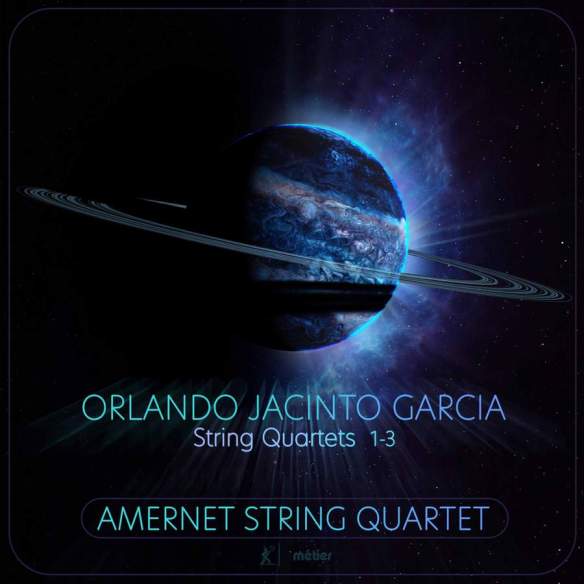
On record – Orlando Jacinto Garcia : String Quartets – Amernet String Quartet (Métier)

Orlando Jacinto Garcia
String Quartet no.1 (1986)
String Quartet no.2 (1998)
String Quartet no.3 (2018)

Amernet String Quartet [Misha Vitenson, Avi Nagin (violins), Michael Klotz (viola), Jason Calloway (cello)]

Métier MSV28613 [65’39”]

Producer Orlando Jacinto Garcia
Engineer Jacob Sudol

Recorded 27 August 2019 at Concert Hall of Wertheim Performing Arts Centre, Miami

Written by Richard Whitehouse

What’s the story?

The highly enterprising Amernet Quartet latest releases comprises the three string quartets by Orlando Jacinto Garcia (b1954), the Cuban-born American composer for whom these works underscore the gradual and incremental changes in idiom across his now substantial output.

What’s the music like?

Although its subtitle Rendering Counterpoint may suggest music which is beholden to such luminaries of post-war complexity as Milton Babbitt, the First Quartet is aesthetically much closer to Morton Feldman (with whom Garcia had undergone an intensive while productive period of study) in its content. Put another way, the very concrete shapes and textures do not so much develop as metamorphose across the course of its almost 26 minutes – with lengthy silences not so much interrupting as motivating the discourse through to an ending the more conclusive for its sparseness. Those daunted by the imposing duration of Feldman’s quartets should find this piece an excellent primer, as well as an engrossing listen on its own terms.

Its subtitle Cuatro might seem straightforward in context, but the Second Quartet predicates the number ‘four’ at conceptual, structural, or expressive levels. Hence four instruments and (continuous) sections, alongside evocations of an eponymous Cuban guitar with four sets of strings, then four composers whose work is alluded to literally yet obliquely. Beyond these, there is the interplay of registers, timbres, textures, and dynamics such as make the resultant piece a varied and involving listen despite (or even because of) its more consonant harmonic sense. Nor is there anything unmotivated about music whose ultimate destination is one of a repose is deeper for its unwavering concentration on the most elemental motifs and gestures.

And so to I Never Saw Another Butterfly, the subtitle of a Third Quartet with inspiration in the art and poetry of children from Terezin (aka Theresienstadt), the transit camp just outside Prague where many artists or composers and their families were interned prior to being sent to concentration camps. Numerous pieces have been written over recent decades in tribute or commemoration, with Garcia’s surely among the most affecting in its absence of extraneous emotion or superfluous rhetoric – opting instead for a contemplative inwardness where solo and ensemble passages are freely alternated, even superimposed over the course of a journey whose 24 minutes proceed eventfully towards a conclusion eloquent in its deft quizzicality.

Does it all work?

Yes, though anyone expecting to encounter radical or seismic changes along the way might be disappointed. More approachable and immediate as Garcia’s idiom has become, there is never any sense of his music courting easy appeal or popular acclaim. Rather, these quartets maintain a steady and methodical course akin to a thawing out or loosening up of emotions audible from the outset. It helps that the Amernet Quartet (who previously recorded quartets by Steven R. Gerber for the Albany label) is so attuned to this music’s understated intensity.

Is it recommended?

Indeed. The sound is well-nigh ideal in its balance and focus, while cellist Jason Calloway’s booklet notes are the more pertinent given his involvement in the actual recording. Garcia’s discography is not yet sizable, but this release should help pave the way to greater coverage.

Listen

Buy

You can discover more about this release at the Divine Arts website, where you can also purchase the recording. For the composer’s website, click here, and for more information on the Amernet String Quartet click target=”_blank”>here
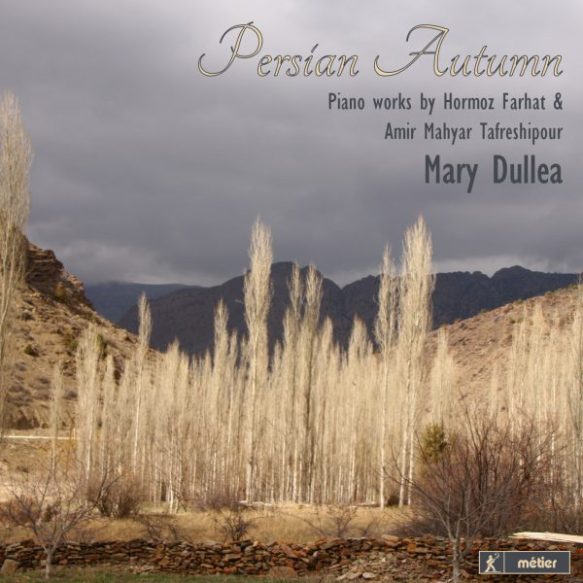
On record – Persian Autumn: Mary Dullea plays piano music by Farhat and Tafreshipour (Métier)

Mary Dullea (piano)

Farhat
Toccata (1952)
Piano Sonata no.1 (1955-7)
Piano Sonata no.2 (2010)
Tafreshipour
Yasna (1999)
Pendar (2013)
Shabahang (2017)
Celebration at Pasargadae (2006)

Métier MSV28610  [72’32”]

Producers Adaq Khan, Amir Mahyar Tafreshipour

Recorded 20-21 December 2019 at Menuhin Hall, Cobham

Written by Richard Whitehouse

What’s the story?

The always enterprising Mary Dullea releases an album of piano music by Iranian composers of the older and middle generations, both having been acclaimed on either side of the Atlantic for their highly contrasted yet equally imaginative amalgam of Eastern and Western sources.

What’s the music like?

Hormoz Farhat (b1928) received his musical education in the USA and has resided in Ireland over four decades. Composing in all the main genres, he has also researched extensively into the Persian modal system, whose influence is evident throughout those works of his maturity.

Premiered by pianist and composer Alexander Tcherepnin, Toccata is among Farhat’s earliest acknowledged works – its alternating declamatory and ruminative manner resulting in music whose virtuosity gained widespread attention. Farhat was fortunate in his exponents, the First Piano Sonata being premiered and advocated by his teacher Lukas Foss – doubtless attracted by its formal rigour and tensile emotional trajectory. A restive opening Allegretto is followed by a subdued if hardly serene Adagio then a Moderato that quizzically elides between scherzo and intermezzo, before the final Rondo draws on motivic elements from earlier movements in its oblique while purposeful course toward the peremptory close. Coming over a half-century later, the Second Piano Sonata is more expansive but never unfocussed in its conception. The initial Allegretto outlines without articulating a sonata design, in what feels closer to a freely unfolding fantasia, then the central Largo yields an improvisatory and often confessional aura, countered by the final Animato in waves of tension and release on the way to a pensive close.

Having pursued musical studies in Esbjerg and London, Amir Mahyar Tafreshipour (b1974) has written a significant amount of chamber and instrumental music – as well as the first harp concerto by an Iranian composer. Recently, he has turned his attention to the operatic domain.

The four pieces recorded here attest to their composer’s acute sense of evocation and formal cohesion. Yasna refers to the Zoroastrian act of worship over an intensifying span as is both hieratic and incantatory, while Pendar – a term implying ‘thought’ and which is also the title of a series of pieces for solo instruments – unfolds as though a stream of consciousness that plays on listeners’ expectations in numerous and intriguing ways. Its title meaning ‘nocturne’, Shabahang was inspired by the crashing of waves against the coasts of the west of Ireland as also the south-east of Iran; its encroaching remoteness finding contrast with the often festive spirit, tempered by more contemplative aspects, of Celebration at Pasargadae – whose outer sections finding this composer at his most emotionally outgoing and uninhibitedly virtuosic.

Does it all work?

Yes, given the highly differentiated yet inherently personal manner by which both composers channel aspects of their heritage via overtly if never inflexibly European means. It helps that Dullea is so attuned to the musical idioms of these composers as also their technical demands.

Is it recommended?

Indeed. Sound is a little hard in more forceful or energetic passages, while remaining clear and well balanced throughout. Notes on each of these pieces are succinct but informative, and this is music which inquiring listeners and pianists alike should certainly find worth investigation.

Listen & Buy

You can get more information on the disc at the Divine Art website, where you can also purchase the recording. Meanwhile for more information on Amir Mahyar Tafreshipour, head to the composer’s website. For more on Mary Dullea click here