In concert – CBSO Youth Orchestra Academy: A Fist Full of Fives

cbso-youth

Sutton A Fist Full of Fives (2016)
Mozart
Violin Concerto no.5 in A major K219 ‘Turkish’ (1775)
Skalkottas
Five Greek Dances (1931-6, arr. 1936)
Beethoven
Symphony no.5 in C minor Op.67 (1804-8)

Irène Duval (violin), CBSO Youth Orchestra / Michael Seal

Royal Birmingham Conservatoire
Saturday 23 July 2022

Written by Richard Whitehouse

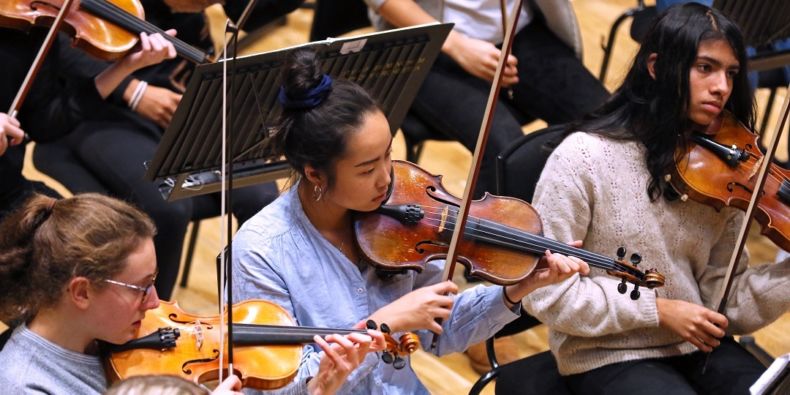
It may be the end of the main season, but that is no reason why the CBSO Youth Orchestra should not have had a concert scheduled for mid-July, with this judiciously contrasted and well-balanced programme assuredly playing to the collective strengths of its present line-up.

Although three of the works had a numerical connection with ‘five’, only the opening piece featured that number in its title. Written for an event featuring Beethoven’s Fifth and scored for similar forces, A Fist Full of Fives finds Adrian Sutton essaying a concert-opener whose interplay of vigorous (even a little martial) and more lyrical ideas evokes a mid-20th century American music evoking Piston or early Carter. Fluent and appealing if far from memorable, it duly put the orchestra through its paces to a degree which the CBSOYO met with alacrity.

Rather more memorable was the Five Greek Dances by Skalkottas which opened the second half. Admittedly the programme note led one to expect a selection from the overall 36 in the versions for full orchestra, rather than the present selection – from a set of seven – for strings. Yet the distinctive character of each dance is hardly diminished in these arrangements by the composer (a proficient violinist), and Michael Seal secured notably characterful playing in a sequence that proceeded from the swaggering Epirotikos, through the stealthy interplay of Kretikos and the bracingly astringent Tsamikos, to the gentle pathos of Arkadikos then the dashing Kleftikos. Fifty years after the CBSO’s world premiere of his First Symphonic Suite, it was good to hear these likely successors tackling Skalkottas with evident enjoyment.

In between those two pieces, Irène Duval gave Mozart’s Fifth Violin Concerto – not exactly underplayed these days, but worth hearing when rendered with such commitment. Not least an opening Allegro whose aperto marking (rightly) encouraged a deftness of phrasing that carried through to the closing bars. The Adagio was ingratiating without any hint of cloying, then the outer sections of the Rondeau an insouciance for which the lively Turkish music at its centre provided a bracing foil. The cadenzas (Duval’s own?) proved unfailingly apposite.

Closing the concert, Beethoven’s Fifth Symphony made a suitably unequivocal impression – not least an opening movement whose rhythmic trenchancy and purposeful rhetoric carried through to a forceful if never hectoring coda. Neither was there any hint of false grandeur in the Andante, its ruminative theme yielding subtlety and not a little humour as it wended its methodical yet never predictable course. Ensemble was a little ragged near the outset of the scherzo, but the transition into the finale had a simmering expectancy that made the latter’s blazing onset more visceral. This music’s familiarity tends to detract from its innovation of form and orchestration, but Seal pointed up such aspects in a reading that never risked losing focus as it headed to a coda whose reiterations of the home key made for a triumphal QED.

A worthwhile programme, then, with performances to match and exactly the sort of concert needed to inject needed impetus into the indolence of summer. The CBSOYO makes its first appearance next season with a programme of Verdi, Bruch and Lutosławski on October 30th.

For more information on the CBSO Youth Orchestra and their next concert, visit the dedicated page on their website. Click on the names for more information on Irène Duval and Michael Seal

In concert – Clare Hammond, CBSO / Michael Seal: Nielsen, Grieg & Sibelius

clare-hammond-grieg

Nielsen Helios Overture FS32 (1903)
Grieg
Piano Concerto in A minor Op. 16 (1868)
Sibelius
Symphony No. 1 in E minor Op. 39 (1898-9)

Clare Hammond (piano, above), City of Birmingham Symphony Orchestra / Michael Seal

Symphony Hall, Birmingham
Wednesday 9 March 2022 (2.15pm)

Written by Richard Whitehouse

A Scandinavian programme this afternoon from the City of Birmingham Symphony Orchestra, featuring music by the three most famous of this region’s composers (so no representation for Sweden), and presided over with his customary authority by CBSO’s associate conductor Michael Seal.

Unusual nowadays to have a programme consisting of overture, concerto and symphony – but Nielsen’s Helios is as fine a curtain-raiser as any, its ‘sunrise to sunset’ scenario captured with one of the most graphic crescendos and diminuendos in the literature. Seal ensured this gradual emergence, and its faster evanescence, were unerringly paced – the horns’ echoing sonorities enfolded into the orchestral texture; and if the intervening intermezzo and fugato rather tread water by comparison, their role within the formal scheme made for a cohesive overall entity.

Whether or not Grieg tired of hearing or at least playing his Piano Concerto, he would surely have appreciated Clare Hammond’s take on its solo part. The inedible opening gesture might have been less than usually arresting, but the opening movement proceeded methodically and often poetically so its structural seams were barely in evidence – culminating in a resourceful account of the cadenza with the composer’s motivic ingenuity much in evidence. Easy to pass off as a bland interlude, the Adagio had an appealing poise that opened into keen pathos at its height. Trenchant rather than impetuous, the outer sections of the finale were rarely less than engaging but it was the warm soulfulness at the centre that really struck home; its return for a triumphal apotheosis did not quite avoid portentousness, but it ensured a decisive conclusion.

A distinctive and, for the most part, convincing performance which Hammond followed with the caressing harmony of the eleventh from Szymanowski’s Op. 33 Etudes – music in marked contrast to the existential drama of Sibelius’s First Symphony which came after the interval.

The latter work’s emergence against a background of fraught self-determination has inevitably taken on far greater resonance during recent weeks, and it was to Seal’s credit that he played down any tendency to overt sentiment – rendering the first movement, its sombre introduction limpidly realized by Oliver Janes, as the striking and frequently innovative study in expressive contrasts it should be. Nor was there any lack of Tchaikovskian pathos in the Andante, whose whimsical passages were as vividly delineated as those eruptive outbursts towards its climax.

The ensuing Scherzo had the right rhythmic tensility and, in its central trio, enticing whimsy – but it was the Finale as set the seal on this performance. The ‘Quasi una fantasia’ marking can result in emotional overkill but Seal kept its prolix follow-through in focus at all times – whether with the anguished recall of the work’s initial theme, surging impetus of its swifter sections, or the heart-on-sleeve immediacy of its ‘big tune’; pervaded by an ambivalence to the fore in a peroration which (almost) avoided histrionics on the way to its fatalistic close.

A fine response from the CBSO, playing here with burnished eloquence and Matthew Hardy making the most of a timpani part that has structural as well as expressive significance. Few having heard it are likely to underestimate this work’s status in Sibelius’s symphonic output.

For more information on the CBSO’s current season, visit their website. Meanwhile for more information on the artists, click on the names to access the websites of Clare Hammond and Michael Seal

In concert – CBSO Youth Orchestra plays Shostakovich with Michael Seal

michael-seal-bcsoyo

Howard Argentum (2017)
Britten
Diversions Op.21 (1940, rev. 1954)
Shostakovich
Symphony no.10 in E minor Op.93 (1953)

Nicholas McCarthy (piano, below), CBSO Youth Orchestra / Michael Seal (above)

Symphony Hall, Birmingham
Sunday 31 October 2021 (3pm)

Written by Richard Whitehouse

It seems quite a while since the CBSO Youth Orchestra was last in action – this afternoon’s concert playing to its strengths with a programme as featured respectively early and mature works from Britten and Shostakovich, while beginning with a recent piece by Dani Howard.

Now in her late twenties, Howard is one among several British composers who have come to prominence in the past five years. Written to commemorate the silver-wedding anniversary of two close friends, the appropriately named Argentum is in a lineage of curtain-raisers by such as John Adams or Michael Torke – drawing audibly yet productively on such post-minimalist traits in music whose unbridled animation subsides towards a mid-point stasis, before rapidly regaining its previous energy over the course of a build-up to the pointedly affirmative close.

The CBSOYO evidently enjoyed making its acquaintance, then seemed no less attuned to the eclecticism pursued by Britten in his Diversions. Written for Paul Wittgenstein, who had lost his right-arm in the First World War, it takes the form of 12 variations on a theme announced by the orchestra whose faux-portentousness determines what follows. Prokofiev is the main influence (Britten could not have known his left-hand Fourth Concerto, written for but never played by Wittgenstein and unheard until the 1950s) on music of an inventiveness and verve admirably conveyed here by Nicholas McCarthy; his characterizing of each variation astutely gauged through to a scintillating ‘Toccata’ cadenza, with Michael Seal similarly judicious in the mock-solemnity of the ‘Adagio’ then a final ‘Tarantella’ of suitably uproarious humour.

Over his years as Associate Conductor of the CBSO, Seal has gained a formidable reputation in symphonic repertoire, with his account of Shostakovich’s Tenth Symphony never less than satisfying in its long-term cohesion. Not least the opening Moderato, unfolding at an almost unbroken pulse with the stark main theme powerfully wrought and its successor lacking only a degree of irony. The central development exuded palpable impetus and while the climactic arrival of the reprise could have been even more shattering, the wind-down into the musing coda was ideally judged. Taken at a swift if never headlong tempo, the Scherzo was suitably graphic in its evoking of violence (whether, or not, a ‘portrait’ of Stalin is beside the point), then the ensuing Allegretto was poised unerringly between slow movement and intermezzo.

This most intriguing portion of the work again lacked little in insight – with due credit to first horn Alex Hocknull for coming through, almost unscathed, in one of the lengthiest and most testing solos of the orchestral literature. A pity that Seal did not head straight into the finale, but his handling of its Andante introduction astutely mingled pathos with anticipation – the main Allegro itself pivoting between nonchalance and defiance through to a conclusion in which any thought of triumph over adversity was – rightly- withheld until the closing bars.

All in all, a gripping performance of a symphonic masterpiece and a fine demonstration of the CBSO Youth Orchestra’s collective prowess. The CBSO returns this Wednesday for Mozart and Mendelssohn frère et soeur, with Benjamin Grosvenor in Beethoven’s First Concerto.

Further information on the CBSO’s current season can be found at the orchestra’s website. For more on Michael Seal, click here – and for more on pianist Nicholas McCarthy, click here

In concert – Jonathan Martindale, CBSO / Michael Seal: Summer Classics

michael-seal

Jonathan Martindale (violin, below), City of Birmingham Symphony Orchestra / Michael Seal (above)

Dvořák Carnival Op.92 (1891)
Vaughan Williams
The Lark Ascending (1914/20)
Elgar
Chanson de matin Op.15/2 (1889)
Grieg
Peer Gynt Suite no.1 Op.46 (1875/88) – no.1, Morning; no.4, In the Hall of the Mountain King
Mendelssohn
A Midsummer Night’s Dream Op.21 (1826)
Vivaldi
The Four Seasons Op.8 (1718/20) – no.2 in G minor RV315 ‘Summer’
Price
Symphony no.1 in E minor (1931-2) – Juba Dance
Tchaikovsky
The Nutcracker Op.71 (1892) – Waltz of the Flowers

Symphony Hall, Birmingham
Friday 2 July 2021 (2pm)

Written by Richard Whitehouse Photo of Jonathan Martindale courtesy of Upstream Photography

The penultimate event in the City of Birmingham Symphony Orchestra’s current season, this afternoon’s Summer Classics featured a wide-ranging selection of pieces that between them spanned over two centuries, and whose ‘feel good’ factor at no time precluded stylish or committed playing.

With longstanding associate director Michael Seal at the helm, the orchestra made the most of Dvořák’s effervescent Carnival overture; the alluring pathos of its central interlude accorded due emphasis, and with some eloquent woodwind solos. Its popularity during recent years has made Vaughan Williams’s The Lark Ascending a regular inclusion in such programmes, and Jonathan Martindale (below, who also led the concert) gave a thoughtful while never flaccid reading – most perceptive in the middle section with its folk-like whimsy and fanciful evocations of birdsong. The CBSO responded with limpid dexterity, the whole performance a reminder that this work is best tackled as a concertante piece and by a player (recalling such as Hugh Bean, Iona Brown and, more recently, Richard Tognetti) who knows the orchestra from the inside.

Next came an ingratiating take on Elgar evergreen Chanson de matin, then excerpts from the First Suite of Grieg’s incidental music to Peer Gynt – a rapturous Morning and stealthy In the Hall of the Mountain King skirting headlong terror at the close. Mendelssohn’s overture to A Midsummer Night’s Dream made for an unlikely but effective centrepiece – the highlight being those fugitive imaginings towards its centre, along with the disarming eloquence of its final bars where the teenage composer conjures a fulfilment he was only rarely to recapture.

The Summer concerto from Vivaldi’s The Four Seasons again saw Martindale as soloist in an account that lacked little of that rhythmic vitality his contemporaries (notably Bach) seized on with alacrity; nor was there any absence of poise in its atmospheric second movement. One who has come in from the cold partly through the recovery of her manuscripts, Chicago-based Florence Price broke with convention by introducing the Juba Dance into her symphonies in lieu of a scherzo; the CBSO responding in full measure to its rhythmic verve. A winning harp solo from Katherine Thomas launched Waltz of the Flowers from Tchaikovsky’s ballet The Nutcracker and ended the main programme in fine style – Seal and the CBSO acknowledging the applause with the final ‘galop’ from Rossini’s William Tell overture as a dashing encore.

Throughout the concert, film expert Andrew Collins interspersed proceedings with his remarks and recollections (not least on that seminal 1970s supergroup The Wombles). The music itself was accompanied by varying shades and colours of lighting, but these rarely seemed intrusive – not least compared to the garish ‘Moulin Rouge’ effects routinely encountered nowadays at the Proms. Certainly, anyone in the process of getting the know just what classical music was all about, and those merely in search of a pleasurable afternoon’s listening, were well served.

Next Wednesday brings the last in this current series of concerts, the CBSO being conducted by Joshua Weilerstein (who is replacing an ‘unable to travel’ Edward Gardner) in an enticing programme of Judith Weir, Prokofiev (with the violinist Alina Ibragimova) and Beethoven.

You can find information on the final concert in the CBSO’s season at their website. For more information on composer Florence Price, click here

In concert – Ian Bostridge, CBSO / Michael Seal: Britten Nocturne & Malcolm Arnold Symphony no.5

michael-seal

Ian Bostridge (tenor), City of Birmingham Symphony Orchestra / Michael Seal (above)

Britten Nocturne Op.60 (1958)
Arnold Symphony no.5 Op.74 (1961)

Symphony Hall, Birmingham
Wednesday 9 June 2pm

Written by Richard Whitehouse

It may have been centred on ‘England’s dreaming’, but there is surely a future for such astute juxtapositions of works by British composers as that heard in this latest concert by the City of Birmingham Symphony Orchestra; two pieces separated by just three years but poles apart stylistically.

The fourth and last of Britten’s orchestral song-cycles, Nocturne is a sequence with emphasis very much on the cyclical aspect. Its eight settings each features an obbligato instrument heard alongside string orchestra, the tenor adopting a flexible arioso manner with which to deliver a range of texts across centuries of English poetry. After a somnolent initial setting of Shelley – strings introducing a spectral rhythmic figure acting as a ritornello across the work – the bassoon emerges for an ominous setting of Tennyson, then the harp for a jejune rendering of Coleridge.

Notably restrained with his characterization thus far, Ian Bostridge upped the expressive ante when horn came to the fore in an evocative treatment of Middleton; the more so as timpani entered for Wordsworth’s troubled verses on the aftermath of revolution. Accrued tension spilled over to a plangent setting of Owen with cor anglais in attendance, then flute and clarinet joined the voice in a rapt take on Keats. All seven instruments duly reappeared for the final setting of Shakespeare – complementing tenor and strings when they arrived at a barely tangible repose.

Throughout, Michael Seal was typically alert and sensitive in accompaniment – before letting the CBSO off its collective leash for Malcolm Arnold’s Fifth Symphony. If not the finest of his cycle (which accolade would likely go to the Seventh), the Fifth is the most representative in its disjunct contrasts and fraught emotions – not least in an opening Tempestuoso whose pivoting between stark irony and consoling empathy results in several assaultive climaxes as were fearlessly delivered. In his pointedly succinct note for the premiere, Arnold confessed himself ‘‘unable to distinguish between sentiment and sentimentality’’ – a disingenuity that made possible the Andante with its aching main melody and soulful secondary theme which between them engender a baleful culmination before the earlier raptness is fitfully regained.

In his unequalled 1973 recording with this orchestra, Arnold secured playing of transcendent poise from the strings in this movement, but Seal was not far behind in the sustained intensity he drew from the present-day CBSO. Nor was there any lack of sarcasm in the scherzo which follows – wind and brass exchanging gestures either side of the clarinets’ freewheeling tune in the trio, then an abrasively confrontational coda. It remains for the Risoluto finale to attempt a summation with elements from the earlier movements thrown together in an atmosphere of martial volatility; climaxing in a restatement of the slow movement’s main theme resplendent but, ultimately, futile – the music collapsing into a void in which bells echo forlornly against fading lower strings. The CBSO imbued these closing minutes with truly graphic immediacy.

This instructive and cathartic programme brought a (rightly) enthusiastic response from those present. Next week features another British symphony, the first by Thomas Adès, alongside music by Purcell and Mozart for what should be a no less provocative and absorbing concert.

For further information about the CBSO’s current series of concerts, head to the orchestra’s website

For further information about the next concert of Purcell, Mozart and Adès on Wednesday 16 June, click here, and for more on Sir Malcolm Arnold you can visit the website dedicated to the composer.