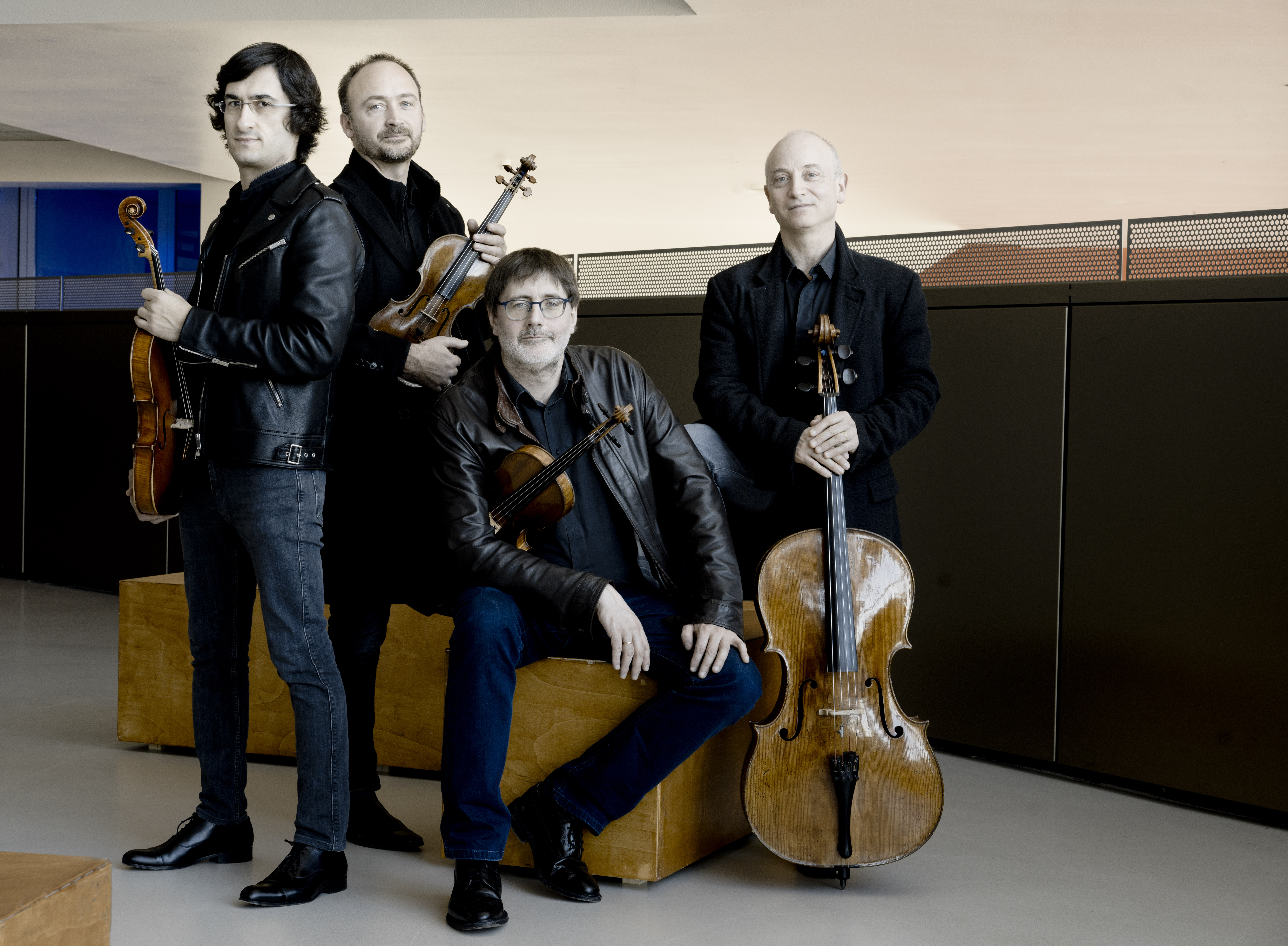
In concert – Quatuor Danel: Shostakovich & Weinberg #9 with François-Frédéric Guy @ Wigmore Hall

François-Frédéric Guy (piano), Quatuor Danel [Marc Danel & Gilles Millet (violins), Vlad Bogdanas (viola), Yovan Markovitch (cello)]

Weinberg String Quartet no.13 Op.118 (1977)
Shostakovich String Quartet no.13 in B flat minor Op.138 (1970)
Shostakovich Piano Quintet in G minor Op.57 (1940)

Wigmore Hall, London
Thursday 6 March 2025

by Richard Whitehouse Photos (c) Marco Borggreve (Quatuor Danel), Lyodoh Kaneko (François-Frédéric Guy)

Quatuor Danel’s cycle at Wigmore Hall focussing on the string quartets of Shostakovich and Weinberg continued this evening with the Thirteenth Quartets by both composers, alongside the Piano Quintet that has long been among the former’s most representative chamber works.

After his exploratory (while not a little disconcerting) Twelfth Quartet, Weinberg avoided the medium for several years before penning four such pieces in relatively swift succession. Cast in a single movement of barely 15 minutes the Thirteenth Quartet, the shortest of his cycle, is influenced as much by Shostakovich’s late quartets as Weinberg’s own precedents. Facets of sonata form underpin its reticent progress from uncertain inwardness to unwilling animation – a vein of equivocation pervading the whole so that its eventual culmination does little more than lead back towards the initial stasis. Its progress enroute is similarly reticent, though this was hardly the fault of the Danel who unfolded the overall design with unforced conviction. Nor did they underplay the plangency of the ending, with its anguished crying into the void.

Seven years earlier, Shostakovich had essayed an altogether more radical take on the single-movement format with his own Thirteenth Quartet. It is dedicated to Vadim Borisovsky, then violist of the Beethoven Quartet, and the viola is audibly ‘first among equals’ over almost its entirety. Nominally the darkest and most forbidding of this cycle, the hymnic lamentation of its outer Adagio sections is thrown into relief by the Doppio movimento central span whose jazz-inflected impetus is but its most fascinating aspect; added to which, those frequent taps onto the body of each instrument (which evoke a death-rattle or a rhythm-stick according to preference) readily accentuate a sense of time running out. Vlad Bogdanas made the most of his time in the spotlight, not least at the close as viola joins with violins to unnerving effect.
After the interval it was a relief to encounter the younger, resilient Shostakovich of his Piano Quintet. Its piano part conceived as a vehicle for himself, this marked the onset of a creative association with the Beethoven Quartet as lasted almost until the end of his life. It also finds the composer immersed in Bachian precedent – witness the powerfully rhetorical dialogue of piano and strings in its Prelude, then the severe yet never inflexible unfolding of form and texture in a Fugue whose abstraction is informed by a pathos the more acute in its restraint.

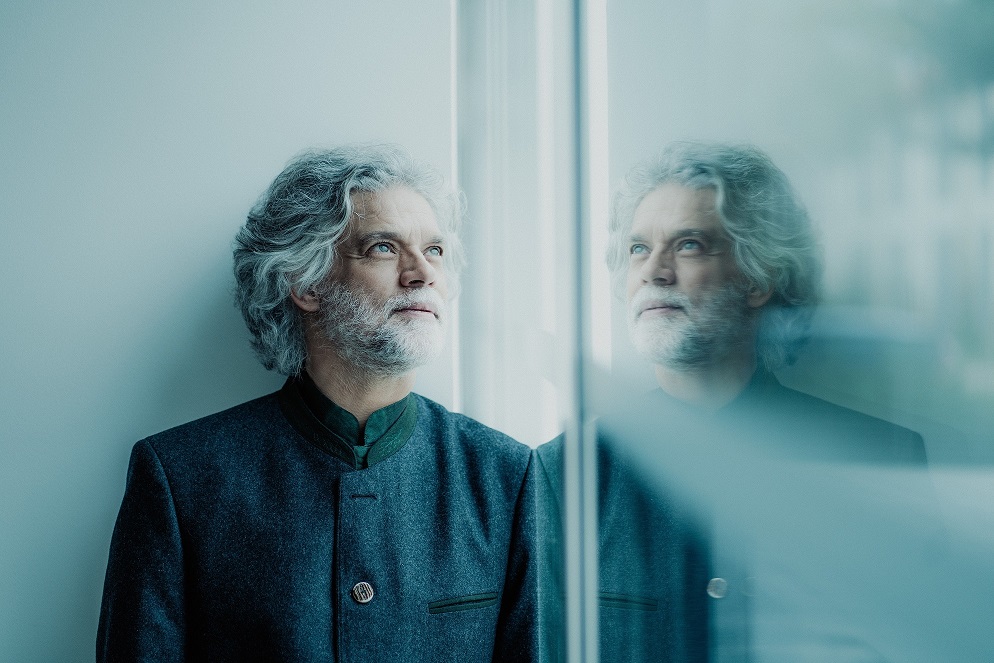
Playful and capricious by turns, the Scherzo makes for a striking centrepiece in spite (even because?) of its technical challenge. Suffice to add that François-Frédéric-Guy (above) and the Danel met this head on – after which, the Intermezzo mined a vein of soulfulness as was never less then affecting, while the Finale sounded more than unusually conclusive in the way it drew together aspects from the earlier movements towards a whimsical and even nonchalant close. At this stage, Shostakovich could still afford a measure of levity in his emotional response.

Thanks to Marc Danel’s acrobatics with a flying bow, the third movement stayed on course but it was no hardship to have this movement given even more scintillatingly as an encore. May 6th brings the penultimate recital in what has been an absorbing and revelatory series.

You can hear the music from the concert below, in recordings made by Quatuor Danel -including their most recent cycle of the Shostakovich quartets on Accentus:

For more information on the next concert in the series, visit the Wigmore Hall website. You can click on the names for more on composer Mieczysław Weinberg, Quatuor Danel and pianist François-Frédéric Guy

Published post no.2,467 – Saturday 8 March 2025

In concert – Quatuor Danel: Shostakovich & Weinberg #8 @ Wigmore Hall

Quatuor Danel [Marc Danel & Gilles Millet (violins), Vlad Bogdanas (viola), Yovan Markovitch (cello)]

Shostakovich String Quartet no.11 in F minor Op.122 (1966)
Shostakovich String Quartet no.12 in D flat major Op.133 (1968)
Weinberg String Quartet No. 12 Op.103 (1969-70)

Wigmore Hall, London
Wednesday 15 January 2025

by Richard Whitehouse Photo (c) Marco Borggreve

This latest instalment in Quatuor Danel’s traversal of the string quartets by Shostakovich and Weinberg comprised the Twelfth Quartets from both composers – masterpieces both, and was prefaced by the teasing brevity and obliqueness of the former’s preceding such composition.

His 60th year marked the onset of Shostakovich’s ‘late period’ – its overt introspection being appropriate for a piece dedicated to the memory of Vasily Shirinsky, former second violinist of the Beethoven Quartet who premiered all but the first and last of the composer’s cycle. In fact, the Eleventh Quartet is appreciably more varied than this memorial aspect may suggest – the Introduction initiating a subdued discourse given an ironic twist in the Scherzo then erupting combatively in the Recitative, prior to the anxiety of the Etude and ruthlessness of the Humoresque. This performance came into its own with the Elegy, a remembrance of enfolding pathos – after which, the Finale assumed that retrospective function found in many of Shostakovich’s later works with due emphasis on its stealthy and quixotic humour.

Just two years on brought Shostakovich’s Twelfth Quartet – if not his greatest then surely in the top two, while arguably uncharacteristic in its self-conscious yet masterly formal design. Although not introductory as such, the Danel was mindful to keep its opening movement on a tight rein such that its interplay of mood and tempo inferred without defining those seismic confrontations to come. This longest and most diverse of its composer’s quartet movements did not disappoint – the Danel having fullest measure of an 18-minute span whose eventual subsiding presages a pizzicato-driven assault the more visceral for being so methodical in its unfolding. Nor was the allusion to initial material at all misconstrued as this work enters its climactic phase, a transformation whose unbridled affirmation was powerfully in evidence.

It might have emerged barely 18 months on, but Weinberg’s Twelfth Quartet feels comparable only in its scope and ambition. A likely response to the creative radicalism this composer had encountered on returning to his native Poland after over a quarter-century, its four movements essentially reinvent the Classical archetype so that the opening Largo outlines a succession of amorphous or disruptive elements with little audible regard for just how they might interact – something that will only come into focus as the work unfolds while opening-out expressively.

This evolution takes in a stealthy if always speculative Allegretto, and a Presto whose violence has become assaultive by its close. It remains for the final Moderato to effect closure through a synthesis almost improvisatory for all its formal rigour. Allied to this comes a dominance of playing techniques that does not intensify the music as drain it of all emotion and so reduce it to merest gestures by the end. A remarkable piece, even so, and a testament to its composer’s tenacity in the face of an unsympathetic, often antagonistic cultural climate at home or abroad.

Tonight’s impressive reading almost had to be abandoned as Gilles Millet’s bridge collapsed just before the end of the third movement, but his last-minute location of a replacement saw it resume to the close – an unexpected hiatus seemingly in accord with this extraordinary work.

You can hear the music from the concert below, in recordings made by Quatuor Danel -including their most recent cycle of the Shostakovich quartets on Accentus:

For more information on the next concert in the series, visit the Wigmore Hall website. You can click on the names for more on composer Mieczysław Weinberg and Quatuor Danel themselves.

Published post no.2,414 – Friday 17 January 2025

In concert – Alexander Roslavets, Gidon Kremer, LPO / Andrey Boreyko @ Royal Festival Hall: A Dark Century

Alexander Roslavets (narrator / bass), Gidon Kremer (violin), London Philharmonic Choir (men’s voices), London Philharmonic Orchestra / Andrey Boreyko

Schoenberg A Survivor from Warsaw Op.46 (1947)
Weinberg Violin Concerto in G minor Op.67 (1959)
Shostakovich Symphony no.13 in B flat minor Op.113 ‘Babi Yar’ (1962)

Royal Festival Hall, London
Wednesday 27 November 2024

Reviewed by Richard Whitehouse Pictures (c) Richard de Stoutz (Andrey Boreyko), Angie Kremer (Gidon Kremer)

Anyone who heard one or other of these works for the first time at this concert by the London Philharmonic Orchestra could be forgiven for thinking that the twentieth century, if not a ‘dark century’ per se, was at the very least a troubled one for all that the quality of its music was undeniable.

With its elements of melodrama and cantata, Schoenberg’s A Survivor from Warsaw is one of his most original conceptions and necessarily so, given the unnerving immediacy of its text in which a speaker has to take on the roles of survivor and officer in just six minutes. Alexander Roslavets rose to this challenge, bringing out emotional contrasts as surely as he instilled his words with that ominous dread whose culmination in the prayer Shema Yisrael was intoned by the London Philharmonic Choir with the right balance between desperation and defiance.

One composer who witnessed something of such atrocities was Mieczysław Weinberg, and if his Violin Concerto demonstrably continues the ‘Romantic’ tradition, this is still an inherently personal statement. Gidon Kremer has championed the composer extensively in recent years and, while technical issues seemingly inhibited the respectively incisive and impetuous outer movements, the restless searching of its intermezzo-like Allegretto then confiding eloquence of its Adagio were abundantly in evidence. For all its outward virtuosity, the music’s essential inwardness is what prevails as the soloist remains musing when the orchestra fell silent at the close of the finale. Kremer was in his element here, as in a touching rendition of Silvestrov’s Serenade which made for an apposite encore and was dedicated to all the people of Ukraine.

Best known for giving the posthumous premiere of Gorecki’s Fourth Symphony with the LPO 10 years back, Andrey Boreyko is well established as an exponent of Shostakovich so that his take on the Thirteenth Symphony did not disappoint. At a distance of over six decades, it can be hard to recapture the provocation of that most eminent Soviet composer using verse by the most populist younger poet, as Yevgeny Yevtushenko then was, but this setting of Babi Yar retains all its expressive force through the immediacy and resourcefulness in which it relates official indifference to the Jewish massacre as that ravine outside Kyiv was transformed into landfill. Broodingly restrained, Roslavets emerged into his own with Humour – its scabrous send-up of bone-headed officialdom inspiring one of Shostakovich’s most scurrilous scherzos.

Fashioning the last three movements into a cohesive if cumulative unity, Boreyko underlined the potency of Shostakovich’s creative vision as he takes the Soviet establishment to task for various failings economic as In the Store, political as in Fears and cultural as in A Career. Implacable then volatile, these first two are rounded off by Yevtushenko’s considering of the relationship between society and the individual; framed by an undulating melody, for flutes then strings, which is one of its composer’s most evocative as well as affecting inspirations.

It duly brought this work, and this performance, to its subdued yet spellbinding close. As the relationship between East and West becomes ever more confrontational, Shostakovich’s 13th remains a testament to rationality and compassion whose denigration is to everybody’s cost.

For details on the 2024-25 season, head to the London Philharmonic Orchestra website. Click on the names to read more about soloists Alexander Roslavets and Gidon Kremer

Published post no.2,373 – Monday 25 November 2024

In concert – Quatuor Danel: Shostakovich & Weinberg #7 with François-Frédéric Guy @ Wigmore Hall

François-Frédéric Guy (piano), Quatuor Danel [Marc Danel & Gilles Millet (violins), Vlad Bogdanas (viola), Yovan Markovitch (cello)]

Shostakovich String Quartet no.10 in A flat major Op.118 (1964)
Weinberg String Quartet no.11 in F major Op.89 (1965-6)
Weinberg Piano Quintet in F minor Op.18 (1944)

Wigmore Hall, London
Monday 25 November 2024

by Richard Whitehouse Photo (c) Marco Borggreve

This latest instalment in Quatuor Danel’s parallel cycle of string quartets by Shostakovich and Weinberg comprised one of the former composer’s most understated pieces followed with two of the latter’s most characteristic yet, at least in terms of expression, utterly contrasted works.

Written during just 11 days, the Tenth Quartet is something of a standalone in Shostakovich’s cycle – coming as it does between the four innately personal quartets that preceded it and the four related to members of the Beethoven Quartet (who premiered all except the first and last of this cycle) that followed. Yet, as its dedication to Mieczysław Weinberg suggests, this is no less specific in intent – hence the musing ambivalence of its initial Andante and visceral force of its scherzo. The Danel savoured their respective essence, cellist Yovan Markovich coming into his own in the ensuing Adagio with its emotionally restrained variations. The link to the finale was seamlessly effected, then the movement built methodically towards a heightened restatement of the passacaglia theme before tentatively retracing its steps to a wistful close.

Written months later, Weinberg’s Eleventh Quartet is by no means lesser by design or intent. Its fugitive opening Allegro exudes a scurrying motion such as resurfaces at key moments in the overall design, akin to that of the Shostakovich in equivocation, and if the scherzo could hardly be more different in its fleeting delicacy (the original such movement it replaced was likely much more demonstrative), the solemn alternation of ensemble and solo writing in its Adagio conjures up a similarly processional aura. Contrast is again pronounced in the finale where, instead of channelling the musical loose-ends towards a formal and expressive unity, Weinberg leaves matters in abeyance; despite (or because of) the most tentative recollection of that scurrying motion which flits across the already fragmented texture at the very close.

If the Danel had long mastered Weinberg at his most refractory, it proved equally adept with the communicative power of his Piano Quintet. At almost 45 minutes this is also his largest chamber work, its five movements unfolding as a discursive if never random sequence such that the furtive questioning of its opening Moderato finds accord with the unsettled humour of its ensuing Allegretto – an intermezzo next to the scherzo-like energy of its central Presto, in which the interplay between François-Frédéric Guy and the Danel was at its most incisive.

Much the longest movement, the Largo accumulates intensity through juxtaposing passages in rhythmic unison with those during which piano and strings predominate. Its impassioned culmination is exceeded by that of a final Allegro whose impetuous main ideas bring about    a climactic return to the work’s opening theme. Even more remarkable is what follows: the intensity soon subsiding prior to this movement’s initial idea returning, quietly transformed, as though to suggest its composer having been reborn as a sentient being and creative artist.

Hearing this work, performances of which have fortunately become more frequent these past two decades, is an experience like few others in the chamber domain; suffice to add that Guy and the Danel were as one in their realizing the scale and impact of this modern masterpiece.

You can hear the music from the concert below, in recordings made by Quatuor Danel -including their most recent cycle of the Shostakovich quartets on Accentus:

For more information on the next concert in the series, visit the Wigmore Hall website. You can click on the names for more on composer Mieczysław Weinberg, Quatuor Danel and pianist François-Frédéric Guy

Published post no.2,378 – Saturday 30 November 2024

In concert – Quatuor Danel: Shostakovich & Weinberg #6 @ Wigmore Hall

Quatuor Danel [Marc Danel & Gilles Millet (violins), Vlad Bogdanas (viola), Yovan Markovitch (cello)]

Weinberg String Quartet no.9 in F# minor Op.80 (1963)
Weinberg String Quartet no.10 in A minor Op.85 (1964)
Shostakovich String Quartet no.9 in E flat major Op.117 (1964)

Wigmore Hall, London
Wednesday 16 October 2024

by Richard Whitehouse Photo (c) Marco Borggreve

Quatuor Danel reached the effective mid-point of its Shostakovich and Weinberg cycle with this programme featuring two of the latter composer’s lesser if still absorbing string quartets alongside one from the former that has come belatedly to be held among his most revealing.

Coming soon after his Fifth Symphony (arguably the finest of this cycle), the Ninth Quartet finds Weinberg at something of a stylistic crossroads with those essentials of his subsequent phase almost within reach. It opens with an Allegro which is among his most visceral in any medium – the Danel (rightly) giving full rein to a seething energy, barely held in check, then to which the Allegretto functions as a shock absorber given its intermezzo-like speculations. The ensuing Andante ventures further towards that secretive and often confessional intimacy central to its composer’s thinking henceforth, though here its introspection is mitigated by a finale which unfolds almost as a synthesis of what went before – the Danel duly mindful of a gradual momentum that does not bring resolution as evade the issue with a nonchalant shrug.

Barely a year on, the Tenth Quartet has the same four-movement and 25-minute dimensions but is otherwise a very different proposition. Here the initial movement is an Adagio whose rhetorical fervency has turned in on itself well before the end, leaving an Allegro to provide oblique continuity with its simmering intensity that never quite risks outright confrontation. If the Adagio that follows promises such, its gestures prove too brittle and short-winded to sustain a more expansive movement – the intensity soon making way for a final Allegretto that sounds intent on avoiding closure with its succession of fugitive interactions, elegantly articulated here, whose lilting gait ultimately alights on the tardiest of cadences. As with its predecessor, any bringing of the work emotionally full circle is conspicuous by its absence.

Now that a first movement has been realized and performed, it is clear what Shostakovich had intended as his Ninth Quartet would have been very different from what emerged – the trenchant while slightly foursquare manner of that earlier effort replaced by the undulating lyricism of a Moderato as methodically sets out all those salient motifs for what follows. Its equivocation was ideally conveyed here – no less than the elegiac character of its successor, then a central movement of a liveliness increasingly waylaid by questioning and self-doubt.

From here, a second Adagio veers between inward musing and explosive pizzicato outbursts as provoked impassioned responses. The emotional ante duly upped, the final Allegro surges forth with new-found energy and purpose – taking in a truculent, folk-tinged episode before breaking off for a return to those pizzicato exchanges. Performances of this work often lose focus at this juncture, but the Danel brooked no compromise as the movement fairly hurtled to a close of manic defiance in what was a notable instance of music ‘playing’ its musicians.

Quite a performance with which to end this latest instalment of the Danel’s dual odyssey but, as has become usual, an encore was forthcoming: the Polka from the ballet The Golden Age affording a sardonic postlude with the insouciance of an earlier, not necessarily ‘golden’ age.

You can hear the music from the concert below, in recordings made by Quatuor Danel -including their most recent cycle of the Shostakovich quartets on Accentus:

For more information on the next concert in the series, visit the Wigmore Hall website. You can click on the names for more on composer Mieczysław Weinberg and Quatuor Danel themselves.

Published post no.2,236 – Saturday 19 October 2024