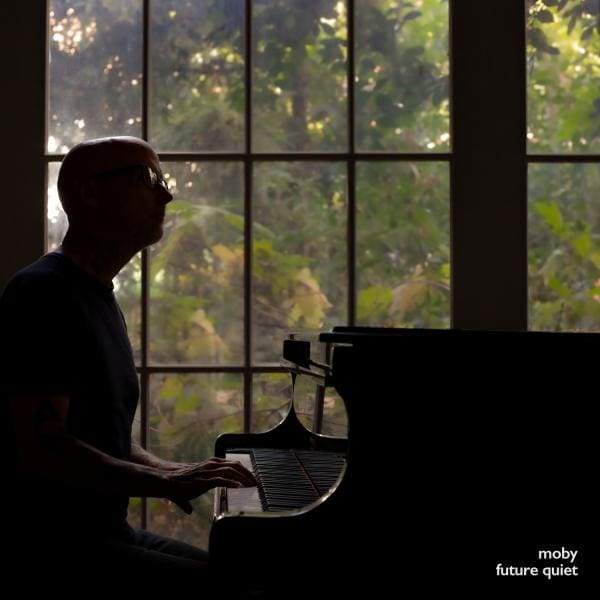
Switched On – Moby: Future Quiet (BMG)

Reviewed by Ben Hogwood

What’s the story?

Quiet is the new loud for Moby, who revisits his ambient roots for album no.23. The springboard for this appears to have been the appearance of When It’s Cold I’d Like To Die, the closing track from the 1994 album Everything Is Wrong, in prominent parts of the Stranger Things series.

That song opens Future Quiet, sung by Gabriels singer Jacob Lusk, while Moby works in a sequence of vocal and instrumental tracks that are mostly on the slow and ambient side.

What’s the music like?

There is little doubt that this is the style Moby does best, his slightly mournful take on electronic ambient music working a treat here.

The vocal guests acquit themselves extremely well, none more so than serpentwithfeet on the understated On Air, India Carney on Precious Mind, and Moby himself on the plaintive This Was Never Meant For Us.

Yet less is more in this area of music, and if anything Moby’s instrumental music speaks with greater clarity. Ruhe and Great Absence are intimate piano pieces that could easily be played in the same house as the listener, while Mott Street 1992 circles back to its main piano motif. Subtle, floated vocals from Elise Serenelle boost Estrella Del Mar, while Tallinn has a lovely solo violin.

Does it all work?

Pretty much. On rare occasions the music threatens to be over-produced, but in general the room Moby affords his music adds to its emotional reach and ambience.

Is it recommended?

Yes, enthusiastically. Moby’s response to a frantic, fraught world is to seek solace in ambient music, and that we can easily join him that says much for the content of Future Quiet. It speaks very subtly but leaves a calming imprint that lasts long after you stop listening.

Listen / Buy

You can explore purchase options for physical formats of Future Quiet at the Norman Records website

Published post no.2,822 – Saturday 7 March 2026

Switched On – Moby: Ambient 23 (Always Centered At Night)

by Ben Hogwood

What’s the story?

Moby is a man of many musical genres, but ambient music is the form that pulls him back most regularly; the style of music in which he feels most at home. His first Ambient release, titled as such, was in 1993 and made subtle waves with its undulating textures and slightly mournful soundscapes, presenting the vision of a man at home in a bedroom studio. As time has progressed so the ambient forms have become longer, culminating in the Long Ambients release of 2019, written to accompany yoga sessions, and a volume of improvised Live Ambients in 2020.

This release is made, in Moby’s words, ‘almost exclusively with weird old drum machines and old synths from my collection, inspired by my early ambient heroes’. By these he means Brian Eno, Martyn Ware, Jean-Michel Jarre and Will Sergeant.

Released for the new year, Moby also says Ambient 23 was written to ease anxiety, with the accompanying wish that ‘we all stop looking for validation from a culture we don’t respect’.

What’s the music like?

As soothing as you can imagine – and an ideal complement to the previous Long Ambients releases. The colours fashioned from the older equipment are a factor of this, and Moby finds a wide expanse of space by writing very slow moving melodic lines. The sounds will be familiar to long-time Moby listeners, with fuzzy textures from the surrounding white noise, elegant piano playing and broad string-based sounds.

The pieces have functional titles, but different characters. amb23-3 has a poised melody from an electronic cello equivalent. amb23-4 feels like a living and breathing organism, before ushering in a slowly dancing treble line amb23-6 has calming chords returning regularly like waves. amb23-9 is ideally weighted, alternating between two thick chords that are nicely weighted, but by contrast amb23-5 floats effortlessly, with ambient white noise in the background. The dappled piano figures of amb23-10 are softly affecting, amb23-11 is like a distant breath of wind, while the piano strokes of amb23-12 are like distant bells.

Does it all work?

It does, provided the listener’s expectations are for pure ambience and nothing more! That said, Moby knows how pace a longer musical structure, and each of these gets into a zen state very quickly.

Is it recommended?

It is – the ideal antidote to the January blues and any accompanying pressure. The serenity of Moby’s ambient music can get you through.

Listen

Buy

For more listening and purchase options, head to Moby’s website

Radio 1 Ibiza Prom with Pete Tong

Prom 16: Late Night With … BBC Radio 1: The Ibiza Prom with Pete Tong

pete-tong

Pete Tong

The choice of Pete Tong to present an Ibiza-themed Prom created a fair bit of controversy in the last few weeks, but the decision paid off handsomely in what was effectively a Proms Essential Mix, with almost all the parts played by live instruments.

[Watch here: http://bbc.in/1JxeD63]

Keen listeners to dance and classical music – and there are a number! – will know the gap between the two is not as great as it might seem. A tune like Derrick May’s Strings of Life, for instance, could comfortably sit alongside a piece of Steve Reich – while Moby’s Porcelain would not be out of place if followed by a piece by Erik Satie.

Both songs were part of this set, a cleverly designed montage of 23 tracks that majored on arrangements made by Jules Buckley for the Heritage Orchestra. These were not ordinary arrangements either, including a sousaphone and a bass flute in the mix! They were not wholly successful in the hall itself, either, but have a lot more detail when heard on the radio – the Royal Albert Hall not being built for club music! Naturally the bass dominated – as it probably should in dance music – and some of the mid-range detail, on which Buckley had clearly laboured – was difficult to pick up.

jules-buckley
Jules Buckley at the Ibiza Prom. Picture (c) Chris Christodoulou

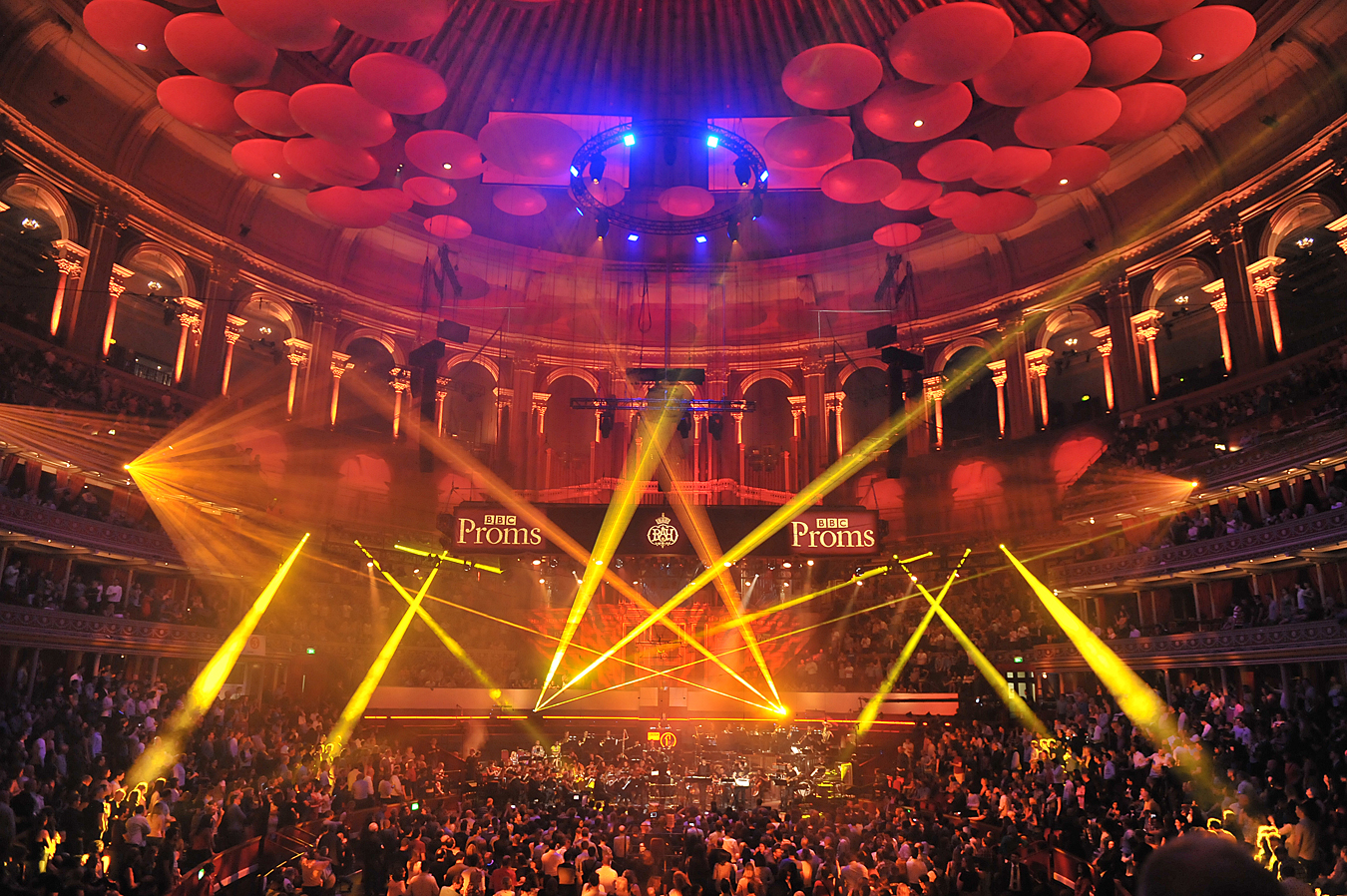
This was not a deal breaker, mind, for a high spirited beginning with Fatboy Slim’s Right Here, Right Now was perfectly judged, and set the tone. The only problem – for me at any rate – was trying to tell my brain that this was a Prom where dancing was not only permitted but actively encouraged, as the below picture shows!

ibiza-prom
The Royal Albert Hall in the Ibiza Prom Picture (c) Chris Christodoulou

The set moved between orchestra-dominated action and guest appearances from Ella Eyre and John Newman, who both acquitted themselves admirably. Eyre has a terrific voice, which she lent to Inner City’s Good Life and her own hit with Rudimental, Waiting All Night. Newman also has past with Rudimental, and his Feel The Love was warmly felt, before a closing cover of The Source feat. Candi Staton’s You Got The Love.

My only two personal regrets were that someone had not tried to arrange Josh Wink’s Higher State of Consciousness – a true Ibiza classic – or, from the blissful end of the spectrum, Groove Armada’s At The River. Those are quibbles, though, for the night was a roaring success, climaxing with the brilliant Café del Mar by Energy 52.

Over the next few days I will publish some links to songs played in the course of the Prom, linking them to classical music – so that you can hopefully see how connections can be drawn between the forms. Safe to say, though, that this particular Prom crossed a few bridges and opened several doors!