

In concert – Ruby Hughes, Natalie Clein & Julius Drake: Schubert and Other Folksongs @ Queen Elizabeth Hall

Ruby Hughes (soprano), Natalie Clein (cello), Julius Drake (piano)

Schubert arr. Jones Der Hirt auf dem Felsen (The Shepherd on the Rock) D965 (1828)
Kodály Sonatina for cello & piano (1922)
Tavener Akhmatova Songs: Dante, Boris Pasternak, Dvustishie (Couplet) (1993)
Brahms 2 Songs Op.91 (1884)
Trad arr. Britten I wonder as I wander (1940-41), At the mid hour of night (Molly, my dear), How sweet the answer (The Wren) (both 1957)
Deborah Pritchard Storm Song (2017)
Janáček Pohádka (Fairy tale) (1910, revised 1923)
Ravel Kaddisch from 2 Mélodies hébraïques (1914)
Bloch From Jewish Life (1924)
Schubert Auf dem Strom (On the river) D943 (1828)
(Encore) Berlioz La Captive

Queen Elizabeth Hall, London, 27 June 2025

by John Earls. Photo credits (c) Philip Sharp (above), John Earls (below)

Two of the most affecting sections of Ruby Hughes’ excellent 2024 album with the Manchester Collective End of My Days are three of John Tavener’s Akhmatova Songs (Dante, Boris Pasternak and  Couplet) and Maurice Ravel’s Kaddish (from 2 Mélodies hébraïques).

These also featured to dramatic effect in this fascinating concert programme of Schubert and Other Folksongs spanning two centuries, where Hughes was joined by Natalie Clein (cello) and Julius Drake (piano).

In this performance the Tavener song miniatures were performed for voice and cello and were at turns powerful, beautiful and urgent across their nine-minute duration. The prolonged silence from the audience afterwards was noticeable. Ravel’s lament-like Kaddish, this time for voice and (sparse) piano, was similarly respectfully performed and observed.

There were non-vocal pieces for cello and piano where Clein and Drake displayed what a well matched duo they are. Zoltán Kodály’s Sonatina was luminescent, Leoš Janáček’s Pohádka absorbing (not least the cello bowing and pizzicato) and Ernest Bloch’s From Jewish Life was both lovely and mournful.
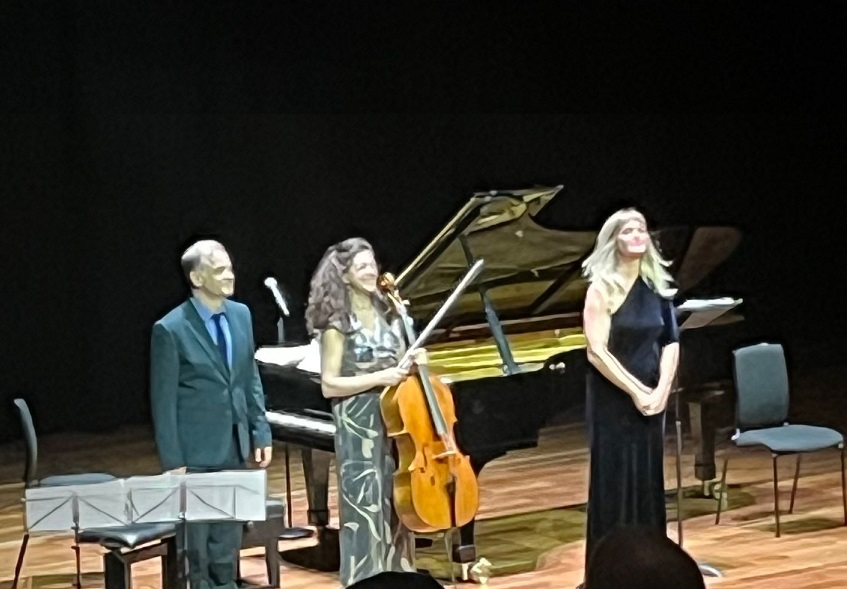
But this was a concert where Ruby Hughes’ amazing voice was to the fore but often in an understated, but no less impactful way. The captivating trio of Benjamin Britten folksong arrangements with their minimal piano trills were a case in point.

The trio performances were also impressive in their delivery and range. Brahms2 Songs (Op.91) were both gorgeous, while Deborah Pritchard’s Storm Song (from 2017, the most recently written piece) was powerfully unnerving between its haunting start and end (the composer was in the audience to take a well deserved bow).

The concert was bookended by two songs written by Franz Schubert shortly before his death in 1828 at the age of just 31. As David Kettle remarks in his excellent programme notes, to call them simply songs is to do them a disservice. Der Hirt auf dem Felsen (The Shepherd on the rock), arranged by Peter Jones for voice, cello (replacing the clarinet) and piano, traversed a journey of yearning and joy that was both delicate and impassioned. The closing Auf dem Strom (On the river) saw Hughes capturing the drama convincingly throughout.

An encore of Berlioz’s La Captive concluded this concert that combined fascinating and thoughtful programming with performances of beautifully judged expression.

John Earls is Director of Research at Unite the Union and posts at @johnearls.bsky.social on Bluesky and @john_earls on X. You can subscribe (free) to his Hanging Out a Window Substack column here: https://johnearls.substack.com/

Published post no.2,579 – Sunday 29 June 2025
Wigmore Mondays – Ruby Hughes, Natalie Clein & Julius Drake: Works for soprano, cello & piano

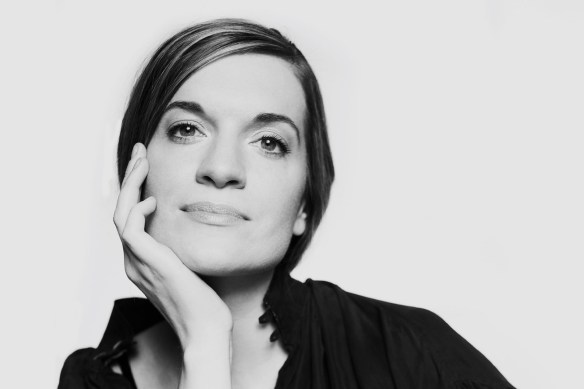
Ruby Hughes (soprano, above), Natalie Clein (cello), Julius Drake (piano, both below)

Wigmore Hall, Monday 9 March 2020 (lunchtime)

You can listen to this concert on the BBC Sounds app here (opens in a new window)

Review and guide by Ben Hogwood

A fascinating hour of music for three instruments not often linked – soprano, cello and piano. Its imaginative programme comprised music by six composers from three different centuries using four languages! It made for a very satisfying whole.

Kodály’s single-movement Sonatina for cello and piano (1:41 on the radio broadcast) began the program. This is a work with which Natalie Clein and Julius Drake are very familiar, having recorded it for Hyperion in 2009, and they immediately found its expressive core. The Sonatina was initially intended for a Sonata the composer finished in 1909, but it happened to work particularly well on its own, and was completed later. Its colourful music – which has parallels to Debussy’s own Cello Sonata – is rich in melodic and harmonic content. Free in form, it speaks directly of the composer’s Hungarian heartlands. Clein’s tone was sumptuous in this performance and Drake’s piano exemplary, the two plotting a convincing course for the work.

This was followed without a break by three of John Tavener’s 6 Akhmatova Songs, written for soprano Patricia Rozario and cellist Steven Isserlis in 1993. In effect the cello is singing here too, its wordless line providing an otherworldly introduction for the third song of the six, Boris Pasternak (10:45). Clein’s rich sound was the ideal foil for the clarity of Ruby Hughes’ soprano. Couplet (12:48) was immediately more agitated, the gruff cello adopting a more questioning slant as it helped describe the poet’s suspicion about praise of her own work. Hughes, too, was more penetrating in her delivery. Finally Dante (14:23) grew outwards from the start, its expressive line shared between singer and instrumentalist.

Deborah Pritchard’s short but powerful Storm Song (16:46), a setting of text by Jeanette Winterson, was the last part of this unbroken first sequence. Premiered almost exactly three years ago, it was led by Hughes’ wide ranging but beautifully shaped melodic lines, soaring above the sinuous cello and piano as they descended into a powerful maelstrom at the song’s heart.

Debussy’s Chansons de Bilitis were next, three heady settings of words by Pierre Louÿs, initially claimed to be erotic works from Ancient Greece. They were in fact the poet’s own construction, a fact Debussy presumably knew. La flûte de Pan (23:02) immediately transported the listener to a sultry outdoor setting and a lovers’ tryst, given appropriately chromatic settings by the composer. Julius Drake provided a rich tapestry in Debussy’s piano writing, and the humid setting was enhanced by the slow, tolling bells of the introduction to La chevelure (25:50) Hughes, now lower in her range, cast the spell. Le tombeau des naïades (29:16) closed this deliberately elusive trio, and we were left feeling as though we were all in on a rendezvous that was not supposed to be happening!

On the palmy beach is a commission from Kings Place for Judith Weir, completed in 2019 for these three performers and watched here by the composer herself. A cycle of four themed songs, it takes encounters with the sea and its inhabitants as inspiration, setting four very different poems by Wallace Stevens, Kathleen Jamie, Norman McCaig and Emily Dickinson. Weir has blogged on how she initially intended to keep the two instruments in step with each other, but how it became ‘much more alluring to liberate the cello’. Presumably for copyright reasons, the text for only one of the four poems (the Dickinson) could be printed, which made the text more difficult to follow in spite of Hughes’ wonderful singing. Yet there was a great deal of communication through the music, for which Clein and Drake were equally responsible.

Clein soared towards the heights in the prologue to the setting of Stevens’ Fabliau of Florida (34:30), where foam and cloud are one, and gave a full-throated epilogue too. Weir’s use of the cello to depict a jellyfish in Jamie’s The Glass-hulled boat (38:23) was uncanny, humorous and strangely touching, the agile lines dovetailing with Hughes’ own words. Norman McCaig’s Basking Shark (42:08) was next, the broad cello line a counterpoint to Hughes’s vivid storytelling and only latterly joined by the piano. Finally the setting of Dickinson’s I started Early – Took my Dog – (656) (46:13) was compelling, the sea toying with the author before ultimately opting not to catch her up.

To conclude a unique concert we heard Schubert’s Auf dem Strom (50:57), written for Beethoven’s memorial a year after his death in 1828 and containing a quotation from the Eroica Symphony. Setting the poetry of Ludwig Rellstab, it was written for soprano with horn and piano accompaniment, the composer later adding an obbligato cello was just as valid instead of the horn. This was to our advantage, for it enabled Natalie Clein to project the phrases beautifully, setting the scene for Hughes’ subtly wrought grief. With eloquent playing from Drake, this felt rather like the slow movement of a Schubert piano trio, but with words – expressive and touching.

Repertoire

This concert contained the following music (with timings on the BBC Sounds broadcast in brackets):

Kodály Sonatina for cello and piano (1922, published 1969)
Tavener Akhmatova Songs (1993) (excerpts) (10:45)
Pritchard Storm Song (2017) (16:46)
Debussy Chansons de Bilitis (1897-8) (23:02)
Weir On The Palmy Beach (2019) (34:30)
Schubert Auf dem Strom D943 (1828) (50:57)

Further listening & viewing

The works by Deborah Pritchard and Judith Weir have not been recorded yet, but you can hear available recordings of the works by Kodály, Tavener, Debussy and Schubert on the following Spotify playlist:

References to Natalie Clein and Julius Drake’s Kodály recordings of 2009 were unfortunately missed from the Wigmore Hall program. You can hear preview clips of their collection, including the Sonatina on the Hyperion website

The most recent collection of music by Judith Weir comes highly recommended. Airs from Another Planet is a collection of songs and chamber music, released on the enterprising Delphian label:

Meanwhile the music of John Tavener continues to enchant in a lasting way. While awareness of the composer centres all too often around his piece for cello and orchestra, The Protecting Veil, this collection of works for cello from RCA – nominated for the Mercury Music Prize in 1997 – has aged very well. It includes all six of the Akhmatova Songs, performed by dedicatees Patricia Rozario and Steven Isserlis: