
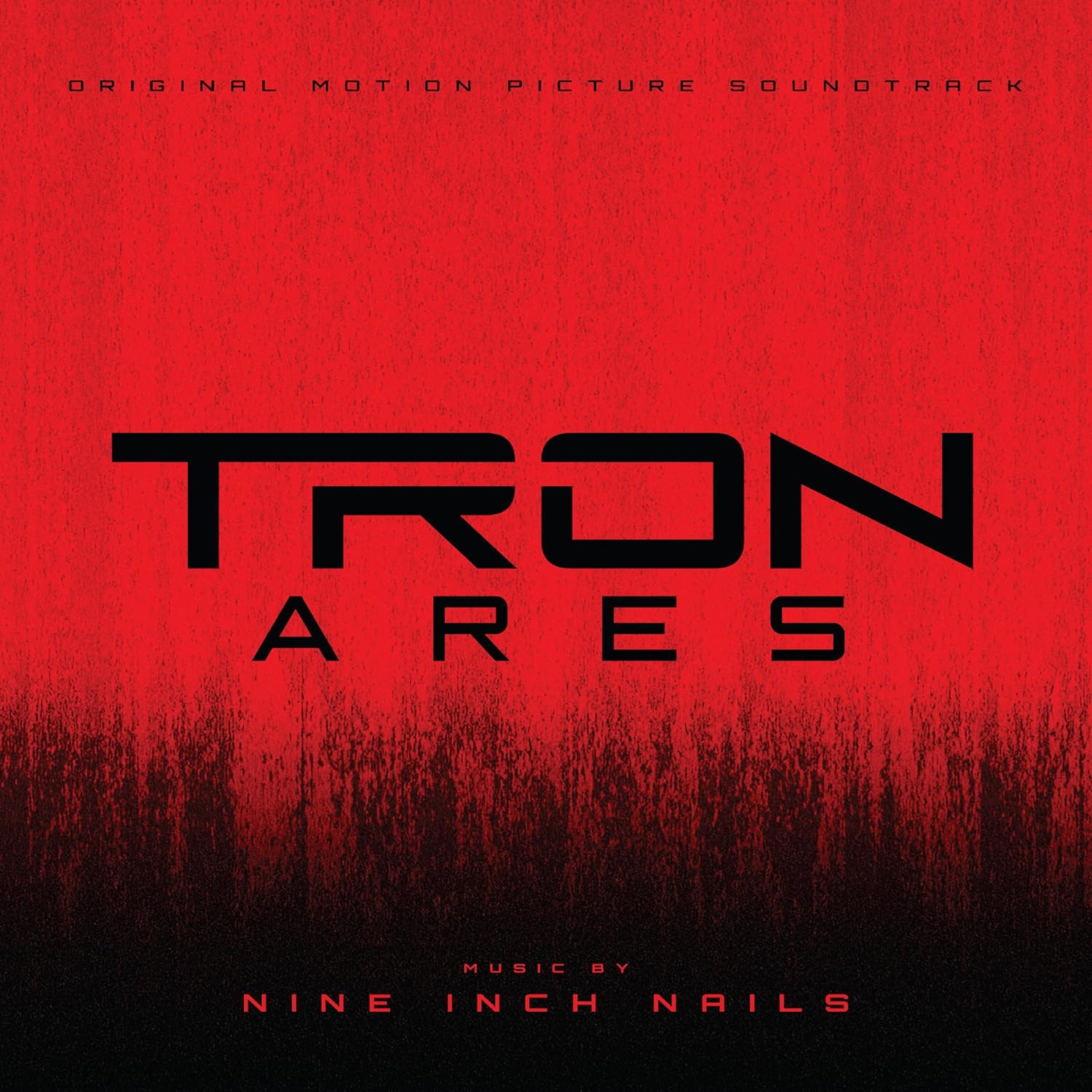
Switched On – Nine Inch Nails – TRON: Ares (Original Motion Picture Soundtrack) (Interscope)

by Ben Hogwood

What’s the story?

Anyone interested in the history of electronic music will know that being asked to score a TRON film is a rare badge of honour.

The previous two iterations in the series have been blessed with distinctive and influential series, from the Wendy Carlos original in 1982 or the Daft Punk soundtrack for 2010’s TRON: Legacy. The importance of the commission is shown in the fact that Trent Reznor and Atticus Ross have switched from their own ‘proper name’ branding to assume the familiar mantle of Nine Inch Nails, meaning TRON: Ares takes on extra significance.

As well as involving Reznor and Ross, Boys Noize and Hudson Mohawke add support as part of a high calibre production cast.

What’s the music like?

Both dated and futuristic, the TRON: Ares score is respectful to the past films in the series as well as being appropriately forward in its aims. The brooding synths throb and pulse in claustrophobic fashion, setting scenes of futuristic dread or an uneasy, present day calm.

At times it feels as though Nine Inch Nails are bringing forward the late 1990s’ penchant for dance-rock, with songs that Crystal Method or even Moby in his brief metal phase might have considered.

And yet the work through this substantial album tends to be more subtle, moving from ambient reflections of near emptiness (Echoes) to juggernauts with rousing choruses (As Alive As You Need Me To Be). On the way we get nods to the graceful synthesizers of Carlos in the original; also the dramatic, pumped-up orchestrations that Daft Punk used to such good effect in Legacy.

Does it all work?

Largely. On occasion the vocal gestures are too obvious yet surely fit the characterisation in the film. Otherwise the score reaches all the parts on headphones.

Is it recommended?

Yes, with conviction. Trent Reznor and Atticus Ross are seasoned film scorers, but don’t fall into the trap of recycling their ideas. TRON: Ares sounds every bit as futuristic as you would like, and its often-euphoric workings carry conviction in their full-bodied beats and bass. Even if you don’t see the film, make sure you hear the soundtrack.

Listen / Buy

You can explore purchase options for TRON: Ares at the Nine Inch Nails website

Published post no.2,722 – Tuesday 18 November 2025
Switched On – Alessandro Cortini: NATI INFINITI (Mute)

by Ben Hogwood

What’s the story?

Nine Inch NailsAlessandro Cortini has established himself as a solo musician and producer of some repute over the years, working alone on impressive electronic scores sich as 2021’s Scuro Chiaro or teaming up with Daniel Avery on 2020’s hugely impressive Illusion Of Time. His list of collaborations and remixes carries some weight, too, either under his own name or the pseudonyms of SONOIO, Blindoldfreak and Modwheelmood.

NATI INFINITI began life as an audio installation for the Museu de Lisboa’s Fábrica da Moagem, running across all four floors of the disused flour mill. To prepare it for this release, it was mixed and mastered by Marta Salogni, and structured into five movements.

Mute’s press release gives all the required detail. “The release utilises the Strega instrument that Cortini co-designed with Make Noise, capturing the ambience of the original piece – commissioned by Sónar Lisboa 2022 – where each of the four floors of the cavernous mill evoked a different state through Cortini’s sound design. Constantly unfolding as the listener travelled through the building, it harnesses the movement of the piece, highlighting the interconnectedness of all things.”

What’s the music like?

Cortini writes with a broad brush, the five tracks stretching over 40 minutes with slow, incremental changes in each.

At least, that’s how it appears on first listen – but further listening reveals more going on just beneath the surface.

The five scenes / movements are brooding, with II especially moody as the musical drones make an approach, gathering white noise, then retreating a little before returning. Here Cortini’s use of quarter tones gives the music a threatening edge, while on III there is a generation of more kinetic energy as the treble pitch wavers while progressing. IV takes on the spirit of an organ, as does V with its really sonorous bass notes – with close listening revealing all sorts of subtle crossrhythms at play as the wave forms bounce off each other.

Does it all work?

It does – and is most effective if all five movements are experienced without a break, in one sitting.

Is it recommended?

Yes. This is a very immersive piece of music, often calming but never retreating to the background, as Cortini gives his voice real stature and presence.

Listen & Buy

Published post no.2,340 – Wednesday 23 October 2024

Switched On: Alessandro Cortini: Scuro Chiaro (Mute)

alessandro-cortini

reviewed by Ben Hogwood

What’s the story?

A new album from Nine Inch Nails’ multi-instrumentalist Alessandro Cortini, Scuro Chiaro is a play on the word ‘chiaroscuro’, which means ‘the use of light and shadow to give strong contrast’.

As he did on previous solo opus Volume Massimo, Cortini has revisited old personal recordings for the building blocks for a new piece of work. Using these sounds and elements in a new context has enabled him to compose eight dramatic pieces using the contrast of the title to powerful effect.

What’s the music like?

Cortini’s music is compelling from the off, operating in long phrases that seem quite relaxed to start with, but actually build up a good deal of tension. This is heightened by the use of contrasting tones – some harsh distortion is involved, but that is complemented and often cushioned by soft synth pads. The long, sustained notes of Ecco set the scene over the steady heartbeat of a bass drum, after which Chiaroscuro itself stretches over a wide canvas, the music slowly shifting in a gorgeous chorale.

The pace of the album is refreshing, Cortini unwilling to put too much on the palette when the colours in place are already striking. Sempre is a great example of this, creating great tension with the slightest of pitch shifts that puts it in and out of harmony. Verde also has minimal roots, growing from primitive beginnings to a powerful whole, all the while using the same loop.

A few earlier influences creep into Cortini’s work, notably early Jean Michel Jarre in Lo Specchio, while the work of German pioneers of the 1970s are also visible at times. Yet this is music with a deeply personal resonance too.

Does it all work?

Yes. The colours Cortini uses are striking, and the structuring of his tracks is beautifully achieved. Not a note is wasted.

Is it recommended?

It is – an album of electronica with real conviction and depth. Scuro Chiaro is ambient music, but not without scenes of tension and drama.

Stream

Buy

Switched On – Daniel Avery & Alessandro Cortini: Illusion of Time (Phantasy)

reviewed by Ben Hogwood

What’s the story?

Daniel Avery and the Nine Inch Nails’ Alessandro Cortini began working together in 2017 with the remotely-achieved collaboration Sun Draw Water, a limited release whose promise hinted heavily at greater things to come.

They completed Illusion of Time a year later when both were touring with the Nine Inch Nails themselves. Since then Avery has delivered Drone Logic, one of 2018’s finest electronic albums, and Cortini has also excelled in a solo capacity with Volume Massimo, clearing the decks for the release of this 45-minute work.

What’s the music like?

Illusion of Time is all about atmosphere, and the ability to press pause on life itself, achieved through an often fascinating blend of analogue electronics and atmospherics. The description from the promotional material of ‘quietly powerful’ is very accurate, and is achieved without any use of drums or percussion.

While that implies much less emphasis on rhythm, Avery and Cortini use textures, pitch and slowly drawn out melodies to create considerable tension and release. The likes of Enter Exit, an expansive track on a bed of white noise, or the first track Sun, emerging through a crackle of white noise and atmospherics, embody this. They alternate slowly between pitches, with indistinct sounds passing across the stereo picture. The title track then gets a more definitive loop that oscillates at an easy pace.

Inside The Ruins is ominous, to these ears at least painting a picture of oppressive history within a decrepit building. It may stand still but there are dark shadows and unseen hazards at hand. By complete contrast, At First Sight has a wonderful depth to surround its soft-centred loop. This steady pulse is the closest Illusion of Time gets to percussion, the bass notes marking time beneath thick swirls of ambience and a piercing melody of otherworldly beauty.

Water, the longest piece of music, is literally a deep dive, dark hues of blue and purple coming to mind as the music gains wonderful depth. It runs seamlessly into Stills, a coda based on a single, warm chord with a foamy crescendo that sinks back to nothing.

Does it all work?

Yes. Time spent listening closely to this album brings the most rewards, for Avery and Cortini are masters of their craft, carefully selecting their blend of sounds to describe the unseen subject matter. Their music is ultimately calming, but with frissons of danger and darkness around the edges.

Is it recommended?

Yes. Illusion of Time is a fascinating meeting of minds, which ends up being the ideal collaboration in the sense that we end up with an equally divided – and united – musical approach. It may fall into the category of ‘ambient’, but with descriptive picture painting and ever-shifting sounds it has a great deal of depth too.

Stream

Buy