
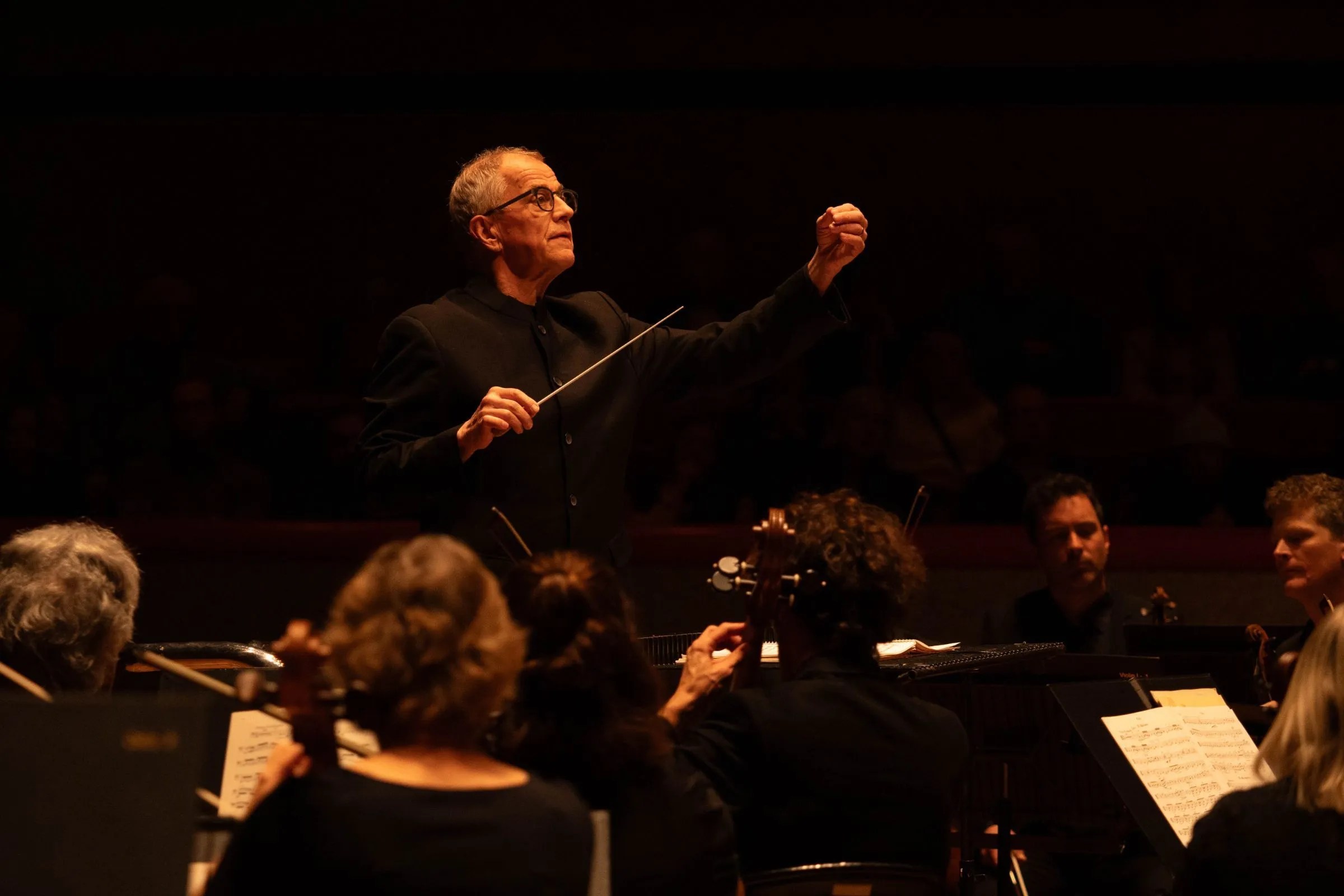
In concert – Helena Juntunen, CBSO / Osmo Vänskä: Sibelius & Shostakovich

Helena Juntunen (soprano), City of Birmingham Symphony Orchestra / Osmo Vänskä (above)

Sibelius
Karelia Suite Op.11 (1893)
Songs – Höstkväll Op.38/1 (1903, orch. 1904); Hertig Magnus Op.57/6 (1909, orch. 1912); Våren flyktar hastigt Op.13/4 (1891, orch. 1913)
The Bard Op.64 (1913)
Luonnotar Op.70 (1913)
Shostakovich
Symphony no.15 in A major Op.141 (1970-71)

Symphony Hall, Birmingham
Wednesday 19 November 2025

Reviewed by Richard Whitehouse Pictures (c) Jonathan Ferro

Finnish conductor Osmo Vänskä makes relatively UK appearances these days such that this evening’s concert with the City of Birmingham Symphony Orchestra was to be anticipated, given the never less than intriguing juxtaposition of works from Sibelius and Shostakovich.

It now appears less frequently on programmes than half a century ago, but Karelia Suite finds Sibelius at his most uninhibited and Vänskä responded accordingly – whether the simmering motion of its Intermezzo or the pulsating activity of its Alla Marcia; its Ballade distilling the keenest atmosphere with Rachel Pankhurst making the most of her plaintive solo. Harpist Karherine Thomas was similarly attuned to her almost obligato role in The Bard, a tone poem whose sombre understatement hardly prepares one for the surging emotion towards its climax.
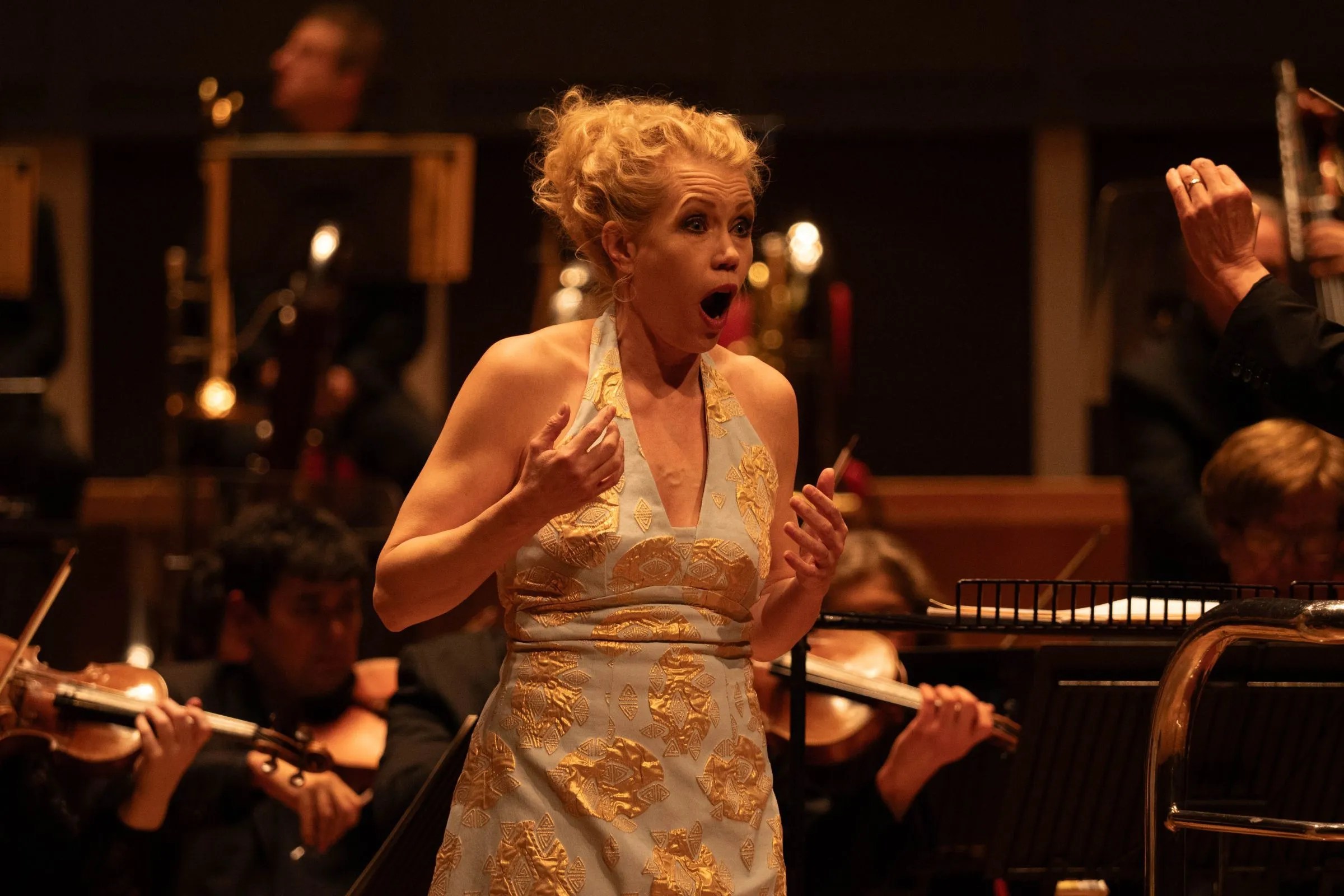
Elsewhere in this half it was Helena Juntunen (above) who stole the show with her judicious selection of Sibelius songs. That almost all these are settings of Swedish texts reflects an introspective Romanticism often overlooked in his output and Juntunen brought out the stark imagining of Autumn Evening then restless aspiration of Baron Magnus as potently as the ecstatic yearning of Spring is Flying. Her swapping sophisticated gown for traditional dress may have pointed up stylistic differences with Luonnotar, but it also underlined the inimitability of this setting from Finnish national epic the Kalevala. Birmingham audiences had been spoiled by hearing Anu Komsi in the piece, but Juntunen was no less inside music whose extremes of timbre or texture result in as heady a culmination then as spellbinding a conclusion as any in Sibelius.

Hard now to recall a time when Shostakovich’s 15th Symphony was believed too inscrutable for wider appreciation, rather than that masterly reassessment of Classical symphonism it is. Vänskä brooked no compromise in an initial Allegretto not without its technical mishaps, for all its sardonic and even scabrous humour came over unimpeded, but it was with the Adagio this performance wholly found its stride. As enhanced by eloquent contributions from cellist Eduardo Vassallo then trombonist Richard Watkin, this was palpably well sustained through to a climax shot through with a defiance borne of desperation, before retreating back into its initial numbness. Continuing directly, the ensuing Allegretto was an intermezzo no less acute in its expression and not least for the way solo instruments melded so deftly with percussion.

Vänskä did not make the mistake of rendering the finale an Adagio, such as holds good only with its portentous introduction. The main Allegretto was persuasively handled – broadening marginally for a central passacaglia builds stealthily if inevitably to a climax corrosive in its dissonance, before retracing its thematic steps towards a coda which evokes the notion of the ‘unbearable lightness of being’ more completely than any other music. Here, also, there was no mistaking the CBSO’s collective focus in bringing this totemic work to its deathless close.

Shostakovich 15 does not lack for probing or memorable readings these days and, if tonight’s did not answer all its questions, Vänskä nevertheless ensured this piece left its mark on what was a commendably full house, and which set the seal on a flawed while memorable concert.

For more information on the 2025-26 season head to the City of Birmingham Symphony Orchestra website. Click on the names to read more about soloist Helena Juntunen and conductor Osmo Vänskä

Published post no.2,727 – Sunday 23 November 2025
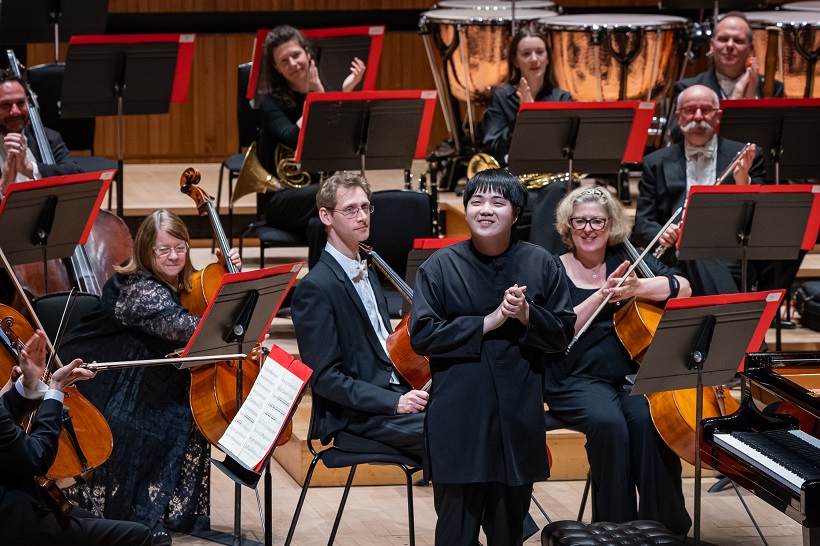
In concert – Mao Fujita, Philharmonia Orchestra / Osmo Vänskä: Missy Mazoli, Mozart & Mendelssohn

Mao Fujita (piano), Philharmonia Orchestra / Osmo Vänskä

Missy Mazzoli These Worlds In Us (2006)
Mozart Piano Concerto no.25 in C major K503 (1786)
Mendelssohn Symphony no.5 in D minor Op.107, ‘Reformation’ (1830)

Royal Festival Hall, London
Thursday 20 March 2025

Reviewed by Ben Hogwood Picture (c) Marc Gascoigne

Japanese pianist Mao Fujita has shown his impressive Mozart credentials in highly praised recordings of the composer’s complete piano sonatas. More recently his focus has shifted to the piano concertos.

Here he was partnered by the Philharmonia Orchestra and the visiting Osmo Vänskä in the substantial Piano Concerto no.25 in C major K503, a ceremonial work with fulsome orchestral accompaniment. Yet less is often more in Mozart performance, and that was certainly the case with Fujita as his fingers spun a magical web of notes. The piano’s magical first entry, after the pomp and circumstance of the introduction, was notable for its lightness of touch, Fujita listening closely to the Philharmonia wind players.

With so much to enjoy in this performance, Fujita exuded technical brilliance but also commendable restraint, always with affectionate shaping of the melodic line. That is, until the unattributed first movement cadenza. Here the rulebook was torn asunder, and a flow of unpredictable counterpoint broke loose, revealing links back to Bach but notably forward towards Beethoven.

Back under control, Fujita made the piano sing in the operatic slow movement, aided again by the quality of the wind section under Vänskä, who secured typically detailed, transparent clarity. The first violins began the finale with their touch as light as a feather, after which Fujita put the pedal to the metal once again, taking great pleasure in Mozart’s sparky dialogue with the orchestra. His encore, the first movement of Mozart’s Piano Sonata in C major K545, featured a delightful ‘wrong’ chord near the end, affectionately given and rounding off a truly memorable performance.

Prior to this we heard Missy Mazzoli’s These Worlds In Us, dedicated to her father, who was a soldier in the Vietnam War. Her imaginative orchestration extended to the use of wheezy melodicas in the outer section, adding a dreaminess and heightening the link with the music of Bali. The sighing violin theme was profound, but most telling of all was the soft rat-a-tat of the snare drum, a quiet but ominous reminder of war amidst the otherwise bright scoring. Mazzoli’s music has deeply human qualities that came alive in this performance.

For the second half, Vänskä led a dramatic account of Mendelssohn’s Symphony no.5, the Reformation. Second in order of composition, it was the last of his symphonies to be properly published, on account of its troublesome reception in 1832. In more recent years however the work has enjoyed greater exposure, rewarding its portrayal of triumph in turbulent times.

The magical hush from the strings of the Dresden Amen, quoted by the composer in the first movement, drew the audience in before Vänskä powered through a turbulent Allegro. The second movement danced like a late Haydn minuet, brisk and with a charming trio, while the Andante looked inwards, initially beyond comfort but ultimately softening to the touch. Mendelssohn’s quotation of the Lutheran chorale Ein feste Burg came to the rescue, sweetly intoned by flautist Samuel Coles, before the orchestra enjoyed Mendelssohn’s exuberant finale, and its parallels to Handel’s Messiah. As is his wont, Vänskä revealed previously hidden orchestral detail, giving a fully convincing account of a symphony whose cumulative power is all the more remarkable given Mendelssohn was 21 at the time of composition. Youth and experience were ideal foils here.

For details on the their 2024-25 season, head to the Philharmonia Orchestra website

Published post no.2,481 – Saturday 22 March 2025

On Record: Sueye Park, Seoul Philharmonic Orchestra / Osmo Vänskä – Isang Yun: Violin Concerto III, Chamber Symphony I & Silla

Isang Yun
Silla (1992)
Violin Concerto III (1992)
Chamber Symphony I (1987)

Sueye Park (violin), Seoul Philharmonic Orchestra / Osmo Vänskä

BIS 2642SACD [67’13″]

Producer Robert Stiff Engineer Jin Choi

Recorded 30 August-3 September 2021, Lotte Concert Hall, Seoul, South Korea

Reviewed by Richard Whitehouse

What’s the story?

BIS makes a notable contribution to the growing Isang Yun discography with a judiciously chosen collection of orchestral pieces from his last years, performed with commitment and insight by the Seoul Philharmonic Orchestra under its recently departed music director Osmo Vänskä.

What’s the music like?

Most famous for his fractious relationship with the then military dictatorship of South Korea, Yun (1917-95) resided mainly in West Berlin from 1964 and built a sizable catalogue which effected a far-reaching synthesis of European modernist techniques with traditional Korean elements. At the forefront of the Western avant-garde during the 1960s, he latterly embraced more traditional genres – composing numerous symphonies, concertos and ensemble works such as extend and enrich this synthesis with engaging while frequently provocative results.

The First Chamber Symphony premiered in Güttersloh by the Deutsche Kammerphilharmonie Bremen and scored for early-Classical forces with pairs of oboes and horns alongside strings. Its three continuous sections outline an expected fast-slow-fast format – offset by the interplay of string groupings in the first section, then the emphasis on solo or chamber formations and contrasts of motion in those that follow. The final section moves towards a sustained passage of exquisite poise, before a sudden upsurge concludes the whole piece with terse decisiveness.

Premiered in Amsterdam by Vera Beths, the Third Violin Concerto follows a similar formal trajectory whose continuity is largely determined by greater or lesser contrasts in motion and emotion between its constituent episodes. Those of the opening section build to an intensive central climax, subsiding into a restive calm which takes on greater serenity in its successor; before the final section unfolds impulsively and with martial undertones towards the closing series of exchanges between violin and orchestra: the soloist has the conciliatory last word.

Subtitled ‘Legend for Orchestra’, Silla was Yun’s final such piece and premiered in Hanover by the Niedersächsisches Staatsorchester. Its title evokes connotations of home and origin – not least Korean court music from the earlier Medieval era, here alluded to within a context of nocturnal celebration. There are again three sections, though here the follow-through feels all but seamless while the orchestration enables a wide range of timbral and textural nuances – not least in a peroration as suggests an affirmation (understandably) rare in this composer.

Does it all work?

It does. Many of Yun’s latter works evince sufficient connections with the Western classical music of earlier eras to be accessible for mainstream audiences, with the pieces here being no exception. Sueye Park is assured and insightful in the concerto, while Vänskä secures playing that emphasizes the allure and iridescence of Yun’s orchestral writing. Over a quarter-century after the composer’s death and his music remains on the periphery of the modern repertoire, but releases such as this will secure it greater advocacy from younger musicians and listeners.

Is it recommended?

Very much so. The recording is as commendable in its clarity and definition as expected from BIS, as are Walter-Wolfgang Sparrer’s notes. One can only hope a follow-up release, perhaps featuring Konturen, the Oboe Concerto and the Second Chamber Symphony, is forthcoming.

Listen & Buy

For buying options, and to listen to clips from the album, visit the BIS website. For more information on Isang Yun, visit the Isang Yun International Society, and for more on the artists click on the names Sueye Park, Osmo Vänskä and the Seoul Philharmonic Orchestra.