
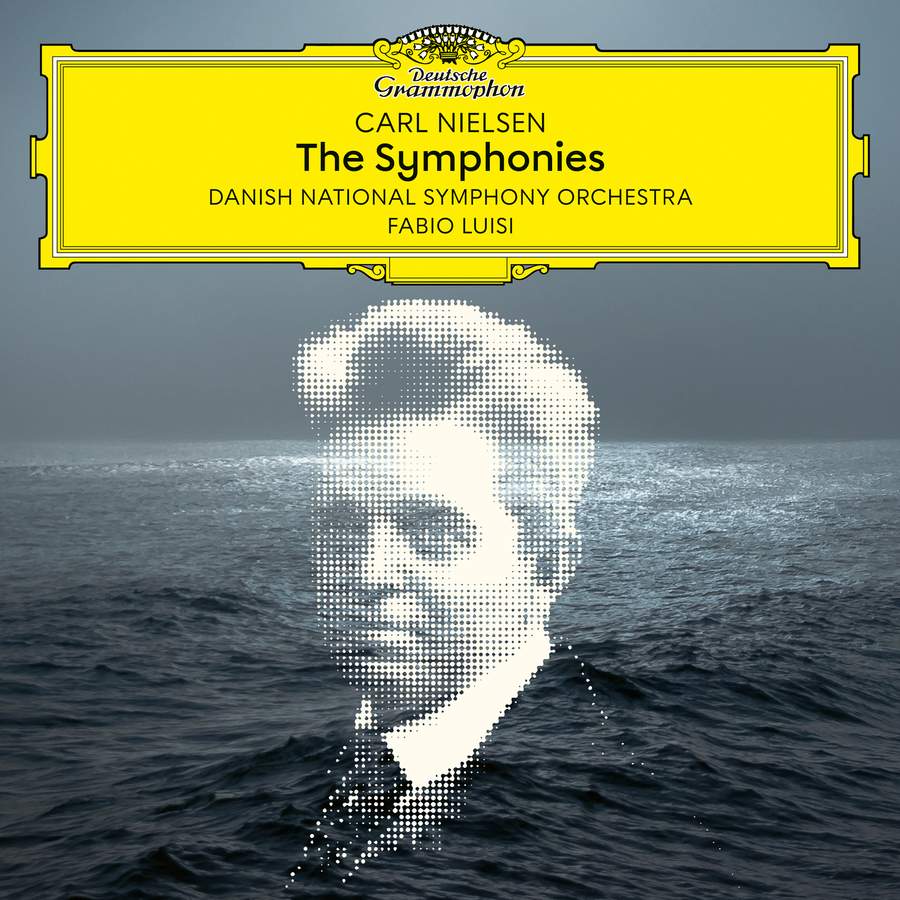
Danish National Symphony Orchestra / Fabio Luisi with Fatma Said (soprano), Palle Knudsen (baritone) (Symphony no.3)
Nielsen
Symphonies: no.1 in G minor FS16a; no.2 FS29 ‘The Four Temperaments’b
no.3 FS60 ‘Sinfonia espansiva’c; no.4 FS76 ‘The Inextinguishable’d; no.5 FS97e; no.6 FS116 ‘Sinfonia semplice’f
Deutsche Grammophon 4863471 [3 hours 36 minutes]
Producer Bernhard Güttler; Engineers Mikkel Nymand, Christoph Stickel
Recorded in live performances at Koncertsalen, DR Koncerthuset, Copenhagen: 1 February (no.4), 3 February (no.2), 3 June (no.6), 17 June (no.1), 26 November (no.3), 28 November (no.5)
Written by Richard Whitehouse
What’s the story?
Deutsche Grammophon continues its latest generation of symphonic cycles (following those first-time traversals of Franz Schmidt and Charles Ives) with that from Carl Nielsen, performed by the Danish National Symphony Orchestra and its incumbent principal conductor Fabio Luisi.
Almost 50 years after the first integral recording of these symphonies (Ole Schmidt with the London Symphony Orchestra on Unicorn/Alto), there are at least 20 such cycles available so that any newcomer needs to bring a fresh perspective on Nielsen’s always distinctive though increasingly unpredictable fusion of innovation with tradition. This pairing of orchestra and conductor is intriguing insofar that the DNSO has been associated with these works from the outset, while Luisi is a musician of broad sympathies with cycles of symphonies by Schmidt (Querstand) and Schumann (Orfeo) plus an incomplete one of tone poems by Strauss (Sony). The result is a Nielsen cycle at times impressive in its conviction if at others dismaying in its inconsistency, and not always in those works or for those reasons one might have expected.
What’s the music like?
Luisi makes his intentions plain at the start of the First Symphony, its initial Allegro launched via an emphatic C major whose impetus is sustained through an impetuous development, with a remorseless acceleration into the implacable coda. Even finer is an Andante by turns elegant and eloquent, strings coming into their own, while only a marginal hesitancy as to the elision between scherzo and intermezzo affects its successor’s stealthy progress. Taut if not inflexible, the final Allegro has innate buoyancy capped with the uninhibited verve generated at its close.
If the Second Symphony is less successful, this is because Luisi does not transcend its status as a symphonic suite. The ‘choleric’ element of the opening Allegro verges on the histrionic, with the humour of the following intermezzo deadpan rather than ‘phlegmatic’. The Andante, though, is superbly sustained over its airily pastoral interlude towards an intensified recall of its ‘melancholic’ opening and coda of fatalistic poise. The ‘sanguine’ trait of the final Allegro is deftly undercut by musing uncertainty, but this yields a slightly tepid resolution in its coda.
Nothing comparable affects the Third Symphony, the ‘expansiveness’ of its opening Allegro abetted by visceral drive in its outer paragraphs and nuanced subtlety in its more speculative passages. The Andante’s interplay of the pastoral and emotional sees a rapturous apotheosis, soprano and baritone vocalises beguilingly intertwined, then the scherzo generates no mean energy prior to its restive ending. Luisi’s steady overall tempo for the final Allegro avoids sluggishness, and not least a coda the more conclusive for its eschewal of wanton triumph.
Despite a properly blazing start to the Fourth Symphony, its opening Allegro emerges as no more than the sum of some admittedly fine parts, with the charm of the ensuing intermezzo just a little too ‘knowing’. The highlight here is a slow movement of real fervency, its dense textures clearly articulated and a transition of simmering intensity into the finale’s headlong fugato on strings. Tension here is ably maintained, but Luisi’s holding back in its peroration replaces that striving onwards Nielsen surely intended with a more generalized affirmation.
This take on the Fifth Symphony is very much a tale of two parts. Luisi audibly locates the ‘tempo giusto’ for the first movement’s opening half – its increasingly ominous expectancy fulfilled in an Adagio of great pathos, albeit with a side-drum cadenza overly reined-in both texturally and emotionally. Too stolid a tempo for the second movement’s initial Allegro is exacerbated by its inhibited Presto, and though Luisi renders its Andante with compassion, his broadening towards the close of the final Allegro is too self-conscious to be convincing.
Is it surprising that the Sixth Symphony rounds off this cycle so perceptively? The complex array of emotions found in its opening movement yields the right ‘innocence to experience’ trajectory, with both the sardonic humour of its Humoreske and the fractured eloquence of its Proposta seria palpably conveyed. Above all, the finale’s outwardly fractious variations unfold with a seamlessness and an inevitability that makes of the coda a culmination whose outcome is held in check until the last bar. A still disputed masterpiece is hereby vindicated.
Does it all work?
Swings and roundabouts. There could be no doubt as to the seriousness with which Luisi has taken on this project, nor of the overall excellence of the DNSO’s playing. Where this cycle falls down is in a lack of focus across the whole, to the extent that there could have been two or even three conductors involved here. Moreover the orchestral sound, warm and immediate but often lacking definition or a consistent balance, feels appreciably different from what this ensemble produces in its home venue – leading one to suspect a modicum of post-production.
For CD adherents the fold-out triple pack is eminently stylish and straightforward, while Jens Cornelius’ note sets the scene adequately enough. The cycle is also available as three separate couplings of Nos. 4 and 5, Nos. 2 and 6 then Nos. 1 and 3 – with the three concertos to follow.
Is it recommended?
Yes, with qualifications. Prospective purchasers are advised to sample the cycle via streaming then proceed accordingly. Certainly, the Third and Sixth Symphonies rank with the finest now available, and listeners should form their own judgement as to the merits of this cycle overall.
Listen
Purchase
To explore purchasing options and hear clips from the recordings, visit the Deutsche Grammophon website. For more on the artists, click on the links to read more about Fatma Said, Palle Knudsen, the Danish National Symphony Orchestra and conductor Fabio Luisi
 Arcana.fm