Recorded 17-19 April 2024 at St Silas’ Church, Kentish Town, London
Reviewed by Richard Whitehouse
What’s the story?
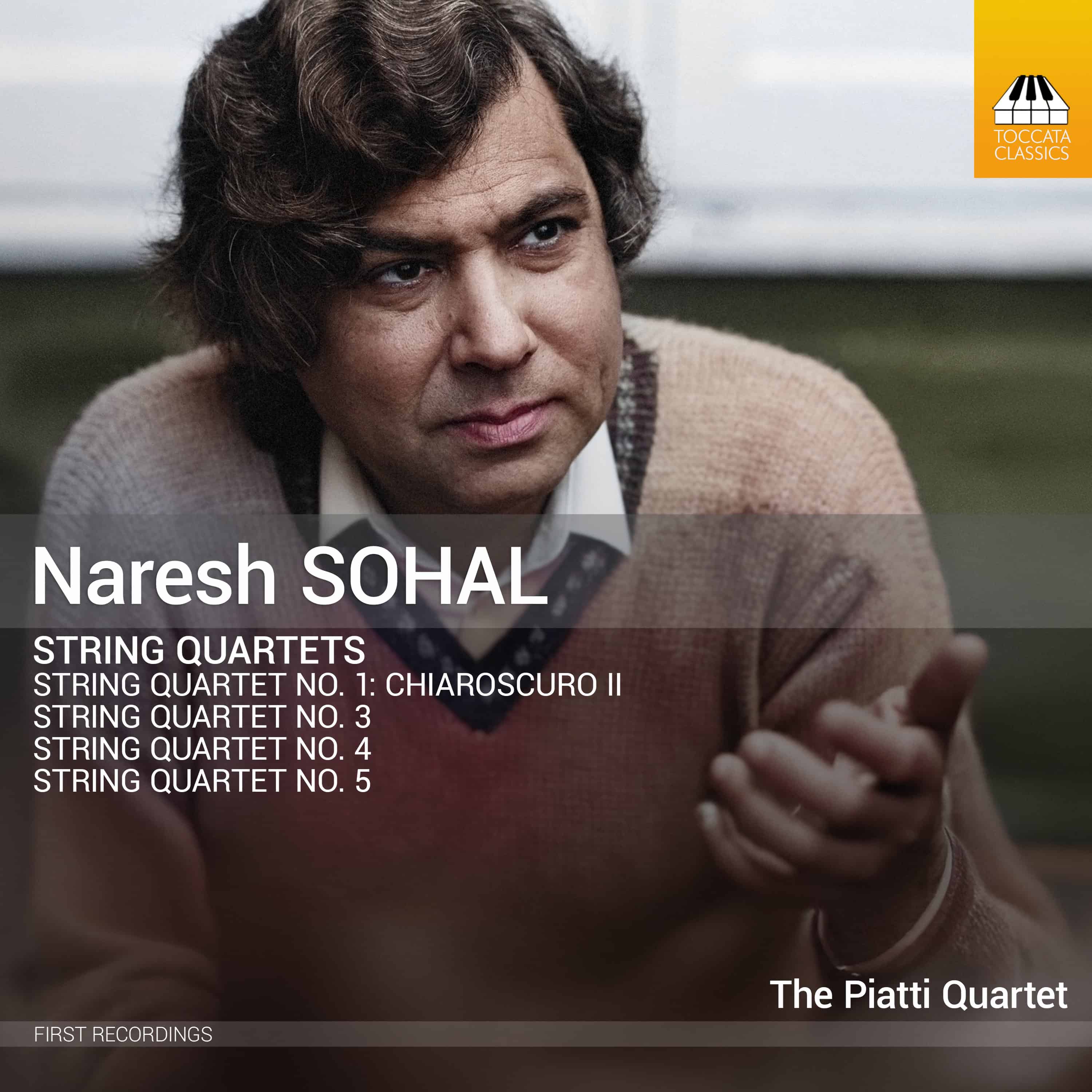
Toccata Classics continues its exploration of Naresh Sohal (1939-2018) with this release of four of his string quartets, admirably rendered by the Piatti Quartet to make an illuminating overview of Sohal’s musical language from across the greater part of his composing career.
What’s the music like?
Although he attracted most attention in his lifetime for his often expansive orchestral works, Sohal wrote widely for chamber media and not least string quartet. This medium brought his intended amalgam of Indian and European facets into acute focus though, typical of one who from the start approached the Western Tradition head on, there is nothing anecdotal let alone tokenistic about Sohal’s idiom which, as these quartets amply confirm, is unified stylistically and remains consistent as it heads toward the formal and expressive clarity of his final pieces.
At the time of his first quartet, Chiaroscuro II (its predecessor for brass quintet is on Heritage HTGCD122-3 – review to follow), Sohal was exploring an overtly avant-garde idiom evident through diverse and starkly contrasted techniques given focus by climactic cadenzas on cello then first violin – prior to its final evanescing into silence. Likewise in a single movement of 15 minutes, the Third Quartet could not be more different in aesthetic. Initially heard against an insistent drone from second violin and viola, its ideas emerge as demonstrable variants on what went before such that its animated central section then its inward continuation are made part of an indivisible process. This only makes those over-emphatic closing chords the more jarring, as though the work’s ultimate resolution had to be stated rather than just insinuated.
The remaining works, both with three movements and each lasting around 20 minutes, might be thought even closer to tradition yet, as so often with Sohal, matters are never this concrete. Thus the Fourth Quartet’s initial movement alternates its impetuous and ruminative themes to purposeful effect, then its central Moderato balances eloquence and introspection with a poise as makes this the likely highlight of the album; the final Allegro channelling motifs previously heard towards its satisfying denouement. The Fifth Quartet manipulates form and expression even more deftly, the Allegretto’s incisive yet never unyielding rhythmic verve duly matched by the Adagio’s melodic richness or the final Allegro’s contrapuntal dexterity on the way to a decisive close. Both of these pieces abound in quartet writing as unaffected as it is masterful.
Does it all work?
Indeed it does. Whether conceived as a single span or separate movements, the musical range of these pieces is a constant source of fascination. Even more surprising is that the Fourth and Fifth Quartets are only now receiving their first hearing, but it would be hard to imagine more committed advocacy than from the Piatti Quartet, which has taken this music to its collective heart. Hopefully these pieces will now find greater exposure in recital, as the importance of Sohal’s legacy becomes evident and its relevance to the present more widely acknowledged.
Is it recommended?
Indeed it is. Sound is almost ideal, while Utsyo Charraborty’s overview is complemented by a biographical note from Suddhaseel Sen and Janet Swinney. Hopefully the Second Quartet and the brief Awakening (soprano and string quartet) feature on a further release from this source.
Piatti Quartet [Michael Trainor and Emily Holland (violins), Miguel Sobrinha (viola), Jessie Ann Richardson (cello)]
RTF Classical / Nimbus Alliance NI 6452 [55’57”] Producer and Engineer Raphaël Mouterde
Recorded 14 December 2023 at All Saints’, East Finchley, London (String Quartet no.2), 25 April 2024 (String Quartet no.3), 20 June 2024 (String Quartet no.4), St Silas, Kentish Town, London
Reviewed by Richard Whitehouse
What’s the story?
Joseph Phibbs builds upon a growing discography with this release of his latter three string quartets, played by the Piatti Quartet that has already recorded his First Quartet, in what is a notable addition to the RTF Classical label administered by the Richard Thomas Foundation.
What’s the music like?
Having reached his half-century earlier this year, Phibbs can look back on a substantial output such as covers all the major genres. Two shorter works – Agea (2007) and Quartettino (2012) – precede his designated First Quartet (2014), a varied and assured five-movement sequence that was written for and premiered then recorded by the Piatti Quartet as part of its collection Albion Refracted (Champs Hill Records CHRCD145). The ensemble’s collaboration with this composer here continues with a volume that further consolidates his standing in the medium.
Written for and dedicated to the Navarra Quartet, the Second Quartet opens with what Phibbs designates a nocturne – albeit a Presto and with scurrying figuration that persists through to a brief passage of repose. It is countered with a scherzo both edgy and volatile, followed by an Interlude whose Chitarra designation indicates the pizzicato strumming that brings a climax of some velocity. Its subsiding into relative stasis presages a final Lento whose lyrical violin theme evolves toward a culmination which is the more conclusive through its sheer fervency.
Written for the Belcea Quartet and dedicated to the memory of composer Steven Stucky, the Third Quartet starts with a sizable movement whose inward introduction and coda frame an Allegro varied and unpredictable in its content but given focus by an eloquent theme prior to its eventual climax. Next is a fugal Presto – a coursing scherzo to complement the capricious intermezzo of a Corrente and, in between, a freely evolving Notturno whose pensiveness manner finds resolution through a finale of an introspection dispelled by its animated coda. Written for the Piatti Quartet and dedicated to the philanthropist Richard Thomas, the Fourth Quartet is again cast in five movements. Here, however, the trajectory seems overtly fluid as this heads from the impetuous Film Sequence, via an atmospheric Notturno then a gently elegiac Cantilena and an incisive Burlesque, to the final Passacaglia. Much the longest movement, this is centred on an extended soliloquy for cello which does not so much refer to earlier ideas as draw the ensemble into a cohesive texture sustained through to the rapt close.
Does it all work?
Pretty much always. Phibbs is a resourceful while often imaginative writer for string quartet, his music demonstrably in the lineage of 20th-century totems such as Bartók or Shostakovich (with a nod toward Britten), without being beholden to these or any other precedents. It helps when the Piatti Quartet, whose own discography features notable releases of Mark-Anthony Turnage (Delphian DCD34254) and Ina Boyle (Rubicon RCD1098), sounds so well attuned to his idiom and has evidently prepared each one of these works with unfailing commitment.
Is it recommended?
Very much so. Sound has the requisite clarity and definition if a little lacking in warmth, and Phibbs contributes informative notes. Readers should investigate further releases on the RTF Classical imprint, which is building into a valuable anthology of contemporary British music.
words from the press release, adapted for publication by Ben Hogwood
The Piatti Quartet releases a new album of Quartets Nos. 2-4 by British composer Joseph Phibbs, “one of the most successful composers of his generation” (BBC Music Magazine).
The Quartet and Phibbs have maintained a close relationship that stretches back several years. Since its joint second prize and Sydney Griller Award at the 2015 Wigmore Hall International String Quartet Competition, the Piatti Quartet has established a high reputation, particularly in the contemporary repertoire. They have recorded and performed Phibbs’ String Quartet no.1 almost 50 times.
Joseph (above) says:
“Having studied the cello as a child, I have always felt a special affinity with string music. My introduction at the age of 14 to the music of Britten was through his first string quartet, the opening of which still fills me with awe, and his works – especially those for strings – have remained a lifelong inspiration. After the first commission, the Piatti’s enthusiasm encouraged me to continue exploring the genre, and – a decade later – it has been both a privilege and a huge pleasure to have another opportunity to write for them (String Quartet No.4). Much of my music is inspired by light and landscapes (as well as cityscapes). When considering which images would best sum up the overall feel of the album, light – both natural and artificial – as seen within a landscape, seemed the most fitting choice.”
As a composer, Phibbs’ main influences are Lutoslawski, Britten and his former teacher Steven Stucky. Over recent years, he has been primarily exploring melody, forging his way using modal, diatonic and triadic harmonies.
Phibbs’s opera Juliana premiered in 2018 showed “a strong sense of continuity with the past – not least in the markedly post-Britten soundworld” (BBC Music Magazine). The Guardian added, “Juliana is that rare thing nowadays, a genuinely well-made, effective new opera that achieves exactly what it sets out to do.”
You can listen to excerpts from this album at the Presto website
Meet Emily Howard, the featured composer at this year’s Aldeburgh Festival. We will hear four works from her impressive canon – a new orchestral piece, sphere, receiving its UK premiere together with Magnetite in a program from the BBC National Orchestra of Wales and Mark Wigglesworth. This concert comes a day after Afference, her string quartet, which will be played by the Piatti Quartet.
Her biggest work to date, however, is a new opera, To See The Invisible. Developed with writer Selma Dimitrijevic and director Dan Ayling, it will receive three performances at the head of the festival. Arcana was able to chat with Emily to get her thoughts on the new pieces. As is traditional, however, I began by asking for her earliest recollections of classical music.
“I was lucky that it was always around me since I was young,” she recalls. “My dad, a medic, also played the cello. I was brought up in the Wirral, near Liverpool, and I remember going to see the Liverpool Mozart Orchestra, and really loving it. I was taken to operas as well, and because my mum is a pianist too, I was around music all the time.”
Howard began learning her music in a traditional route, but soon realised composition was the discipline for her. “When I was really young I started learning the cello. I was never so good at very regular and disciplined practice – even then I was always more interested in exploring new sounds and tones. Composing came naturally in that way, at the age of eight or nine years old, and what I really wanted to do was write a piece for orchestra. I made a piece for the cello, and transcribed for orchestra. I wrote it all out and the composer/conductor Guy Woolfenden, who was a great influence, was really kind and got the orchestra to play it through!
Fast forward to 2016, when Emily’s Torus (Concerto for Orchestra) enjoyed its world premiere at the BBC Proms in 2016, her ‘home’ orchestra conducted by Vasily Petrenko. It made a strong impression on those present (including yours truly). She declares herself “really pleased, overwhelmed” with the reaction. “The piece has won a British Composer Award since then, too. You can’t tell necessarily how these things are going to go but I was absolutely delighted!”
To See The Invisible is her biggest work to date, and she considers the challenges in writing such a substantial piece for the stage. “It lasts about eighty minutes in total. To be honest I have no idea how I managed to write something that long, but I suppose you’ve got the narrative and texts, which have helped to extend it to a length similar to that of Mahler’s Third Symphony. I had worked with Selma before on Zátopek!, a mini-opera I completed several years ago. We have been talking ever since, and with our director Dan Ayling, the approach has been truly collaborative, making it a very exciting and enjoyable experience. Composing abstract music is not a sociable activity necessarily, and I have found that throughout the opera process, it really helps when you share ideas with your creative partners, and take on board their viewpoints, often very different. Collaboration is a wonderful thing, and it does change you.”
The opera takes its inspiration from a short science fiction story by Robert Silverberg. “For ages Selma and I had been talking about writing an opera based on the experience of a person who is shunned by a society. The central character would be ignored, rather like being sent to Coventry. While Selma was writing the libretto, her brother said about the Silverberg story in which a character is sentenced to a ‘Year of Invisibility’ for ‘a crime of coldness’. It turned out that Selma had been partially remembering the story and we read it and the opera became an adaption. We were really knocked out by the Silverberg.”
She describes the setting in more detail. “It is a sort of musical deuce, where this person is somehow different, and the story plays on the isolation of people who do not fit the system and are excluded from society. Therefore I wanted The Invisible, the opera’s protagonist, to be vocally distinct from the other characters and I chose for them to be represented by baritone and soprano voice simultaneously, particularly in the character’s private moments.” The singers are required to have great flexibility and dexterity here. “The soprano and baritone have really wide ranges, together they are a meta-voice portraying an emotional journey, with the baritone often a lot higher than the soprano.”
Musically, the opera is about collisions between The Invisible’s world and the World of Warmth. “I have intentionally set up contrasting sound worlds with The Invisible’s language consisting of musical extremes, ranging from ethereal to anguished. The World of Warmth is much more traditional and tempered in feel.” The opera looks beneath the surface of these different worlds. “With the World of Warmth, we are all asking is this really the world of warmth?”
One of the many intriguing elements of Howard’s work is its fascination with the relationship between music and mathematics. This is perhaps best captured in a recent work, The Music of Proof.
A collaboration with mathematician Marcus du Sautoy, it began while Howard was writing another – Torus (Concerto for Orchestra) – itself a musical work influenced by mathematics. “I met Marcus through a friend when I was writing Torus, and we had a coffee at the Royal Albert Hall. We really connected about the piece, and about the doughnut shape of the hall’s construction. He immediately said the Royal Albert Hall is torus-shaped (shaped like a doughnut), and since then we have been meeting and working together on various projects.”
“We presented The Music of Proof at New Scientist Live in 2017, featuring a newly composed work entitled Four Musical Proofs and a Conjecture premiered by the Piatti Quartet, five miniatures for string quartet. Each miniature is related to a different style of mathematical proof and in order to compose them, I had asked myself the question “What if I approach writing music as though I am proceeding with the construction of a mathematical proof?” This was a completely different way of working for me and certainly helped me to brush up on some mathematical proofs I had all but forgotten! In the show, Marcus explains the proof, and I explain what I did in response – I have found very different ways to translate aspects of these proofs into music, and then you get to hear the music. We’ve recently repeated the show in Sheffield at Music in the Round.”
The success of the collaboration has filtered through to Howard’s tuition work at the Royal Northern College of Music. “At the RNCM, we have started PRiSM (which stands for Centre for Practice & Research in Science & Music), and we are encouraging collaborations between music students, scientists and mathematicians. I feel that there are real links to be explored: for me both music and maths are about pattern-making.”
“As a composition student, I had wanted to take ideas from mathematics and science and create musical shapes with them, and to begin with I found this difficult. As my musical craft has grown, I feel as though I’ve become more successful at translating ideas from mathematics into musical ideas on which to base my work. For instance, when I created Torus, I imagined I was on the surface of the shape, travelling around and around in one direction, and encountering different landscapes as I went. Around 14 minutes into the work, there is a significant shift and a complete change of musical soundworld, and this is where I had instead imagined a rotation in the other direction. So considering mathematical shapes in this way does help me to define musical shapes and structure in my compositions.”
Returning to the Aldeburgh Festival, Afference – completed in 2014 – represents a significant foray into chamber music. “That was a very difficult piece to write”, she admits. “I had written several orchestral pieces and I really wanted to write some chamber music. I spent ages on it and it’s helped me a lot to write that piece. Perhaps with chamber music in general and certainly with this work, everything feels much sparser and I find that every note, every gesture has a poignant significance. The Piatti Quartet are playing it at the festival, and it will be very interesting to hear them perform another of my works – they’re such fantastic players. They’ve put in an incredible amount of work on the piece.”
Howard is naturally delighted to be given such a prominent role in this year’s festival. “It’s an honour, I’m really proud of being Composer In Residence, alongside esteemed colleagues such as Sir Harrison Birtwistle, Simon Holt, and of course it’s Benjamin Britten’s festival. It’s a wonderful festival and a magical place – especially for opera. In fact we developed To See The Invisible in Aldeburgh, so the piece has grown up there!”
For more information on Emily Howard, visit the composer’s website



 Arcana.fm