In concert – Quatuor Danel: Shostakovich & Weinberg #11 @ Wigmore Hall

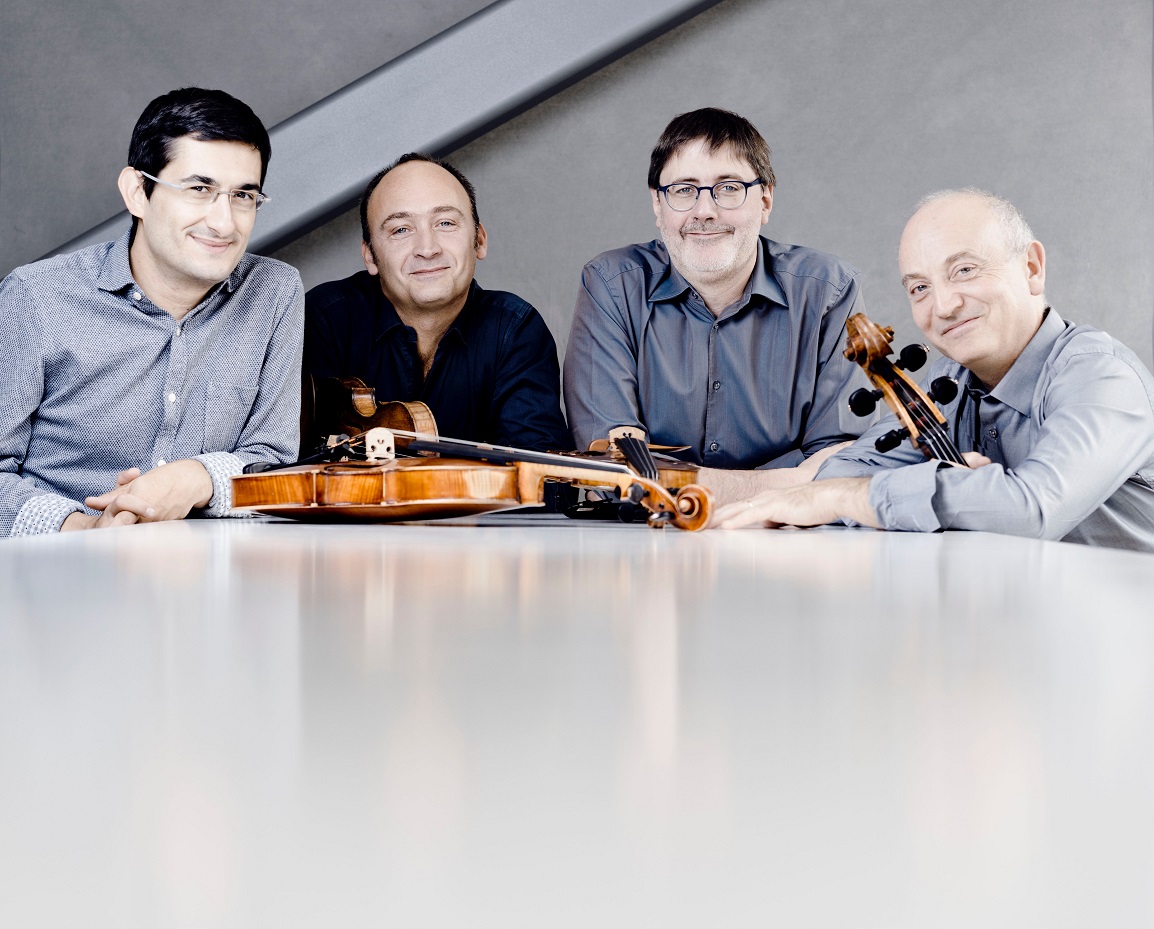
Quatuor Danel [Marc Danel & Gilles Millet (violins), Vlad Bogdanas (viola), Yovan Markovitch (cello)]

Weinberg String Quartet no.16 in A flat minor Op.130 (1981)
Weinberg String Quartet no.17 Op.146 (1986(
Shostakovich String Quartet no.15 in E flat minor Op.144

Wigmore Hall, London
Friday 27 June 2025

by Ben Hogwood Photo (c) Marco Borggreve

After giving fresh insight and context to the 32 string quartets and two piano quintets of Shostakovich and Weinberg, Quatuor Danel finally brought their Wigmore Hall cycle of both composers to a close. The journey began just before the COVID pandemic but was necessarily aborted. However on the series resumption in 2023 Wigmore Hall artistic and executive director John Gilhooly generously suggested the quartet begin the concerts afresh, a gesture acknowledged by Quatuor Danel first violinist Marc Danel before the group’s encore.

Danel admitted it had been difficult deciding which work should close the combined cycle, yet this concert proved the group had made the right decision, closing with some of Shostakovich’s final musical thoughts. Before that we heard the two very contrasting last quartets by Weinberg. His String Quartet no.16 was completed in 1981, the year in which his sister would have reached her sixtieth birthday had she not been murdered, along with the composer’s parents, in the Holocaust. Bearing her dedication, the quartet is a work of conflicting emotions, with an underlying tension trumped by a strong and lasting resolve.

Stylistically, Weinberg’s writing reflects his reacquaintance with the music of Bartók. This was evident from the heavy-set bow strokes of the first movement, where Danel led with power and precision. Weinberg allows time for calmer thoughts, but there was a guarded watchfulness that the Quatuor Danel conveyed most vividly here. The contrast between Scherzo and Trio in the second movement was striking, the emphatic gestures of the former upturned by the ghostly outlines of the otherworldly trio, which hinted at an alarm going off in the distance. The climax of the Lento felt like the culmination of a unified protest from all four instruments, its dissonant cries living long in the memory, before the waltz of the finale. Cold to the touch, the four instruments were muted but not silenced, and a period of moving stillness in the music held the attention before the waltz returned for the thoughtful closing bars.

With the String Quartet no.17, completed five years later, the mood changed completely. With a more explicit tonal language, this piece started in high spirits, Weinberg relishing the opportunity to revisit and quote from his earlier works, doing so in the spirit of pure musical enjoyment. A rustic first theme was brilliantly played here, as was the richly voiced chorale proving such an effective counterpart. This single movement work falls into four distinct sections, and eloquent solos from Danel and cellist Yovan Markovitch were memorable, before the feathery textures that began the finale, after which the chorale theme returning in an even brighter light. The positive disposition of the quartet gave it a youthful appearance beyond the references to early works, the composer enjoying childhood recollections through the viewpoint of relative seniority. The Danel ensured we were aligned in that viewpoint, too.

Shostakovich’s String Quartet no.15, however, is indisputably the work of a man in the twilight of his life. Written in six slow movements, it is one of the most distinctive utterances in the repertoire both of Shostakovich and the string quartet, and no performance should leave its audience unmoved. In the course of 40 minutes, Shostakovich leaves us with music that in terms of speed never really gets out of first gear, but whose intensity is unrelenting from its very first bars.

The Danel found that intensity with unerring accuracy, right from the first drawn-out melodies. Musically we seemed to have travelled back several centuries, the work unfolding with almost painful slowness, Shostakovich’s frailty made clear through music. And yet there is a spiritual quality looking ahead to the music of Arvo Pärt and Silvestrov, a kind of minimalism conveyed in searching, long-phrased melodies.

The Quatuor Danel were sparing in their use of vibrato, which made for an even more effective expressive tool when used, while their intonation was commendably flawless in such a difficult key for strings. In the second movement, ironically titled Serenade, the music felt inverted, its distinctive outcries made through crescendos reaching for the very soul. Marc Danel gave a searing solo at the beginning of the central Intermezzo, after which he sat, head bowed, listening to his three colleagues, while the viola solo from Vlad Bogdanas for the Funeral March was similarly charged. The Epilogue returned to the remarkable stillness present for much of this work, after which there was an equally moving silence.

It would be difficult to suggest an encore for music with such finality, but the quartet found an answer – in the shape of the first movement of Shostakovich’s String Quartet no.1. This might be thought an odd choice, but, as Danel explained, its music was a timely reminder for the world in which we live that the sun would come back. Hearing Shostakovich’s first and last statements for quartet in such proximity, it was hard not to agree with him – and so – with huge credit to the players for some memorable performances – this wonderful cycle concluded in the best possible way.

You can hear the music from the concert below, in recordings made by Quatuor Danel -including their most recent cycle of the Shostakovich quartets on Accentus:

For more information, click on the names for more on composer Mieczysław Weinberg and Quatuor Danel themselves.

Published post no.2,580 – Sunday 29 June 2025

In concert – Quatuor Danel: Shostakovich & Weinberg #10 @ Wigmore Hall

Quatuor Danel [Marc Danel & Gilles Millet (violins), Vlad Bogdanas (viola), Yovan Markovitch (cello)]

Weinberg String Quartet no.14 in B flat minor Op.122 (1978)
Weinberg String Quartet no.15 in G flat major Op.124 (1979-80)
Shostakovich String Quartet no.14 in F sharp major Op.142 (1972-3)

Wigmore Hall, London
Tuesday 6 May 2025

by Richard Whitehouse Photo (c) Marco Borggreve

Quatuor Danel’s interrelated cycle of string quartets by Shostakovich and Weinberg reached its penultimate stage this evening, and a programme with two of the latter composer’s most oblique such pieces heard alongside what is the most accessible of the former’s late quartets.

Second in a quartet of quartets written in the years after Shostakovich’s death, Weinberg’s Fourteenth Quartet continues straight from the sombre equivocation of its predecessor. Its five continuous movements never progress systematically as lurch forwards from an edgily austere first movement, by way of a moodily impassive successor, then on to a scherzo and intermezzo that are not so much elusive as gnomic in character; prior to a finale where any attempt at overall synthesis gradually subsides to leave only the wanly resigned conclusion. An ending, moreover, whose fatalism feels the more dismaying as it withdraws into virtual silence, as if Weinberg’s self-communing may well be a defence or even escape. As with its successor, his replacing tempo headings with metronome markings only abets obfuscation.

The Fifteenth Quartet might appear relatively less stark in outcome yet is certainly the most radical of all these works in formal design. Its nine mainly brief movements are interpretable in various ways – but a speculative sonata design is implied by the aggressive ‘development’ of the central three movements as framed by respectively angular and thrusting ‘transitions’; surrounded in turn by a two-stage ‘exposition’ of almost secretive inwardness which is itself balanced by a ‘reprise’ whose incrementally more direct expression facilitates that eventual, albeit tenuous sense of closure. Other approaches are entirely plausible, though there was an undeniable culmination imparted to those middle movements as the Danel steered its secure course through this fascinating if always disconcerting instance of Weinberg’s later maturity.

After such obliquities, the seeming directness of Shostakovich’s Fourteenth Quartet was the more affecting, though nothing should be taken at face value at this stage of its composer’s creativity. Allusions to earlier works (his own and others) abound and while the presence of serial elements is reduced next to its predecessors, sparsity of texture ensures a distanced or remote feeling even when this music is at its most active. As is true for most of the opening Allegretto, its lilting poise increasingly fitful as it nears a regretful if still inquisitive close.

By contrast, the central Adagio finds this composer at his most inward and confessional; its content allotted for much of its course to first violin and cello, so affording an austerity into which the eloquence of the ‘Angel Serenade’ by Gaetano Braga is a reminder Shostakovich was at time considering an operatic treatment of Chekhov’s story The Black Monk. The final Allegretto initially brings a more impetuous discourse, but this elides seamlessly into a coda whose pale radiance essentializes the work’s home key in a leave-taking of acute poignancy.

As always, the Danel gave its collective both here and in those miniatures which served as a welcome encore: two pieces from Prokofiev’s Visions fugitives, arranged for string quartet by Sergey Samsonov with a sensitivity for those piano originals as was nothing if not idiomatic.

You can hear the music from the concert below, in recordings made by Quatuor Danel -including their most recent cycle of the Shostakovich quartets on Accentus:

For more information on the final concert in the series, visit the Wigmore Hall website. You can click on the names for more on composer Mieczysław Weinberg and Quatuor Danel themselves.

Published post no.2,528 – Friday 9 May 2025

In concert – Quatuor Danel: Shostakovich & Weinberg #8 @ Wigmore Hall

Quatuor Danel [Marc Danel & Gilles Millet (violins), Vlad Bogdanas (viola), Yovan Markovitch (cello)]

Shostakovich String Quartet no.11 in F minor Op.122 (1966)
Shostakovich String Quartet no.12 in D flat major Op.133 (1968)
Weinberg String Quartet No. 12 Op.103 (1969-70)

Wigmore Hall, London
Wednesday 15 January 2025

by Richard Whitehouse Photo (c) Marco Borggreve

This latest instalment in Quatuor Danel’s traversal of the string quartets by Shostakovich and Weinberg comprised the Twelfth Quartets from both composers – masterpieces both, and was prefaced by the teasing brevity and obliqueness of the former’s preceding such composition.

His 60th year marked the onset of Shostakovich’s ‘late period’ – its overt introspection being appropriate for a piece dedicated to the memory of Vasily Shirinsky, former second violinist of the Beethoven Quartet who premiered all but the first and last of the composer’s cycle. In fact, the Eleventh Quartet is appreciably more varied than this memorial aspect may suggest – the Introduction initiating a subdued discourse given an ironic twist in the Scherzo then erupting combatively in the Recitative, prior to the anxiety of the Etude and ruthlessness of the Humoresque. This performance came into its own with the Elegy, a remembrance of enfolding pathos – after which, the Finale assumed that retrospective function found in many of Shostakovich’s later works with due emphasis on its stealthy and quixotic humour.

Just two years on brought Shostakovich’s Twelfth Quartet – if not his greatest then surely in the top two, while arguably uncharacteristic in its self-conscious yet masterly formal design. Although not introductory as such, the Danel was mindful to keep its opening movement on a tight rein such that its interplay of mood and tempo inferred without defining those seismic confrontations to come. This longest and most diverse of its composer’s quartet movements did not disappoint – the Danel having fullest measure of an 18-minute span whose eventual subsiding presages a pizzicato-driven assault the more visceral for being so methodical in its unfolding. Nor was the allusion to initial material at all misconstrued as this work enters its climactic phase, a transformation whose unbridled affirmation was powerfully in evidence.

It might have emerged barely 18 months on, but Weinberg’s Twelfth Quartet feels comparable only in its scope and ambition. A likely response to the creative radicalism this composer had encountered on returning to his native Poland after over a quarter-century, its four movements essentially reinvent the Classical archetype so that the opening Largo outlines a succession of amorphous or disruptive elements with little audible regard for just how they might interact – something that will only come into focus as the work unfolds while opening-out expressively.

This evolution takes in a stealthy if always speculative Allegretto, and a Presto whose violence has become assaultive by its close. It remains for the final Moderato to effect closure through a synthesis almost improvisatory for all its formal rigour. Allied to this comes a dominance of playing techniques that does not intensify the music as drain it of all emotion and so reduce it to merest gestures by the end. A remarkable piece, even so, and a testament to its composer’s tenacity in the face of an unsympathetic, often antagonistic cultural climate at home or abroad.

Tonight’s impressive reading almost had to be abandoned as Gilles Millet’s bridge collapsed just before the end of the third movement, but his last-minute location of a replacement saw it resume to the close – an unexpected hiatus seemingly in accord with this extraordinary work.

You can hear the music from the concert below, in recordings made by Quatuor Danel -including their most recent cycle of the Shostakovich quartets on Accentus:

For more information on the next concert in the series, visit the Wigmore Hall website. You can click on the names for more on composer Mieczysław Weinberg and Quatuor Danel themselves.

Published post no.2,414 – Friday 17 January 2025

In concert – Quatuor Danel: Shostakovich & Weinberg @ Wigmore Hall

Quatuor Danel [Marc Danel & Gilles Millet (violins), Vlad Bogdanas (viola), Yovan Markovitch (cello)]

Shostakovich String Quartet no.1 in C major Op.49 (1938)
Weinberg String Quartet no.1 in C major Op.2/141 (1937, rev. 1985)
Shostakovich String Quartet no.2 in A major Op.68 (1944)

Wigmore Hall, London
Monday 13 November 2023

Reviewed by Richard Whitehouse. Photo (c) Marco Broggreve

No-one could accuse the Quatuor Danel of bowing to circumstance. Having had to abandon its cycle of the combined Shostakovich and Weinberg string quartets some three-and-a-half years ago owing to the COVID pandemic, the ensemble has commendably started again and from scratch. Tonight accordingly saw the first instalment in this survey of 32 quartets, with an evening such as traced the beginnings of what promises to be an enterprising and, above all, rewarding series of recitals from musicians with a palpable empathy for both composers.

A more unassuming start could scarcely be imagined than with Shostakovich‘s First Quartet. Not only did the composer leave it relatively late until tackling this genre, but the result is as understated a debut as could be imagined. Perhaps in its trying to up the emotional ‘ante’, the Danel sacrificed some of the opening movement’s wistful elegance, but the ensuing variations on a Mussorgskian melody were ideally poised, with the quicksilver scherzo and rumbustious finale reinforcing the infectious charm as well as technical mastery of this ingratiating debut.

The most obvious criticism of Weinberg’s First Quartet is that it bears little resemblance with what was to follow. Yet given its indebtedness to Bartók and Szymanowski, the initial Allegro pursues its doggedly eventful course through some torturous chromatic harmonies and dense textures, while the central Andante evokes a tense and even ominous atmosphere enhanced by its being muted throughout. Only with the final Allegro does the future composer come to the fore, its driving rhythms and folk inflections as Weinbergian as is the teasing evanescence of those closing bars. Now that Daniel Elphick’s reconstruction of the original version has been performed publicly, the revision is more clearly one of ‘less is more’ afforded by hindsight – which does not make this teenage effort, or the Danel’s rendering of it, any less impressive.

As the last in a sequence of large-scale chamber works, Shostakovich’s Second Quartet has tended to be overshadowed by his Piano Quintet and Second Piano Trio, but that it does not want for stature was underlined by the Danel’s reading. The fervent while formally lop-sided Overture responded audibly to this trenchant and forthright approach, its modally inflected plangency carried through to the Recitative and Romance in which Marc Danel‘s impulsive take on those florid first violin solos was ably complemented by the fraught interplay toward its climax. Nor was there any lack of purpose in the Waltz and its ominous revisiting of the composer’s past, before the closing Theme with Variations evinced inexorable momentum on route to an implacable restatement of that theme for a warning pure though hardly simple.

Given such music and music-making it might have been churlish to expect an encore, yet the Danel duly provided an additional few minutes in the guise of an Improvisation and Rondo Weinberg wrote around 1950 but which was only premiered 69 years later. More is the pity, as the former proved as affecting as the latter was appealing in melodic directness. January 12th sees the second instalment, with Shostakovich’s Third preceded by Weinberg’s Second and Third Quartets, of a series which one fervently hopes will now run its intended course.

You can read all about the next concert in the series at the Wigmore Hall website – and click on the name to read more about Quatuor Danel.

Published post no.2,011 – Thursday 16 November 2023

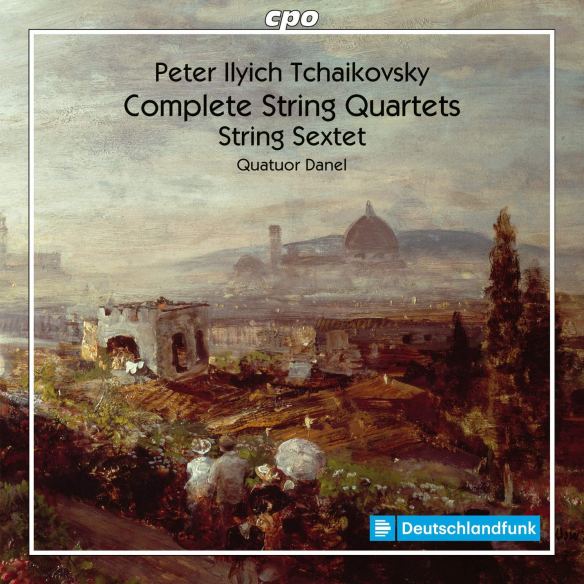
On record – Quatuor Danel: Tchaikovsky – Complete String Quartets & Souvenir de Florence (CPO)

Quatuor Danel [Marc Danel & Gilles Millet (violins), Vlad Bogdanas (viola), Yovan Markovitch (cello)], Vladimír Bukač (viola)*, Petr Prause (cello)*

Tchaikovsky
String Quartet no.1 in D major Op.11 (1871)
String Quartet no.2 in F major Op.22 (1873-4)
String Quartet movement in B flat major (1865)
String Quartet no.3 in E flat minor Op.30 (1876)
String Sextet in D minor Op.70, ‘Souvenir de Florence’ (1890)*

Written by Ben Hogwood

What’s the story?

This is a very welcome release from the Quatuor Danel. Having already given us complete cycles of Weinberg and Shostakovich – a total of 32 string quartets – they extend their reach back to Tchaikovsky and the first major quartet cycle in Russian music. There are two discs which include the three published quartets, the quartet movement and Souvenir de Florence, the composer’s String Sextet.

What’s the music like?

Following these pieces is a very interesting way of charting Tchaikovksy’s development as a composer.

The String Quartet no.1 in D major gives evidence of his major early influences, with Mozart and Mendelssohn in evidence. It also contains as its second movement the Andante cantabile, removed and arranged for string orchestra and very popular as a standalone piece for reflection.

The String Quartet no.2 in F major is weightier, with a more overtly Romantic musical language as Tchaikovsky shows more obvious emotion in his writing. The String Quartet no.3 is unusually cast in E flat minor, not a key string players regard with great affection, but one which offers very effective, dark colouring in an elegiac work.

The cycle is nicely positioned at regular intervals in the composer’s career, predated by a Quartet Movement in B flat major from the mid-1860s and capped by the String Sextet, Souvenir de Florence, from 1890, written while the composer was working in the Italian city.

Does it all work?

Yes. These are excellent performances from a quartet clearly attuned to Russian chamber music. They enjoy the graceful music with which the String Quartet no.1 starts, gliding forward with poise and elegance. As the development of the ideas gathers pace and intensity, so the quartet become more animated, convincingly driving through to the final bars. The Andante Cantabile is fresh and free of indulgence, its central dance offsetting the thoughtful main material. The Scherzo has plenty of cut and thrust, plus an enjoyable, bubbly trio, while the finale is in a similar vein but sunnier, enjoying the major key and some glorious melodies from Marc Danel’s violin.

Once fully in to gear, the String Quartet no.2 has an exuberant first movement. It is a high voltage performance, occasionally brimming over with its high spirits, but with a nicely judged and serene close. The quartet enjoy the rustic sounds of this work, particularly evident when Tchaikovsky uses open fifths in the lower parts, and they get admirable clarity from the big textures in the middle of the Andante.

The String Quartet no.3 receives a telling performance, getting right to the heart of Tchaikovsky’s thoughts. Sombre and thoughtful in its introduction, the first movement soon has admirable depth, the transition to the faster music ideally judged. The quartet relish Tchaikovsky’s fulsome writing but also the deeply soulful character of the movement’s second theme. The Scherzo is light on its feet, enjoying the exchanges from the top of the first violin to the bottom of the cello and back again, while the muted start to the third movement is particularly intense, deeply telling in its sorrowful and respectful closing pages. The finale largely shakes off these shackles but for a brief reference to the mood of the third.

As a useful postscript the Quartet Movement has a quiet and mysterious beginning, and it is not initially obvious where the work is going but then it blooms into a full structured movement, using the influence of Schubert and Mendelssohn to strong effect.

Finally a spirited account of the Souvenir de Florence, busy and upfront from the start, with plenty of energy from the six players – but with time too to enjoy both the softer second theme of the first movement and the lovely slow movement, where the cello line blooms beautifully. The shimmering central section here has plenty of drama, then the sound becomes earthy as the cello line returns. Textures are occasionally stretched in the third movement but the finale has a dramatic sense of urgency as well as a lovingly dispatched, broadly phrased second theme bringing brief parallels to the composer’s fantasy overture Romeo and Juliet. After this the sextet secure a thoroughly emphatic and affirming finish.

The big challenge with these works is getting the melodies to sing through the full textures with which Tchaikovsky writes, but the Quatuor Danel achieve the right balance throughout these excellent versions.

The elegance of the first quartet is immediately appealing, as is the red blooded cut and thrust of the second and the deeply emotive third, the best performance here. Having the Quartet Movement and an excellent account of Souvenir de Florence is the icing on the cake.

Is it recommended?

Yes. There is formidable competition in these pieces from the Borodin String Quartet, in company with Genrikh Talalyan and Mstislav Rostropovich for the Souvenir de Florence, and also from the Gabrieli and Chilingirian Quartets.

Yet despite these the Quatuor Danel offer an excellent modern alternative, with excellent performances and recording all round. It’s time for Tchaikovsky’s string quartets to come in from the cold.

Listen

Buy

You can listen to clips from the Quatuor Danel’s Tchaikovsky cycle and purchase a copy at the Presto website here