
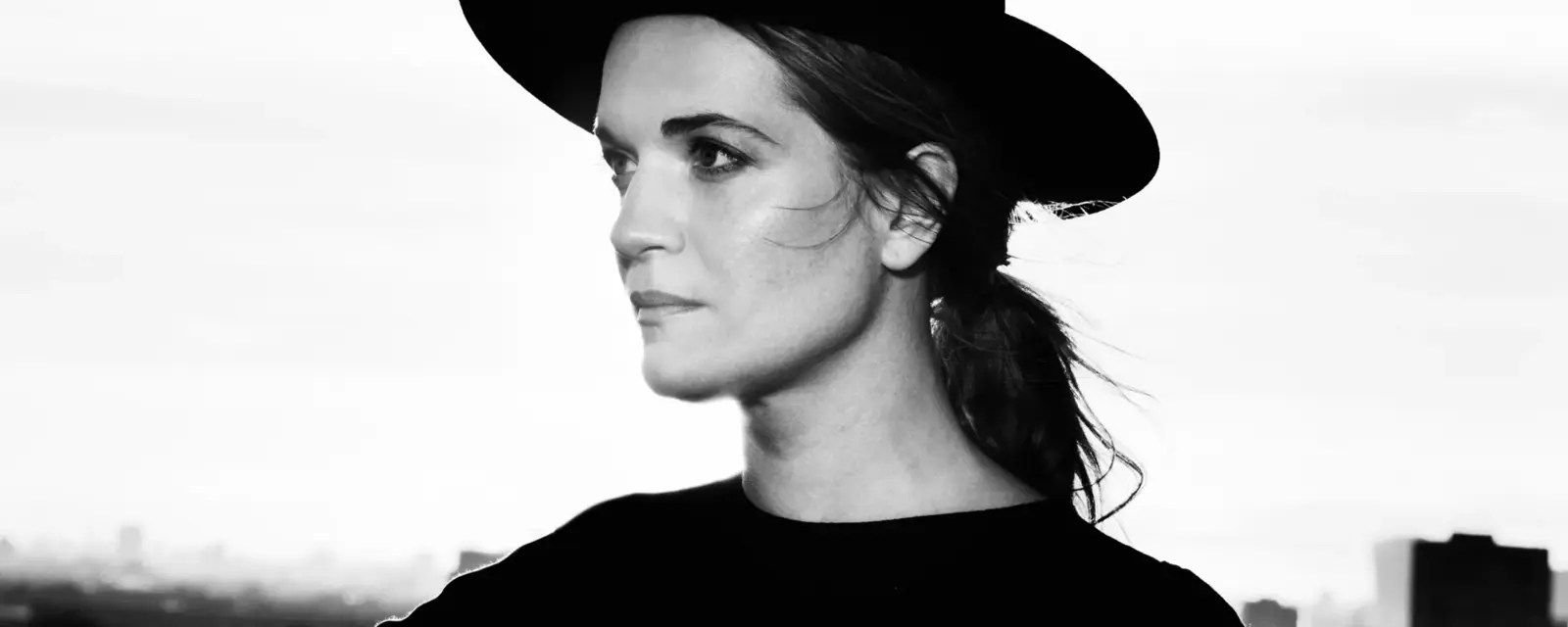
In concert – Ruby Hughes, Natalie Clein & Julius Drake: Schubert and Other Folksongs @ Queen Elizabeth Hall

Ruby Hughes (soprano), Natalie Clein (cello), Julius Drake (piano)

Schubert arr. Jones Der Hirt auf dem Felsen (The Shepherd on the Rock) D965 (1828)
Kodály Sonatina for cello & piano (1922)
Tavener Akhmatova Songs: Dante, Boris Pasternak, Dvustishie (Couplet) (1993)
Brahms 2 Songs Op.91 (1884)
Trad arr. Britten I wonder as I wander (1940-41), At the mid hour of night (Molly, my dear), How sweet the answer (The Wren) (both 1957)
Deborah Pritchard Storm Song (2017)
Janáček Pohádka (Fairy tale) (1910, revised 1923)
Ravel Kaddisch from 2 Mélodies hébraïques (1914)
Bloch From Jewish Life (1924)
Schubert Auf dem Strom (On the river) D943 (1828)
(Encore) Berlioz La Captive

Queen Elizabeth Hall, London, 27 June 2025

by John Earls. Photo credits (c) Philip Sharp (above), John Earls (below)

Two of the most affecting sections of Ruby Hughes’ excellent 2024 album with the Manchester Collective End of My Days are three of John Tavener’s Akhmatova Songs (Dante, Boris Pasternak and  Couplet) and Maurice Ravel’s Kaddish (from 2 Mélodies hébraïques).

These also featured to dramatic effect in this fascinating concert programme of Schubert and Other Folksongs spanning two centuries, where Hughes was joined by Natalie Clein (cello) and Julius Drake (piano).

In this performance the Tavener song miniatures were performed for voice and cello and were at turns powerful, beautiful and urgent across their nine-minute duration. The prolonged silence from the audience afterwards was noticeable. Ravel’s lament-like Kaddish, this time for voice and (sparse) piano, was similarly respectfully performed and observed.

There were non-vocal pieces for cello and piano where Clein and Drake displayed what a well matched duo they are. Zoltán Kodály’s Sonatina was luminescent, Leoš Janáček’s Pohádka absorbing (not least the cello bowing and pizzicato) and Ernest Bloch’s From Jewish Life was both lovely and mournful.
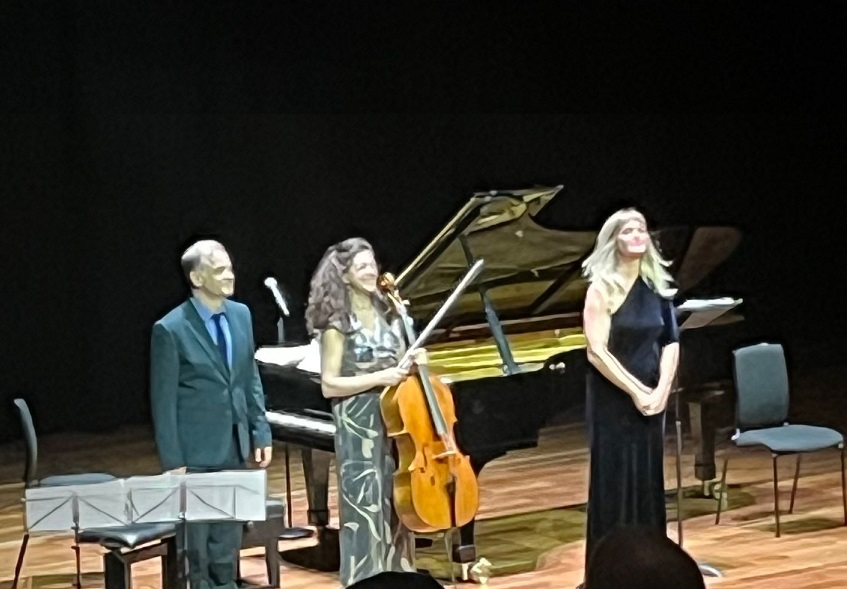
But this was a concert where Ruby Hughes’ amazing voice was to the fore but often in an understated, but no less impactful way. The captivating trio of Benjamin Britten folksong arrangements with their minimal piano trills were a case in point.

The trio performances were also impressive in their delivery and range. Brahms2 Songs (Op.91) were both gorgeous, while Deborah Pritchard’s Storm Song (from 2017, the most recently written piece) was powerfully unnerving between its haunting start and end (the composer was in the audience to take a well deserved bow).

The concert was bookended by two songs written by Franz Schubert shortly before his death in 1828 at the age of just 31. As David Kettle remarks in his excellent programme notes, to call them simply songs is to do them a disservice. Der Hirt auf dem Felsen (The Shepherd on the rock), arranged by Peter Jones for voice, cello (replacing the clarinet) and piano, traversed a journey of yearning and joy that was both delicate and impassioned. The closing Auf dem Strom (On the river) saw Hughes capturing the drama convincingly throughout.

An encore of Berlioz’s La Captive concluded this concert that combined fascinating and thoughtful programming with performances of beautifully judged expression.

John Earls is Director of Research at Unite the Union and posts at @johnearls.bsky.social on Bluesky and @john_earls on X. You can subscribe (free) to his Hanging Out a Window Substack column here: https://johnearls.substack.com/

Published post no.2,579 – Sunday 29 June 2025

In concert – Orchestra of the Age of Enlightenment: Bach Brandenburg Concertos @ Queen Elizabeth Hall

Orchestra of the Age of Enlightenment

J.S. Bach
Brandenburg Concertos:
no.1 in F major BWV1046 (dir. Huw Daniel)
no.3 in G major BWV1048 (dir. Margaret Faultless)
no.5 in D major BWV1050 (dir. Margaret Faultless)
no.4 in G major BWV1049 (dir. Huw Daniel)
no.6 in B flat major BWV1051 (dir. Oliver Wilson)
no.2 in F major BWV1047 (dir. Rodolfo Richter)

Queen Elizabeth Hall, London
Wednesday 13 November 2024

Reviewed by Ben Hogwood Pictures (c) Mark Allan

The music of Bach proves a great source of consolation for many in uncertain times, and the underlining feeling from this packed concert was that the Orchestra of the Age of Enlightenment had offered just that, deep into their tour of the great master’s complete Brandenburg Concertos.

The six concertos, written for a variety of instrumental ensembles, were published just over 300 years ago in 1721 and sent to Christian Ludwig, Margrave of Brandenburg. In a crowded field, they have become one of Bach’s best-loved groups of works, and although they were not designed to be played together they respond extremely well to a concert such as this.

It is difficult to imagine a better set of performances than those given by the OAE, playing without a conductor in the spirit of the compositions, assigning the direction of each concerto to the uppermost string player. The program was introduced with a spark by violinist Margaret Faultless, whose enthusiastic demeanour set the tone for the evening. As the notes of the Brandenburg Concerto no.1 in F major lifted off the page Bach’s inspiration was immediately apparent, like walking into a room of animated conversation. The horns of Ursula Paludan Monberg and Martin Lawrence were front and centre, pointed aloft in a necessary but striking pose. The balance between the 13 players was ideal, not just in the busy first movement but in the emotive Adagio, led by the beautiful tones of oboe trio Clara Espinosa Encinas, Sarah Humphrys and Grace Scott Deuchar. Yet the horns took centre stage, powering the bright Allegro, before a perky series of Menuetto dances were bisected by a bracing second trio.

One of the many joys of the concert was the different sonorities of each piece, which changed to nine string instruments for the Brandenburg Concerto no.3 in G major. This had the requisite spring in its step for the quicker outer movements, especially the jovial dialogue of the third. Meanwhile the ensemble elaborated on Bach’s two written chords that make up the slow movement, where the focus was on violin (Faultless) and harpsichord (Steven Devine) Their tasteful improvisations were an ideal foil.

Completing the first half was the Brandenburg Concerto no.5 in D major, in effect an early keyboard concerto. The seven players were positioned closer to the audience, allowing greater intimacy and the chance to appreciate some of the wondrous sequences in the first movement. Taking the lead here were flautist Lisa Beznosiuk, who recorded the concertos with the orchestra back in 1987, alongside Faultless and Devine. They delivered a sublime Affettuoso second movement, a moment of reflection from the fast movements where Devine was a revelation, his virtuosic brilliance never too showy even in the trickiest of cadenzas.

To begin the second half of the concert the mellow sonorities of the recorders took the lead in the Brandenburg Concerto no.4 in G major, with beautiful clarity achieved by Rachel Beckett and Catherine Latham. Violinist Huw Daniel mastered the busy figuration of his part with considerable flair, while the poise of the accompanying ensemble was consistently satisfying. This concerto is deceptively forward looking, with pointers towards Beethoven in the slow movement, which here benefited from the weighty support of viola da gamba (Richard Tunnicliffe) and double bass (Cecilia Bruggemeyer), both ever presents through the evening. The pugnacious finale, with one of Bach’s many earworms, was great fun in the hands of these nine players.

The colours darkened appreciably for the Brandenburg Concerto no.6 in B flat major, whose highest instrument is the viola. Bach’s scoring here is remarkably inventive, and was brought to life as Oliver Wilson led a fluent account of the first movement. The violas showed their versatility as melody instruments in the reduced scoring of the Adagio, reduced from seven to four players and enjoying its elegant dance-like figurations, before the syncopations of the Allegro were winningly delivered.

Finally the Brandenburg Concerto no.2 in F major was a suitably upbeat piece on which to finish, with soloist David Blackadder – having waited an hour and a half to play – enjoying his moment on stage. He made the trumpet line look – and sound – straightforward, when with this instrument it is anything but! Again the balance was carefully wrought, so that the intricate violin contributions of director Rodolfo Richter could be clearly heard. A lightness of touch from the 11 players brought the phrasing of the Andante to life, with some typically spicy harmonies stressed, before the brilliant colours of the closing Allegro assai, and a celebratory closing statement.

It was a treat to hear the six Brandenburg Concertos presented in this way, a reminder that – in the words of Huw Daniel – these concertos deserve to be the centre of attention. The humming of the audience afterwards was testament to their lasting appeal, 300 years on.

You can listen to the Orchestra of the Age of Enlightenment’s recordings of the Brandenburg Concertos from 1987-88 for Virgin Classics below:

Published post no.2,362 – Thursday 14 November 2024

In concert – Sol & Pat (Sol Gabetta & Patricia Kopatchinskaja) @ Queen Elizabeth Hall

pat-sol

Leclair Violin Sonata in C major Op.5/10: Tambourin (c1734)
Widmann 24 Duos: Valse bavaroise; Toccatina all’inglese (2008)
J.S. Bach Prelude in G major (from BWV860) (c1722)
Francisco Coll Rizoma (2017)
Domenico Scarlatti Sonata in G, Kk.305
Ravel Sonata for violin & cello (1922)
J.S. Bach 15 Two-part Inventions BWV772-86 (selection) (c1723)
Ligeti Hommage à Hilding Rosenberg (1982)
Xenakis Dipli zyia (1951)
C.P.E. Bach Presto in C minor Wq114/3 (c1768)
Kodály Duo Op.7 (1914)

Patricia Kopatchinskaja (violin), Sol Gabetta (cello)

Queen Elizabeth Hall, London
Tuesday 26 October 2021

Written by Richard Whitehouse

Combining two of the most charismatic and creative string players of their generation was such a good idea to make one surprised it had not happened earlier, but tonight the Patricia Kopatchinskaja and Sol Gabetta double-act hit the Southbank Centre in no uncertain terms.

A stomping entrée to Leclair’s Tambourin in C (a rare instance when Kopatchinskaja donned footwear) launched proceedings in arresting fashion, while Jörg Widmann’s Valse bavaroise and Toccatina all’inglese – both from his resourceful playbook of 24 Duos – allured and engaged. Bach’s Prelude in G (from BWV860) afforded a limpid breathing-space, then Francisco Coll’s Rizoma fairly intrigued with its incrementally shifting textures and ethereal harmonics – just the sort of piece, indeed, necessary for energizing the violin-and-cello medium. Kopatchinskaja admitted to disliking the arrangement of Scarlatti’s Sonata in G (Kk305) and canvassed the audience for its opinion, the response encouraging an incisive take on music whose enthusiastic response left her shaking her head in mock consternation.

The first half concluded with Ravel’s Sonata for violin and cello – much less often revived than it should be, ostensibly on account of the duo-medium, but an undoubted masterpiece when rendered with such commitment as here. Kopatchinskaja and Gabetta teased out those exquisite tonal obliquities of the Allegro, countered by the alternate brusqueness and suavity of the scherzo or distanced rapture of the slow movement; before the finale brought matters to a head with its headlong syncopation and no lack of that ‘spirit’ as indicated in the score.

A brief inclusion from Bach’s 15 Two-Part Inventions (BWV772-86) opened the second half with pointed understatement (presumably more so than the Scarlatti sonata that was originally scheduled), with the expressive poise of Ligeti’s Hommage á Hilding Rosenberg duly making way for the acerbic interplay of Xenakis’s Dipli zyia which is among the most Bartókian of the formative pieces to have found posthumous revival by this composer (who is hopefully being suitably commemorated throughout his centenary in 2022).

Kopatchinskaja and Gabetta then sat side by side for a speculative reading of C.P.E. Bach’s Presto in C minor (Wq.114 No. 3) made the more so through its being played pizzicato throughout. Interesting, too, how such an arrangement can dissolve any perceived boundary between musical epochs.

The programme reached a culmination in every sense with Kodály’s Duo, one of several large-scale chamber-works for strings on which his reputation as a composer of ‘abstract’ music rests. After a tensile account of the preludial Allegro, Kopatchinskaja and Gabetta rendered the central Adagio with sustained pathos and a timbral acuity made more so by their faultless intonation. Nor was there any lack of eloquence in the finale, its deliberate progress building a momentum that was released in the coda to heady and exhilarating effect.

Quite a concert, then, with a performance to match by two musicians who complement each other’s playing to a mutually beneficial degree. Hopefully they will be returning with another wide-ranging programme before too long. The enthusiastic audience evidently felt likewise.

For more information on the new Sol & Pat release, head to the Linn Records website