Listening to Beethoven #224 – Leonore Overture no.3 Op.72b

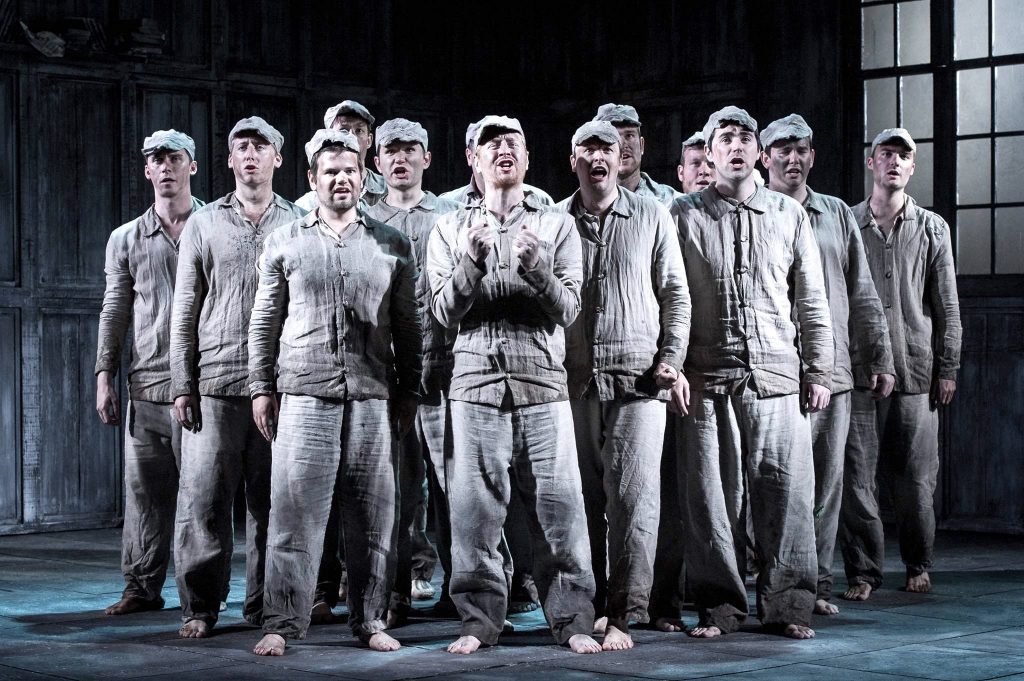
Beethoven’s Leonore as seen in a production by Buxton Opera, 2016

Leonore Overture no.2 Op.72b, used by Beethoven for a revision of his opera in three acts (1804-05, Beethoven aged 34)

Duration 14’30”

by Ben Hogwood

Background and Critical Reception

As the writer Herbert Glass points out, in program notes written for a concert by the Los Angeles Philharmonic, “Beethoven spent more time writing the overture to Fidelio than Rossini and Donizetti spent on entire operas, overture included”! He goes on to qualify this investment of time, asserting that “No. 3…distils the essence of the opera itself, transmitting its power in less than a quarter-hour’s playing time’.

No.3 – confusingly – is the second in order of composition, following no.2 which was used in the first performance of the opera. No.1 – a heavily trimmed version – would follow later, with the Fidelio overture itself a reinvented prelude to the finalised opera.

Robert Simpson, in an essay about Leonore and the resultant Fidelio, points out that the advantage of this overture over its predecessor is “its very accurate delineation of all these key relationships” – by which he means the conflict between the opera’s ‘home’ key of ‘C’ and the ‘prison’ key of B flat major, where the malevolent character Pizarro is found. He describes Beethoven using C major as “an open sky”, and B flat as “the oppressive atmosphere of the jail”, then discussing at length the key of Florestan (A flat major) and Leonore herself (E major). His conclusion is that “no-one will ever exhaust all this great music, surely the greatest ever written for the theatre”.

Thoughts

While listening to the Leonore Overture no.2 I noted that the orchestral dialogue ‘operates on the scope more of a symphonic poem than an overture’ – and that is even more a case in point with the third overture. As an orchestral piece it may be longer but it is a thrilling listen, especially when Beethoven’s ‘open sky’, as Simpson calls it, is found.

To get there we have to traverse the awful claustrophobia of the prison, but there are always shafts of light – the flute solo in Florestan’s key around two-thirds of the way through, and the offstage trumpets that set an incredibly vivid scene. After the uncertain groping in the dark, the blazing light of C major. On the way there we experience some trials, most noticeably a striking dischord right before the end – a wonderful dramatic touch that carries the deepest possible impact.

Recordings used

Berliner Philharmoniker / Herbert von Karajan (DG)
Cleveland Orchestra / George Szell (Sony)
Orchestre Lamoureux, Igor Markevitch (DG)
Chamber Orchestra of Europe / Nikolaus Harnoncourt (Teldec)
Philadelphia Orchestra / Riccardo Muti (EMI)

Once again Herbert von Karajan, with the silvery strings of his Berliner Philharmoniker machine, comes up trumps with a wholly satisfying version. Yet Igor Markevitch is arguably more dramatic still, his final pages a terrific release of tension built up earlier, in a reading that undercuts most others by a minute. Any of the other three serve as ideal guides, too.

You can listen on the links below:

Also written in 1805 Carafa Il Fantasma

Next up 32 Variations in C minor, WoO80

BBC Proms at Cadogan Hall – Marmen Quartet play Haydn & Robert Simpson

Marmen-Quartet

Marmen Quartet [Johannes Marmén & Ricky Gore (violins), Bryony Gibson-Cornish (viola), Sinéad O’Halloran (cello)]

Haydn String Quartet in D major Op.64/5 ‘Lark’ (1790)
Simpson String Quartet no.1 (1951-2)

Cadogan Hall, London
Monday 16 August 2021 (1pm)

Written by Richard Whitehouse

In his centenary, it was timely to include music by Robert Simpson (who spent three eventful decades at the BBC) at the Proms, and while one might have hoped for one of his symphonies in the evening concerts, his First Quartet at a Cadogan Hall recital was hardly less welcome.

Finished when Simpson was in his early thirties and dedicated to Enescu (who read through and commended the score during his last visit to the UK), the First Quartet fairly typifies the composer’s music at this time in its stealthy take on progressive tonality and methodical yet never pre-ordained design. Thus, the opening Allegro evolves seamlessly from wistful then animated main ideas through an inwardly probing development to a trenchant reprise then a headlong coda; the ensuing Andante unfolding a series of variations on a ruminative theme – structured as a palindrome – that grows in intensity towards a fervent culmination before it touches on the work’s opening theme on route to a limpid final repose. Simpson was to use   a two-movement format on subsequent occasions, but never so elegantly or lucidly as here.

In his introductory remarks, Johannes Marmén stated that the Marmen Quartet had not been familiar with Simpson’s music until asked to learn the First Quartet for this recital. Evidently played-in beforehand, this afternoon’s performance was impressive in its formal command and audible feel for a distinctive idiom of far-reaching consequences. Hopefully this group will tackle further Simpson – the Second and Third Quartets, which explore the potential of their predecessor in what effectively becomes a ‘meta-quartet’, are a good place to continue.

A passing allusion to Haydn’s Lark Quartet at the start of the Simpson made the former a natural pairing, of which the Marmen made a virtue with its attentive and insightful account. After an animated reading of the initial Allegro (second half repeat included to make it weightier), the Adagio was notable for its eloquent ensemble and a tentative wit made manifest in the lively Menuetto. Sparkling yet never skittish, the final Vivace rounded off this performance in appealing fashion – leaving little doubt of the Marmen Quartet as an outfit with a future.

You can find more information on the BBC Proms at the festival’s homepage

Listening to Beethoven #156 – String Quartet in C minor Op.18/4

op184-Friedrich_-_Morning_mist_in_the_mountainsMorning Mist In The Mountains, by Caspar David Friedrich (1808)

String Quartet in C minor Op.18/4 (1798-1800, Beethoven aged 29)

Dedication Count Johann Georg von Browne
Duration 25′

1. Allegro ma non tanto
2. Andante scherzoso quasi allegretto
3. Menuetto: Allegro
4. Allegro – Prestissimo

Listen

written by Ben Hogwood

Background and Critical Reception

The roots for the fourth published quartet in the Op.18 set are thought to go back as far as Beethoven’s time in Bonn, where sketches for this piece could well have been made. It was, however, the fifth completed work in this group of six, and sits after two relatively sunny works in G and D major respectively.

Robert Simpson, writing about the quartet, identifies ‘a direct shortness of address, a certain impatience with the finesse of transition, and a clear simplicity of texture, with instantly assimilable melodic invention. For all this, there is no lack of subtlety in the proportions, and the sense of movement is as perfect as a cat’s.’ He identifies the Minuet as the most serious movement of the four, ‘having the urgency of some of Beethoven’s later scherzo movements’. The finale is ‘one of Beethoven’s rare excursions into the Hungarian style of which Haydn was fond’.

Ludwig Finscher is more critical, going as far as to identify this piece as ‘undoubtedly the most problematical of the set’, suggesting influence from Mannheim and a semi-orchestral approach.

Thoughts

It almost wouldn’t be a set of early Beethoven works without a work in C minor, as the composer revisits one of his darker keys. Yet there is not quite so much edge of the seat drama as the early Piano Trio Op.1/3, nor the Pathétique sonata.

Yet there is a good deal to enjoy, serious though the approach is. Each of the four movements shares the tonality of C, though the slow movement gives us a little respite from the minor key tonality. There are shafts of light here, as there are in the ‘trio’ section of the third movement, after its resolute start.

Beethoven again uses the third movement as one of his more modern sounding sections, following as it does after a straight faced but relatively conventional first movement and a thoughtful second. It is the finale where the fireworks occur, especially if the quartet performing the work take the theme a bit faster each time it comes back. It can be witty and more than a bit outrageous, a great piece to see in concert – and a final tune that keeps you whistling as you head for the door!

Recordings used and Spotify links

Quatuor Mosaïques (Andrea Bischof, Erich Höbarth (violins), Anita Mitterer (viola), Christophe Coin (cello)
Melos Quartet (Wilhelm Melcher and Gerhard Voss (violins), Hermann Voss (viola), Peter Buck (cello) (Deutsche Grammophon)
Borodin String Quartet (Ruben Aharonian, Andrei Abramenkov (violins), Igor Naidin (viola), Valentin Berlinsky (cello) (Chandos)
Takács Quartet (Edward Dusinberre, Károly Schranz (violins), Roger Tapping (viola), Andras Fejér (Decca)
Jerusalem Quartet (Alexander Pavlovsky, Sergei Bresler (violins), Ori Kam (viola), Kyril Zlotnikov (cello) (Harmonia Mundi)
Tokyo String Quartet (Peter Oundjian, Kikuei Ikeda (violins), Kazuhide Isomura (viola), Sadao Harada (cello) (BMG)
Végh Quartet (Sándor Végh, Sándor Zöldy (violins), Georges Janzer (viola) & Paul Szabo (cello) (Valois)

The Melos Quartet are excellent in this piece, with a quickfire fourth movement – while the Jerusalem Quartet also give a very fine account. The Quatuor Mosaïques once again have a lovely sound, their slightly reduced vibrato helping bring out the links to Haydn and Mozart, while keeping the music pointing firmly forward in its direction.

You can chart the Arcana Beethoven playlist as it grows, with one recommended version of each piece we listen to. Catch up here!

Also written in 1800 Dussek Piano Sonata no.8 in E flat major Op.44

Next up String Quartet in A major Op.18/5