
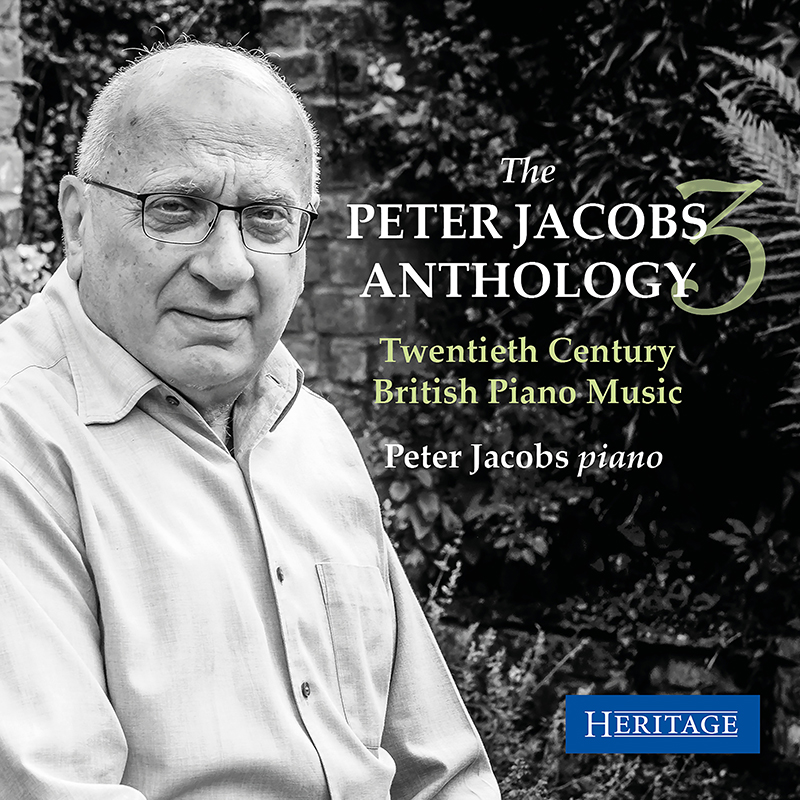
On Record – The Peter Jacobs Anthology Volume 3 (Heritage Records)

Peter Jacobs (piano)

Allum Nocturne in C sharp minor; Prelude No. 24 in D minor (both c.1950)
Bantock (arr. composer) Omar Khayam (1906-09) – Prelude and March
Fenney Au Printemps (pub. 1915)
MacDonald Waste of Seas (1976)
Purcell arr. Stevenson The Queen’s Dollour (pub. 1710, arr. 1958)
Simpson Variations and Finale on a Theme of Haydn (1948)
Truscott Prelude and Fugue in E flat minor; Prelude and Fugue in C major (1957)

Heritage Records HTGCD127 (67’25”)
Recorded live at London College of Music, April 1979

Reviewed by Richard Whitehouse

What’s the story?

Heritage continues adds to its extensive Peter Jacobs discography with this recital focussing on music by British composers mainly of the early and mid-twentieth century, each rendered with that combination of fluency and insight which this pianist brings to all his performances.

What’s the music like?

According to his booklet note, Jacobs gave this recital at an Annual General Meeting for the Havergal Brian Society in 1979, though the present writer remembers a pretty much identical programme being given at this event in 1982. The seeming unavailability of works by Brian (Four Miniatures then Prelude and Fugue in C minor) played on this occasion is regrettable, but these are easily available elsewhere while the recital’s purpose in drawing together music by various of Brian’s contemporaries, colleagues or advocates remains essentially unchanged.

Granville Bantock’s choral epic Omar Khayam has numerous excerpts worthy of autonomous status – not least its evocative Prelude and quizzical March. Apparently written in a weekend, Harold Truscott’s brace of Preludes and Fugues – that in E flat minor as methodical as that in C is impetuous – makes one regret he did not attempt a complete cycle. An amateur composer in the most professional sense, Walter Allum’s piano music wears its indebtedness to Chopin but deftly – witness his intricately designed Nocturne or Prelude in D minor which brings to a vividly decisive end a cycle likely worth hearing in its entirety. William J. Fenney enjoyed a modest reputation just after the First World War with Au Printemps (also known as ‘In Early Spring’) a trilogy the more affecting in its emotional restraint – ‘light’ music but never facile.

Forward to what was then the present, Malcolm MacDonald’s Waste of Seas (also known as Hebridean Prelude) sustaining a plangent atmosphere and of a pianistic resourcefulness to suggest his modest output as worth further investigation. A relatively early work, Variations and Finale on a Theme of Haydn has Robert Simpson drawing a wide but integrated range of moods from the innocuous Minuet of Haydn’s 47th Symphony (its palindromic aspect more intensively mined in Simpson’s Ninth Quartet), prior to an extended final section more akin to the iconoclastic fugal writing in late Beethoven. Such exhilaration needs a brief touchdown such as Jacobs supplies in Ronald Stevenson’s lucid take on one of Purcell’s most poignant inspirations; a reminder the former is often at his most creative in the realm of transcription.

Does it all work?

Indeed so, not least when those pieces by Bantock, Allum, Fenney and MacDonald have yet to receive commercial recordings. Jacobs himself has recorded the Truscott (Heritage) while there are studio accounts of the Simpson by Raymond Clarke (Hyperion) and of the Purcell/ Stevenson transcription from Murray McLachlan (Divine Art) or Christopher Guild (Toccata Classics). To hear these works in close proximity and so perceptively realized is, of course, its own justification and no one interested in this music need hesitate to acquire this release.

Is it recommended? Very much so. Whatever its provenance, the recording sounds entirely satisfactory thanks to Heritage’s expert remastering and one only hopes further such releases from Peter Jacobs’s doubtless extensive archive will be possible. This latest anthology is warmly recommended.

Listen / Buy

You can hear excerpts from the anthology at the Presto Music website, and explore purchase options at the Heritage Records website. Click on the composer names to read more about Robert Simpson, Ronald Stevenson and Harold Truscott

Published post no.2,761 – Thursday 8 January 2026

On record – Ronald Stevenson: Piano Music Volume Five: Transcriptions of Purcell, Delius and Van Dieren (Christopher Guild) (Toccata Classics)

stevenson-5

Delius The Young Pianist’s Delius (1962, rev. 2005)
Purcell Toccata (1955); The Queen’s Dolour – A Farewell (1959); Hornpipe (1995); Three Grounds (1995)
Stevenson Little Jazz Variations on Purcell’s ‘New Scotch Tune’ (1964, rev ’75)
Van Dieren String Quartet No. 5 (c1925, rev. 1931; transcr. c1948-1987); Weep You No More, Sad Fountains (1925, transcr, 1951); Spring Song of the Birds (1925, transcr. 1987)

Christopher Guild (piano)

Toccata Classics TOCC0605 [80’57”]

Producer / Engineer Adaq Khan

Recorded 5 – 6 September 2020, 5 January 2021 at the Old Granary Studio, Toft Monks, Norfolk

Written by Richard Whitehouse

What’s the story?

Christopher Guild continues his survey of Ronald Stevenson’s piano music with this volume comprising transcriptions of Purcell, Delius and Van Dieren – the latter’s Fifth Quartet fairly exemplifying Stevenson’s dedication to the spirit as much as the letter of the music at hand.

What’s the music like?

The essence of Stevenson’s re-creative approach is evident in his Purcell transcriptions, not least the Toccata with its deft changes of register and tensile rhetoric where Busoni’s benign presence can be felt. A lighter and more playful manner is evident in the Hornpipe, whereas the Three Grounds point up conceptual as well as musical links with Bach and, through their forming a ‘sonatina’ of unlikely cohesion, Beethoven. Greater license is demonstrated in the Little Jazz Variations, surely among Stevenson’s most delightful pieces in its blurring of the ‘boundary’ between transcription and composition and enhanced by its discreet take on pre-bop jazz idioms. The Queen’s Dolour looks to the poignant final aria from Dido and Aeneas for what is one of the most characteristic and, moreover, affecting Stevenson transcriptions.

All these pieces have been previously recorded, but not the remainder of this programme. A pity that The Young Pianist’s Delius is not more widely known, as this cycle of 10 miniatures drawn from across the composer’s output is a gift to pianists who have little original Delius to work with, whereas listeners who are unfamiliar with or deterred from investigating this easily misunderstood figure could hardly hope for a more representative or appealing breviary of his music. It helps that Stevenson’s transcriptions are straightforward but not in the least didactic.

Two songs by Bernard van Dieren – gravely eloquent as regards Weep You No More or deftly effervescent in Spring Song of the Birds – have secured a measure of familiarity when heard as encores. Not so the Fifth Quartet, never recorded in its original guise, whose transcription occupied Stevenson over almost four decades. Premiered in its revision in 1931, this work is among the most substantial from its composer’s later years as it unfolds from a discursive (if never rhapsodic) sonata design, via circumspect and headlong intermezzi, to a lively scherzo then soulful Adagio – before a resolute finale offers closure. Tonal ambivalence and textural intricacy are borne out in this recasting in terms of piano which lasts five minutes longer than the Allegri Quartet’s 1988 broadcast; not that Guild’s reading seems to lose focus in any way.

Does it all work?

Yes, given Stevenson’s command of keyboard technique and, moreover, his placing of this at the service of the piece in question. To paraphrase his comments on Liszt – were the classical repertoire suddenly to disappear, much it could still be accessed through those transcriptions that he made over the greater part of his career. Nor is the technique required of a consistently advanced degree, with the Delius and several of the Purcell pieces accessible to most capable pianists, though the Van Diren quartet necessitates an ability not far short of the transcriber!

Is it recommended?

Indeed. Christopher Guild is a resourceful and probing guide to Stevenson’s art; his Steinway D heard to advantage and his booklet notes readably informative. One final thought – the Van Dieren Quartets positively cry out for an integral recording: how about it, Toccata Classics?

Listen

https://open.spotify.com/album/6EDUvp6G1WYgOY3yIHegtF

Buy

You can discover more about this release at the Toccata Classics website, where you can also purchase the recording. To find out more about the composer, visit the Ronald Stevenson Society, while for more on Christopher Guild, click here