
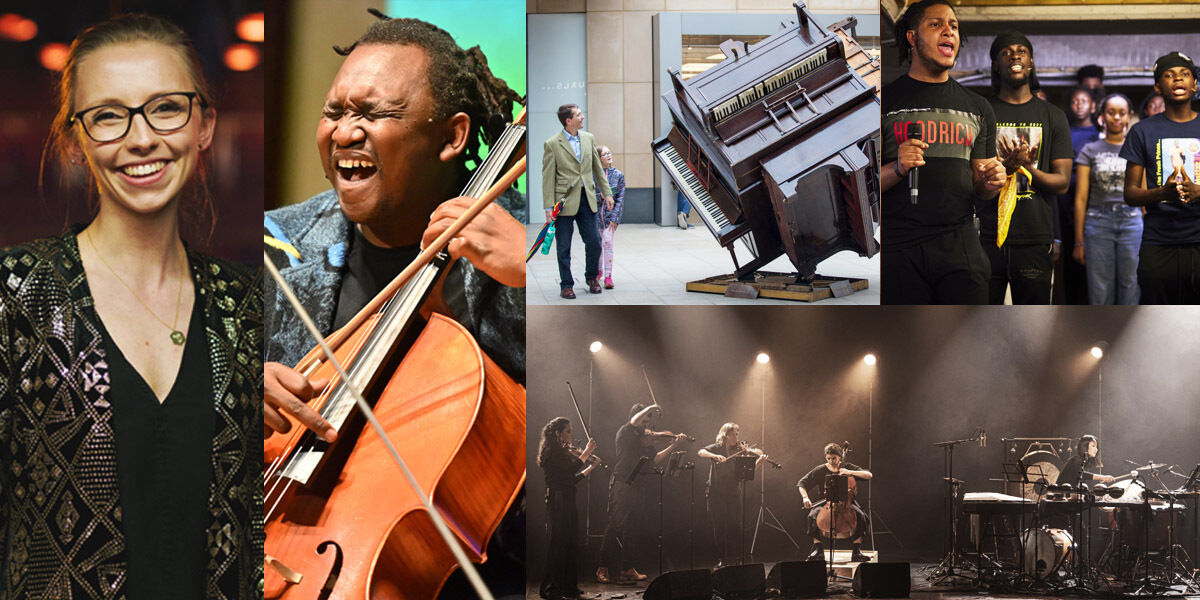
Live review – Royal Philharmonic Society Awards 2023 @ Queen Elizabeth Hall

From left: RPS Awards winners Anna Lapwood, Abel Selaocoe, Leeds Piano Trail, The Endz, Manchester Collective

Queen Elizabeth Hall
2 March 2023

by Ben Hogwood

Timing is everything in music – and as the attendees of the Royal Philharmonic Society Awards unanimously agreed, both the show and its message at the Queen Elizabeth Hall were just what classical music needed.

As RPS chairman John Gilhooly emphasised in his no holds barred opening address, times in the industry are hard. Arts Council England have never been less connected with classical music than they are currently, looking past its versatility and potential to make increasingly bizarre funding decisions. All working in music are affected, from those starting out in education and learning their first instrument to those receiving music as therapy and stimulation for dementia and good mental health. Music, it is clear, should not be treated as a ‘nice to have’ extra. Rather, it is a galvanizing force bringing good into the lives of everyone ready to receive it, as we all saw during lockdown and as we experience from day to day.

Gilhooly’s passionate speech threw down a gauntlet to the government and Arts Council but did so in the spirit of collaboration and community. These two words appeared at regular intervals throughout the evening, which captured a wide range of heartwarming and inspirational work taking place around the country, in spite of these restrictions.

Winners included the Torbay Symphony Orchestra, representative of so many life-giving amateur ensembles around the UK in the joy they bring to so many who take part or spectate. Joy, too, is at the heart of Anna Lapwood’s tireless and effervescent work, the organist deservedly collecting the Gamechanger award for her achievements in bringing the instrument to a whole new audience. Put #playlikeagirl into TikTok or Instagram, and you’ll see what I mean!

The awards, stylishly presented by BBC Radio 3 anchors Petroc Trelawny and Hannah French, captured classical music in so many different forms. Timothy Ridout, a shining viola player of the present and future, credited his Luton and Bedfordshire musical roots as key to the Young Artist Award. Abel Selaocoe won the Instrumentalist Award, the cellist expanding the scope of his instrument to encapsulate non-Western musical traditions. How remarkable that an instrument with such a long history continues to develop.

There were even happy pandemic stories. Theatre of Sound won the Opera and Musical Theatre award, their production of Bartók’s Bluebeard’s Castle born during lockdown and executed in Stone Nest, just off Shaftesbury Avenue in London. Martyn Brabbins, music director of English National Opera, deservedly won the Conductor award for his fearless work with the beleaguered company, in which he continues to form strong connections with his musicians, old and new alike.

The Multi-Story Orchestra won the Impact Award for their searing production The Endz, expressing the feelings of a young Peckham group for the death of teenager Malcolm Mide-Madariola, killed while standing up for a friend in a knife fight. Even the brief excerpt we heard conveyed their strength of feeling, and their acceptance speech confirmed how cathartic music had been in expressing their feelings.

One of the most poignant moments of the night came when Manchester Camerata’s film Untold – Keith (above) earned them the Storytelling Award, confirming once again the power of music to help people cope better with dementia. Meanwhile on the streets Leeds Piano Trail won the Series and Events Award for their strategically placed pianos, bringing more than 200,000 aspiring musicians to the city centre, while composer Gavin Higgins took the Large-Scale Composition Award for his Concerto Grosso, a rousing success at the BBC Proms with the Tredegar Town Band and BBC National Orchestra of Wales under Ryan Bancroft.

The live music in the awards was astutely programmed. Sheku Kanneh-Mason gave a striking excerpt from the Cello Sonata no.2 by Leo Brouwer, written for him and fresh off the page in a first performance. Soprano Anna Dennis, winner of the Singer Award, sang a striking song of Elena Langer, Stay O Sweet beautifully weighted with beautifully floated counterpoint from oboist Nicholas Daniel.

The most distinctive musical voice of the night, however, was that of composer Ben Nobuto. Having won the Chamber-Scale Composition Award for the innovative SERENITY 2.0, and somehow achieving an authentic and wholly original balance between Frank Ocean and Caroline Shaw in the process, he joined Ensemble Award winners Manchester Collective for a performance of Danish folk song Old Reinlender. This was cleverly approached from the first movement of Bach’s Violin Concerto in A minor, the join between the two almost imperceptible but negotiated in joyful, songful music.

Sadly no members of Arts Council England were present to witness any of these musical tonics – it is to be hoped they will listen when the awards are aired on BBC Radio 3 on Monday 6 March. You should listen too, for you will find classical music, in spite of all its challenges, is swimming strongly against the tide.

You can watch the Royal Philharmonic Society Awards on the RPS website within the next week – while BBC Radio 3 will broadcast the ceremony, presented by Petroc Trelawny and Hannah French, on Monday 6 March. Click here to listen

The 2021 Royal Philharmonic Society Awards – saluting musical heroes

written by Ben Hogwood

If an awards ceremony does its job properly, it should provide those attending and watching with lasting feelings of inspiration, hope and even wonder.

The Royal Philharmonic Society Awards did just that at the Wigmore Hall on Monday, recognising some superhuman musical achievements as we dared to think in more hopeful terms of classical music emerging from the pandemic.

Restrictions such as those imposed in lockdown can often bring out the best in creative minds, and the 13 awards made during the evening showed this time and time again. When such minds are backed into a corner, some of the solutions can be truly mindboggling. You can judge for yourself when the Awards are published online next week, and aired on BBC Radio 3 on Monday 8 November (to open in a new window click here)

Perhaps the most striking and wide reaching initiative on show was ENO Breathe, the program set up for sufferers of long-Covid to help with breathing and anxiety, and now rolled out to 50 NHS Trusts across the UK. All the people involved in its creation were rightly acknowledged here, praising a program which has benefited from the expertise of opera singers and colleagues at Imperial College Healthcare:

It was indeed a night to acknowledge the tireless work of those behind the scenes, who effectively enable their organisations or teams to give the appearance of a swan while they work feverishly beneath the surface. Bassoonist Ashby Mayes is a prime example. He gave a bubbly performance of Weber’s Rondo Ongarese with pianist Kumi Matsuo, but then violinist Nicola Benedetti revealed his ‘other’ vocation as technology inventor and troubleshooter as part of The Benedetti Foundation’s online work.

Benedetti rightly added the Instrumentalist Award to her already impressive armoury, for she is a true modern ambassador for classical music. With the ability to face outwards to politicians but also inwards to those at early or difficult stages in their musical journey hers is a consistently inspiring presence.

As the evening progressed it became ever clearer that each category had three nominations that were effectively winners, and they were recognised as such in the excellent presentations from RPS Chief Executive James Murphy, RPS Chairman and Director of Wigmore Hall John Gilhooly and BBC Radio 3 presenter Katie Derham. They all brought a fresh and enthusiastic approach to the awards, sharing with us the delight of simply being in the same room again.

Further inspiration came from Kadiatu Kanneh-Mason, winner of the Storytelling Award for her book House of Music. In revealing just how many publishers had turned down the volume ‘because black people don’t play classical music’ (!) she illustrated just how persistence and endurance can overcome such ridiculous hurdles. Peter Brathwaite, nominated for his Radio 3 program In Their Voices, showed the same thing

Elsewhere there were joyous stories of music making in lockdown, providing solace to everyone. The World How Wide, led by the Chorus of Royal Northern Sinfonia, won the Series and Events Award with a vibrant recasting of Vaughan Williams’ Tallis Fantasia, showing off the region’s natural beauty with a film directed by NOVAK that made you want to be there:

Meanwhile Hilary Campbell and the Bristol Choral Society used online resources in the best possible way to launch a new CD and a Christmas carol competition for new composers. They won the Inspiration award, showing in the process how amateur music making is so important to the mental and physical health of all the country’s musicians. Good CDs can enlighten and inspire us, but first-hand musical experiences can rarely be bettered.

This can be felt throughout the Bold Tendencies initiative in Peckham, Hannah Barry’s transformation of a disused multistorey car park claiming the Gamechanger Award. Dani Howard’s Trombone Concerto, written for Peter Moore and the Royal Liverpool Philharmonic Orchestra, confirmed its status as a powerful new vehicle for the instrument, while Jennifer Johnston won the Singer Award for her artistry and services to the same city. Back online, meanwhile, Vopera claimed the Opera and Music Theatre Award for their vibrant and imaginative digital production of Ravel’s L’enfant et les sortilèges, brilliantly backed by musicians from the London Philharmonic Orchestra:

Other winners – last but certainly not least – included Laura Bowler, who won the Chamber-scale Composition Award for her remarkable work Wicked Problems, the composer performing with bass flautist Ruth Morley at the ‘sound’ festival in Aberdeenshire. Ryan Bancroft won the Conductor Award to supplement his burgeoning reputation with the BBC National Orchestra of Wales, and Edinburgh’s Dunedin Consort capped a year of stellar online music making, including the premiere of Errollyn Wallen’s opera Dido’s Ghost, with the Ensemble Award:

Finally we heard from the Hermes Experiment, winners of the Young Artist Award. This exciting and highly original ensemble comprises soprano (Heloise Werner), clarinet (Oliver Pashley), double bass (Marianne Schofield), harp (Anne Denholm) and co-director Hanna Grzeskiewicz. The group stand for original creation of mostly new music in an open and diverse musical setting. Their contagious love and boundless enthusiasm was at the heart of Pashley’s arrangement of Piazzolla’s Concert d’aujourd’hui, capturing the spirit of a bright and uplifting evening.

Our wholesome congratulations go to all the nominees for the RPS Awards – and indeed to all of those unnamed who did not quite make the shortlist. You are all winners in our eyes!

To learn more about the Royal Philharmonic Society visit their website