

Picture (c) Benjamin Ealovega
Barnabás Kelemen (violin), BBC Symphony Orchestra / Ryan Wigglesworth (above)
Barbican Hall, London / Wednesday 2 March
This typically well-planned BBC Symphony Orchestra concert had a surprise or two in store. Bookending the quartet of works on display were two pieces by Stravinsky – the Agon ballet from 1957 and the Symphony of Psalms.
They provided a good illustration of how Stravinsky changed styles as a composer, and how in spite of that he retained a fascination with older polyphonic styles. Some of the sound worlds in Agon, a set of twelve tableaux for twelve dancers, frequently alighted on melodic figures or chords that felt ‘old’, holding dissonances and deliberately leaving chords unresolved.
Agon is viewed as the work where Stravinsky starts to take his leave from a more obviously tonal approach to composition. In this performance it was lean yet colourful, with excellent solos from leader Stephanie Gonley, mandolin player Nigel Woodhouse, harpist Sioned Williams and Christian Geldsetzer and Richard Alsop, the two BBC SO lead double bass players, who nailed their otherworldly harmonics on each appearance.
The Symphony of Psalms was more obviously outgoing but saved its greatest emotional impact for the quieter music, the closing pages of ‘Omnis spiritus laudet Dominum’ (‘Let everything that hath breath praise the Lord’) from the BBC Symphony Chorus given out with softly oscillating orchestral figures.
Stravinsky uses the lower end of the orchestra in this piece, with no violins or violas, adding extra percussive punch from two pianos – all aspects that Wigglesworth brought forward in a taut performance. Great credit should however go to chorus master Hilary Campbell, who was unfortunately not mentioned in the concert programme. She is clearly popular with the singers, and helped secure that extra degree of accuracy and emotional involvement. One of Stravinsky’s most cinematic scores, it was in this performance a powerful statement of affirmation.
Wigglesworth positioned his own Violin Concerto modestly after the interval – I say modestly as in its five years of existence the piece has already ramped up an impressive number of performances. On this evidence its status is well-deserved, for it is a tightly structured unit of no little tension, the soloist searching for his ultimate melody while the reduced, ‘classical’ orchestra try and find their ultimate tonality.
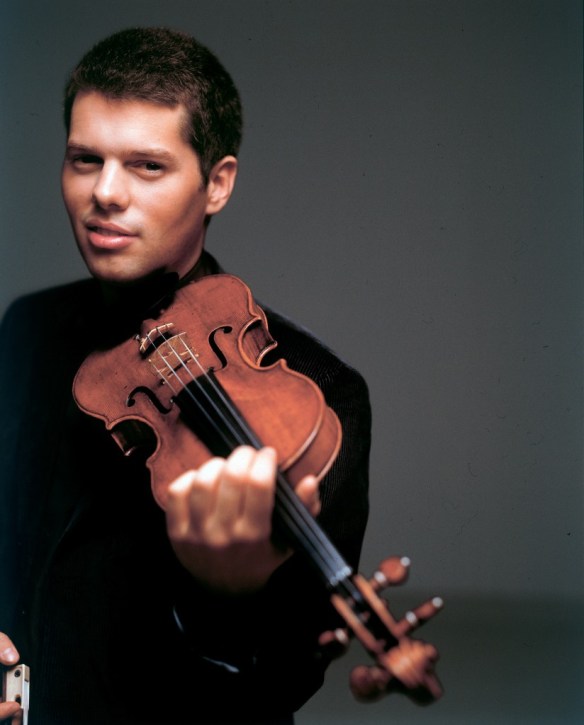
Soloist Barnabás Kelemen (above) was a macho presence, with a little too much testosterone at times when the violin was surging forward, but he balanced that with some incredibly sensitive playing at the quietest moments of the piece, where the audience strained on his every note. Both melody and tonality were resolved in moments that confirmed Wigglesworth as a composer of impressive style and instinct.
The one dud in the program was Britten’s Four Sea Interludes and Passacaglia from the opera Peter Grimes, seen through the visual projections of Tal Rosner. This was a commission from four American orchestras in Britten’s centenary year 2013, with each interlude was set to the images of the city from which the commission came. For its UK premiere Rosner added a portrait of London to go with the other orchestral excerpt from the opera, the Passacaglia. This was centrally placed, keeping the order in which the scenes appear in the opera.
Although well played by the orchestra, the idea sadly fell flat on several levels. Although Britten spent time in America – and indeed began Peter Grimes there – the work’s roots are so entrenched in Suffolk that to suggest anything other than the Aldeburgh coastline through the music feels completely wrong. Rosner’s constructions were skilled, and had a few fine moments where close-up images of the Golden Gate Bridge rotated in technicolour.
Sunday Morning, with its bright building blocks of orchestral colour, was revealed to be a minimalist precursor of the music of John Adams through the clever constructions of its visuals. However despite Britten’s more universal appeal as a composer these days, Peter Grimes surely belongs wholeheartedly in Suffolk – and any suggestion to the contrary, however well intended, feels wrong.


