In concert – Martin Fröst, Janine Jansen, LSO / Gianandrea Noseda: Lost and Found @ Barbican Hall

Martin Fröst (clarinet), Janine Jansen (violin), London Symphony Orchestra / Gianandrea Noseda

Beethoven Leonore Overture no.3 Op.72b (1806)
Beamish Distans: Concerto for violin and clarinet (UK premiere) (2023)
Prokofiev Symphony no.7 in C# minor Op.131 (1952)

Barbican Hall, London
Thursday 20 June 2024

Reviewed by Ben Hogwood Pictures (c) Mark Allan

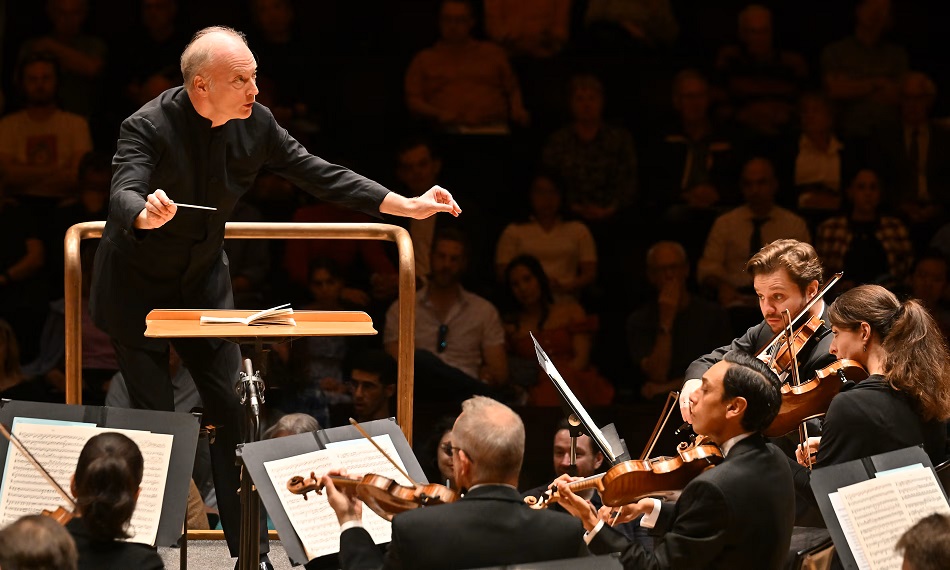
The London Symphony Orchestra and their principal guest conductor Gianandrea Noseda continued their Prokofiev symphony cycle with the elusive Seventh, prefaced by one of Beethoven’s four operatic overtures and a finally realised UK premiere.

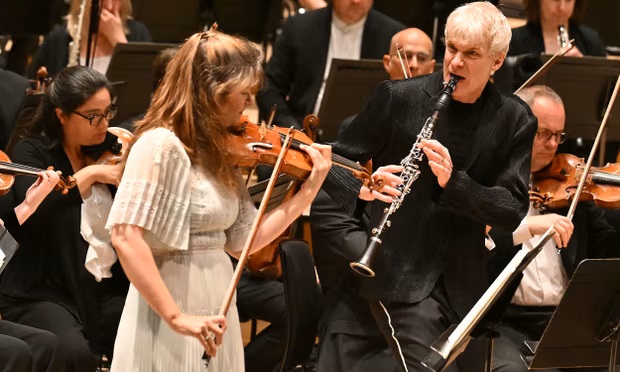
This was Distans, a co-commission between four orchestras for Sally Beamish to write a concerto for the unusual combination of clarinet and violin. Its first performance was delayed due to the pandemic, which became the inspiration for the content of the work. Themes of separation run through the three movements, drawing on the composer’s Swedish and Scottish connections. Separated from her children during lockdown, Beamish also used the forceful musical personalities of soloists Martin Fröst and Janine Jansen (both above) for inspiration.

The two began offstage, however, beckoning to each other across the Barbican Hall as Calling, the first movement, took shape. This was named in the concert notes as ‘kulning’, “the high-pitched singing of women calling the calls on remote pastures”. Beamish’s wide-angle musical lens produced an effective and touching first paragraph, the soloists eventually united on stage in music of the dance, evoking a Swedish fiddle with the full weight and energy of the orchestra in support.

Echoing, the slow second movement, explored more intense feelings of isolation through beautiful scoring, earthy cellos and metallic percussion casting a rarefied light suggesting a Swedish winter. The third movement, Journeying, was powered by an ancient march, the soloists together in spirit and melody, out in the elements with the orchestra. Although the music of beckoning reappeared, the mood was one of reunification, the soloists now at peace and content to remain on stage.

Distans made a strong impact in the hall, and Beamish’s writing for clarinet in her first major piece for the instrument made the most of Martin Fröst’s extraordinary breath control and agility. Jansen also fully inhabited the spirit of the piece, though her part often felt within that of the clarinet, and rarely used the high register. This was definitely a work to hear again, for Beamish’s sound world is a very attractive one in concert.

After the interval, Prokofiev’s Seventh Symphony was given an affectionate performance, yet one that also found the darkness lurking within. One of Prokofiev’s final works, the Seventh was written for the Soviet Children’s Radio Division, and as a result adopts a youthful stance, with commendably little room for nostalgia. Instead the composer gets up to his characteristically witty tricks, with inventive scoring enjoyed by the orchestra as woodwind doubled in octaves, and the piano and harp supplemented lower strings.

The music danced, a reminder of Prokofiev’s balletic qualities. The second movement Allegretto had poise in its first tune but a heavier swagger in the second, suggesting the unpredictable movements of older age – though an impressively powerful and assured close was reached. The following Andante enjoyed rich string colours, together with brilliant individual characterisations from oboe (Juliana Koch) and cor anglais (Clément Noël).

Yet the abiding memories came from two themes used in the outer movements. The first, a sweeping unison for orchestra, lovingly recreates the key and spirit of the composer’s first piano concerto, one of his greatest early successes – and was delivered with great charm here. The second, a cautionary motif from flute and glockenspiel resembling a ticking clock, returned like a regretful memory at the end – reminding this listener of an equivalent moment in Shostakovich’s last symphony, completed nearly 20 years later. It ended this performance on a thoughtful note, in spite of the exuberance that had gone before. The LSO were excellent throughout, presenting a convincing case for the Seventh as a bittersweet triumph, and reminding us in the process of Prokofiev’s abundance as a melodic composer.

Meanwhile Beethoven’s Leonore Overture no.3 began in a more desperate mood of resignation, the opera’s main character Florestan losing all hope in prison. Noseda – fresh from recording a symphony cycle with the National Symphony Orchestra in Washington – has very strong Beethovenian instincts, and paced this just right, with an appropriate hush falling over the hall. As the drama heightened, and an evocative offstage trumpet beckoned, the release from prison led to an outpouring of joy, sweeping us up in its forward momentum. The players were off the leash, enjoying every second.

You can find more information on further 2023/24 concerts at the London Symphony Orchestra website

Published post no.2,216 – Friday 21 June 2024

In appreciation – Maurizio Pollini

by Ben Hogwood. Picture (c) Matthias Bothor / DG

Yesterday we heard the sad news of the death of the great Italian pianist Maurizio Pollini, at the age of 82.

You can read a number of tributes to Pollini, by Barry Millington on the Guardian website and by HarrisonParrott, his agents.

Throughout his career Pollini recorded for Deutsche Grammophon, leaving a succession of remarkable recordings ranging from a famous early collection of the Chopin Etudes through to pioneering modern collections, with a landmark LP of works by Schoenberg and a 20th century collection of Stravinsky, Webern, Boulez and Prokofiev. The playlist below is a personal selection of favourites and a memory from seeing Pollini play Schumann‘s Fantasie in C major at the Royal Festival Hall.

Published post no.2,127 – Saturday 24 March 2024

A quick note: Unknown Prokofiev

by Ben Hogwood

Yesterday lunchtime I listened on BBC Radio 3 to a very fine recital from London’s Wigmore Hall by pianist Elisabeth Brauss. It was a typically inventive hour including music by Beethoven, Albéniz and Prokofiev (above) that you can listen to by clicking on BBC Sounds

The Prokofiev chosen was an early work, a selection of eight pieces from the ten the composer published as Op.12 in 1913. It put me in mind of a huge amount of piano music by the composer that goes under the radar, left in the shadow of the nine piano sonatas and the famous transcriptions from ballets Romeo & Juliet and Cinderella.

Here, then, is a celebration of those pieces – performed by Frederic Chiu. They show the composer getting into his stride, with plenty of wit, but a soft centre too:

Inspired by this discovery, I have gone on to purchase some of the composer’s other collections of pieces, including the Music for Children. I will report back at a later date on those, I expect!

In concert – Cleveland Orchestra / Franz Welser-Möst @ Carnegie Hall: Prokofiev & Webern symphonies

Prokofiev’s trademark technicolour orchestration contrasted with Webern’s sparse score for his Symphony Op.21 performed by the Cleveland Orchestra with Franz Welser-Möst.

Cleveland Orchestra / Franz Welser-Möst

Prokofiev Symphony No. 2 in D Minor Op. 40 (1924-1925)
Webern Symphony, Op. 21 (1927-1928)
Prokofiev Symphony No. 5 in B-flat Major, Op. 100 (1944)

Carnegie Hall, United States
Sunday 21 January 2024

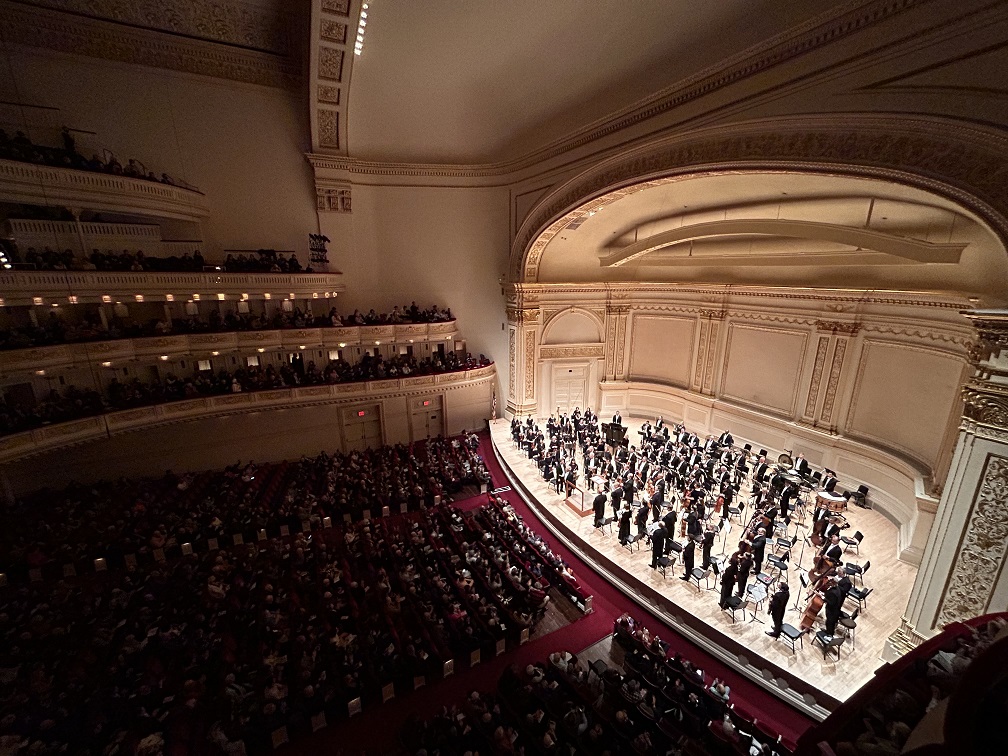
Reviewed by Jon Jacob. Photo (c) Jon Jacob

Most concerts start with some kind of concert opener. An overture, for example, gives the band on stage the opportunity to get accustomed to the acoustic with an audience in it, while giving the audience a chance to settle down before the main event. That the Cleveland Orchestra got underway so deftly with the epic industrial landscape of Prokofiev’s Second Symphony immediately hinted at the kind of concert this would turn out to be. 

Conducted by their music director, Austrian conductor Franz Welser-Most, the Cleveland Orchestra presented three works as part of Carnegie Hall’s ongoing series examining the fall of the Weimar Republic: two symphonies by Russian composer Prokofiev, contrasted with Webern’s Symphony for chamber ensemble. 

Prokofiev’s Second Symphony, written in 1924 and premiered in Paris in 1925, is an epic work brimming with fiendish detail and tantalising textures. The first movement’s brutal industrial landscape is depicted with a gargantuan, lumbering brass section, piercing brass top lines, and occasionally shrill woodwind. The combination did at times cause the person sat next to me at Carnegie Hall to put her fingers in her ears. This was contrasted by a tender oboe solo at the beginning of the short second movement theme, followed by a series of short variations which saw a remarkable range of colours and textures from the strings and woodwind. This was a polished, confident and assertive performance throughout, right from the start.  

In contrast, the material in the Prokofiev’s Fifth Symphony, written in 1944 when the composer had returned to the Soviet Union, is lighter and the treatment of it far more playful, energetic and in places vigorous. In the performance, the orchestra sometimes sounded underpowered meaning things felt overly romantic. The second movement Allegro had spirit and bounce, moving through multiple personalities and moods, cheerful, cheeky and, from to time, just a hint of macabre too, though, like the final movement, it did feel like it lacked a bit of grit. After Franz Welser-Most paused for a police siren to disappear out of earshot down 7th Avenue, the third movement opened with tantalizingly papery strings over which the solo was passed effortlessly between different combinations of woodwind instruments whilst still making everything feel whole. Later we heard rich, warm, heart-tugging string sounds (the leaps in the upper strings got me every single time).

Webern’s ‘miniature’ ten-minute, two-movement Symphony, written three years after Prokofiev’s Second Symphony, could have sounded like an academic curiosity in comparison to the Russian composer’s technicolour orchestration. Yet in this concert, Webern’s Op. 21 acted as a palette cleanser, pivoting us from the epic Second to the more box-office appealing Fifth of Prokofiev’s symphonies.

Special praise to Cleveland’s principal clarinet Afendi Yusuf, whose rounded burgundy tone was simply to die for. A gorgeous sound throughout. Excitable applause also for some fruity queues from bass clarinetist Amy Zoloto and contrabasoonist Jonathan Sherwin.

Further listening

Some recommended recordings to listen to are based simply on the final movement allegro which in the case of Herbert von Karajan’s Berlin Philharmonic recording is a tour-de-force. On the other hand, in Valery Gergiev and the London Symphony’s performance, there’s a crazed sense of menace. In concert, Franz Welser-Most seemed to pull out a more playful character in the final movement and this is also reflected in the Cleveland’s 2023 recording under his direction. I’m always going to prefer the unhinged characterisation, but that probably says more about my character than it does about the performance.

Meanwhile the Cleveland Orchestra recorded Webern’s Symphony as part of an album devoted to the composer’s orchestral music, under their former music director Christoph von Dohnányi in 1998.

Jon Jacob is a writer, digital content producer and strategist, authors the Thoroughly Good Classical Music Blog, and produces the Thoroughly Good Podcast.

Published post no.2,064 – Monday 22 January 2024

In concert – Fazil Say, CBSO / Kazuki Yamada: Prokofiev, Saint-Saëns & Rachmaninoff

Fazil Say (piano), City of Birmingham Symphony Orchestra / Kazuki Yamada

Prokofiev Symphony no.1 in D major Op.25 ‘Classical’ (1916-17)
Saint-Saëns Piano Concerto no.2 in G minor Op.22 (1868)
Rachmaninoff Symphonic Dances Op.45 (1940)

Symphony Hall, Birmingham
Wednesday 4 October 2023

Reviewed by Richard Whitehouse. Picture (c) Fethi Karaduman

French and Russian music has dominated the start of this season by the City of Birmingham Symphony Orchestra, this afternoon’s programme continuing the trend with early pieces by Prokofiev and Saint-Saëns heard alongside Rachmaninoff’s last and arguably greatest orchestral work.

Prokofiev consigned two earlier such pieces as juvenilia prior to his Classical Symphony, an infectious refit of Haydn in the early 20th century and calling-card for a career that beckoned in the West. If Kazuki Yamada slightly over-egged the humour in the opening Allegro, as too a rather self-conscious take on the Gavotte, the limpid phrasing of the intervening Larghetto was as disarming as was the interplay of wind and strings in the Finale – a reminder, here as throughout, that such musical directness should not be mistaken for mere technical facility.

This could be said of the Second Piano Concerto that Saint-Saëns unleashed on an evidently nonplussed Parisian audience half-a-century earlier. True, the conflation of Bach – given a makeover worthy of Alexander Siloti – with Liszt affords the opening movement an almost makeshift design, but Fazil Say took it firmly in hand from a surging ‘chorale-prelude’ to a tersely decisive coda. A pity his pianism was not applied a little more deftly in the ensuing intermezzo, its ingratiating poise smothered by an almost hectoring insistence, but the final Presto suited this most demonstrative of present-day virtuosi to a tee – its perpetuum mobile undertow maintained with unflagging resolve through to those almost brutal closing chords. Credit to Yamada for enhancing the total effect with his astute and precise accompaniment.

Say, as much composer as pianist, responded to the applause with his Black Earth – a study in sonority alluding to the golden-age of Turkish balladry as well as the Saz (a Turkish lute) in a mood of sombre fatalism which, unlike his orchestral epics, did not outstay its welcome.

The CBSO has given frequent performances over the decades of Rachmaninoff’s Symphonic Dances, but none so incendiary. Not that there was anything overly powerhouse in Yamada’s conception of an initial piece whose outer sections felt trenchant in their energy, with the alto saxophone melody at its centre eloquently given by Kyle Horch and the coda rendered with melting grace. Nor was any lack of suavity in the central piece, its underlying waltz motion poised on a knife-edge of sardonic humour rightly given its head in the hectic closing pages.

Yamada had the measure, too, of the last piece with its dramatic introduction and impulsive continuation, but it was in the lengthy central episode this reading really came into its own – the composer creating music of an intoxicating expression via subtleties of harmonic nuance or textural shading rather than any defining melodic line. From here, impetus was seamlessly restored to a climactic emergence of the Dies irae plainchant then surged on to the explosive closing gesture that might have resounded longer had the audience not unreasonably erupted.

Yamada responded with Lezginka from Khachaturian’s ballet Gayane. An exhilarating close to an afternoon as began for early arrivals with what sounded like a medley from a mid-1970s children’s TV show on the first-floor performance space: it could only be here in Birmingham.

You can read all about the 2023/24 season and book tickets at the CBSO website. Click on the artist names for more information on pianist Fazil Say and conductor Kazuki Yamada