
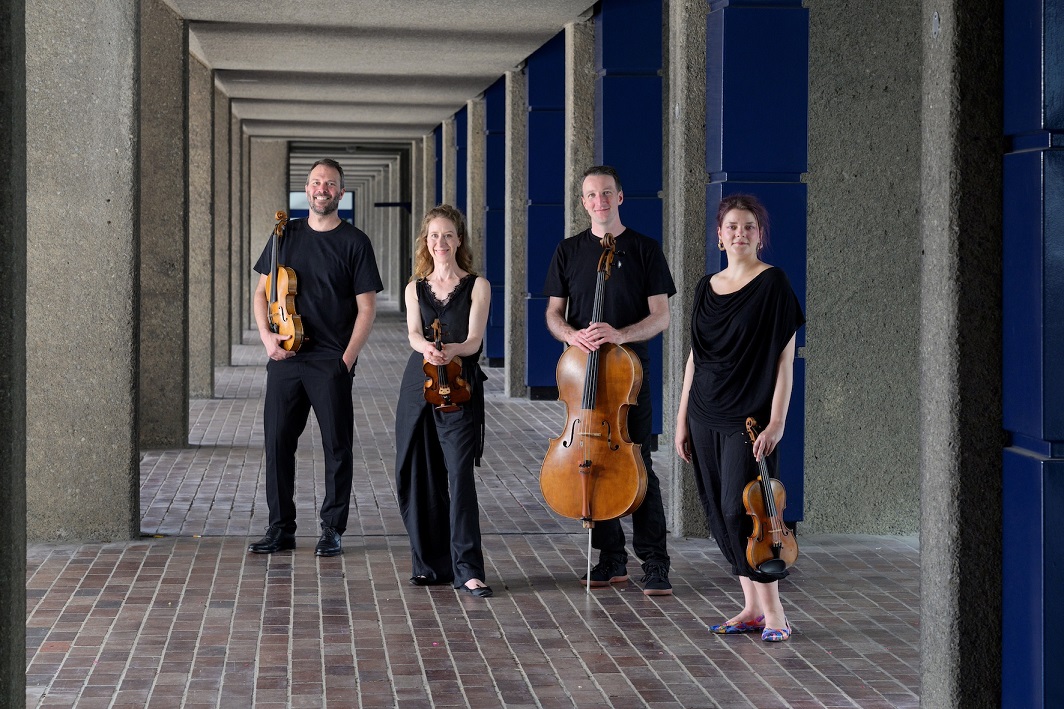
In concert – Heath Quartet @ London Chamber Music Society, St John’s Church Waterloo – Haydn, Bacewicz, Locke & Beethoven

Heath Quartet [Maja Horvat & Sara Wolstenholme (violins), Gary Pomeroy (viola), Christopher Murray (cello)]

Haydn String Quartet in G major Op.33/5 ‘How Do You Do?’ (1781)
Bacewicz String Quartet no.6 (1960)
Locke Suite III in F (c1660)
Beethoven String Quartet no.16 in F major Op.135 (1826)

St John’s Church, Waterloo, London
Sunday 28 September 2025, 6pm

Reviewed by Richard Whitehouse

This early evening concert marked not just the start of London Chamber Music Society’s new season but also that of its first at St John’s Waterloo, following some 17 seasons in residence at King’s Place. The actual programme, however, could not have been more typically LCMS.

What better than to start with a Haydn quartet? His Op. 33 abounds in ‘less is more’ writing, not least the fifth in this set whose buoyant opening Vivace features a cadential figure which provides the nickname, then a Largo whose keening melody for first violin and cadenza-like passage betrays likely operatic origin. The Heath Quartet was equally inside the Scherzo with its amiable impulsiveness, while the final Allegretto had a genial humour that carried through to its good-natured payoff. A piece deserving of greater prominence within the Haydn canon.

As does the Sixth Quartet in Grażyna Bacewicz’s output. Evidently a breakthrough in terms of her writing for strings, its stealthy yet never brazen Modernism is clear from the opening movement in its subtle overhaul of sonata design, then the Vivace with its intensive rhythmic interplay. A ‘song without words’ centred on cello, the slow movement is a soulful interlude prior to a final Allegro as makes inventive play with rondo design – the widening expressive gulf between its stable refrain and its unpredictable episodes deftly sidestepped at the close.

Purcell’s music for consort might be the most directly acknowledged precursor of the string quartet, but that by Matthew Locke is hardly less significant and preceded it by almost two decades. This third of his six four-part suites is no exception – the substantial and teasingly discursive Fantasia being followed with an elegant Courante and a soulful Ayre then a (surprisingly?) trenchant Saraband. Throughout, the Heath’s seamless interplay was such as to relativize any distinction between a consort of viols and the ensemble of strings it became.

An ensemble taken to a peak of perfection on the cusp of the Romantic era with Beethoven’s last string quartet. Here the Heath judged the equable poise of its opening Allegretto then the quixotic humour of its scherzo to perfection. Neither was there any lack of feeling in a slow movement whose pathos becomes the greater for its understatement; the ‘difficult decision’ that informs the finale duly rendered with a sure sense of this music’s venturing towards its playful conclusion. Beethoven was rarely so profound as when he was being this disarming. A persuasive start to a new season and a new chapter in the illustrious history of the LCMS. A wide range of recitals is scheduled between now and June, while those unfamiliar with St John’s need have no doubt as to the excellence of its acoustic or attractiveness of its setting.

Click on the links for more information on the Heath String Quartet, the London Chamber Music Society and events at St. John’s Church, Waterloo. You can also click for more on composer Grażyna Bacewicz

Published post no.2,676 – Friday 3 October 2025

In concert – Southbank Sinfonia / Rebecca Miller: Discovering Dorothy Howell

Southbank Sinfonia / Rebecca Miller

St John’s, Waterloo, London
Thursday 19 September 2019

Dorothy Howell
The Rock Overture (1928)
Divertissements (1950)
Humoresque (1919)
Koong Shee Ballet (1921)

reviewed by Ben Hogwood
photo credit (Rebecca Miller) Richard Haughton

It remains an acute embarrassment to classical music that even today it is still so male-orientated when it comes to composers and conductors in particular. Happily measures are in place to address the imbalance, which means that not before time Dorothy Howell (1898-1982) gets some of the attention her music should have been getting 100 years ago. Great credit for this should go to the Southbank Sinfonia and their associate conductor Rebecca Miller, a devotee of the composer who had led the orchestra in a week-long exploration of her music, working with members of Howell’s family.

The result was an hour of music making that everyone enjoyed. It has been a while since I have watched an orchestra with so many smiles, yet still on their game. There were many smiles as Miller teased the syncopated dance rhythms out of the music, revelling in the composer’s nickname of ‘the English Strauss’.

Such a nickname is a little dangerous, as it immediately brings parallels to the waltz, and a tendency toward lighter entertainment rather than anything substantial. With that in mind it should be pointed out that Howell’s output of 150+ works includes a Piano Concerto (recorded by Miller and her husband, pianist Danny Driver, for Hyperion) and some substantial chamber music.

Dorothy Howell (above)

This ‘rush hour’ concert began with an overture / tone poem. The Rock, contrasting with Rachmaninov’s moody symphonic work of the same name, still felt like a place for nature to let itself go. Bright woodwind and an expansive orchestral picture transported us out onto the windswept coast, where attractive flute melodies and tonal harmonies combined to give a breezy outlook. There were a few pitfalls below the surface, Howell occasionally hinting at something darker in the lower strings, but this was a persuasive and energetic account.

Next we heard the Three Divertissements, a short but appealing work with its roots in the dance. Published as Howell’s last orchestral work, its three movements are each in triple time, furthering the Strauss connections – but in the first one working a nice line in syncopation to make the beat elusive for even the keenest of dancers. Rebecca Miller (below) enjoyed these, dancing on the podium herself, and the players clearly did too, with the heat haze created by the strings in the slow second dance particularly memorable. Clarinet, flute, oboe and cor anglais once again excelled, with a special mention for triangle and tambourine, putting the finishing touches to a performance with a smile on its face and a spring in its step.

The short Humoresque was cut from the same cloth, but the Koong Chee ballet felt much more substantial. Based on a Chinese crockery pattern, the work derived from a plot in a lush garden, with a lake populated by pelicans and flamingos, and with the daughter of the owner promised in marriage falling instead for the gardener. Lovestruck, she was swept away – or not, as the case may be, for Howell left an elusive ending.

The colours of this work would have resonated with those who enjoy the Eastern-leaning orchestral works of Holst or John Foulds, but again Howell’s edge could be felt with the light rhythmic touch she was capable of adding. In Miller she had the most passionate advocate, the conductor admitting in her introduction that it is an ambition to stage the work with dancers one day.

That would be an enjoyable experience, for her introduction was ideal and gave us helpful pointers for the point in the story where the woman is imprisoned (Rebecca Watt’s cor anglais solo was heartfelt here) or when the woman’s father shoots at the gardener, his two arrows hitting their target where the percussion were concerned.

My interpretation of the ending would be that it was bittersweet, the father regretting his decision to shoot the arrows but exonerated as the gardener did not die. At least, that’s what the music told me – for once again it was a colourful and committed account that fired the imagination.

The Southbank Sinfonia should be applauded for their dedication to Howell’s cause, their dedication and enthusiasm creating a wholly enjoyable concert. The welcome to audience members should also be praised, creating an environment where concert-goers new and old are equally welcome. More power to their elbows!

Danny Driver and Rebecca Miller recently released their recording of Dorothy Howell’s Piano Concerto on Hyperion, with more details below: