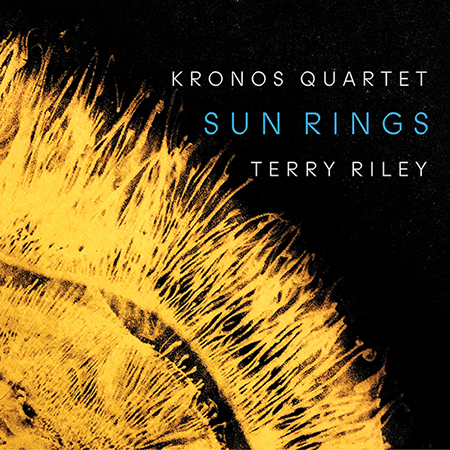
In concert – Sacconi Quartet & Festival Voices: Earth Unwrapped – Terry Riley’s Sun Rings

Sacconi Quartet [Ben Hancox, Hannah Dawson (violins), Robin Ashwell (viola), Cara Berridge (cello]; Festival Voices [Lucy Cronin, Ana Beard Fernández, Lucy Goddard, Sam Jenkins, Michael Craddock, Oskar McCarthy] / Greg Batsleer; Brett Cox (electronics)

Riley Sun Rings (2002)

Hall One, Kings Place, London
Thursday 16 January 2025

by Ben Hogwood Pictures courtesy of Monika S Jakubowska / Kings Place

A sobering thought: in the course of this concert, the NASA spacecraft Voyager 1 travelled another 60,000 miles away from the Solar System.

Quite how far it will travel in the course of the Kings Place festival Earth Unwrapped remains to be seen, but by that time audiences will have enjoyed a wide array of musical and visual treats, all designed to heighten awareness of the plight in which we find ourselves here on planet Earth.

Such thoughts were close to the surface throughout Sun Rings, an ambitious start to the festival. The substantial work was completed by Terry Riley in 2002, the result of an approach made by NASA to the Kronos Quartet. They wanted to create a work based on recordings of ‘space sounds’ (plasma waves) from Voyager 1 made by Professor Donald Gurnett. Riley had these transferred to audible audio frequencies in order to mark 25 years since the spacecraft was launched, at the same time contemplating the place of humanity in the universe. Since Sun Rings was completed, Voyager I has passed from the Solar System to interstellar space.
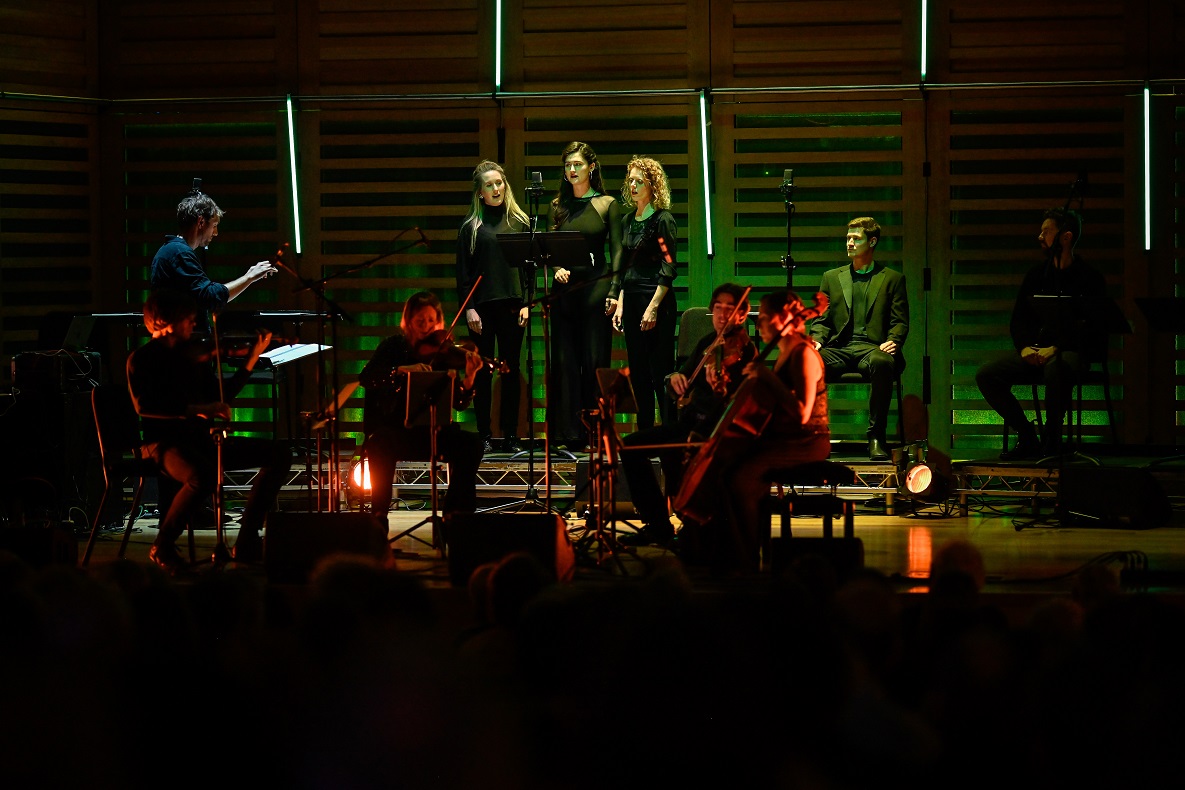
The Kronos Quartet released their recording of Sun Rings in 2019 (reviewed by Arcana here), and until now were the only ensemble to have played the piece in public. This UK premiere from the Sacconi Quartet and Festival Voices changed that, an illustration of the ever-growing reach of ‘minimalist’ music. The twelve assembled on stage performed heroically, the unbroken span of ten movements lasting 90 minutes yet delivered with flair, poise and no little emotion.

The music was prefaced by words from Riley himself, a stamp of authenticity and gratitude from the 90-year-old composer. It was the first of many audio clips carefully managed by Brett Cox, whose contributions were crucial to the success of the performance. Chief among these were the audio translations of the Voyager craft itself, converted by Riley from spectrographs. They provided an industrial edge to the sound – reminiscent of Voyager contemporaries Cabaret Voltaire – and were alternately eerie and consoling in their different sound worlds. As the audience sat in the dark the notion of being on our own journey was inescapable, a reminder that our own planet moves even quicker than Voyager 1 itself.

The quartet made a strong start, bolstered by colourful percussion. The Overture, Hero Danger and Beebopterismo sections had rhythmic vitality, complemented by the electronics and samples. Towards the halfway mark however the momentum and intensity flagged, the notion of deep space now all around us but feeling more oppressive. Time stood relatively still in the eerie Earth / Jupiter Kiss section, though Riley’s musical intensity flagged before being re-energised by the Festival Voices. The excellent singers brought expression and impetus to Earth Whistlers and Prayer Central, but on occasion it was difficult to hear some of the words, the singers’ pitch aligned with the frequency of the audio recordings.

The most powerful music, ironically, was the slowest and the most restrained. The coda, One Earth, One People, One Love, became a deeply felt meditation, the singers whispering under their breath as they moved slowly to the exit in an inspired piece of choreography. The pensive strings remained, adding their commentary to recorded spoken word, whose statements could not have been more apt.

As I write this, the news of alarming carbon dioxide levels in the Earth’s atmosphere serves as a reminder of our changing world, hurtling towards the environmental precipice. This stark reality check confirms Earth Unwrapped to be arguably the most important arts festival in London this year – and this was an auspicious start.

For more information on the Earth Unwrapped festival, head to the Kings Place website. Click on the artist names for Sacconi Quartet and Festival Voices, and composer Terry Riley. You can visit NASA to find out where Voyager 1 and Voyager 2 are now

Published post no.2,415 – Saturday 17 January 2025
Switched On: Ambient Focus – Terry Riley & Cornelius

by Ben Hogwood

It is relatively rare for Arcana to recommend a radio program, but we are more than happy to make an exception for this rather wonderful two-hour slot. Taking the reins are Cornelius and Terry Riley, with two hours of ‘handpicked tracks curated in collaboration…featuring field recordings made in Kyoto by radio producer and sound artist Nick Luscombe. This Ambient Focus special celebrates the Ambient Kyoto Festival (2023), featuring performances by Terry Riley and Cornelius, both based in Japan.

There is a delicate intensity to the first two tracks we hear from Sleepy Dragon and Raymond Scott, before the beautiful Dream from Ryuichi Sakamoto. Riley’s own Journey From The Death Of A Friend picks up a compelling, understated momentum, as does the colourful orchestration of Toumani Diabeté’s Elyne Road in the hands of the London Symphony Orchestra. To be continued…with ever more adventurous work from John Zorn, Bill Frisell, Julien Lage and Gyan Riley (The Forking Path), Terry Riley (The Harp Of New Albion), and Jon Hassell (the gorgeous if haunting Last Night The Moon Came). The mix moves to beatific waters with Cornelius’ own Dream In The Mist and Kaitlyn Aurelia Smith’s Milk, finishing with restrained, thoughtful and exotic music from La Monte Young and Marian Zazeela, The Well-Tuned Piano in the Magenta Lights.

You can listen to the mix on BBC Sounds until the end of the year, here

On record – Kronos Quartet & Terry Riley: Sun Rings (Nonesuch)

Written by Ben Hogwood

What’s the story?

The Kronos Quartet and Terry Riley have a rewarding history of collaboration covering more than 35 years. Sun Rings is surely one of the most emotive pieces in that history, and is certainly one of the most performed since its premiere in 2002. Here it receives a first full recording.

The work dates back to a commission from NASA, who were looking to mark the 25th anniversary of the launch of the Voyager 1 space probe. They specifically wanted to know if the Kronos could use the ‘space sounds’ collected from the Voyager crafts by physics professor Don Gurnett, who developed plasma wave instruments to receive them. On hearing the results Kronos leader David Harrington immediately contacted Terry Riley to get him on board.

While writing in New York, Riley was interrupted by the World Trade Center attacks of 11 September 2001. They inspired him to turn the focus of his work to peace.
This is the first recording of Sun Rings in its entirety, a chance for those in more than 50 countries who have already experienced it live to hear it in recorded form. Weighing in at nearly 80 minutes, it is a big work, expanding the quartet by adding San Francisco-based vocal ensemble Volti to two of the longest sections, Earth Whistlers and Prayer Central.

What’s the music like?

Fascinating, and timeless in a way that suggests the deep space into which the Voyagers continue to travel. There is a restless edge too, as it seeks the lasting peace Riley had in mind.

After the space sounds set the work in perspective, Hero Danger is a rewarding combination of the otherworldly electronics and the string quartet, with thoughtful lines suggesting a slightly worrisome contemplation. In response Bebopterismo carries urgent anxiety in its angular melody, the music put on edge.

Riley’s musical language is interesting, never purely ‘minimalist’ but repeating his more distinctive melodic ideas. There are rather beautiful dovetails between violin and viola halfway through Planet Elf Sindoori, but just when the ear thinks the sonorities of Sun Rings have been fully established, Earth Whistlers comes as quite a surprise.

It is here the choir are introduced, and this substantial movement makes much of their pure tones. It does perhaps distract from the subject at hand, replicating in a way the interruption of the September 11 attacks on Riley’s thoughts. When we train our gaze fully on Voyager again with The Electron Cyclotron Frequency Parlour there is an intriguing displacement between the close up quartet sound and atmospherics further away, but the focus has shifted.

Prayer Central, the most substantial movement, is soft and contemplative but becomes more animated and off the beat. Venus Upstream is full of anxiety, as though time is limited, its tension spiked by the alarm in the background. The spoken quote from Alice Walker to begin the last section is telling, asking, “Do you really know where you are at this point in time and space and in reality and existence?” It is just the right side of preaching, helped by some lovely cello playing from Sunny Yang.

Does it all work?

Most of the time, though with the caution that for maximum effect the piece is best heard in full and in a quieter place. Then the field recordings really come through to the front. Sun Rings is a substantial piece of work, though there are some natural dips in inspiration once the ideas of each section have been exposed. The use of the choir may split opinion too.

Is it recommended?

Yes. For those following the Kronos Quartet and Terry Riley it is an essential purchase, while providing further evidence of the positive effect astronomy can have as a creative stimulus, not to mention the endless drive for world peace. Between them Riley and the quartet have looked outside of the box to create something unique and, on this evidence, a major work that will last in spite of a few reservations.

Listen

Buy

You can get Sun Rings from the Nonesuch website

John Tejada

john-tejada

John Tejada is a well established and highly respected techno musician – but his roots lie in an upbringing full of classical music. Arcana called him on a break from work in his California studio, where he wrote his tenth album Signs Under Test, released on Kompakt this month.

He spoke about the benefits of a musically open family, how that led him to hone his own approach to music, and why he loves the music of Steve Reich. But first, after a quick listen…

Can you remember your first encounter with classical music?

My first memories were from my parents, with my mother being an opera singer and my father a clarinettist and conductor. I would often get dragged around to gigs! One of my first memories was seeing them practice, and that made it very real. I think that probably that programmed me into the routine of how you get up, have breakfast and then practice, and that has stuck with me right through to this day. It was a big influence in what I do now.

There are often moments in your music where you are subtly very inventive, using unusual rhythms and less conventional harmonic patterns. Does that stem from your upbringing do you think?

I suppose it does, but I couldn’t properly explain it. It’s one of the different ways I got to where I am now. My focus is not on getting played out by DJs but it is an enjoyment of listening to what feels interesting. Getting the fuzzy feeling, that’s what I’m after!

What does classical music mean to you?

I wouldn’t say that ‘classical’ music means a great deal to me, as I tend towards the stuff that the more modern composers did, I would go with my mum to see Steve Reich concerts; we’d go to see that stuff together. I don’t actively listen to the classic stuff, but because opera was always on at full blast in the house I got to hear a lot of it. It gave me an interesting perspective on what music is and what it can do. It has stuck with me the whole way through.

The categorisation of what is classical music has always puzzled me. The early works of Stockhausen are classical but today sound like something like that could be released on Torch Records! Looking back, it’s pretty wild what was going on in the 1950s and 1960s compared to what people do today.

Is Steve Reich a big influence on your work?

Absolutely. One of the biggest goose bumps I have ever had was going to see the Music for 18 Musicians live for the first time:

You start to see that live, and you say “Holy shit, it’s real!” It flared up a real love of the music in me. No-one bothered to notice that on my last album The Predicting Machine there is a strong nod to Reich on the fourth track, Winter Skies:

Reich was so revolutionary in the way he showed people could have ideas of just using tape loops. He was a massive influence on digital music today with the loops and the phase experiments – he laid the fundamentals to what people are still doing now. I would love to see Music for 18 Musicians performed on synths, I think that would be really successful.

What would you say classical music – as you listen to it – and techno have in common?

I think a lot of stuff! I really enjoy making those connections. I think classical music – and the music of Reich – refers to looped and non-looped music that is beatless. The question for techno is ‘Can you do that with a beat?’ For me though the fundamentals of techno and drone are laid down without a beat. Terry Riley and Steve Reich discovered that. It is an interesting connection there, but I find a lot of people won’t give it a chance. It’s like eating a vegetable. There are times when I won’t explore because I just don’t know.

What do you know and like at the moment?

I am a big fan of Terry Riley, because he is one of those great composers who cross into other areas. In his album A Rainbow in Curved Air he used music in a way that would give Autechre a run for their money:

I also think early Art of Noise records are really interesting, you have people trying stuff out – because why not? I remember when I was listening to some of this stuff at home, and being nearly asleep but being scared silly at the same time! We had some really interesting radio in the mid-1980s, and I was absorbing some crazy stuff.

I remember one time when one of my friends came round who was writing some particularly experimental stuff. He was playing that new stuff for me, which was a real risk for him playing it at full blast. Mum came in and said, “What are you playing, it’s really interesting – it sounds like…” and then she named three different composers. It wasn’t the standard request to turn it down at all!

Would you like to try writing more classically based music?

I have done some more experimental things on labels like Plug Research, but yes – I do have an idea to do something that is modern classical. We’ll see how that develops!

John Tejada’s new album Signs Under Test is out now on Kompakt – and you can listen to it on the label’s website here. For more about the artist himself, visit his Facebook page