
On Record: Don Banks: Vocal and Chamber Music (Toccata Classics)

Don Banks
Horn Trio (1962) a
Five North Country Folk Songs (1953) b
Prologue, Night Piece and Blues (1968) c
Three Studies (1954) d
Piano Sonatina in C sharp minor (1948) e
Violin Sonata (1953) f
Tirade (1968) g

(bg) Jenny Duck-Chong (mezzo-soprano), (c) Francesco Celata (clarinet), (a) Robert Johnson (horn), (af) Ole Böhn (violin), (d) Geoffrey Gartner (cello), (g): Rowan Phemister (harp), David Kim-Boyle (siren), Alison Pratt, Daryl Pratt, Joshua Hill (percussion), Daniel Herscovitch (piano)

Toccata Classics TOCC0591 [81’34″]

Producer David Kim-Boyle Engineer David Kinney

Recorded (cdf) 21 September (ag) 24 September and (be) 5 November 2020 at Recital Hall West, Conservatorium of Music, Sydney

Reviewed by Richard Whitehouse

What’s the story?

Toccata Classics provides a strong case for the greater recognition of Don Banks (1923-80) with this release of a representative cross-section of vocal and chamber works, performed by Australian and Australia-based musicians who are never less than empathetic with his music.

What’s the music like?

Wholly neglected following his untimely death, Banks was a senior figure in the generation of Australian composers – featuring such as Malcolm Williamson, David Lumsdaine and Nigel Butterley – who posited a decisive if hardly uniform course for the country’s music during the post-war era. Based in London for two decades, he made a living through teaching (notably at Goldsmith’s College) or writing music for horror films (notably Hammer productions), while evolving an increasingly personal language which can be heard in those works included here.

Earliest is the Piano Sonatina whose three movements – an agile Allegro, pensive Largo that nimbly amalgamates elements of fugue and chorale, then an impulsive Risoluto – constitute no mean statement of intent. It was the Violin Sonata which Banks considered his Op. 1, its pithy if contrasted ideas drawn into intensive development that effortlessly sustains a single movement whose 15 minutes seem never less than eventful. More unexpected is his identity with traditional sources in Five North Country Folk Songs (written for Sophie Wyss no less), whose piano accompaniments enhance the sentiment of each text with deadpan humour and audible affection. Reflecting his time spent with Dallapiccola (and, by extension, Webern), Three Studies for cello and piano applies its serial thinking both deftly and resourcefully.

By the 1960s, Banks had fashioned an idiom that was demonstrably but never slavishly of its time. One of the finest instances is the Horn Trio that, for all its inherent abstraction, pursues a tangible emotional trajectory from its forceful opening Allegro, via an Adagio of no mean eloquence, to a final Moderato in which the work’s arresting slow introduction is transformed through hunt-like gestures. Conversely, Prologue, Night Piece and Blues for Two underlines his love for jazz and its deployment within a ‘third stream’ context; here, the music’s restraint affords a sultriness alluring and ominous. Tirade could hardly be more different – its setting of Peter Porter’s impassioned poem on the increasing commercialization of Australian culture notable for a virtuoso vocal part and its imaginative writing for a sizable array of percussion.

Does it all work?

Almost always. Banks took a compositional path that assuredly takes no prisoners, yet which is rarely less than engrossing and, on occasion, affecting. Almost all these pieces would stand up well in recital today, not least for the opportunities they provide to enterprising performers. Other than the concertos for horn and violin (Lyrita), few of his major works are available in modern accounts, and if Toccata could undertake or even licence recordings of his orchestral Divisions or such cross-genre conceptions as Nexus and Meeting Place, so much the better.

Is it recommended?

Very much so. These performances, rarely less than authoritative, are heard to advantage in a spacious but never diffuse ambience. Daniel Herscovitch contributes detailed and informative annotations, and this release hopefully marks a first stage in the rediscovery of a major figure.

Listen & Buy

For buying options, and to listen to clips from the album, visit the Toccata Classics website. For more information on Don Banks, click here

On Record: Sherban Lupu – The Unknown Enescu Vol. 2 (Toccata Classics)

Enescu
Romanian Rhapsody no.1 in A major Op.11/1 (1901, arr. 1957)
Impressions roumaines (1925, arr, 2008)
Sonata Torso in A minor (1911)
Impromptu concertant in G flat major (1903)
Regrets in G flat major (1898, compl. 2018)
Adagio in B flat major Op.3/3 (1897, arr. 1929)
Valse lente ‘L’Enjôleuse’ (1902)
Caprice Roumain (1925-49, compl. 1994-6)

Sherban Lupu (violin) with Viorela Ciucur (piano); Sinfonia da Camera / Ian Hobson (Caprice Roumain), Ian Hobson (piano, Romanian Rhapsody)

Toccata Classics TOCC0647 [72’52″]

Producers / Engineers Florentina Herghelegiu, Christopher Ericson (Romanian Rhapsody), Jon Schoenoff (Caprice Roumain)

Recorded 7-8 April 2022 at George Enescu Auditorium, University of Music, Bucharest, 2 February 2001 at Krannert Center for Performing Arts, Urbana, Illinois (Caprice Roumain), 15 March 2004 at Krannert Art Museum, Champagne Illinois (Romanian Rhapsody)

Reviewed by Richard Whitehouse

What’s the story?

The expansion and enrichment of George Enescu’s catalogue has been in progress for several decades. Toccata Classics now issues a follow-up of works realized by others, posthumously published or performed in unfamiliar arrangements, all featuring the violinist Sherban Lupu.

What’s the music like?

Enescu’s early output charts a steady incline from precociousness to mastery, evidenced by the melodic poise of the Adagio from his First Piano Suite arranged by violinist Sandu Albu, or a fragmentary transcription of the bittersweet piano waltz Regrets as completed by Lupu. L’Enjouleuse might well have been a hit had its composer chosen not to publish it under the pseudonym ‘Camille Grozza’, its smouldering pathos in contrast to the objectified elegance of Impromptu concertant which was intended as a test-piece for the Paris Conservatoire.

Much the most significant among these earlier items, Sonata Torso belongs to a sequence of unfinished or unpublished pieces from between the First and Second Symphonies (1905-12) that find Enescu reassessing and extending his musical idiom. For all its prolixity, as would have made further movements unfeasible, this yields a wealth of tonal and harmonic incident within its rarefied ambit. Realized by Lupu from extensive sketches, Impressions roumaines makes for an invigorating entrée into the Third Violin Sonata for which this was preparation.

Lupu was also the catalyst behind Caprice Roumain on which Enescu intermittently worked for almost a quarter-century and the nearest he came to a violin concerto in his maturity. As completed by Cornel Țăranu, its compact design takes in a sombre and often ominous initial Moderato, a lightly sardonic scherzo modelled on the hora, a Lento of understated eloquence then a final Allegro whose synthesis of folk and art elements resembles Bartók in procedure if not aesthetic. Happily, this realization is increasingly being taken up by younger violinists.

Opening the collection with the First Romanian Rhapsody might seem unnecessary given its popularity over more than 120 years, yet this arrangement by composer and violinist Marcel Stern remains little known despite being published 65 years ago. The initial stages faithfully recreate the instrument interplay of Enescu’s original, and though the heady continuation can only hint at its scintillating orchestration, what results is a bravura concert-piece in its own right. Duo partnerships everywhere could do worse than try out this version in their recitals.

Does it all work?

Pretty much. This is a collection which, drawn from various sources and recorded at several locations, is given focus by the commanding presence and unstinting advocacy of Lupu. His playing may not be technically immaculate, though it does convey the essence of Enescu’s increasingly personal language; not least in Caprice Roumain, which he previously recorded with Cristian Mandeal (Electrecord) and to which this is a more than worthy successor. Ian Hobson’s credentials in Enescu hardly need restating, and neither do those of Viorela Ciucur.

Is it recommended?

Yes. Those who are primarily interested in the Caprice should investigate David Grimal’s superb account with Les Dissonances (La Dolce Vita) but this release, enhanced by detailed notes from Valentina Sandu-Dediu, makes a valuable addition to the Enescu discography.

Listen & Buy

For buying options, and to listen to clips from the album, visit the Toccata Classics website. For information on the artists, click on the names of Sherban Lupu and Ian Hobson

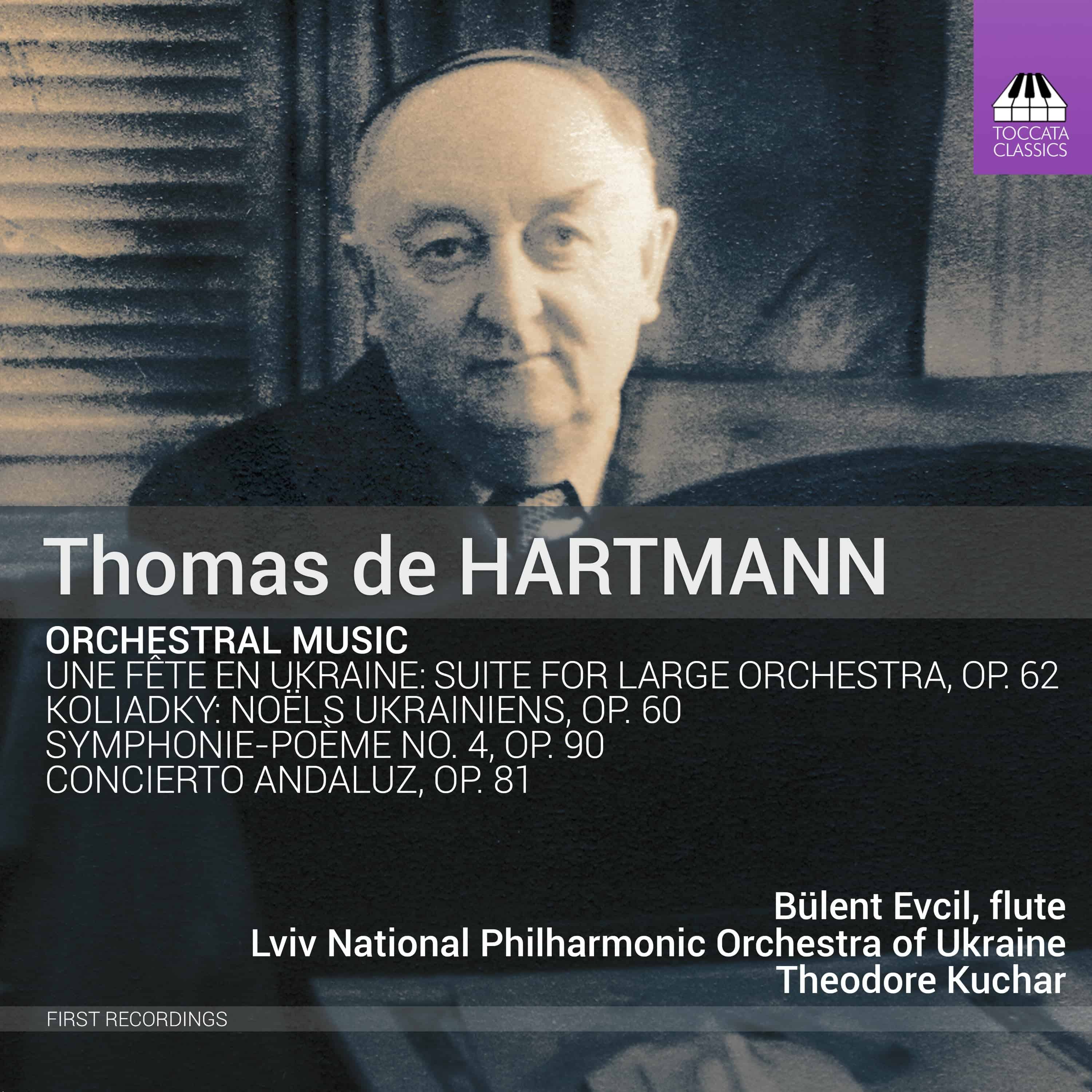
On Record – Bülent Evcil, Lviv National Philharmonic Orchestra of Ukraine / Theodore Kuchar – Thomas de Hartmann: Orchestral Music (Toccata Classics)

Thomas De Hartmann
Koliadky – Noëls Ukrainiens Op.60 (1940)
Une fête en Ukraine Op.62 (1940)
Concierto Andaluz Op.81 (1949)
Symphonie-Poème no.4 Op.90 (1955)

Bülent Evcil (flute), Lviv National Philharmonic Orchestra of Ukraine / Theodore Kuchar

Toccata Classics TOCC0633 [65’43″’]
Producer Andriy Mokrytskiy Engineer Oleksii Grytsyshyn
Recorded 11-13 September 2021 at National Philharmonic Hall, Lviv, Ukraine

Reviewed by Richard Whitehouse

What’s the story?

Toccata Classics continues its explorations with this release of orchestral music by Thomas de Hartmann (1885-1956), his posthumous reputation largely centred on his association with the Armenian philosopher George Gurdjieff but whose own music is well worthy of revival.

What’s the music like?

Although the Noëls Ukrainiens might appear as the descendent of folk-inspired sets by such as Rimsky-Korsakov or Lyadov, de Hartmann seeks rather to evoke the essence of this music than by quoting traditional melodies. The initial Chant spiritual for strings is a pertinent case in point – its textural and expressive restraint characteristic of what follows, notably the more developed final numbers: the chorale-like solemnity of La veille de l’Épiphanie, simmering fervour of Adieu, Koladá and Mussorgskian vigour of Goussak for an effervescent ending.

In his later years de Hartmann tackled the symphonic genre, albeit from a typically personal vantage in his Symphonie-Poèmes. The fourth of these remained unfinished at his death, with only its initial movement fully orchestrated. Over little more than five minutes, it provides a fair encapsulation of the composer’s later thinking – not least through an elaborate and often imaginative orchestration which accentuates formal obliqueness and expressive disjunctions. Intriguing as it is to speculate what came next, this remains a cohesive statement as it stands.

Written for Jean-Pierre Rampal then taken up by equally illustrious flautists such as Marcel Moyse, the Concierto Andaluz packs a considerable amount into its 10 minutes. Whether in the plaintive lyricism of the Entrada y Romanza, the fleet-footed and capricious Scherzino that is Juego – its winsome trio providing for necessary contrast, or the sultry evocation of Cante y Juerga, this is something of a hidden gem from the repertoire of concertante works for flute and deserving of greater exposure. Bülent Evcil leaves no doubt as to his advocacy.

Arranged from an eponymous ballet celebrating Catherine the Great, Une fête en Ukraine is de Hartmann at his most engaging. Not least the festive Ouverture, with its antecedents in the Russian ‘silver age’, or regal eloquence of Fanfare et Sarabande. The final three items are most substantial – the suitably fanciful imaginings of Incantation et danse du Chamane, the plangent modality of Nocturne, then the panache of Danilo Coupor (an English dance popular among Russian nobility in the early 19th century) which brings a scintillating close.

Does it all work?

Pretty much. That all four of these pieces are from de Hartmann’s maturity means that such influences as there were of earlier composers, primarily the melodicism of Tchaikovsky and harmonic innovations of Rimsky, have been subsumed into a more astringent while always eventful idiom. Both the shorter pieces would make attractive additions to a concert, and the larger collections each feature several items that are worth encountering in their own right – maybe as encores to round-off a programme from one of the more enterprising orchestras.

Is it recommended?

Yes, not least with the Lviv National Philharmonic giving of its best under the astute direction of Theodore Kuchar. Unexceptionally fine sound, with exceptionally detailed annotations from John R. Mangan and Evan A. MacCarthy. A follow-up volume of de Hartmann is imminent.

For more information on this release, and for purchase options, head to the Toccata Classics website. More on Thomas de Hartmann can be found here – while you can click on the artist names for more on Bülent Evcil, Theodore Kuchar and the Lviv National Philharmonic Orchestra of Ukraine

On record – William Wordsworth: Orchestral Music Vol.4 (Toccata Classics)

wordsworth-4

Liepāja Symphony Orchestra / John Gibbons

William Wordsworth
Jubilation Op.78 (1965)
A Spring Festival Overture Op.90 (1970)
Confluence Op.100 (1976)
Symphony No. 7, Op. 107, ‘Cosmos’ (1980)

Toccata Classics TOCC0618 [59’21”]

Producer Normands Slāva
Engineer Jānis Straume

Recorded 4-5 February and 16-18 June 2021, Amber Concert Hall, Liepāja, Latvia

Written by Richard Whitehouse

What’s the story?

Toccata Classics continues its survey of William Wordsworth’s orchestral music with a fourth volume featuring the composer’s Seventh Symphony, alongside three other pieces that reflect his increasing concentration and refinement of thought during those latter decades of his life.

What’s the music like?

If the Fifth Symphony and Cello Concerto (recorded on TOCC0600) represent a highpoint of Wordsworth’s orchestral output, the works that follow are only relatively less ambitious and equally personal. The four heard here appeared at five-year intervals. Subtitled ‘A Festivity for Orchestra’, Jubilation is akin to a ‘concerto for orchestra’ in its intensive while unshowy pursual of those possibilities inherent in its opening fanfare-like idea; one which returns near the close of this engaging piece to provide a rounding-off of good-humoured decisiveness.

A Spring Festival Overture is even more self-contained in its demeanour, though the gradual emergence of activity out of the sombre introduction is a telling metaphor for the coming of this season and the musical discourse attracts attention purely through its dexterity of thought.

Had Confluence been Wordsworth’s ‘sixth symphony’, no-one could surely have doubted its rightness given this music’s motivic density and textural subtlety. As it is, these ‘Symphonic Variations’ are a notable staging-post in the composer’s odyssey towards ever more distilled expression – the variations proceeding as distinct yet interrelated episodes where most of the instruments have a soloistic spot. The penultimate section, with its allusion to Elgar’s Violin Concerto, finds Words worth at his most felicitous and the final build-up at his most visceral.

Scored for comparably sizable forces, the Seventh Symphony continues a process of formal elaboration across a single, unbroken span – its seven sections less a series of variations as a succession of paraphrases on ideas which are nothing if not rarefied. Appropriate, then, that its ‘Cosmos’ subtitle should embody a lifelong fascination with the universe – whether in its astronomical or spiritual dimensions. Inclusion of a prepared tape suggests something more radical than is the case – pre-recorded material limited to two slowly repeating string chords that recur at crucial formal and expressive junctures to channel underlying momentum over   a course inevitable as to its ultimate destination. Paul Conway’s booklet note implies this as being Wordsworth’s most original orchestral work and the present writer would not disagree.

Does it all work?

Yes, though this is not the place to start for anyone new to Wordsworth’s music (the previous instalment with the Fifth Symphony makes for an ideal point of entry). Playing the works in chronological order (rather than Opp. 90, 107, 78 and 100 as on this disc) reveals ever greater focus on motivic essentials allied to an understated while often questing harmonic sense that may have reflected their composer’s immersion in the Scottish East Highlands or the wisdom accrued with age, yet the experience feels never less than absorbing and sometimes profound.

Is it recommended?

Indeed. The playing of the Liepāja Symphony Orchestra is comparable to that on earlier volumes, while John Gibbons directs with his customary ear for detail and care for balance. Hopefully a fifth volume, perhaps including the hitherto unheard Sixth Symphony, will not be long in coming.

Read, listen and Buy

You can read Richard’s review of the first three volumes in the Wordsworth series on Arcana, clicking here for the first volume, here for the second and here for the third

You can listen to clips and purchase this disc from the Toccata Classics website. For more information on WIlliam Wordsworth, click here. For more on the performers on this recordings, click on the names for websites devoted to John Gibbons and the Liepāja Symphony Orchestra respectively.

On record: Steve Elcock: Orchestral Music, Volume Three (Toccata)

elcock-3

Steve Elcock
Symphony No. 6 Op.30 ‘Tyrants Destroyed’ (2017)
Symphony No. 7 Op.33 (2020)
Manic Dancing Op. 25 (2015)

Marina Kosterina (piano, Manic Dancing), Siberian Symphony Orchestra / Dmitry Vasiliev

Producer/Engineer Sergei Zhiganov
Recorded 21-25 June 2021, Philharmonic Hall, Omsk

Toccata Classics TOCC0616 [75’54”]

Reviewed by Richard Whitehouse

What’s the story?

Toccata Classics continues its survey of Steve Elcock’s orchestral music with a third volume that features two of his most recent symphonies alongside his piano concerto malgré-lui, each demonstrating a visceral immediacy and a quixotic individuality as previously encountered.

What’s the music like?

After the Beethovenian dialectic of his Fifth Symphony, Elcock concentrated on smaller scale projects prior to its successor. Cast in two movements (the first slightly longer), this might be felt to emulate another totemic Fifth, that by Nielsen, but Elcock’s Sixth is a wholly different proposition. The opening Molto moderato unfolds incrementally and even hesitantly from its subdued beginnings on lower strings, so making the baleful climactic processional the more unnerving when it suddenly arrives. Nor does the ensuing Allegro bring any real catharsis – its gradual and methodical build-up (via that cumulative harmonic and rhythmic intensifying found in Pettersson but which Elcock has made his own) at length culminating in a vehement peroration which would seem to fulfil the remit of this work’s subtitle in unequivocal terms.

Three years on and the Seventh Symphony sees a very different approach. Here every aspect speaks of intended equivocation, the single movement redolent of Elcock’s Fourth in variety of incident yet eschewing its tonal and textural complexity for an overt transparency abetted by relatively modest instrumentation and modally informed clarity of content. Vestiges of an expanded sonata design can be sensed in the stealthy alternation of slower and faster tempos, leading to a central developmental crux as brings in its wake less a reprise than the statement of a melody evidently heard in a dream but whose eloquence and poise seem nothing if not tangible. From here the music heads back towards its modal origins, then it evanesces away for what is the deftest and most affecting conclusion in any of Elcock’s symphonies thus far.

Placed between these symphonies as (necessary) shock-absorber, Manic Dancing is another of Elock’s concertante pieces. The integration of piano and orchestra recalls the Sinfoniettas Giocosa and La Jolla by Martinů, even if the febrile velocity of its outer Allegros could hardly be mistaken for urbanity. The central Largo in the emotional heart in every sense – its limpid opening offset by a restiveness to the fore in twin climaxes, with cadenza-like facets emerging out of the texture before the animated music resumes its designedly manic course.

Does it all work?

Indeed, not least in underlining the overt distinctiveness of Elcock’s symphonies as taken on their own terms. As before, the playing of the Siberian Symphony Orchestra leaves nothing to chance in bringing out the sheer imagination and richness of the orchestral writing, with Dmitry Vasiliev ensuring that formal cohesion remain paramount. Marina Kosterina contributes animated and resourceful pianism, and those who have responded positively to earlier volumes in this series (TOCC0400/0445) will be gripped or maybe even a little disconcerted by this latest addition.

Is it recommended?

Yes, not least with sound of clarity and impact comparable to earlier instalments, and detailed notes from Francis Pott. Toccata will hopefully continue its series of Elcock’s chamber music, while the English Symphony Orchestra has recorded his Eighth Symphony for future release.

Listen

Buy

For further information, audio clips and purchase information visit the Toccata Classics website. For more on Steve Elcock you can visit the composer’s website