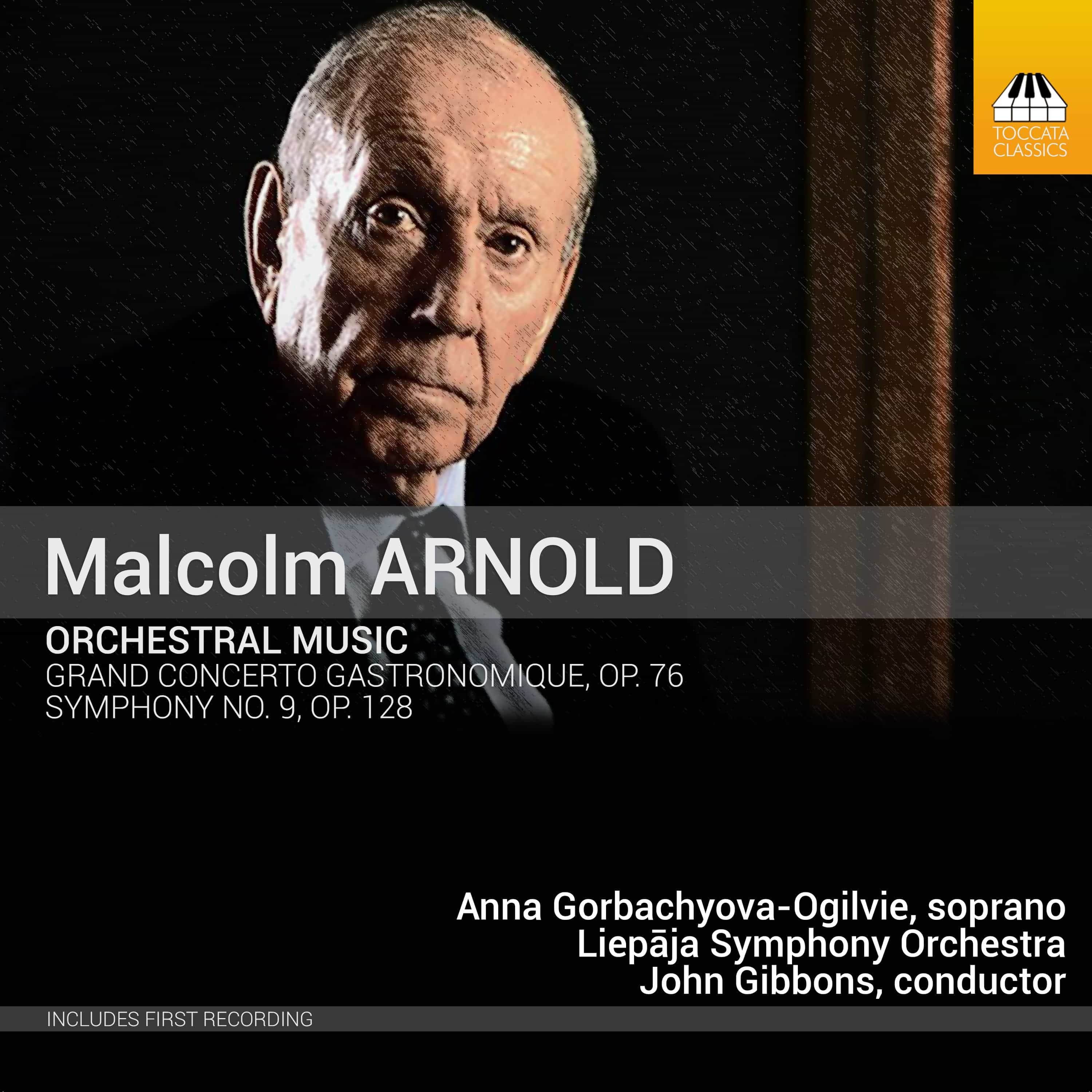
On record – Arnold: Symphony no.9 & Grand Concerto Gastronomique (Liepāja Symphony Orchestra / John Gibbons) (Toccata Classics)

toccata-arnold

Malcolm Arnold
Grand Concerto Gastronomique Op.76 (1961)
Symphony no.9 in D Op.128 (1986)

Anna Gorbachyova-Ogilvie (soprano, Concerto), Liepāja Symphony Orchestra / John Gibbons

Toccata Classics TOCC0613 [57’30”]

Producer Normands Slāva
Engineer Jānis Straume

Recorded 14-16 June 2021 at Great Concert Hall, Liepāja

Written by Richard Whitehouse

What’s the story?

Toccata Classics marks the centenary of Malcolm Arnold’s birth (falling on October 21st) in a pertinent coupling of his final symphonic statement with music finding this composer at his most irreverent and, by so doing, juxtaposes the two sides of his creativity to startling effect.

What’s the music like?

It was the compositional hiatus resulting from emotional breakdown then tortuous recovery as provided the catalyst for the Ninth Symphony, whose superficial simplicity belies the anguish beneath its surface. John Gibbons (who had earlier conducted this work in London, as part of a nine-year Arnold cycle, and Northampton) brings tangible expectancy to the opening Vivace, its arresting initial gestures soon revealing that textural starkness which goes on to define the whole work, with a circuitous evolution even more marked in the Allegretto – an intermezzo whose wistful theme effects less a series of variations than poignant searching for formal and expressive closure. The ensuing Giubiloso is more overtly a scherzo with its headlong motion or trenchant exchanges between wind and strings, yet even here a curious detachment prevails.

Arnold’s eight previous symphonies each concluded in a relatively short and decisive finale, but the Ninth’s final Lento proves anything but – its sustained slowness abetted by restrained dynamics and a sparseness of detail which could have made for unrelieved gloom were it not for those myriad ‘shades of grey’ the composer draws from his reduced palette. An additional factor is Gibbons’s pulse for this movement as a tactus (one-second) rather than crotchet beat, leading to a traversal several minutes less than earlier recordings by Andrew Penny (Naxos), Vernon Handley (BMG) or Rumon Gamba (Chandos) and, as a result, making the cadential chord one of benediction than resignation. Whether or not this approach convinces depends on how one views the symphony overall, but there can be no doubting its sincerity of intent.

Composed for the Astronautical Music Festival – the last of several events inspired by Gerard HoffnungGrand Concerto Gastronomique is Arnold at his most uproarious. Its designation ‘for Eater, Waiter Food and Large Orchestra’ betrays a visual aspect not essential for enjoying this 15-minute consumption of Brown Windsor soup, roast beef, cheese, Peach Melba – with a sensuous cameo by soprano Anna Gorbachyova-Ogilvie – then coffee with brandy; framed by a Prologue and Epilogue of due portentousness, but thankfully no ‘Mr Creosote’ in evidence.

Does it all work?

As a coupling, yes. As to content, the Ninth Symphony will likely always divide opinion as to whether it is what Arnold intended or merely the best that he was able to achieve after the traumas of the preceding decade, but no-one could accuse Gibbons of realizing it as other than a cohesive entity whose formal proportions are as precisely judged as its expressive trajectory is purposefully conveyed. Listeners not convinced by those earlier recordings should certainly hear this new account, lucidly and persuasively rendered by the Liepāja Symphony Orchestra.

Is it recommended?

Yes, enhanced by thought-provoking booklet notes from Timothy Bowers along with realistic sound. Should still-missing orchestral pieces by Arnold (notably the Op. 1 First Divertimento or the Op. 12 Symphonic Suite) come to light, Gibbons will hopefully be asked to record them.

Listen

Buy

You can discover more about this release at the Toccata Classics website, where you can also purchase the recording. You can read more about the Malcolm Arnold society at their website, while for more on each of the performers, click on the names Anna Gorbachyova-Ogilvie, Liepāja Symphony Orchestra and John Gibbons

On record – Weinberg: Complete Violin Sonatas Volume Three (Yuri Kalnits & Michael Csányi-Wills) (Toccata Classics)

weinberg-violin-sonatas

Mieczysław Weinberg
Violin Sonata no.3 Op.37 (1947)
Violin Sonata no.6 Op.136bis (1982)
Solo Violin Sonata no.3 Op.126 (1979)

Yuri Kalnits (violin), Michael Csányi-Wills (piano)

Toccata Classics TOCC00096 [60’36”]

Producers Yuri Kalnits, Michael Csányi-Wills
Engineer Rupert Coulson

Recorded 9-12 July 2016 at St John’s Fulham, London; 7-8 July 2020 at K Studios, London (Solo sonata)

Written by Richard Whitehouse

What’s the story?

After a lengthy hiatus, Toccata Classics duly continues its series devoted to the violin sonatas by Mieczysław Weinberg with this third volume featuring two further sonatas with piano and the last of his solo sonatas – in performances comparable to those on the earlier two volumes.

What’s the music like?

It is a measure of how the Weinberg discography has grown that, in the decade or more since this cycle commenced, all the composer’s violin sonatas have now been recorded on several occasions. Good, then, that Toccata has opted to see it through as the interpretative stance of Yuri Kalnits and Michael Csányi-Wills is a persuasive one – not least for the subtlety of its interplay between violin and piano such as underlines the increasingly and flexibly idiomatic nature of Weinberg’s writing for a medium that remains problematic whatever its popularity.

With the Third Sonata (1947), Weinberg achieved an all-round assurance as is evident from the flexible handling of content within each of these progressively longer movements. Thus, the moderately paced initial Allegro exudes a purposefully provisional feel, fulfilled by the central Andantino with its achingly expressive deployment of Jewish folk elements, before being intensified in the final Allegretto cantabile that moves adeptly between eloquent and energetic ideas prior to a Lento coda which brings the work deftly and movingly full-circle.

Unlike its predecessors the Third Solo Sonata, dedicated to the memory of the composer’s father, unfolds as a continuous span which, though it can be viewed as several interrelated movements, is more akin to variational episodes on the motives heard at the outset. As if to underline this audacity, the writing for violin is the most resourceful and imaginative to be found in in any of these pieces – a heady succession of mood and textures such as reaffirms Weinberg’s technical and creative mastery when confronting apparent restrictions head-on. 

Weinberg abandoned the duo medium in the late 1950s and when the Sixth Sonata emerged, it went unacknowledged until 2007. Yet a work dedicated to the memory of his mother must have held a deeply personal significance. The initial Moderato, where the instruments come together only at the centre and are framed by an anguished prologue for violin then resigned epilogue for piano, speaks of intensely subjective emotion – as do the elegiac central Adagio and a finale which surveys previous material in a more consoling if ultimately fatalistic light.

Does it all work?

Yes, not least given the widely differing concept that underlies each piece (further proof that Weinberg repeated neither himself nor other composers), as well as the undemonstrative yet searching approach of the performers. Others may favour the commanding rhetoric of Linus Roth (Challenge Classics) or the forthright incisiveness of Stefan Kirpal (CPO), but the more understated manner of Kalnits and Csányi-Wills likely brings out the inward intensity of this music more completely. As a cycle for repeated listening, it should prove difficult to surpass.

Is it recommended?

Indeed, abetted by almost perfect instrumental balance and detailed notes by David Fanning. A fourth volume – which, other than the early Three Pieces, might feature the Sonata for Two Violins and Gidon Kremer’s arrangement of the 24 Preludes for cello – is keenly anticipated.

Listen

Buy

You can discover more about this release at the Toccata Classics website, where you can also purchase the recording. You can read more about Yuri Kalnits here, and more about Michael Csányi-Wills here

On record – Alexander Tchaikovsky: Orchestral Music Volume One (Siberian Symphony Orchestra / Dmitry Vasiliev) (Toccata Classics)

alexander-tchaikovsky

Alexander Tchaikovsky
Symphony no.3 Op.75 (1995-2002)
Symphony no.7 Op.139 ‘Quarantine Symphony’ (2020)

Siberian Symphony Orchestra / Dmitry Vasiliev

Toccata Classics TOCC0587 [60’12”]

Producer Vadim Dedik
Engineer Adaq Kahn

Recorded in live performances: 19 May 2019 (Symphony no.3), 20 September 2020 (Symphony no.7) at Philharmonic Hall, Omsk

Written by Richard Whitehouse

What’s the story?

Toccata Classics continues to investigate those paths lesser trod with this first instalment of symphonies by Alexander Tchaikovsky, likely the leading composer of the older generation in Russia, whose music is directly and audibly in the lineage of his geographical forebears.

What’s the music like?

Born in Moscow in 1946, Alexander Tchaikovsky is a nephew of composer and pianist Boris – but, in contrast to the latter’s selective output, has built an extensive catalogue featuring 14 operas (in addition to operettas and musicals) and three ballets, alongside numerous concertos and (to date) seven symphonies that frequently evince an illustrative or at least programmatic aspect. This is borne out in music highly evocative in import if without loss of that formal or expressive focus needed to sustain the two, wholly different, abstract arguments pursued here.

With its lengthy gestation and opulent instrumentation, the Third Symphony is a key work in the composer’s output. Its minimalist aspects occasioned more by Nielsen or Prokofiev than any post-war figure, the initial Allegro opens stealthily as its main theme gradually comes to the fore – tension increasing through a series of dissonant outbursts towards a massive climax across the orchestra that subsides into a sombre close. The central Allegro molto is described as ‘‘essentially a sequence of waltzes’’, which indicates its motion but not its stark emotional contrasts and violent denouement. It remains for the final Andante, proceeding without pause, to attempt a reconciliation; its furtive gestures opening-out onto a sustained expression whose restive and volatile content does not pre-empt the inexorability of the waltz music at the close.

Its title referring to the COVID-19 pandemic that occasioned its compact design and smaller forces (strings with percussion and piano), the Seventh Symphony comprises two movements. The first of these alternates between a plaintive Andante and trenchant Allegro molto, which latter gradually comes to the fore in a conclusion of unbridled abandon. Almost twice as long, the Adagio unfolds on the lines of a ‘prelude and fugue’ – the initial section sustaining a rapt eloquence that is intensified after the strings’ airy ascent and the commencement of the fugue in its methodical while deeply felt progress towards a fervent close. It is worth noting that the composer himself contracted the virus soon after completing this work – and which duly led to his missing the premiere in Omsk – but from which he has fortunately made a full recovery.

Does it all work?

For the most part, yes. This is music governed by the impulses as brought it to fruition, such that its underlying logic can be difficult to discern even on repeated hearings, while ensuring that a sense of destination – and arrival thereat – is never absent. The playing of the Siberian Symphony Orchestra is up to the standards of earlier releases for this label, Dmitry Vasiliev bringing a discipline and cumulative momentum to the often lengthy individual movements. There is little evidence of audience ‘presence’ in what are designated as live performances.

Is it recommended?

Indeed. The sound conveys the impact of these symphonies (the Third in particular) with no lack of immediacy, and there are insightful notes by pianist and composer Jonathan Powell. Hopefully more volumes of Alexander Tchaikovsky’s orchestral music will be forthcoming.

Listen

Buy

You can discover more about this release at the Toccata Classics website, where you can also purchase the recording. You can read more about Alexander Tchaikovsky here, and more about conductor Dmitry Vasiliev here

On record – Livia Teodorescu-Ciocănea: Le rouge et le noir (Romanian National Opera / Răsven Cernat) (Toccata Classics)


TOCC_0595

Teodorescu-Ciocănea
Le rouge et le noir (1999-2000)

Mihaela Stanciu (soprano), Romeo Cornelius (countertenor), Chorus and Orchestra of Romanian National Opera / Răsven Cernat

Toccata Classics TOCC0595 [75’25”] Synopsis included

Producers Florentina Herghelegiu, Erika Nemescu
Engineer Alexandru Părlea

Recorded 11-15 June 2000 at studios of Romanian Radio Broadcasting Corporation, Bucharest

Written by Richard Whitehouse

What’s the story?

Toccata Classics here continues its coverage of Livia Teodorescu-Ciocănea (b1959) with the ballet Le rouge et le noir, whose frequently lurid scenario allows her orchestral prowess and range of invention full rein – making for a musical experience cohesive almost despite itself.

What’s the music like?

Alongside a distinguished academic career (her PhD in composition was undertaken at the University of Huddersfield), Teodorescu-Ciocănea has amassed a sizable output that ranges across all the main genres. Her music has been compared to that of Horaţiu Rădulescu and Ştefan Niculescu in its usage of ‘spectral’ elements, but its expressive character is arguably closet to that of Pascal Bentoiu with its pivoting around post-romantic and modernist traits. Appropriate, then, for a ballet score complementing its subject-matter in no uncertain terms.

In her introductory essay, the composer describes Stendhal’s novel upon which this ballet is based as a ‘‘powerful and romantic one’’; which might almost be thought euphemisms for a scenario in which histrionics are emphasized to the point of – and even beyond – overkill. All is revealed in her track-by-track synopsis, but maybe this is a score best tackled – at least on first hearing – minus the distractions of Stendhal’s narrative with its cumbersome symbolism or mostly unsympathetic protagonists; one that culminates in a disingenuously tragic outcome.

Appreciating this ballet ‘in the abstract’ is facilitated, moreover, by the theatrical immediacy of its music. Structured in three acts, framed by a prologue and epilogue, it draws the listener through the story with no inherent longueurs (the ballet initially lasted for around 95 minutes, which Teodorescu-Ciocănea has reduced to its present 75 through withdrawing the numbers ‘‘that seemed to me redundant or transitional’’). Highlights are the second half of Act Two’s first scene – a propulsive passacaglia set in the mayor’s house; the subsequent scene, with its plangent and evocative love-duet set at Vergy; the brief while potent Passion Tango in Act Three’s second scene; and the Epilogue which brings about the denouement with a fervour and a dramatic inexorability that comprehensively transcends the narrative which inspired it.

Does it all work?

For the most part, yes. Listeners might well be advised to tackle the music straight off, rather than study the scenario beforehand. In the (understandable) absence of the visual component, this is a piece best evaluated on its own terms; without the cringing element of melodrama as derived from Stendhal, yet another of those ‘classics’ novels which has rightly been relegated to an academic footnote in history. The present performance surely presents this work to best advantage – vocalists Mihaela Stanciu and Romeo Cornelius eloquent in their contributions, and Răsven Cernat securing a visceral response from the forces of Romanian National Opera. The track-listing gives immediate access to each scene in the three acts, while Joel Crotty’s biographical outline is invaluable given the almost complete absence of material in English.

Is it recommended?

Yes, in the hope Toccata will go on to release examples of Teodorescu-Ciocănea’s orchestral and choral music – not least the oratorio Poppy Fields, her ‘in memoriam’ for those who fell in the First World War and on a scale as was largely ignored by major composers in the UK.

Listen

Buy

You can discover more about this release at the Toccata Classics website, where you can also purchase the recording. To read more about Toccata’s exploration of Teodorescu-Ciocănea’s piano music, click here

On record – Mihalovici: Piano Music (Matthew Rubinstein) (Toccata Classics)

TOCC-0376-Mihalovici-piano-music-cover

Mihalovici
Sonatine, Op. 11 (1922-3). Quatre Caprices, Op. 29 (1928). Ricercari, Op. 46 (1941). Quatre Pastorales, Op. 46 (1950). Sonate, Op. 90 (1964). Passacaille (pour la main gauche), Op. 105 (1975)

Matthew Rubinstein (piano)

Toccata Classics TOCC0376 [73’52”]

Producer Boris Hofmann
Engineer Henri Thaon

Recorded 5 & 6 June, 30 & 31 July 2018 at Jesus-Christus-Kirche, Berlin

Written by Richard Whitehouse

What’s the story?

Toccata Classics turns to the Romanian émigré Marcel Mihalovici (1898-1985) whose music has been poorly served by recording but whose works for piano, most often premiered by his wife Monique Haas, affords (in this selection) a representative overview of his sizable output.

What’s the music like?

Among the shorter pieces, the Sonatine typifies the neo-classical objectivity of the composer’s earlier music with the nimble fluidity of its outer movements framing an Andante of winsome delicacy. More testing pianistically, the Quatre Caprices recall Mihalovici’s slightly younger (and similarly Paris-based) contemporary Alexander Tcherepnin in their oblique poise along with that stealthily accumulating energy made manifest in the motoric Allegro – its ‘furioso’ marking subtly underlined here – though not before an Andantino of ruminative elegance. If the Quatre Pastorales strikes a deeper note, this is likely through the deft folk inflections as are manifest across the alternate whimsy and exuberance of these miniatures – culminating with a final Allegro reminiscent of Enescu in its ringing sonorities and cascading harmonies.

A breakthrough in several respects, Ricercari proceeds less as a set of variations than of free variants on a discursive theme whose indebtedness to a passacaglia – not merely for its tempo – is explored intensively during what follows. Surprisingly, perhaps, most of the ‘variations’ are rapid or at least flowing in manner – the propulsive ninth of these heading into a fugue as revisits the theme with renewed impetus in a gradual accumulation of energy; culminating in a notably equivocal restatement of the theme, itself making way for the tenuous final gesture.

The latter two works come from Mihalovici’s high maturity – the Sonate outwardly evoking Classical precepts with its clearly defined three movements. Less so the opening Allegretto’s nonchalant overriding of expected formal divisions, the central Lento’s freewheeling play on gesture and phrase (with its tangible recourse to the ‘doina’ crucial to Romanian traditional music), then the final Allegro’s capricious yet purposeful unfolding towards a conclusion of no mean agility in which the composer’s pianism is at its most combative and declamatory.

The left-hand Passacaille is a fair definition of ‘late masterpiece’, its gnomic theme made the basis of 18 variations whose diversity of motion and consistent brevity belie the formal focus with which the composer builds towards the lengthier closing brace. Hence the 17th with its plaintive demeanour and probing introspection, then the 18th – a ‘quasi una cadenza’ – that steers a determined course through to its unexpectedly stark close: mastery of means allied to that of technique in this undoubted enhancement of a distinctive if often intractable medium.

Does it all work?

It does, not least because Mihalovici is clearly a master at combining different stylistic facets that are more than the sum of their influences. Matthew Rubinstein evidently appreciates this with interpretations of methodical attention to detail, allied to playing of undoubted panache.

Is it recommended?

It is, given that only two pieces had been earlier recorded with only Ricercari easily available. Spaciously defined sound from the fabled Jesus-Christus-Kirche, and detailed notes by Lukas Näf. Hopefully, recordings of Mihalovici’s orchestral and chamber music will prove feasible.

Listen

Buy

You can discover more about this release at the Toccata Classics website, where you can also purchase the recording.