
On Record – James Turnbull, Poppy Beddoe, Mira Marton, BBC NoW / Matthew Taylor: Matthew Taylor: Orchestral Music Vol.2 (Toccata Classics)

James Turnbull (oboe), Poppy Beddoe (clarinet), Mira Marton (violin), BBC National Orchestra of Wales / Matthew Taylor

Matthew Taylor
Symphony no.6 Op.62 (2021)
Oboe Concerto Op.60 (2020-21)
Clarinet Concertino Op.63 (2021)
Violin Concertino Op.52 (2016)

Toccata Classics TOCC0708 [69’32’’]
Producer Andrew Keener Engineer Andrew Smillie
Recorded 17 & 18 December 2022 in Hoddinott Hall, Millennium Centre, Cardiff

Reviewed by Richard Whitehouse

What’s the story?

Toccata Classics continues its now extensive coverage of Matthew Taylor (b.1964) with this coupling of his most recent symphony alongside three of his concertante pieces, two of them here played by the soloists for whom they were written and all with the composer conducting.

What’s the music like?

Those familiar with Taylor’s symphonic output will recall that the Fifth ended with an adagio of powerfully inward emotion, and the Sixth Symphony picks up on this directly. Dedicated to the memory of Malcolm Arnold in the year of his centenary, it is his contemporary Robert Simpson (a pervasive influence on Taylor’s formative years) who comes most to mind in an opening movement whose alternation between relative darkness and lightness is informed by a gradually cumulative momentum the more striking given this music’s textural transparency.

The second of three continuous movements centres on a fugal theme of affecting poise, one whose transformation is made more so by orchestration where piano and harp confirm their substantive rather than merely colouristic roles. Only with the finale does Arnold’s presence assert itself – the jazzy cast of its clarinet theme facilitating allusions to, if not quotations of, several of this composer’s salient works prior to a culmination that, launched by a crescendo of mounting anticipation, rounds off the whole work with a decidedly no-nonsense terseness.

Of the other pieces, the Oboe Concerto is most substantial. Imaginatively scored for Haydn-esque forces, with cors anglais instead of oboes, it inverts the expected order of movements with the first of these featuring a central section whose intermezzo-like deftness offsets the sombreness either side. There follows a Scherzo which further develops the primary motifs with dextrous virtuosity, before an Adagio affords not just closure but a sense of fulfilment   through the emotional raptness such as pervades this most eloquent among Taylor’s finales.

Taylor having earlier written concertos for clarinet and violin, the present works are lighter in their overall mood but not slighter in actual content. Thus, the Violin Concertino intersperses respectively trenchant and lively outer sections with an ‘aria’ of wistful elegance, whereas the Clarinet Concertino frames its pert amalgam of slow movement and scherzo with an Andante of autumnal repose then a finale of artless naivety. Brahms is mentioned in the latter instance, though the late woodwind sonatas of Saint-Saëns and Poulenc might be felt equally apposite.

Does it all work?

It does, and not only because of Taylor’s sill in writing from a soloistic or orchestral vantage. Each of the concertante pieces confirms his feeling for the instrument in question, while the symphony reaffirms his status among the leading exponents of this genre from the past half-century. The three soloists are audibly attuned to his music, and the BBC National Orchestra of Wales continues the favourable impression it made with his Fourth Symphony (recorded by Kenneth Woods on Nimbus NI6406) by similarly responding to the composer’s direction.

Is it recommended?

It is, and not least when the booklet features informative notes by Taylor himself. This release is dedicated to the memory of Tom Hammond (1974-2021), trombonist and conductor whose untimely death deprived the musical world of a gifted musician and exemplary human being.

Listen & Buy

You can listen to samples and explore purchase options on the Toccata Classics website Click on the names for more on artists James Turnbull, Poppy Beddoe and Mira Marton, the BBC National Orchestra of Wales and composer / conductor Matthew Taylor

Published post no.2,219 – Monday 24 June 2024
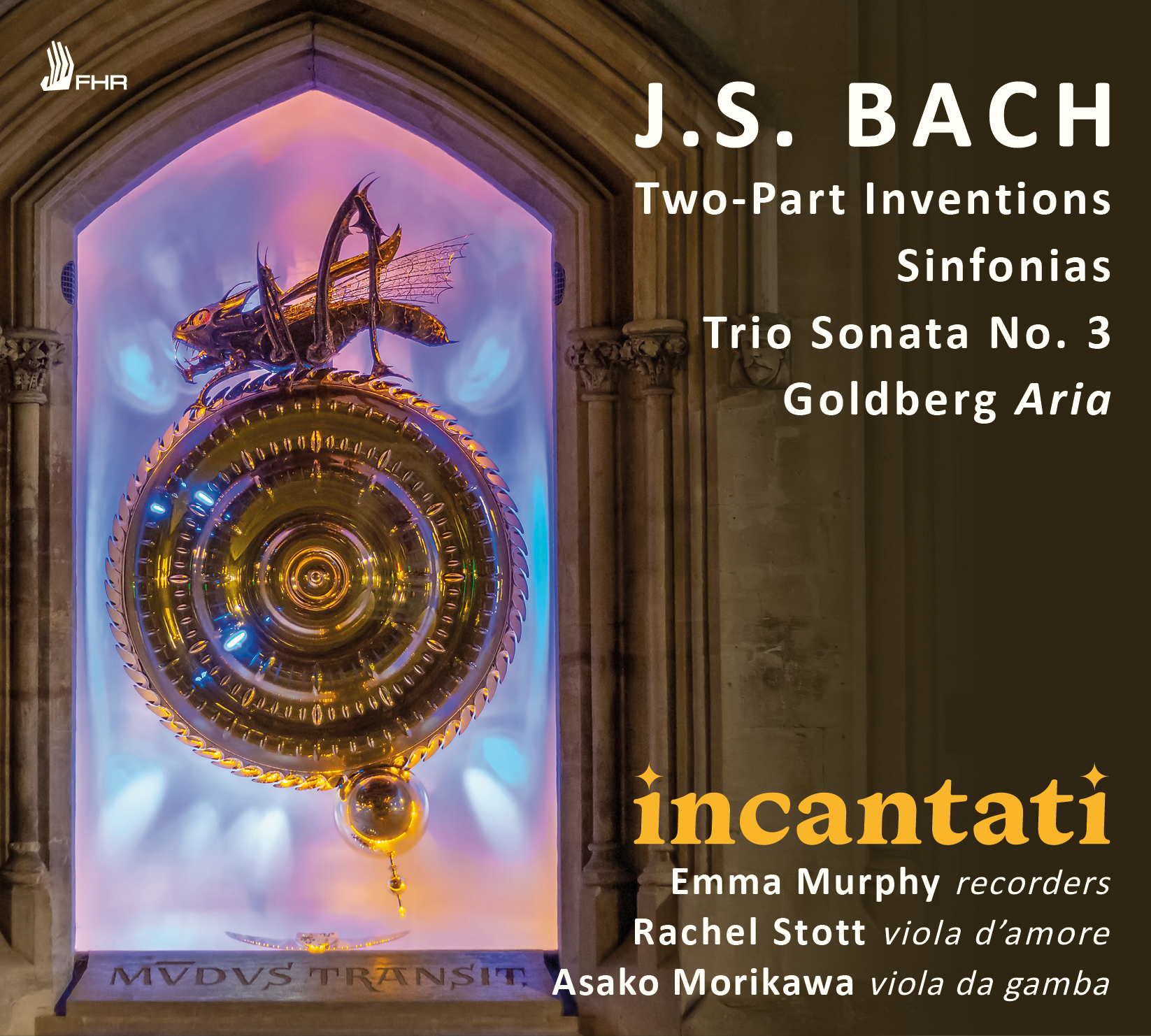
On Record – incantati: J.S. Bach: Two-Part Inventions, Sinfonias, Trio Sonata no.3, Goldberg ‘Aria’ (First Hand Records)

incantati [Emma Murphy (soprano/alto/tenor recorders, voice flute); Rachel Scott (viola d’amore); Asako Morikawa (viola da gamba)]

J. S. Bach
Inventions, BWV772-86 (selection): no.1 in C; no.2 in C minor; No.4 in D minor; No.7 in E minor; no.8 in F; no.10 in G; No.11 in G minor; No.13 in A minor; No.15 in B minor. Sinfonias, BWV787-801 (selection): no.1 in C; no.4 in D minor; no.8 in F; no.9 in F minor; no.11 in G minor; no.13 in A minor
Chorale-Preludes: Herr Jesu Christ, dich zu uns wend BWV655; Wer nur den lieben Gott lässt walten BWV691; Allein Gott in der Höh sei Her BWV716
Trio Sonata no.3 in D minor BWV527
Trio Sonata no.6 in G major BWV530/2
Aria in G major (from Goldberg Variations BWV988)

First Hand Records FHR122 [59’48”]

Producer Tom Hammond
Engineer John Croft

Recorded 19-21 May 2021 at Church of the Ascension, Plumstead, London

Reviewed by Richard Whitehouse

What’s the story?

The trio incantati performs a miscellany of pieces by Bach, including selections from the two-part Inventions and the three-part Sinfonias, excerpts from the trio sonatas and several chorale preludes in what is a diverting hour-long recital by three complementary Baroque instruments.

What’s the music like?

Both the Inventions and Sinfonias stem from Bach’s period in service to Prince Leopold of Anhalt-Cöthen during 1717-23. Both sets comprise 15 pieces that ascend in chromatic order (from C major to B minor) and they explore a range of formal and contrapuntal possibilities. While the Inventions are often canonic and the Sinfonias are mainly fugal, there are various instances where Bach allows his melodic inspiration full rein. Conceived as teaching pieces they may have been – most notably for his eldest son, the talented though quixotic Wilhelm Freidemann – but there is never any feeling that these cannot be appreciated as music for its own sake. Perhaps the ideal way to enjoy them is to play them, but few of those who do will find themselves able to match the discipline and insight conveyed by the present musicians.

Also included here are three chorale-preludes which can be found in either of the Notebooks for Anna Magdalena Bach that the composer assembled from a variety of sources (including music by other composers) while at Cöthen and later at Leipzig. Although these may be less intricately textured than the two- and three-part pieces, their focus on elaborating the melodic line against a spare if pertinent harmonic accompaniment brings its own rewards. Otherwise, the trio sonatas are drawn from the set of six Bach likewise assembled in Leipzig and which also derive from pedagogic material written with Wilhelm Friedmann in mind. The third of these pieces is included here complete – its three movements being ruminative, eloquent and vivacious. The Aria on which Bach based his Goldberg Variations makes for a limpid envoi.

Does it all work?

It does. For all its economy and restraint, this music is never easy to perform and record such that the delicate interplay can be savoured in real-time – but incantati and Chiaro Audio have done just that. It helps when the pieces played have been judiciously chosen to underline the variety that Bach draws from his textures and in relatively diverse contexts. Put another way -none of this music is unfamiliar even to non-specialists, but hearing it played thus ensures it is not predictable. Ivan Moody’s succinctly informative notes are an additional enhancement.

Is it recommended?

Indeed. As recommendable as this release is in musical terms, it also and regrettably serves a commemorative function. Emma Murphy, who died in August from the effects of an auto-immune disorder just before her 50th birthday, was among the leading recorder players of her generation and respected advocate for her instrument whether as performer or teacher. Tom Hammond, who died last December from heart failure at 47, was a musician of many talents – trombonist, conductor (notably those premieres of Matthew Taylor’s Third Symphony and his Flute Concerto) of Sound Collective and Sinfonia Tamesa, teacher (masterclasses on the occupied West Bank in Israel), co-organizer of Hertfordshire Music Festival and producer for Chiaro Audio. This proved to be their final recorded project, and both will be greatly missed.

For further information on this release, and to purchase, visit the First Hand Records website. For more on incantati, click here – and for more information, click on the names of Emma Murphy, Tom Hammond and Chiaro Audio