BUNKR, an electronic musician whose first two albums have been greatly appreciated on these pages, is back with a third album.
Antenne is due on Friday 28 June – and if you head on over to Bandcamp on the page below you can hear the first excerpt from it, Ceres Outpost. The signs are good for a quality third opus! Keep coming back here to find out more in the next 10 days…
Echaskech describe their new album as ‘a soundtrack to an imaginary movie based on James Lovelock’s book and theory of the ‘Novacene’. Reflecting the tragedy of the previous epochs’ climate damage and the optimism of a more positive future, the tracks trace the dream-like lives of a group of humans co-existing with cyborg collaborators.
Deep into a distant future, the world has survived a brutal climate breakdown and shifted from an epoch defined by humankind, the Anthropocene, to one defined by hyper intelligent beings – the Novacene.
What’s the music like?
One of the strengths of Echaskech’s music has been their ability to combine floated ambience with earth shattering beats – yet this release sees them leaning heavily towards the former discipline.
It proves an effective move, for Dom Hoare and Andy Gillham have always been expert scene-setters, creating vivid and spacious pictures even before the beats make themselves known, and that is the case here. The key is a slight adjustment in the musical tension, so that the listener is drawn into a more meditative state of mind, but not necessarily relaxed, as there is still enough tension here.
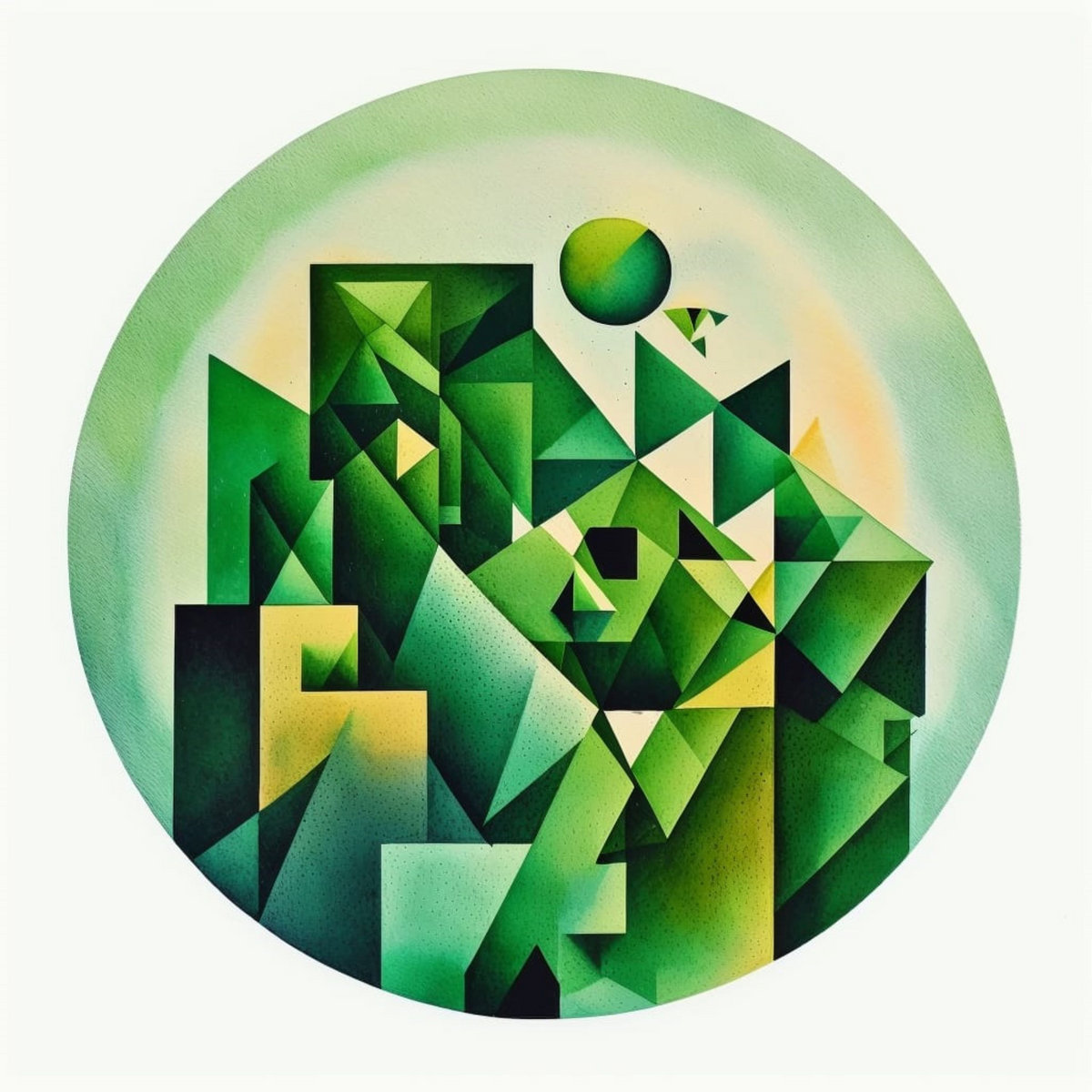
Instead the music tends to reflect the cover, the synths creating deep washes of colour and full harmonies that bring James Lovelock’s concept to life. Walking With Spheres is very descriptive, with sharper outlines against the broad canvas. Conversion Using Sunlight has an ambient backdrop of birdsong, into which the warm synth colours emerge. The duo still use beats, and Garden of Antheia has a steady, dubby tread. The title track presents a bright outlook, reinforced by an atmospheric closing pair.
Does it all work?
It does. Best heard in an uninterrupted sequence, Novacene works as an immersive experience – best heard this way – or if it retreats to the corner of your listening.
Is it recommended?
Very much so. Echaskech have a high quality threshold with their releases, and Novacene shows the best of a ‘less is more’ approach, securing ambient music that still rewards closer listening,
Alphabox is the new pseudonym under which Andrew Dobson is operating. Dobson has a good deal of previous form, as the much-loved Digitonial – where ambience could be found through cultured and beautifully sculpted electronica.
Alphabox looks to do similar, though is more beat-based and has a new home on the VLSI label.
What’s the music like?
Deeply satisfying – and, on the strength of this EP, music with staying power. The cool textures and easy profile of Feather set the tone, with the assurance that Dobson has clearly kept from his previous work. Gateway Station is relatively easy going, though there is more depth to the piano line than meets the eye, and a loop of consonant harmonies to go with the offbeat rhythm track which prove oddly reassuring.
Meanwhile the closing Blyth feels more like Plaid, but with a folky undertone containing a lot of agreeable melodic content, backed by a purposeful rhythm.
Does it all work?
It does indeed – and is beautifully produced by an expert hand.
Is it recommended?
It is – an auspicious beginning for a project that already looks like one to follow.
Statement Foliage is described in the accompanying commentary on Bandcamp as ‘a continuation of Jonathan Krisp’s focus on the topography of natural and electronic haunts…merging complex twisting acid lines with glistening synths to evoke hallucinations of a retro-futuristic sun drenched landscape’.
It is his first release since 2019, when Rewilding showed him to be a very adaptable tunesmith, managing his own electronic bedding with flair and imagination.
What’sthemusiclike?
As fresh as the title implies! Statement Foliage picks up where its predecessor left off, with music that throws open the doors and windows to beckon the listener outside. Best heard on headphones, it has an endearingly fresh approach to the scope of its textures, the brightness of the colours, the complex but very danceable rhythms and those twisted acid lines, which are indeed complex but which can wash over the listener like a stream.
A hushed voice and airy sound picture make Vanishing Point the ideal start, on which the warmth of Parhelion and Secret Well Springs Of The Soul build comfortably. Krisp’s music has a friendly tone, but the strength of the beats in Silo, an especially good track, should not be taken for granted, nor the inner power harnessed by Bridgid, with its watery riff and profile.
Krisp’s music is easy to engage with, and presents an optimistic outlook.
Does it all work?
It does. If anything Krisp could afford to make some of the tracks longer, to make the most of the green shoots offered by all the melodic material he has at his disposal.
Is it recommended?
It is indeed. There is a lot of positive energy at work here, and Jonathan Krisp delivers an album with fertile musical imagination and some really attractive colours – not to mention some really satisfying beats. Well worth exploring.
Olivine Window is no ordinary album. Its origins lie in the Soviet spy satellite Cаяём1 (which translates roughly into English as ‘We speak as one’). This craft, launched in 1983, went missing and was thought to have ditched into the Laptev Sea – though no evidence was found to reinforce this claim.
The details were kept secret until the fall of the Soviet Union in 1988, at which point amateur radio enthusiasts started picking up a new transmission whose frequency was compromising that of other similar, high frequency stations.
This pioneering release collects recordings attributed to the station renamed Sareem1, then SareemOne. They have been restored, corrected and prepared for digital release by Mach V and Andy Gillham, of Echaskech, who have assigned each track a name from the ENIGMA logs where most of the recordings can be found.
Compelling – and almost entirely weightless. The six compositions have no percussion or meaningful bass, meaning they exist as the original transmissions did – in mid-air. The melodies are extended to the point where each progression has a slow inevitability about it, slow enough to operate as a deep, ambient melody.
The wide-open panorama is established with Losing Nils, which has an air of melancholy, while The BCDE looks upwards to a more fragmented, heavily synthesized melody played over the top.
As the album progresses so the pieces become more substantial, with each maintaining a similar textural blueprint while varying in style. 3TIGHTGAPS has a slide guitar feel, its white noise and slow vibrato both uplifting and incredibly calming. There are hints of percussion in a slightly bassier interference, which also makes itself known in the thrumming introduction to Sol’s Goodbye. This flickers like a flame against broad background strokes, high in the treble range and carefully marshalled.
Between them the last two tracks last over 26 minutes, yet remain compelling to the close listener. Olivine Window itself has hints of the human voice and a diverse range of timbres, though its watery textures remain as a support throughout. Mastaba looks wider still, its textures akin to a massive intro for a shoegaze song, guitar-like sounds rippling over sustained notes. Rich chords and sonorous white noise combine to make the audio equivalent of cotton wool.
Does it all work?
It does. This is very deep ambient music, ideally produced and matching its cover art, which is the striking, immersive Day of Radiance Quilt by Susannah Eisenbraun
Is it recommended?
Yes, without hesitation. The fascinating back story demands to be read, and is more than matched by a soundtrack that does wonders for the mind.