The Oberon Symphony Orchestra play Sibelius, Liszt and the Saint-Saëns ‘Organ’ Symphony

oberon-orchestraOberon Symphony Orchestra and Samuel Draper

Richard Whitehouse on the Oberon Symphony Orchestra‘s latest concert of Sibelius, Liszt and Saint-Saëns, given at their home of St James’s, Sussex Gardens, London on Saturday 17 September

Sibelius The Swan of Tuonela Op.22/2 (1895)

Liszt Les préludes (1854)

Sibelius Valse triste Op.44/1 (1903)

Saint-Saëns Symphony No. 3 in C minor, Op. 78, ‘Organ’ (1886)

Andrew Furniss (organ), Oberon Symphony Orchestra / Samuel Draper

Tonight’s concert (the fourteenth) from the Oberon Symphony had a strong element of Liszt running through it – not least a welcome revival of the symphonic poem Les préludes which, while its historical importance is undeniable, retains only a marginal place in the repertoire.

Although it started out as the autonomous overture to settings of Joseph Autran’s Les quatre éléments (the connection with Alphonse de Lamartine’s Nouvelles méditations poétiques was made later and its reasoning remains unclear), Les préludes is essentially an abstract reflection on the passage of life from aspiration to fulfilment, and Samuel Draper rightly emphasized the cyclical evolution of its themes as these outline a viable sonata design whose introduction and coda confirm the emotional distance travelled. The secondary themes are among Liszt’s most appealing and were eloquently rendered; if the stormy central development seemed inhibited, a convincing momentum was maintained from the ethereal interlude through the reprise then on to an apotheosis whose grandeur was shorn of bombast or unnecessary grandiloquence.

These latter qualities, wholly extraneous to Liszt’s thinking, had by the mid-twentieth century reduced this piece to little more than caricature: harmlessly in the case of its soundtrack to the adventure series Flash Gordon, but offensively so when the final bars were used to announce Nazi bombing successes during the Blitz. In stressing purely musical virtues, a performance such as this can only abet the work’s and the composer’s cause; hopefully Draper will have an opportunity to include another of Liszt’ s symphonic poems in these concerts before long.

When Saint-Saëns (retrospectively) dedicated his Third Symphony to the memory of Liszt, the latter’s reputation was still intact – not least in terms of its cyclical form, making this work the harbinger of an intrinsically French take on the genre that prospered over the next century.

Draper assuredly had the measure of this stealthy evolution across two parts. After a plaintive introduction, the Allegro took time to intensify towards the climactic reprise of its first theme, but the transition to the Adagio had the right expectancy and the latter movement was almost ideal in blending seraphic poise with a lucidly unfolding variation. Andrew Furniss ensured that the organ timbre was fully integrated into that of the orchestra – the Oberon being heard at its best in a scintillating account of the scherzo; after which, the finale was taken firmly in hand so that its big tune (did those smiles among the audience betray knowledge of its use as the 1977 hit ‘If I Had Words’?) emerged unhackneyed, while the fugal and pastoral episodes were drawn into a tight-knit and cumulative progression towards the resplendent peroration.

Prefacing each of these pieces in either half was music by Sibelius. For all its popularity, The Swan of Tuonela is among its composer’s most introspective statements. Draper brought out a sustained anguish in the strings, ideally complemented by plangent cor anglais playing from Bruno Bower. If the fraught climax of Valse triste was a little diffuse, the elegiac opening and close were tellingly rendered – underlining why this miniature rapidly became a worldwide success, and thus making the composer’s signing away of its copyright the more regrettable.

The next concert by the Oberon Symphony Orchestra, with a selection of Mozart’s arias and Mahler’s Fourth Symphony (soprano Anousheh Bromfield) is on Saturday 21st January 2017

Watch the previous concert from the Oberon Symphony Orchestra, with Cosima Yu as soloist in Copland‘s Clarinet Concerto:

Further information can be found at the orchestra’s website

Mariinsky Orchestra with Valery Gergiev – Prokofiev Symphonies (2)

Gergiev conducts Prokofiev 2 – Kristóf Baráti (violin), Mariinsky Orchestra / Valery Gergiev (above)

Cadogan Hall, London; Tuesday 27 September 2016

The second part of this week’s heavyweight Prokofiev triptych was even more rewarding than the first.

Having been blasted into limp submission by the composer’s Second and Third Symphonies – the ‘roaring twenties’ in musical form! – it was time to move into the next decade with the much more delicate Symphony no.4.

Among the seven Prokofiev symphonies this is probably the least understood, partly because it exists in two versions. The first version, heard here, was finished in 1930 and runs for 25 or so minutes. The second, revised version is a different animal altogether, with a bigger orchestra and augmented structure that make the resultant 37-minute work a heavyweight in comparison.

It was rewarding, then, to experience the delicacy and lyricism Gergiev brought to the original score. Based on themes from the ultimately unsuccessful ballet The Prodigal Son, Symphony no.4 was full of grace and shimmering textures, with particularly excellent contributions from flute, oboe and clarinet. The plot of the ballet was on occasion directly imported, so the third movement scherzo was essentially a seduction with imaginative orchestral colour, while the slow movement was both ardent and moving. The outer movements featured a more brash approach, but one that Gergiev held together well.

Watch a performance from 2012 of Gergiev conducting the Mariinsky Orchestra in the Symphony no.4.

There was then a second chance to enjoy the playing of violinist Kristóf Baráti (below), who if anything outdid his first night performance. His interpretation of the Violin Concerto no.2 (1935) shone brightly, especially in the gorgeous tune of the slow movement, where a light waltz found the Mariinsky Orchestra stripped down to their bare essentials, suiting the Cadogan Hall acoustic perfectly.

The slightly drunk demeanour of the last movement was enjoyable, both violin and orchestra messing about with the rhythms to enhance the off-beat experience, while the first movement, beginning carefully on solo violin, expanded convincingly. Baráti gave us an encore of a movement from the Second solo violin sonata by Ysaÿe, but which time he had comfortably proved his stature as a very fine violinist.

Gergiev saved the best for last, a white hot performance of the Symphony no.5 (1944). On the face of it this work is an affirmative wartime symphony, but like so many pieces by Prokofiev and his contemporary and colleague Shostakovich there is a thinly veiled undercurrent of unease and turmoil. Gergiev found it immediately and pressed home the point throughout, either by making fast tempo choices for the second movement Scherzo and finale, or by deliberately leaning on some of the more painful outbursts of the slow movement.


Watch a performance from 2012 of Gergiev conducting the Mariinsky Orchestra in the Symphony no.5.

The Mariinsky orchestra were superb, led once again by some of the most authoritative and technically proficient violinists I have ever seen. Their unity of sound took the breath away at the higher points of Prokofiev’s writing, and was complemented by outstanding contributions from clarinet, flute oboe, trumpet and even orchestral piano. Gergiev could not have overseen a better performance; that it was capped with an encore of Masks from the ballet Romeo and Juliet showed us how close Prokofiev the symphonist and stage composer stayed together throughout his musical life.

Ben Hogwood

Mariinsky Orchestra with Valery Gergiev – Prokofiev Symphonies (1)

gergievIt might surprise you to learn that Prokofiev is big business right now! So much so that the forthcoming Robbie Williams single, Party Like A Russian, credits the composer as its inspiration.
It is assumed the source material will be Dance of the Knights, from Romeo and Juliet (otherwise known as The Apprentice theme tune!) but hopefully it will lead to an increase in curiosity around the composer and his music.

With unexpectedly impeccable timing, all seven of Prokofiev’s symphonies are being performed at the Cadogan Hall this week, with the best possible combination of conductor and orchestra. Valery Gergiev (above) has been leading celebrations in Russia of the 125th anniversary of the composer’s birth, and for three nights he has welded together a program of the symphonies, the two violin concertos and the Sinfonia Concertante for cello and orchestra.

A bruising first-night encounter boldly included the Second and Third symphonies, their sheer volume fairly peeling a layer off the ceiling of the hall. Both works are from the 1920s, when, like many composers, Prokofiev was intent on making as much noise as possible, working his ideas in a mechanical fashion with little room for warmth or respite.

Aggression coursed through the Symphony no.2 (1924-25), the piercing brass and biting string lines cutting through the dry acoustic and making a powerful impact. There were brief moments of respite, but even then – such as the first movement’s thump of double basses and bassoons – these were a change in colour rather than mood.

The second movement broadened its scope however, and the soaring tune Prokofiev gives to the violins offered a graceful if cold alternative. The piece is rarely heard in public and it was easy to see why, for its lopsided form and constant attack make it a challenging listen even today – but few could deny its impact.

Watch a performance from 2012 of Gergiev conducting the Mariinsky Orchestra in the Symphony no.2.

The Symphony no.3 (1928) is cut from similar cloth, but has a greater dramatic impulse. This is due to its operatic origins, with much of the source material drawn from Prokofiev’s opera The Fiery Angel. Once again the Mariinsky orchestra were superb, but the violins were sensational in their precision, playing their melodies from on high with searing intensity.

The machine of the first movement ground into action but there was deep seated passion here too, and the swooning violins took over the second movement with some weird yet rather sensual portamenti. The third movement packed a punch and led to another bruising but utterly thrilling last movement climax, where Gergiev cajoled every sinew of his orchestra to contribute. Wind and brass – especially bassoons, trumpet and horn – were all at the peak of their form.

Watch a performance from 2012 of Gergiev conducting the Mariinsky Orchestra in the Symphony no.3.

Some contrast to all this bombast was welcome in the form of Prokofiev’s Symphony no.1 (‘Classical’) (1916-17). Exquisitely crafted, it is one of his best loved pieces, with not a note out of place as it completes a wonderful modern pastiche of a Haydn symphony. Often Prokofiev’s tunes feel like they have included bags of wrong notes, but they are all so memorable – and with some well-chosen speeds Gergiev brought out the invention if not quite all of the charm.

Watch a performance from 2012 of Gergiev conducting the Mariinsky Orchestra in the Classical Symphony.

The Violin Concerto no.1 (1917-23) was equally soothing in comparison to its neighbours, and Hungarian violinist Kristóf Baráti played with assurance, charm and a frisson of attitude when the going got faster. It was the more delicate music that made this performance memorable, however, with some lovely sonorities from the orchestra as together with the violinist they painted a bright, wintry landscape.

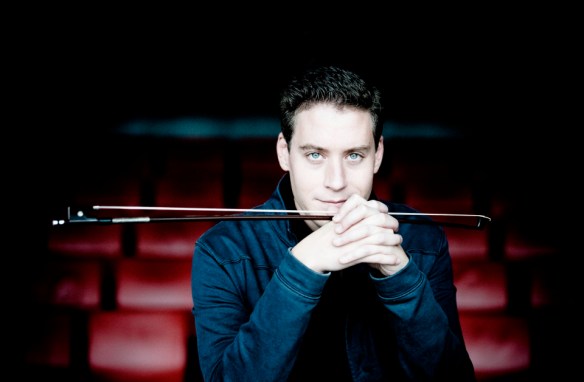
Kristóf Baráti Photo: Marco Borggreve

Kristóf Baráti
Photo: Marco Borggreve

With a generous and challenging concert lasting more than two and a half hours you would think an encore would be far from Gergiev’s mind, but no – we were in for a final treat courtesy of Liadov’s shimmering symphonic poem The Enchanted Lake. It was a soothing come down from the emotional highs and lows of the symphonies – and only heightened the expectations for the second and third parts of this so-far exhilarating voyage.

Ben Hogwood

On record: The Panufnik Legacies II (LSO Live)

lso-panufnik-legacies-2

Colin Matthews, Max de Wardner, Evis Sammoutis, Christopher Mayo, Toby Young, Elizabeth Winters, Larry Goves, Raymond Yiu, Anjula Semmens and Edmund Finnis Panufnik Variations
Duncan Ward P-p-paranoia
Alastair Putt Spiral
Aaron Parker Captured
Kim B. Ashton Spindrift
James Moriarty Granular Fragments
Elizabeth Ogonek as though birds
Leo Chadburn Brown Leather Sofa
Bushra El-Turk Tmesis
Matthew Kaner The Calligrapher’s Manuscript

London Symphony Orchestra / François-Xavier Roth

Summary

Three years on and the Panufnik Legacies series continues with a disc no less substantial if perhaps less diverse than its predecessor. Beginning with a set of variations on the opening theme from what is arguably the Polish-born composer’s greatest work, this continues with nine pieces again by participants of the Panufnik Composers Scheme – all testament to the scope and ambition of the LSO Discovery project which has played a crucial, even decisive role in introducing many new composers to audiences at the Barbican and LSO St Luke’s.

What’s the music like?

Panufnik Variations comprises the ‘theme’ from that composer’s Universal Prayer (1969), followed by 11 variations that open-out its essence without always probing it in any depth. From this perspective, variations by Evis Sammoutis, Christopher Mayo, Larry Goves and Anjula Semmens (3, 4, 7 and 9) are the most perceptive, with that by Raymond Yiu (8) the most entertaining in its allusion to a more famous Panufnik work often revived by the LSO. Colin Matthews orchestrated theme, first and final variations in highly professional fashion.

Of the stand-alone pieces, Duncan Ward’s P-p-paranoia packs a fair degree of incident into compact proportions, while Alastair Putt’s Spiral takes a segment of the Fibonacci Sequence as basis for its accumulating impetus. Aaron Parker’s Captured evidently utilizes ‘‘looping techniques and ambient forms’’ for its four brief fragments without a context, then Kim B. Ashton’s Spindrift evokes abstract seascapes in its ebb and flow. James Moriarty’s Granular Fragments evolves his notions of timbre and texture over three subtly contrasted miniatures.

Elizabeth Ognek’s as though birds elides its three miniatures into a cohesive if unfocussed whole, whereas Leo Chadburn’s Brown Leather Sofa brings a de Chirico-like ethos to bear on his austere musical sculpture. Bushra El-Turk’s Tmesis draws on Arabic prosody for a piece abundant in gestures that ultimately lack distinction. Finally, Matthew Kerner’s The Calligrapher’s Manuscript looks to the model-books from Johan Hering in a lengthy (12-minute) work whose two parts respectively predicate textural density then melodic clarity.

Does it all work?

Yes, inasmuch that all of these pieces – each written between 2011 and 2013 – give notice of compositional techniques thoroughly absorbed and confidently handled. If there is a proviso, it is that most (but not all) of them seem almost too well suited to the premise of small-scale works designed to slot into an ostensibly mainstream programme without causing any undue provocation. That several composers operate in part outside of the classical domain feels of little consequence when the music in question follows so overtly a post-modernist template.

Is it recommended?

Certainly, though the greater stylistic range of the first Panufnik Legacies release (LSO Live LSO5061) is a better starting-point for those wishing to get a real sense of what this scheme is about. What is never in doubt here is the excellence of the London Symphony Orchestra’s playing as it tackles these pieces, or of François-Xavier Roth’s commitment to a cause made possible in part via the involvement of the Panufnik estate. Two years after that composer’s centenary, one can only hope his own music will retain more than a foothold in the repertoire.

Richard Whitehouse

Ask the Audience at the BBC Proms – Sam Hogwood on Verdi’s Requiem

Ask The Audience Arcana at the Proms
sammi-2This is the final installment of this year’s series where Arcana invites a friend to a Prom who does not normally listen to classical music. In an interview after the concert each will share their musical upbringing and their thoughts on the concert – whether good or bad! Here, it felt right to bring the editor’s wife along! So Samantha Hogwood (above) gives her thoughts on Prom 74.

Soloists, BBC Proms Youth Choir, Orchestra of the Age of Enlightenment / Marin Alsop

Verdi Requiem (1874)

You can watch this Prom on the BBC iPlayer here

Arcana: Mrs Hogwood, what was your musical upbringing?

Well a lot of it was from my father, who’s now a silver fox…and we were brought up on things like Pink Floyd, Queen and Fleetwood Mac, and lots of blues and jazz – though no specific names jump out at me. He used to play things like Rick Wakeman, Mike Oldfield’s Tubular Bells, Jean Michel Jarre’s Oxygene – all that kind of stuff – and all sorts of what might be considered wacky music! There was one particular album – Rick Wakeman I think – where it was like a battle. King Arthur I think it was, and there was a cover where there was a horse being stabbed, I remember lying on the floor behind the sofa with my dad’s headphones on, imagining what it was like to do battle, and feeling sad that so many horses must have died. I was completely knocked out by things like that.

king-arthur

The cover of Rick Wakeman‘s King Arthur

There are so many amazing bands, but things that stick in your mind…and music I used to hear when sharing a flat with my dear friends Kate and Jan. I think of Fleetwood Mac, Stevie Nicks, Judy Tzuke, then bands like Hawkwind, The Clash and loads more. Listening to Abba with my dear friend Anne as well. I used to hate the Sex Pistols though because they used to gob on everyone! I love Orb-type stuff, the Chemical Brothers, Basement Jaxx, and Underworld had a massive influence on me when I moved down to London. I used to listen to loads of music then, in my room.

Could you name three musical acts you love, and why you love them?

Well we’ve seen the Super Furry Animals together a lot, and I love them so much because they’re wacky, original and colourful:

I used to love David Lee Roth, and had a poster of him over my bed. It wasn’t that I fancied him necessarily – well, I did! – but it was the cockiness he portrayed, the glint in his eye, the kind of music he sang and the humour as well – like the song Just A Gigolo, with his band mates onstage – a bit like Magic Mike. I went to three or four concerts on my own to see him!

I would say Joni Mitchell too, because every time I hear her voice she takes me to a place that I completely identify with, whether it’s Big Yellow Taxi, Blue or Heartbreak – stuff that you’ve done that you know you can’t get back, you have to accept it. It’s joyous but heartbreaking too, and every time I hear her I just want to melt. I know all the words, all the nuances, and all the notes, and I love her songwriting.

What has been your experience of classical music so far?

Well quite a lot from the beginning, because my mum and dad used to listen to stuff like Strauss – the music to 2001 – or Holst‘s The Planets­ – but there was a whole lot more. Apparently I kicked off about learning classical guitar, so they took me to do that, and I got to grade 8. Mum and Dad do like to regale the fact that I was so frustrated with practising that I once bit my guitar! There were chew marks around it! That’s basically what they will remember. I did very well in exams but I used to bite my guitar a lot and was locked in my room and made to practise. I gave it to a woman in London.

Then I met you – my husband now! – and we realised we had a lot in common. You would suggest stuff to go and see. We talk about music a lot, and I used to regale the music I listened to – and still do now. After a period of time I went to the Proms with you, but I haven’t been very often. I love listening to classical music, and we’ve been to see Holst’s The Planets and Britten’s War Requiem, which was incredible but more depressing – but the voices lifted you up. I’m really lucky to have seen that, but I do find it difficult to sit still while I’m listening for a long period of time at concerts, where I would like to move around. If I was watching a film it would be different.

How did you rate your first Proms experience?

It was mind blowing. It made my hair stand on end, as soon as I heard the orchestra and the singers I was blown away. There was one particular part that they use a lot in the X-factor, that we’re all familiar with – which is really annoying – but I loved it. It was colourful and beautiful. There were dips on occasion when the soloists were singing, which is what seems to happen, but I would say I was really listening to it, and at times I was closing my eyes and feeling the music.

I absolutely loved it, but I’ve been to a few concerts with you and so I guess you knew I would like it! I’m very good at switching myself off and on again from the day, because you can’t go somewhere in a bad mood and enjoy a concert, so I find you do have to do that sometimes.

I haven’t been to the Proms as often as you have but I think it is an amazing cultural institution that has been going for so long. I think they have been good at introducing new things, and having the tickets where you can stand is really good. I definitely think they could do more to introduce classical music to the greater public though, because I know for a fact those who have heard it on advertisements or TV have no idea where it’s come from, or the context, and they would love to go and see it. They could do more to introduce the more general classical music to encourage people.

That’s where I think your website could be the most amazing thing. Nobody makes enough of an effort to introduce people to new kinds of classical music. We’ve got loads of friends who love the classical music we’ve played at parties, from 1 o’clock in the afternoon, people who have loved it but don’t know an awful lot about it. It would be amazing if we could encourage more people like that along to the Proms to experience the environment, because tonight was absolutely gorgeous and amazing!

Would you go again?

Definitely. I loved it!

Verdict: SUCCESS