On record – Clare Hammond, Swedish Chamber Orchestra / Nicholas McGegan: Mysliveček: Complete Music for Keyboard (BIS)

Clare Hammond (piano), Swedish Chamber Orchestra / Nicholas McGegan

Josef Mysliveček (1737-1781)
Keyboard Concerto no.1 in B flat major (late 1770s)
Six Easy Divertimenti for Harpsichord or Piano-forte (1777)
Keyboard Concerto no.2 in F major (late 1770s)
Six Easy Lessons for the Harpsichord: Sonatas 1-6 (1780)

BIS BIS-2393 [74’22”]

Producer and Engineer Thore Brinkmann

Recorded March 2018 at the Örebro Concert Hall, Sweden

Written by Ben Hogwood

What’s the story?

Not many composers could claim to have influenced one of the greatest composers to have lived, but Il Boemo (The Bohemian) could do just that. Josef Mysliveček, to whom the nickname was applied, was a Czech composer of rare standing and a mentor to Mozart in the 1770s. He had a life of eyebrow-raising but ultimately tragic events, culminating with his death in great poverty in Rome in 1781, having nearly lost his nose a couple of years earlier to a botched operation.

Clare Hammond’s interview for this site puts more musical detail onto his fascinating tale. More importantly this disc for BIS serves notice of Mysliveček’s standing as an important musical figure and prodigiously talented composer. If you like Mozart, his music is a natural but essential step for further exploration.

What’s the music like?

Really enjoyable. The Piano Concerto no.1, where Hammond is joined by the Swedish Chamber Orchestra conducted by Nicholas McGegan, has a sparky personality, with plenty of vigour in its fast outer movements and elegance in the softly voiced central slow movement. There is an economy of thought, too – it finishes quickly with the minimum of fuss.

Clare Hammond clearly loves this music, and she plays with poise but also enjoys the instinctive nature of Mysliveček’s writing. The solo works are notable for their compressed construction, never threatening to outstay their welcome and on occasion producing unexpectedly dark undercurrents.

She is alive to these and handles the technical challenges really well. The Six Easy Divertimenti sound anything but unless they are in her hands! She makes the most of their tendencies to surprise, as in the mysterious pauses on some pretty exotic chords in the fifth piece.

The Piano Concerto no.2 has some notable syncopations in its first movement, as well as some adventurous harmonic diversions, before slipping into the minor key for a profound slow movement. Some of the music is contrary, staying away from big technical displays when you might expect them, but the third movement has a spring in its step nonetheless.

The Six Easy Lessons (again sounding pretty difficult!) bring parallels with the keyboard music of Domenico Scarlatti, and receive crisp and characterful performances. The second movement of the First Lesson reminds of the Czech composer’s tendency to spice up his melodies with chromatic movement, and this is one of many good tunes to be found throughout these spirited pieces.

Does it all work?

Yes. The structure of Mysliveček’s output from Hammond gives an ideally balanced disc, with the concertos complemented by the solo works. The clarity of her performance ensures it can be heard in the best possible light, and recording from the BIS engineering team is ideal.

Is it recommended?

Yes, and it fills a gap in the 18th century discography. Here is an important figure on whom the spotlight so rarely shines – and we are grateful to Hammond and McGegan for directing it to the right place.

Stream

Buy

You can buy this release directly from the BIS website
Switched On – GLOK: Dissident (Bytes)

What’s the story?

Ride’s Andy Bell has pulled together all his solo recordings to date under the GLOK alias. GLOK – the German word for ‘bell’ with a crucial letter missing – has been an undercover enterprise until now, an anonymous project brought to life by Bytes chief Joe Clay, a Ride fan himself.

As this story suggests Bell is modest about his side project, but now he has been ‘outed’ as a one-man band, expect to hear a lot more of this music as the year progresses, even allowing for a new Ride album due in August.

What’s the music like?

Dissident unwittingly taps into the success of recent TV series such as Deutschland 83 and 86, where the pleasures have been as much about the music as they have been the plot. Yet as Bell looks back to the 1980s and further, he brings in the influence of Krautrock luminaries such as Can, Neu! And Bauhaus. He does this without compromising his own skills as a guitarist and his credentials as a much-loved ‘shoegaze’ producer.

Keith Tenniswood has remastered the whole album, which unfolds at a very natural pace. The title track clocks in at nearly 20 minutes, but is one of those productions you can completely lose yourself in, the main riff turning away in the background while running through a series of filters, the drum beats receding and then coming back with extra depth.

Bell expands his outlook with the subtle groove of Kolokoi (the Russian word for ‘bell’) and the airy textures and firm kick drum of Pulsing, which has a tempo suitable for dub-infused house. Cloud Cover adds a reminder of his first known discipline as a guitarist – a nice acoustic meander here – while the closing Exit Through The Skylight introduces chattering beats and a more processed feel.

Does it all work?

Yes. Bell has equal headspace for the past and the present, setting the mood perfectly with tracks that are suitable for both ends of the day. ‘Dissident’ on its own shows he can master big structures with durable ideas, while the shorter tracks teem with melodies, subtle humour and a refreshing lack of pretence. The album repays both foreground and background listening, preferably in a hotter climate!

Is it recommended?

Yes. Ride fans will love it, but the recommendation extends to anyone with a love of instrumental music and synthesizers.

Stream

Buy

Ibiza – A symphony of dance music

When you think of Ibiza, what are the visual images generated in your head?

Are they glorious sunsets and heat-soaked villas with sandy beaches…or a bunch of rowdy types ‘on tour’ or on extended stag / hen weekends?

Happily, from first-hand experience, the natural pigeon holing that occurs thanks to reality TV programmes and social media is pretty wide of the mark.

Sure, there are those that go to the White Island to completely lose themselves and their minds, but equally there are those who travel for more soothing mental reasons. There is room for both and more besides in Ibiza.

With the visual images addressed, what are the musical images that come to mind? Because no trip to Ibiza can be complete without dance music – and yet, as with the visuals, there is much more here than at first appears.
During our holiday last month, I reflected on the way Ibiza’s music is structured, like acts in a play or even movements in a symphony.

There is a slow introduction. The day dawns, people rise slowly and amble to the pool, the breakfast bar, the beach – and their soundtrack is chillout music.

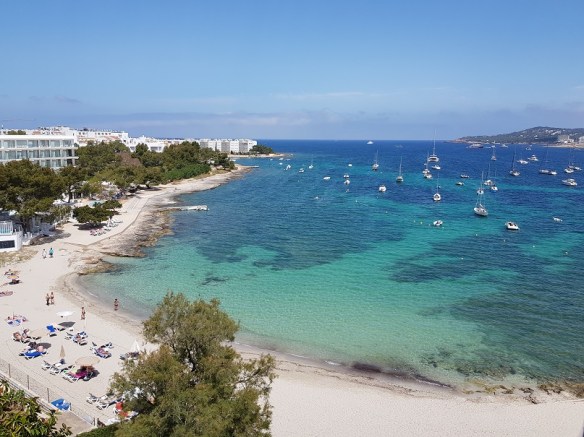
Where we stayed, at the excellent Axelbeach hotel across from San Antonio (view from the balcony above!), blissful poolside vibes slowed the pulse rate and calmed the fevered brow from the previous night. Then, gradually, as the day took hold, so too did the beats – and deep house music became the order of the day. Moody basslines and rich chords were the soundtrack as we flitted in and out of sunkissed reveries. At this point I particularly enjoyed the music of Mark Alow, reflecting the intense heat of the midday sun.

The effortless soundtrack grew ever so slightly faster as the day went on, like an extended warm-up DJ set preparing for the night ahead. As the sun dipped in the sky it was time to head across the bay to San Antonio, and the much-revered sunset strip.

This is one of the most established parts of Ibiza holiday life, though it treads a fine line between keeping the carefree atmosphere of those late 1980s beach parties, where the likes of Danny Rampling, Paul Oakenfold, Nicky Holloway and Johnny Walker discovered the island’s potential, and the commercialism that has inevitably struck more recently.

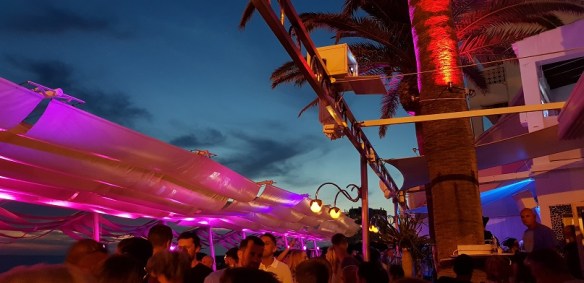
Café Mambo, 25 years old this year, sits squarely between the two. Service is efficient, mostly friendly but occasionally too dismissive. Clearly our looks are important at this point, which was never the issue with Ibiza before I would have thought! Yet as we settle the magic of the area takes hold, and everyone anticipates the sunset moment itself.

Through the week we were to discover that the Golden Buddha bar just round the corner offers a much more authentic and unfiltered sunset experience, but this was good for now. We were at Cafe Mambo for a night promoting Pacha, and Radio Slave was in the wings with his brand of minimal, stretched out techno.

From the moment the dull red orb of the sun disappeared below the sea line, as we took a breath he sprang into action, delivering a dramatic change in mood and tempo, the onset of darkness bringing with it fresh energy. That he did this with such deceptively simple music was really impressive, his remix of Sasha’s Cut Me Down the calling card as the night opened up again. This would – in symphonic terms – be the start of the big finale.

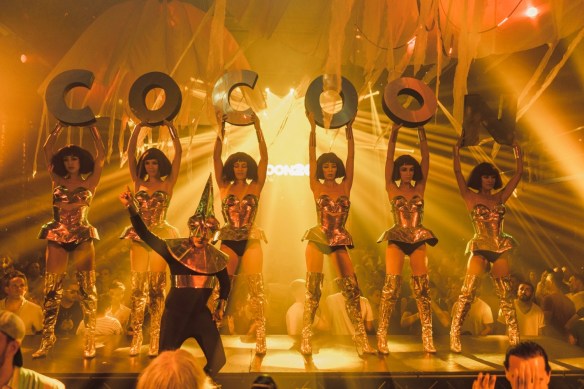
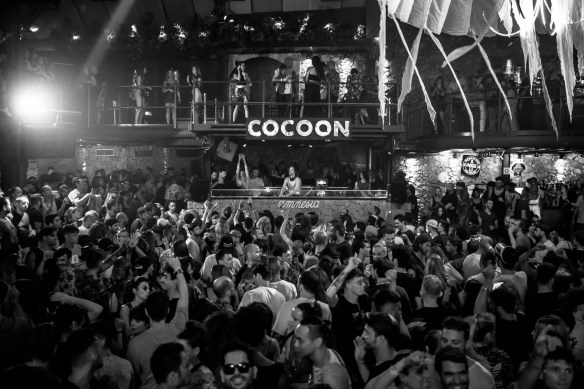
A couple of nights later we found ourselves in Amnesia, where the finale was effectively split into two. Craig Richards and Seth Troxler were the opening DJs for a night with Cocoon, part of the season celebrating 20 years of the club on the island. A club and record label run by Sven Väth, Cocoon has always been about good times and an almost complete lack of pretence, and although prices at Amnesia are not exactly welcoming, everything else was.

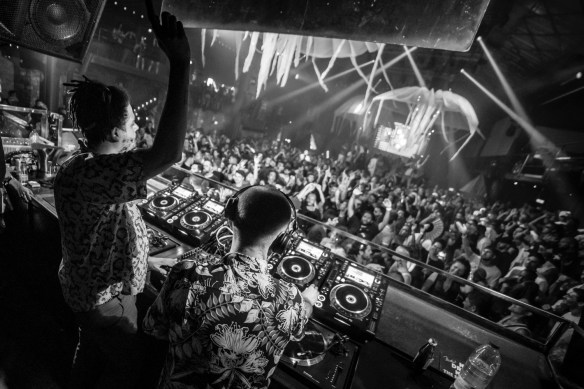
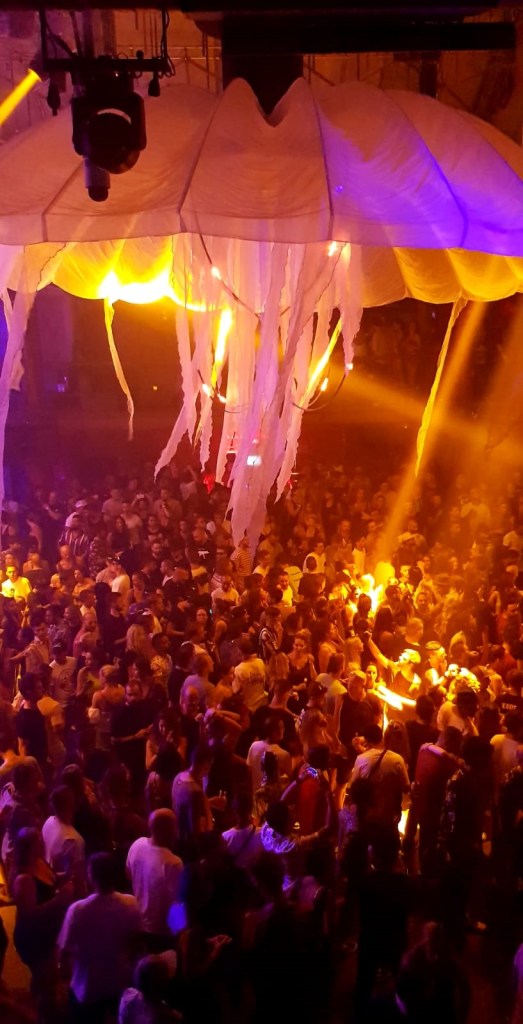
It occurred to me at this point just how similar the roles of DJ and conductor are. Richards and Troxler were back to back, each choosing a tune or two in a relay style, the turntables their orchestra as the music unfolded. The dancefloor, initially empty, began to fill as their hypnotic beats took hold, the ‘less is more’ approach complemented by colourful dancers and two great big jellyfish, suspended above the dancefloor.

All this was happening on the terrace. In the main room, the beats were faster, the night more advanced, and those who had come to throw themselves around were having a ball. Back at the terrace, all that was about to arrive with Riccardo Villalobos, the Chilean DJ celebrated – like Radio Slave – for minimal yet timeless interpretations of house and techno.

With Villalobos though there is a much more primal instinct at play, which you can see as much from his image as you can hear it in his music. His set is not really about individual tracks, more about the pulsing rhythms as a whole, the DJ himself a ball of nervous energy behind the decks as he flits about impatiently, tweaking levels and ushering new depths of tremor-inducing drums.

It is incredibly effective, and even the relative lack of a melody does not prove a massive problem. The tunes can be found elsewhere of course, with the likes of Defected, Pacha and Soul Heaven serving up incredibly popular seasons of more soulful house in San Antonio itself.

Musically sated, we return to the hotel – and the cycle / symphony begins all over again. Ibiza really is one of a kind, and this trip was a fascinating insight to me of just how much dance and classical music have in common. Their functions can cross over, their structures are similar, yet the inspiration is equally lasting. Classical music might often try to claim the intellectual high ground, but the music can strive for cleverness and lose its immediacy. Dance music is clever in a different way, speaking to its lovers directly as it aims squarely for the feet and heart.

What I’m saying here is that different strokes for different folks is what music is all about. Long may it stay that way!

Here are two playlists from our ten days in Ibiza – ‘poolside’ and ‘club’:

Not surprisingly the ‘club’ one is shorter as a lot of the tracks we heard are not yet available – but hopefully it still catches the essence of our nights!

While we were there the sad news came through that Philippe Zdar, of French duo Cassius (below), had died in a tragic accident. Given his contribution to dance music in the last 20 years it was great to hear some of their tunes woven into DJ sets, especially at Café Mambo – and so this playlist starts with Cassius’ best-known tune as a small tribute. I was fortunate to interview Philippe once and found him a really engaging and mischievous subject. Both those qualities came across in his music and he will be greatly missed.

Prom 1 – BBC Singers, Symphony Chorus and Orchestra / Karina Canellakis – Janáček Glagolitic Mass, Dvořák & Zosha Di Castri


Prom 1: Asmik Grigorian (soprano), Jennifer Johnson (mezzo-soprano), Ladislav Elgr (tenor), Jan Martiník (bass), Peter Holder (organ), BBC Singers, BBC Symphony Chorus, BBC Symphony Orchestra / Karina Canellakis (above)

Di Castri Long Is the Journey, Short Is the Memory (2019) (BBC commission: World premiere)
Dvořák The Golden Spinning Wheel Op.109 (1896)
Janáček Glagolitic Mass (Final version, 1928)

Royal Albert Hall, Friday 19 July 2019

Reviewed by Richard Whitehouse

You can listen to this Prom on the BBC Sounds app here

In its including of a female conductor, a premiere alluding to the 50th anniversary of the first moon-landing and a Henry Wood ‘novelty’, the First Night of this year’s Proms encapsulated the season in almost all essentials while making for an engaging programme in its own right.

The premiere was that of Long Is the Journey, Short Is the Memory from Canadian composer Zosha Di Castri. Now in her early thirties, Di Castri has achieved recognition for the arresting timbres and textures of her music and there was no doubt as to the scintillating sonorities she drew from the orchestra in what, loosely defined, was a cantata where changing conceptions of the Moon were articulated through a text drawn centred on the musings of Chinese-British writer Xiaolu Guo alongside fragments by Sappho and Giacomo Leopardi. A pity, then, that the composer’s rather moribund word-setting and vagaries of the Albert Hall acoustic meant the emotional affect of this text went for relatively little, for all the orchestral component was often spellbinding in its evoking the immensity yet also intimacy of space above and beyond.

Certainly the BBC Singers projected its contribution with audible assurance, while the BBC Symphony Orchestra responded ably to the astute direction of Karina Canellakis both here and in a rare revival of Dvořák‘s symphonic poem The Golden Spinning Wheel. Third of his four late such pieces drawing on the folk-ballads of Jaromir Erben, this is usually heard in the abbreviated version prepared by Josef Suk but tonight brought the full-length original with Erben’s poem set line by line in an uncanny musical embodiment of the text. That said, its sheer repetition of motifs and themes can prove excessive and while Canellakis had the measure of the work’s evocative aspect, she was less successful when trying to infuse the sprawling structure with any cumulative impetus such that the rousing final peroration seemed all too long in arriving.

There could not be a piece less given to longeurs than Janáček‘s Glagolitic Mass, first heard in the UK almost nine decades ago but not at these concerts until 1972. Recent hearings have opted for the conjectural urtext whose sometimes reckless audacity its composer toned down before the premiere, but this evening reinstated the final version that Canellakis directed with verve and sensitivity, if lacking a degree of fervency which turns a fine performance into an indelible embodiment of that pantheist spirituality central to the music of Janáček’s maturity.

Not that there was much to fault in the singing, with Asmik Grigorian more than equal to the demanding tessitura of the soprano part and Ladislav Elgr hardly less attuned to the stentorian tenor role. Jennifer Johnson was a mezzo of no mean eloquence, while bass Jan Martiník was only marginally too impassive. Peter Holder duly put the Albert Hall organ through its paces in an incisive and ultimately thunderous organ solo – after which, it was hardly the BBCSO’s fault if the final Intrada sounded a little underwhelming as its rhythmic elan was undoubted.

Throughout this account, the contributions of both orchestra and BBC Symphony Chorus left little to be desired. Hard to believe the intricacies of Janacek’s writing were once put down to technical inadequacy. In that respect, as with space exploration, progress has been absolute.

Wigmore Mondays – István Várdai & Sunwook Kim play Falla, Schubert & Kodály

István Várdai (cello, above) & Sunwook Kim (piano, below)

Falla Suite populaire espagnole (1914) (2:07 – 16:05 on the broadcast link below)
Schubert Arpeggione Sonata in A minor D821 (1824) (18:00 – 44:40)
Kodály Hungarian Rondo (1917) (46:46 – 56:28)

Wigmore Hall, London
Monday 15 July 2019

To hear the BBC broadcast through BBC Sounds, please follow this link

Commentary and Review by Ben Hogwood

The cello has always been one of the instruments closest to a pure imitation of the voice. Its range and its ability to phrase are both qualities that make it ideal for arrangements of songs.

Spanish composer Manuel de Falla may have collected and published his Siete canciones populares españolas (Seven Spanish Folksongs) for voice and piano, but they were soon arranged for violin and piano, then for cello and piano by Maurice Maréchal. The instrumental arrangements removed the second song and changed the order to make an effective concert suite. In this slightly understated but effective beginning from cellist István Várdai and pianist Sunwook Kim the music is laid bare, just as Falla would no doubt have preferred.

The first song, El paño moruno (The Moorish Cloth) (2:07), is quite restless but nicely ornamented in this performance with a subtle swing to the rhythms. The second, Nana (4:43), is bittersweet, falling on the side of sorrow, while the rustic Cancíon (7:17) makes nice use of the cello’s glassy harmonics. Polo evokes a lovely, summery heat haze with its dreamy thrummed chords (8:48) topped by a really powerful melodic line from Várdai. The quieter, yearning thoughts of Asturiana (10:18) make a more subtle impression afterwards, before the lively and uplifting Jota (12:59) completes the set.

The arpeggione was an instrument from Schubert’s time that did not last for long. With six strings and frets like a guitar, it did not catch on as a repertoire instrument, and so the substantial Arpeggione Sonata Schubert wrote for the instrument was threatened with redundancy, before finally being published in 1867. The work transcribes ideally for the cello or viola with piano accompaniment, its melodies lying under the fingers with deceptive ease.

The first movement (from 18:00) is the largest of all, expanding to make the most of what seems like quite a plaintive initial idea (the first section repeated from 21:15). It is an elegant dialogue between cello and piano, where at times the two feel like dancers in and out of hold. Some more vigorous diversions aside, the music returns to the slightly downcast mood of the opening, pensive rather than outgoing. István Várdai really makes his cello sing in the higher register, while Sunwook Kim shows a delicate touch on the piano.

The slow movement (30:32) is short but meaningful, with a floated melody from the cello threatening to make it as substantial a length as the first movement, but then gliding effortlessly into the finale (35:04) Here Schubert’s dance writing reappears, enjoyably so in the more upbeat minor key diversion (36:37) but returning to the slightly troubled air we became aware of earlier, enjoying itself to an extent but never fully throwing off the melancholic shackles apparently dogging him from the rejection of his opera Alfonso und Estrella.

No such issues in the Kodály Hungarian Rondo, like the Falla celebrating its origins with feeling. This piece, written in 1917 not published until 1976, starts with what seems like an innocuous tune on the cello (46:46) but one that goes on to dominate, reappearing for both instruments and in various guises. Complementing it are a host of other folksy melodies, most with a distinctive Hungarian flavour in their rhythm or melodic profile. As the piece progresses so the energy levels rise, to an impressive set of flourishes near the end, played with great panache by the two soloists.

As a generous encore, cooling the temperature after the Kodály, we had Mendelssohn’s Song Without Words Op.107 – the only one he wrote directly for cello and piano (57:50). Várdai was playing a Stradivarius cello dating from 1673 that used to belong to none other than Jacqueline du Pré – and he brought out the instrument’s gorgeous tone, especially in the midrange, and abundantly in the Kodály. With Kim’s sensitive accompaniment, they made it an extremely enjoyable concert with which to close the Wigmore Hall’s 2018-19 lunchtime season. See you for more in September!

Further reading and listening

The music in this concert can be heard below. István Várdai has recorded the arrangement of the Falla suite, but not the pieces by Schubert or Kodály. The Mendelssohn is played by Jacqueline du Pré – possibly on the cello heard in this very concert! – accompanied by her mother Iris.

Várdai has, however, completed a disc of works for cello by the Hungarian composer that include one of the cellist’s ultimate tests, the Sonata for Solo Cello:

You can watch a video of Várdai playing Kodály’s Duo for Violin and Cello with violinist Gilles Apap, at the HarrisonParrott website:

Kodály’s music is colourful and passionate, staying very close to the composer’s roots. This selection of orchestral works serves as the ideal introduction to his tuneful music, conducted by conductors and fellow countrymen Ádám and Iván Fischer: