On record: London Symphony Orchestra / François-Xavier Roth – Panufnik Legacies III (LSO Live)

Panufnik Legacies III:
Ashby Desires (2016)
Campbell Frail Skies (2015)
Giguère Revealing (2015)
Horrocks-Hopayian A Dancing Place (Scherzo) (2010)
Lee Brixton Briefcase (2011)
Morgan-Williams Scoot (2015)
Roth Bone Palace Ballet (2014)
Sergeant but today we collect adds (2008)
Shin In this Valley of Dying Stars (2016)
Siem Ojos Del Cielo (2008)
Taplin Ebbing Tides (2014)
Whitter-Johnson Fairtrade? (2008)

London Symphony Orchestra / François-Xavier Roth

Producer Jonathan Stokes
Engineer Neil Hutchinson
Recorded 26-27 April 2019, LSO St Lukes, London

LSO Live LSO5092 [67’54”]

Reviewed by Richard Whitehouse

What’s the story?

Operating since 2005, the LSO Panufnik Composers Scheme (in memory of the Polish-born British composer) has enabled a generation of aspiring artists to be heard on an international platform, with results that are rarely less than diverting and sometimes not a little compelling.

What’s the music like?

Ayanna Witter-Johnson questions the ethicality of third-world production in the interests of Western consumerism via an eventful while (purposely?) inconclusive interplay of grinding rhythms and ominous harmonies. Ewan Campbell draws on meteorological conditions of the sky for this study of no mean textural and timbral finesse, though what is much the longest piece rather loses focus in its fraught closing stages. Cevanne Horrocks-Hopayian toys with concepts derived from Ancient Greek theatre, Classical concepts of democracy and the Marx Brothers in this scherzo whose gender-specific aspects go for little assessed purely as music. Donghoon Shin takes his cue from the nature of stars in a piece whose overtly impressionist elements do not preclude episodes of more purposeful activity, even scintillating virtuosity.

Alex Roth seeks to convey notions of human experience through a diverse orchestral palette – submerged within, an 1888 recording of Handel’s Israel in Egypt adds its intriguing temporal resonance. Matthew Sergeant draws on disparate objects displayed at a 1953 exhibition for a sequence of vignettes whose unforeseen interconnectedness results in unlikely yet engaging variations on the initial premise. Patrick Giguère seems intent on conveying that process of ‘revealing’ less as a reduction in musical layers as of accessing the essence of the composer, which proves worthwhile more in theory than in practice. Sasha Siem takes up the notion of ‘‘the eyes of a person who is absent or no longer there’’ for a piece where the struggle of a melody to break into the foreground creates palpable tension in the shortest of these pieces.

Bethan Morgan-Williams gives preference to clarinets in music whose sudden transformation from nonchalance to anxiety is achieved with appealing verve and an ultimately barbed irony. Michael Taplin has contributed a study in (as its title suggests) emergence and evanescence such as the orchestra is well equipped to convey, provided that the music does not outstay its welcome. Benjamin Ashby seeks to reconcile opposites – namely those of the flesh and of the spirit – in a process where understated antagonisms (inevitably?) seems rather more arresting than even their tentative reconciliation. Finally, Joanna Lee draws upon memories of cassette players (presumably those formerly referred to as ‘ghetto-blasters’) that frequently enlivened inner-city environs during the 1980s, albeit with greater visceral impact than is evident here.

Does it all work?

Mostly, and not least because François-Xavier Roth draws playing of unstinting commitment from the London Symphony Orchestra. His support for the Panufnik Composers Scheme has been a primary factor in its success over the past 15 years and will doubtless continue to be so.

Is it recommended?

Yes, notwithstanding a relative lack of underlying rhythmic energy or cumulative momentum with almost all these pieces. Anyone interested in sampling what is on offer should head to the Shin, Sergeant or Siem pieces (though not necessarily in that order!) then proceed from there.

Listen

Buy

For further information, audio clips and purchase information visit the LSO Live website

On record – Peter Dickinson: Chamber & Instrumental Music (Toccata Classics)

Peter Dickinson
Violin Sonata (1961)
Air for solo violin (1959)
Metamorphosis for solo violin (1955, rev 1971)
String Quartet no. 1 (1958)
Fantasia for solo violin (1959)
Lullaby for violin and piano (1967)
String Quartet No. 2 (1976)
Quintet Melody for solo violin (1956)
Tranquillo for violin and piano (1986, rev. 2018)

*Peter Sheppard Skaerved (violin); **Roderick Chadwick (piano); ***Kreutzer Quartet [Peter Sheppard Skaerved, Mihailo Trandafilovski (violins), Clifton Harrison (viola), Neil Heyde (cello)]

Toccata Classics TOCC0538 [71’26”]

Producer Peter Sheppard Skaerved
Engineer Jonathan Haskell

Recorded 27 July & 29 November 2017, 16 January & 26 March 2019

Written by Richard Whitehouse

What’s the story?

Toccata Classics turns its attention to Peter Dickinson (b.1934), whose impeccably crafted and stylistically wide-ranging music has enhanced British music over almost seven decades – not least these chamber and instrumental works that are all recorded here for the first time.

What’s the music like?

Dickinson might consider the Violin Sonata to be among his more challenging works, but its serial technique is subtly embedded into outer Fast movements whose rhythmic tensility has an engagingly Bartókian impetus, while the central Slow movement alludes to Greensleeves near the start of its spare yet eloquent and at times impassioned course. At the other end of the scale, Lullaby is one of several warmly attractive and immediately accessible pieces derived from the abandoned opera The Unicorns, while Tranquillo is a recasting of part of the central section from the Violin Concerto (recorded on Heritage HTGCD276 along with concertos for organ and piano) Dickinson wrote as an In memoriam to Ralph Holmes – with whom he often gave recitals, not least of Beethoven’s Spring Sonata which makes a belated appearance here.

Dickinson’s output for solo violin is hardly less significant – whether with the folk-inflected plaintiveness of Air or the deftly accruing velocity of Metamorphosis (that both were initially conceived for flute makes this idiomatic new guise the more striking). More ambitious is the Fantasia with its grandly (but never wantonly) rhetorical gestures and vaunting passagework that aptly evokes the skyline of New York – in which city the composer studied during 1958-61, a time of considerable social and cultural upheaval. No less affecting despite (or perhaps because of?) its brevity, Quintet Melody is all that has survived from a quintet written when a Cambridge undergraduate. Dickinson has composed music for solo instruments throughout his composing career, of which those featured here constitute some of the most appealing.

Surprising that Dickinson’s string quartets have only now received their first recordings. The First Quartet opens with an intensively argued Allegro whose energy is the more palpable for its formal concentration, then the haunting ‘night music’ overtones of the central Lento – not least its quietly ecstatic solos and trenchant rhythmic ostinatos – carry over to a final Allegro whose ‘misterioso’ marking denotes its speculative progress to an eruptive climax and highly equivocal close. Unfolding as an eventful and often ingenious single movement, the Second Quartet evokes Ives in the way strings wend their leisurely yet methodical way to a rendition of the ‘rag’ that piano – heard on tape – has been sounding fragmentarily all the while. That this arrival is anything but decisive only makes the process of getting there more intriguing.

Does it all work?

It does, not least as Dickinson is a master of ‘less is more’. The longest of these pieces is little over 15 minutes in length, but this does not detract from the variety of incident and expression that the composer has invested into their content – not to mention their technical challenges.

Is it recommended?

It is, given the all-round excellence of the performances and the ideal ambience in which they have been recorded. A fluent author, Dickinson’s own observations on each piece are nothing if not apposite, and it is to be hoped that a follow-up disc might yet emerge from this source.

Listen

Buy

You can discover more about this release at the Toccata Classics website, where you can also purchase the recording.

Read

You can read about Peter Dickinson at his website

Listening to Beethoven #38 – Duo for two flutes in G major


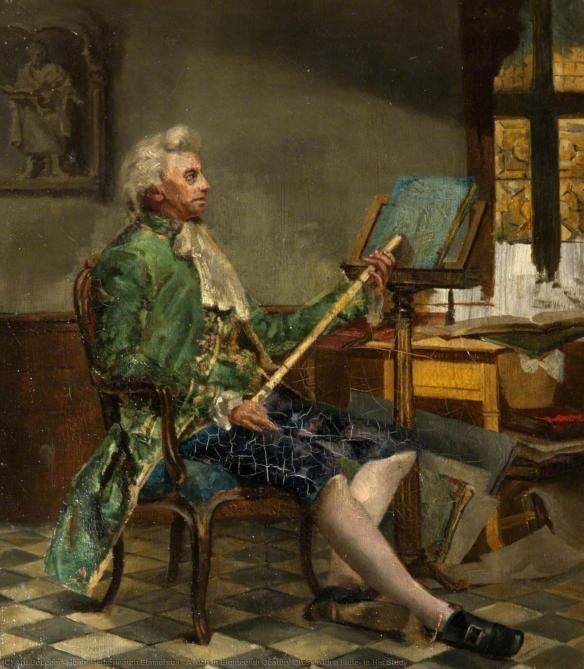
A Man in Eighteenth Century Dress with a Flute, in His Study by (Henry Hetherington Emmerson) (1877)

Duo for two flutes in B flat major WoO 26 (1790-92, Beethoven aged 21)

1 Allegro con brio
2 Menuetto quasi allegretto

Dedication ‘for friend Degenharth’
Duration 6′

Listen

Background and Critical Reception

This is the first of Beethoven’s chamber works not to include the piano – though it was not published until after his death. The dedication, ‘for friend Degenharth’, is to a lawyer, a member of Beethoven’s close circle of friends. It has prompted speculation that the piece may have been a commission or a present.

Either way, it is a short work in two movements of roughly equal length, and continues the close affinity Beethoven had with the flute at this time. Technical demands are thought to be few (according to Flutetunes.com at any rate!) so the music is suitable for most ability levels.

Thoughts

The two movements of the Duo are charming. The melodic parts are closely intertwined in the first section, like butterflies dancing in a breeze. Beethoven shifts to the minor key half way through, as though intending to move off on a set of variations. The music has a more graceful feel at this point, but then the dancing butterflies return.

The instruments stay close for the second movement, where the second flute has a simple arpeggio ‘Alberti’ figuration. There is more of a dance form evident here, in triple time.

Beethoven’s domestic side is on show here, with communal music making the main aim. As a result there is nothing too challenging here, but the charms are many.

Recordings used

Patrick Gallois, Jean-Pierre Rampal (DG)
Patrick Gallois, Kazunori Seo (Naxos)

Gallois and Rampal are brilliant together, and it proves almost impossible to tell their instruments apart at times!

Spotify links

Patrick Gallois, Jean-Pierre Rampal

Patrick Gallois, Kazunori Seo

You can chart the Arcana Beethoven playlist as it grows, with one recommended version of each piece we listen to. Catch up here!

Also written in 1792 Haydn Piano Trio in G major HXV:32

Next up 8 Variations on a theme by Count Waldstein

Listening to Beethoven #37 – An Minna


Peanuts comic strip, drawn by Charles M. Schulz (c)PNTS

An Minna WoO 115 for voice and piano (1790-92, Beethoven aged 21)

Dedication not known
Text Anonymous
Duration 0’55”

Listen

Background and Critical Reception

Very little is known or written about this short song, but it appears to be another of the small nuggets Beethoven completed before departure from Bonn to Vienna in late 1792. The text is anonymous and even a translation could not be found online.

Thoughts

An Minna is a brief song indeed. Barely has it started then Beethoven wraps it up very quickly! It has a positive complexion though, despite slightly awkward phrasing (no doubt text related). The vocal line feels quite plaintive in the baritone version, and the piano has plenty of room.

Recordings used

Peter Schreier (tenor), Walter Obertz (piano)
Hermann Prey (baritone), Leonard Hokanson (piano)

As befits most of his Beethoven songs so far, Schreier does not hang about but has a nice, bright tone. Prey, in a lower ranger, is fuller and broader in scope.

Spotify links

Peter Schreier & Walter Obertz

Hermann Prey & Leonard Hokanson

Also written in 1792 Claude Joseph Rouget de Lisle La Marseillaise

Next up Duo for two flutes in G major

On record – Roderick Williams, Michael Dussek & Bridge Quartet: Those Blue Remembered Hills (EM Records)

Gurney
The Western Playland (and of Sorrow) (1920)
Edward, Edward (1914)
By A Bierside (1916)
String Quartet in D minor (1924-5)
Howells
There was a Maiden (1915)
Girl’s Song (1916)
King David (1919)
The Mugger’s Song (1919)

Roderick Williams (baritone), Michael Dussek (piano), Bridge Quartet [Colin Twigg, Catherine Schofield (violins), Michael Schofield (viola), Lucy Wilding (cello)]

EM Records EMR CD065 [80’52”]

Producer Rupert Marshall-Luck
Engineer Patrick Allen

Recorded 4 & 5 June 2018 at Potton Hall, Suffolk

Written by Richard Whitehouse

What’s the story?

The latest release from EM Records is largely devoted to music by Ivor Gurney (1890-1937), including the second of his song-cycles with ensemble and the first recording of a large-scale string quartet composed before encroaching mental illness led to a cessation of his creativity.

What’s the music like?

Time was when Gurney was viewed as a poet who also wrote songs, but recent research has unearthed piano music, two orchestral pieces and numerous chamber works. Just how much he wrote and destroyed in a period of activity through to 1927 will probably never be known.

It was the success of Ludlow and Teme (recorded on EMRCD036) which led Gurney to essay a second song-cycle after A. E. Housman. Equally well received, The Western Playland was revised in 1925, when (and of Sorrow) was added to the title as if to point up that emotional dislocation the composer felt when incarcerated at City of London Mental Hospital – far from his beloved Gloucestershire. The eight songs traverse a wide expressive range, with such as a limpid setting of Loveliest of Trees and a purposeful take on Is my Team Ploughing very different in manner yet comparable in quality to those by Butterworth or Vaughan Williams. The forced jollity of the initial Reveille strikes a slightly jarring note, but the final March conjures a luminous poise which is further enhances by its extended instrumental postlude.

Also featured are two of Gurney’s songs with piano – that of the anonymous ballad Edward, Edward summons a malevolence that finds natural contrast with the sombre wartime (indeed, trench-bound) setting of John Masefield’s By a Bierside. Four songs by Herbert Howells are a reminder of the close personal and regional ties between these composers – three of which are appealing in their craftsmanship, with the setting of Walter de la Mare’s King David as affecting as any song from this period and justifiably receiving of the poet’s endorsement.

The centrepiece here is a String Quartet in D minor – one of several written during Gurney’s incarceration and which, fortunately for posterity, he was able to hear performed thanks to the redoubtable musicologist Marion M. Scott. Extensive revisions made deciphering his ultimate intentions more difficult, but the time and effort has been well worthwhile. The EMR release referred to above contains the original version of the work’s Adagio, and the revision as heard here only intensifies its anguished pathos. This, along with the ruminative ensuing intermezzo, are the highlights of an ambitious entity – the motivic ingenuity of whose opening movement feels undermined by lack of textural or rhythmic clarity; this latter failing arguably inhibiting the vehemence and drama which otherwise inform the finale as it surges to its fatalistic close.

Does it all work?

Almost. Roderick Williams is at his perceptive best in the songs, sensitively accompanied by Michael Dussek. The Bridge Quartet is superb in the song-cycle and makes a fine effort in the quartet, of which further performances are needed to assess the full extent of its achievement.

Is it recommended?

Indeed. Gurney is a composer whose stature has only latterly become apparent, and to which this disc is a signal contribution. Spacious and natural sound balance, together with detailed and often insightful annotations, further enhance what is another indispensable EMR release.

Listen and Buy

You can discover more about this release at the EM Records website, where you can hear clips from the recording and also purchase.