Ed Driver Fruits Of Their Laboue (world premiere) Ed Pelham (clarinet), Tabitha Bolter (horn), Aidan Campbell (bassoon), Stone Tung (trumpet), Eddie Curtis (bass trombone), Michal Oren (conductor) Schoenfield Café Music (1987) Rubie Besin (violin), Layla Ballard (cello), Alexander Doronin (piano) Reich Different Trains (1988) Jordan Brooks, Sara Belic (violins), Scott Storey (viola), Sam Hwang (cello)
Performance Hall, Royal College of Music Wednesday 15 March 2023, 6pm
by Ben Hogwood
If you live in or around London, it is well worth reminding you that one of the best ways in which to experience classical music is to visit one of the enterprising colleges and academies in the city. They are packed with interesting recitals, with several lunchtime or early evening concerts per week, with interesting programmes and enthusiastic students ready to give them. The two most obvious examples are the Royal Academy of Music and the Royal College of Music, though more can be sought and found.
It was the Royal College of Music in which your reviewer spent an early evening hour. Currently excelling (on the strength of reviews) in a Respighi – Ravel double bill of opera, which sadly this reviewer did not have the time to experience, the college is enjoying a rich vein of musical form. This is due to a strikingly successful renovation of their ground floor space, and a very fine Performance Hall, suited for chamber-sized concerts such as this one. Here we had the chance to appraise the talent within the college, both at composer and performer levels.
The first piece was a world premiere, Ed Driver’s quintet Fruits Of Their Labour. Born in 2000, Driver is a composer of some repute, with recent accolades from the Birmingham Contemporary Music Group and a new piece for the Hermes Experiment just two of his recent notable attributes. Fruits of Their Labour proved an attractive curtain raiser for this concert, Driver enjoying the unusual quintet combination of clarinet, horn, bassoon, trumpet and bass trombone.
Based on a Czech folk song, the piece has a springlike feel as it alternates between dynamism and relative stillness, making the most of the colourful textures available. The energetic sections were contagious, but the slower passages made an arguably greater impact, their chorale-like figures filling the room.
In the latter stage Driver instructed that trumpet and bass trombone should pour water into their instruments, resulting in a sound between a gargle and something of a plumbing malfunction. While effective, the combination with the other instruments was a little superfluous, and when the music returned to its chorale figure the warmer colours were more attractive. On this evidence Driver is a composer of imagination and flair, one to keep in our sights. He received an excellent premiere performance, too, brilliantly played and conducted with authority by Michal Oren.
Next up was a piano trio with a difference. Paul Schoenfield wrote Café Music for the Saint Paul Chamber Orchestra in 1987, looking to bridge the gap between the music you might hear at Murray’s steakhouse in Minneapolis and that heard at the Minnesota ensemble’s home. He achieves his aim with music of great virtuosity and considerable humour, with a great number of enjoyable and quirky themes crammed into a three-movement, 15-minute piece. Rubie Besin, Layla Ballard and Alexander Doronin played these with considerable brio, the pianist in particular impressing with his combination of technical skill and rhythmic drive. The technical demands on the players meant there was not always room to bring the humourous sleights through at their fullest, but Besin and Ballard ensured the music had a smile on its face and a spring to its rhythms, their attractive tones bringing the melodies across with room to spare. The performance that had many flourishes, while allowing time for occasional reflection.
The main work of the evening, Steve Reich’s Different Trains, has become established as a lynchpin of the string quartet repertoire, a reflection of its strength and originality. Inspired by childhood journeys to visit his parents during the Second World War, the piece uses a collection of recordings of trains before, during and after the war – spliced together with interviews from a retired porter, Reich’s governess and two survivors of the Holocaust. Their speech patterns are taken up by the stringed instruments in performance.
This performance had a few balance issues, due to the complexity of balancing loud train noises with live strings in a small performance space, and as a result the words themselves were difficult to hear at times. Yet the quartet gave a fine performance, viola player Scott Storey and cellist Sam Hwang shaping the speech melodies with expression and guile. Violinists Jordan Brooks and Sara Belic added colourful and characterful phrases themselves, bringing rich treble to the train whistles and to some of the motifs generated by the interviews.
Different Trains lasts nearly half an hour, but it says much for the musical content that it passes in the blink of an eye. The quartet here should be congratulated for their musicality and concentration, bringing Reich’s music to energetic and often poignant life.
A fine concert, then – and a reminder to make the most of all this wonderful music if it’s on your doorstep!
For information on concerts at two of London’s central music education hubs, click on the names for concerts at the Royal College of Music and the Royal Academy of Music. Meanwhile you can listen to the premiere recording of Different Trains below
James Chapman is breaking new ground with his fifth long player under the Maps pseudonym.
Whereas we have previously admired his crafting of richly coloured soundscapes and winsome melodies, Chapman has gone for broke this time and made a number of concessions in the direction of 1990s dance music.
This brings a whole new element to his style of compositions, and an album that began to form in the wake of his 2019 opus Colours. Reflect. Time. Loss. now has its own platform. In addition, Counter Melodies is structured as a DJ set might be.
What’s the music like?
In a word, euphoric. James Chapman has been sitting on this natural instinct for a while, and right from the dazzling salvo of synths starting Witchy Feel it is clear that he knows exactly how to make people dance.
As Counter Melodies progresses, the energy levels remain turned up to the max. Windows Open is upfront and brightly coloured, while a plethora of rave references and rhythm patterns lead to euphoric breakdowns, best experienced in the likes of Lack Of Sleep – which was indeed inspired by insomnia, a time of worry put to good use.
Heya Yaha demonstrates a rhythmic versatility we haven’t seen before from Chapman, with a really good rhythm, given a more jagged profile. Thru Lights is lent an exotic colour with what sounds like a cimbalom, typical of this album’s willingness to throw expectations out of the window.
Does it all work?
It does – colourful, energetic and pleasingly rough around the edges.
Is it recommended?
Very much so. A surprise for Maps fans, which may take a little bit of getting used to – but James Chapman has succeeded in bringing the living, breathing, sweating dancefloor right to the middle of your living room.
The composer talks about her new work for the London Philharmonic Orchestra, a revival of her opera Four Sisters and how the Russian-born, UK-based composer channels her feelings on the conflict in Ukraine.
Interviewed by Ben Hogwood
Arcana is in conversation with composer Elena Langer. Born in Russia but moving to study in this country two decades ago, she is full of anticipation at the weekend she has coming up. On Saturday 18 March the London Philharmonic Chorus and Orchestra, together with soloist Kristina Blaumane, will give the first performance of The Dong With The Luminous Nose, a major new piece for the forces.
Exercise is uppermost in Langer’s mind when we are connected to our call, however. “I’m rehearsing with the chorus tonight”, she says, “and after our call, I’m going to have a swim. I love cold water swimming, and I go to Hampstead Heath, where there is a well-known ladies’ pool.” Given the temperature on the day we talk is a little above freezing, this is a brave move. “Yes, it’s cold – but it will be a quick swim, and it gives you a kick for the rest of the day. It means I will be nice and well-behaved with the chorus!”
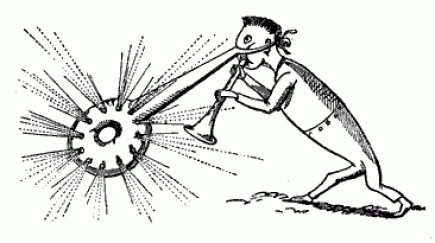
As you will have gathered, Elena has a healthy sense of humour, and a zest for life too. The primary reason for our conversation is to talk about a major new choral piece receiving its world premiere in the Royal Festival Hall soon. The Dong With The Luminous Nose is a setting of a nonsense poem by Edward Lear (illustrated below), though as we quickly establish it is a work of several layers. “It’s not nonsense as such, it is a love story”, she explains. “The Dong is broken hearted, and went mad – but it’s told in the right way.”
She recalls her first encounter with the poem, “maybe about 10 years ago. A journalist friend introduced me to it, and I really liked it – and then forgot about it. Then at the right time I remembered, because when I was asked to write this piece for chorus and orchestra I found it difficult to find the right text. Often composers set religious texts that don’t resonate, and I love setting poems, but poems for the chorus quite often feel wrong – the words never quite come across as they should. With The Dong it is a poem, but it’s a little opera for chorus. It tells a story, and you follow it, and it felt like the perfect vehicle for the task.”
The opening lines of The Dong set a telling scene: “When awful darkness and silence reign over the great Gromboolian plain”. Elena reveals how she set them to music. “I started with a big solo cello, a concentrated line. The cello represents the Dong or his longing, his soul. She is playing that solo, and that tells the story in music from beginning to end. Then the music continues in the very low registers of the orchestra, tremolo – and tam-tam, with low bassoon and trombones, low double basses too. I only used the basses in the beginning and introduce the timbres of the chorus gradually. The story is told by the basses, and then the tenors, who begin on the word ‘light’, and then all the female chorus only appears when it says “The Dong, The Dong”. We are introduced to every layer of the piece gradually, because there are lots of layers, all with the big chorus and the cello.”
With so many forces at her disposal, is it tempting to use them too much? “I have them and I like using everything a lot, but obviously it should make sense. The cello tells the story and follows the climaxes and moods of the text. It’s a strange genre – a cantata on one hand, but at the same time it’s a cello concerto because sometimes the cello is in competition with the chorus or the orchestra, and there are some instrumental bits which make it slightly symphonic.”
Rather than copy established formats, Elena has sought an original approach. “I tend to not think about what genre I’m writing in, like making new film”, she explains. “It’s not a romantic comedy, or a drama – it has everything – a bit like a good salad! This approach runs through my operatic work, when you have these resources and you use them as tools to make the drama and to have an effect on the audience. I want to tell the story as precisely as I can with my resources.”
The cello part is written for Langer’s good friend Kristina Blaumane, principal cello of the London Philharmonic Orchestra. “She’s an old friend of over 20 years, and she has this passionate, romantic side to her personality, with big emotions. I hope the cello part does that – it’s quite virtuosic, and it requires this soulful, deep, rich sound, which she has in her instrument. She looks wonderful on stage and tells the story in a dramatic way!”
Delving deeper into the story itself, the title – The Dong With The Luminous Nose – brings up a parallel with the young Shostakovich, and his first satirical opera The Nose. Would the story have appealed to him, possibly? “The plot is the opposite, as the nose disappears”, points out Langer, “so you have two noses! But you’re right, I love this in Russian literature where you get this fantastical thing which comes from Gogol, and runs through the work of Daniil Kharms, a Leningrad poet who behaved in a very eccentric way, and who I’m sure was influenced by the English tradition of Lewis Carroll and Edward Lear. It’s fantastical and surreal, but at the same time dramatic and real. All kinds of political, horrible things are happening around us, and I don’t feel like the kind of artist who comments directly on direct events.”
Elena qualifies her observation. “My survival technique is escapism, using music as something that when I write I am in control of my notes. I build this world, but I’m not in control of the rest of the world. The events – the real events – seem like a dream. In a way it’s my lament, to comprehend the world and what’s happening, done through this crazy little creature The Dong, who goes mad and loses what’s important to him.”
Inevitably, talk turns to the conflict in Ukraine. Elena may have lived in the UK for over 20 years, but the links are still strong. “I love being here, and I am in some way detached, but in some way not. I still have friends in both places, but I don’t want to run around with flags. I want to express how I feel in my own way.”
Langer’s music is indeed deeply expressive, as attendees to the Royal Philharmonic Society Awards, heard at the Queen Elizabeth Hall recently, will attest. Soprano Anna Dennis, oboist Nicholas Daniel and pianist John Reid gave a moving performance of her song Stay, Oh Sweet. It confirmed Langer’s intensely vocal approach to composition – even when writing for voices. “Yes, I think so”, she agrees, “and my cello writing for Kristina proves that. I see every instrument of the orchestra as a voice, rather than some composers who work the other way round.”
Coincidentally, on the night The Dong receives its premiere, Langer’s one-act opera Four Sisters will be performed in a new production by the Royal Conservatoire of Scotland in Glasgow. It is part of an appealing program, the 2012 opera paired with César Cui’s A Feast in Time of Plague.
“It should be fun!” she says with amusing understatement. “Four Sisters was commissioned 12 years ago by Dawn Upshaw, who had a class at Bard College in the Fisher Arts Centre, in upstate New York. They have a conservatoire there, and Dawn had a nice class there, mostly of girls. She asked me to write something that would involve more girls, as they needed parts for everyone. I thought of a funny mix of Three Sisters by Chekhov and something like Sex And The City! Each part is equal, there are no prima donnas!”
Langer studied briefly with Upshaw, but the pair’s connection goes back still further. “In 2009 I was invited to participate in the project writing for Carnegie Hall writing songs with Dawn Upshaw and Osvaldo Golijov, the Argentinian-American composer. I spent a week or more with Dawn and some singers, and she liked my work – hence the commission. She is a very good teacher, she teaches to sing and to understand what you are doing, what you are thinking about – not just the notes.”
Elena does not sing herself. “Oh no, I have a terrible voice!” she laughs. “I can play on the piano and play my pieces if I need to show them to directors or to performers, but never singing!”
On her arrival in the UK from Moscow, Langer spent one year studying with Julian Anderson, and then moved to the Royal Academy of Music for her PhD. “I saw Simon Bainbridge there, and he was very encouraging, a pleasant presence. That’s also where I met Anna Dennis, who has been my muse since then. When I write for sopranos, I have her timbre in my ears. She is very versatile, and a good musician too. She can play cello and piano.”
After the recent flurry of activity, “like a wave”, Langer is planning to take a short break. “I wanted to have a short break to stop the conveyor”, she says, as I have only just finished the arrangement that we made of Stay My Sweet for the awards. It was originally written for string trio, harpsichord and voice, and I arranged it for voice, oboe and piano. The original is recorded on Harmonia Mundi.”
Her musical thoughts are still active, mind. “It is my week off, but I’m already thinking about a Trumpet Concerto! I was working in November, and had a fantastic concert with the Boston Symphony Orchestra, who were doing a suite from my opera Figaro Gets A Divorce. They have a fantastic, very bright brass sound, polished and very smart. Their trumpeter asked me if it is possible to write a Trumpet Concerto for him and the chamber orchestra, so I agreed – and now I imagine a kind of quasi-Baroque piece, bright and energetic. I will probably write that next.”
Is the Baroque period an inspiration for her work? “It’s one of the colours which I have. My taste, as you can probably tell from my music, is very eclectic. I like all kinds of music, like Baroque and Rossini, Donizetti, Strauss, Wagner and Handel. I get excited by music! The Baroque period I like, and have written a lot for harpsichord and oboe, partly because Anna has sung a lot of Baroque music. I have been commissioned through her – and soon in Aldeburgh, at Snape, they will perform another of my compositions, Love and Endings. They are three songs based on Middle English poems, and they’re written for Anna, Mahan Esfahani and Nick Daniel. It’s going to be performed at Easter.”
She is intrigued by Esfahani’s approach. “It’s going to be the first time that I work with him. While I was writing the new songs, I went to Oxford to visit his harpsichord, and I played the instrument which was specially built for him. It is much more resonant than your normal Baroque instrument, and has more notes. It has a very thick and groovy bass!”
As well as the wide range of classical music above, Langer also encounters pop music through her son. “He’s 17, and sometimes when he’s in a good mood he shares some music that he listens to. I love a lot of it, rap and RnB. He played something that was a crossover between Muslim prayer, and rap, and something else, made in East London. I like this kind of thing, and also older jazz from the 1920s to 1950s. My favourites are Ella, Miles Davis, Coltrane and my favourite, Oscar Peterson.”
Returning to her own compositions, a glance at Langer’s list of works on her website reveals that The Dong has the biggest orchestral group she has used so far. “I’ve never used chorus and orchestra like this, it’s the first time, other than in my operas. I was a bit worried about it, as it’s completely different.”
She will hear the piece in full two days before the concert, “but tonight I’ll rehearse with the chorus. We are rehearsing in bits, to give the chorus more time to prepare – and then Kristina will join the chorus, and only then will we have everyone. I hope it works!”
She laughs, nervously – but also modestly. “This whole thing, you spend so much time orchestrating, doing the parts and this and that, and you just hope it sounds right!” With experience, she is less often surprised by the results. “The older I get, the more close it is to the initial idea. I think it’s a part of being a bit more skilful, although when I studied at the Tchaikovsky Conservatoire some of our teachers would say we must take risks and write something where we don’t know what the sound will be. I don’t want that, as I have a vision. I want it to be like a well-built house, it should not have anything unpredictable.”
The Dong With A Luminous Nose will receive its world premiere on Saturday 18 March at the Royal Festival Hall. For ticket information and purchase, visit the London Philharmonic Orchestra website. Meanwhile you can find information about the performance of Four Sisters at the Royal Conservatoire of Scotland website
This is the fifth solo album from Steve Mason, once of The Beta Band – and it is designed as a record to bring people together through art, music and culture, in the face of the uncertain climate in which we currently live.
The spirit of collaboration runs through Mason’s work this time around, with co-producer Tev’n helping Mason oversee a line-up that includes Pakistani singer Javed Bashir, Indian singer Kaviraj Singh, the multi-disciplined Adrian Blake and British gospel singers Jayando Cole, Keshia Smith and Connie McCall.
What’s the music like?
Brothers & Sisters is a protest record of the most uplifting kind. The trademark shuffle is still present in Mason’s beats, but this time around he has added a great deal of purpose and urgency to the songs. Where before in his music a more laidback mood was in evidence, now the music is ignited, a zest for life and human companionship coarsing through his songwriting.
As the album title Brothers & Sisters implies, there is a strong family unity between the songs, a communal pull that reaches out to bring the listener in and on board. This is typified by The People Say, where Mason looks to celebrate our differences rather than pull people apart. All Over Again is redolent of early Primal Scream and sees some of his best vocals yet, with the gospel singers seizing their chance to shine.
No More, meanwhile, has a powerful undercurrent of standing up together for what we believe. Aided by Javed Bashir‘s assertions, its strong resolve is matched by a battery of percussion. “This is the people speaking, we are not the same!” they sing, reaching for the sky.
Pieces Of Me, reveals Mason at his most vulnerable, with spiritual undertones to the deeply felt vocal as he sings of “pieces of me inside, people I know who died”. Then Mason ends the album with a final rallying call, Brothers & Sisters demanding that we “pump up the volume”.
Does it all work?
Yes, emphatically. Mason’s songwriting has moved up a level, responding to adversity and collaboration with lyrics and vocals that reach out to directly to the listener.
Is it recommended?
Yes, enthusiastically. Brothers & Sisters is both a call to arms in the face of adversity and an extremely uplifting album, Steve Mason feels the urgency, the need for us humans to stick together whatever our background – and this career-best effort will get a good many converts to the cause.
Listen
Buy
You can explore buying options for Brothers & Sisters at the Domino website
Esther Abrami (violin), English String Orchestra / Kenneth Woods
Saxton Scenes from the Epic of Gilgamesh (2022-3) [World Premiere] Bruch Scottish Fantasy in E flat (1880) Mendelssohn Symphony no.3 in A minor Op.56 ‘Scottish’ (1841-2)
Sheldonian Theatre, Oxford Friday 10 March 2022
Reviewed by Richard Whitehouse
There cannot be any more historic or atmospheric performance venues than the Sheldonian Theatre in Oxford, which is still going strong after over 350 years and the setting for this latest contribution to the English Symphony Orchestra’s ‘21st-Century Symphony Project’.
Speaking only recently, Robert Saxton stated a reluctance to call his Scenes from the Epic of Gilgamesh a symphony and yet the piece, a result of many years’ thinking about the musical treatment right for one of the oldest written texts, has a formal cohesion and expressive unity comparable to previous instalments in the ESO’s project. Scored for late Classical forces of pairs of woodwind, horns and trumpets with timpani and strings, its textural clarity serves to imbue any illustrative aspect with an abstract focus duly sustained across the five movements.
Charting a deft course over its narrative, the work heads from the fluid motion of a Prologue to The Journey to the Forest of Cedar, whose passacaglia-like evolution finds this composer at its most harmonically alluring, then to From dawn to dusk and a scherzo as tensile as it is evocative. Lament distils a tangible emotional force into its gradual yet inexorable build-up, moving straight into an Apotheosis which opens out the melodic content of earlier ideas and so brings a powerful culmination as the hero is forced to seek his immortality by other means.
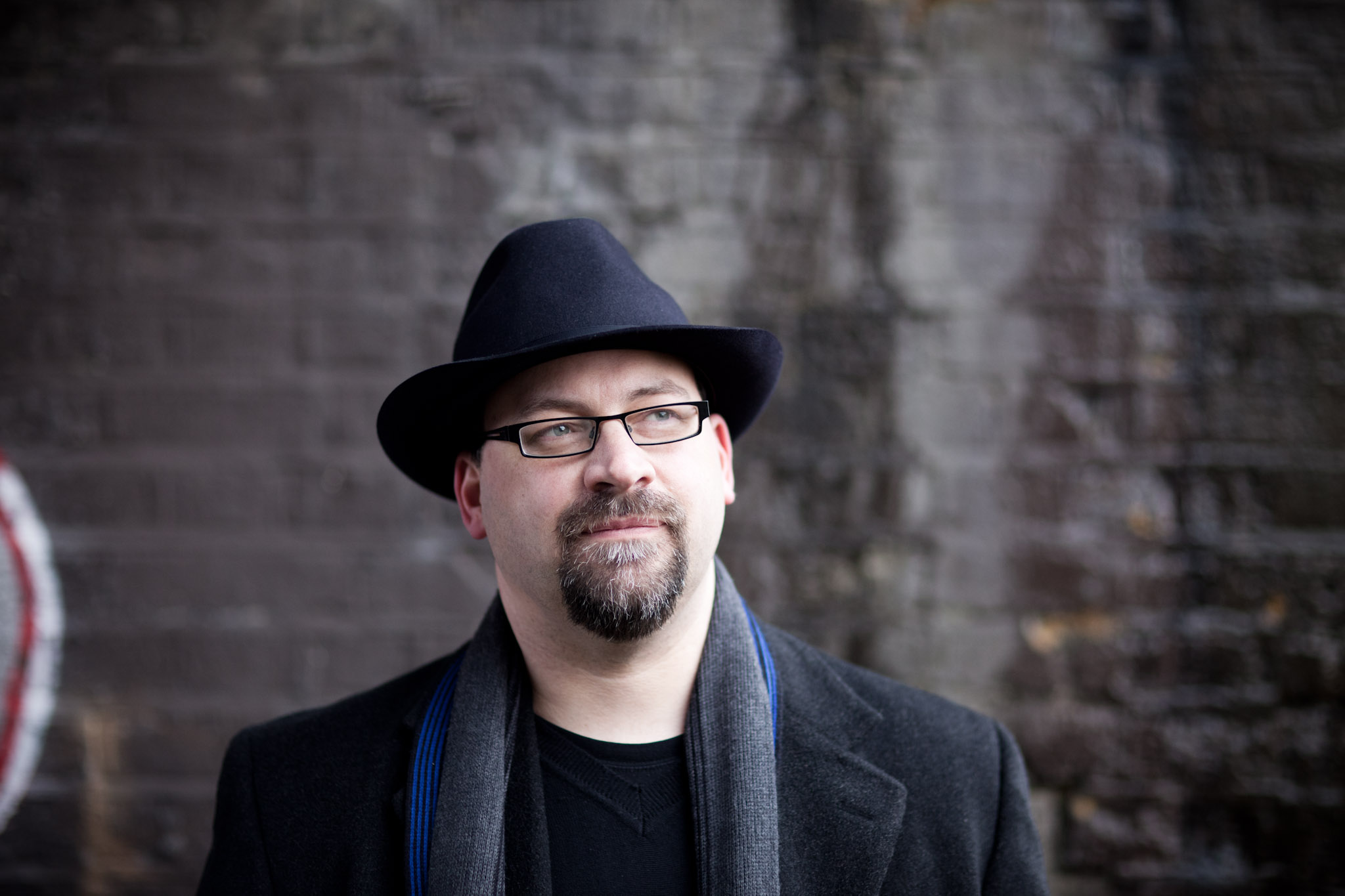
More overtly tonal it may have become, Saxton’s music still presents considerable challenges technical and interpretive. Suffice to add these were met with finesse and no little conviction by Kenneth Woods (above) and the ESO who, having previously recorded this work for future release, were fully conversant with its elusive while always approachable idiom. Almost four decades on from the flamboyant pieces which helped establish his name, Saxton revealed an orchestral mastery that will hopefully find an outlet in further such pieces – whether or not ‘symphonic’.
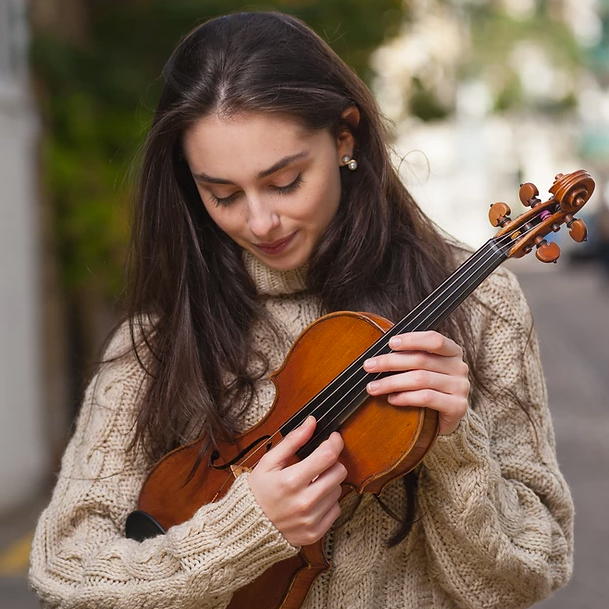
Tonight’s concert was also notable for featuring the ESO’s new Creative Partner and Artist in Residence – violinist Esther Abrami (above), her presence on social media enhanced by the release of her eponymous debut album for Sony. Stylishly attired (with an image that, for older readers, might recall Audrey Hepburn), she gave an account of Bruch’s Scottish Fantasy at its best in the transition from sombreness to eloquence of its Introduction and high-flown sentiments of an Andante in which the composer’s recourse to folk melodies is at its most felicitous. Before it, the Scherzo ideally needed more incisiveness for its engaging humour fully to register, with the final Allegro (given in abbreviated form) rather less than ‘warlike’ – though its mellifluous second theme enabled Abrami to conjure a tonal warmth which was never less than appealing.
After the interval, the ESO came fully into its own with an impressive take on Mendelssohn’s ‘Scottish’ Symphony. Whatever its genesis in his tour of that country when just 20, the work is demonstrably that of a composer who, having reached a creative mid-point, surveys his many successes but also failings. Hence the fatalistic aura such as informs the opening movement’s introduction or the tense agitation of its main Allegro – both of which were palpably brought out by Woods, who then gave the brief if scintillating scherzo its head. The highlight was an Adagio whose constant pivoting between pathos and anguish was graphically stated – aided by an orchestral discipline no less evident in the final Allegro, its martial overtones carrying through to a pause in which the decision to opt for tragedy or triumph is held in the balance.
That the work closes in triumph has often been felt its downfall but, as conveyed by Woods at a swift if not inflexible tempo, such an apotheosis is one of determination or even defiance in the face of whatever is to come. It certainly brought this concert to a memorable conclusion.




 Arcana.fm