
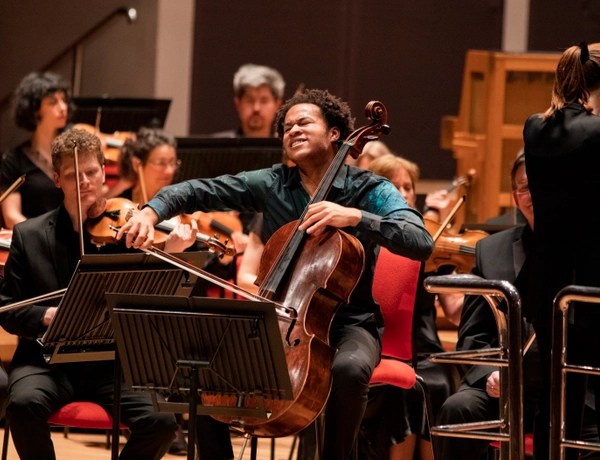
Sheku Kanneh-Mason (cello), City of Birmingham Symphony Orchestra / Kazuki Yamada
Beethoven Leonore Overture no.1 Op. 138 (1807)
Shostakovich Cello Concerto no.1 in E flat major Op.107 (1959)
Walton Symphony no.1 in B flat minor (1932-5)
Symphony Hall, Birmingham
Saturday 16 September 2023
Reviewed by Richard Whitehouse
Having opened the City of Birmingham Symphony Orchestra’s season two days earlier with Verdi’s Requiem, Kazuki Yamada returned for a judicious programme comprising three ‘No. 1’s’ – two mid-20th century masterpieces and an overlooked gem from the previous century.
Beethoven’s First Leonore Overture is in fact the third such piece written in conjunction with his eponymous opera, being intended for a Prague production that never materialized. Shorter in duration and simpler in design than its two ‘successors’, it sets the scene without attempting an overview of Leonore’s dramatic essence. Yamada duly made the most of an introduction as speculative as it was searching, then steered a lively course over the main Allegro – not least a surging crescendo into the coda such as Rossini had taken to heart before the decade was out.
It was with Shostakovich’s First Cello Concerto that Sheku Kanneh-Mason won BBC Young Musician of the Year in 2016 and thus launched a career that shows no signs of stalling. In the meantime, his take on this piece has deepened and at times darkened – the opening Allegretto exuding keen irony abetted by the incisive response from an orchestra whose single horn and double woodwind are thrown into sharp relief against modest strings. If the ensuing Moderato seemed a little measured, its stark intimacy was eloquently sustained to a yearning climax then mesmeric interplay of cello harmonics with celesta in the coda. The third-movement Cadenza emerged with real cumulative impetus, and not even the hiatus while Kanneh-Mason replaced a broken string could stem the final Allegro’s sardonic course to its decisive closing flourish.
A work that has latterly regained (at least in the UK) the reputation it enjoyed decades earlier, Walton’s First Symphony has had regular performances from the CBSO (and a recording with Simon Rattle), and this reading did not lack for commitment. Not least an opening movement such as built methodically and remorsefully from initial expectancy, through a central span of brooding stasis, to a pulverizing culmination; the only proviso being the frequent inaudibility of its underlying pulse in lower strings during the climactic stages. The scherzo seemed even finer in its tense amalgam of spite and barbed humour, its treacherous syncopation dextrously handled, while the slow movement unfolded from a wistful flute melody (affectingly rendered by Marie-Christine Zupancic) to its climax of baleful intensity subsiding into numbed regret.
The finale still tends to be seen as surrender to well-tried symphonic precedent yet, as Yamada presented it, did not eschew formal or emotional obligations. The resolute introduction, agile fugal writing and irresistible build-up to the timely appearance of extra percussion all became part of a conception vindicated by the elegiac trumpet theme (ably conveyed by Jason Lewis); leading to a peroration in which Yamada’s urging his players onward briefly risked unanimity of response while still resulting in the sheer affirmation of those thunderous closing chords.
Overall, an engrossing performance which augurs well for the CBSO’s first full season with Yamada. Next week places the spotlight on Thomas Trotter who, having done forty years as City Organist in Birmingham, takes the loft for repertoire staples by Poulenc and Saint-Saëns.
You can read all about the 2023/24 season and book tickets at the CBSO website. Click on the artist names for more information on cellist Sheku Kanneh-Mason and conductor Kazuki Yamada
 Arcana.fm