

by Ben Hogwood
Helen Grime
In the classical music calendar, summer effectively begins with the start of the Aldeburgh Festival. This year’s model – the 76th running of the Suffolk festival – comes prefaced by a line from Shelley:
And, hark! Their sweet sad voices! ‘t is despair
Mingled with love and then dissolved in sound.
At the heart of this year’s festival are four featured artists – tenor Allan Clayton, violinist Leila Josefowicz and composers Daniel Kidane and Helen Grime. Scottish composer Grime, currently living in London, joined Arcana for a chat to talk about the range of her compositions in the festival this year, and the close link she enjoys with its audience and organisers.
Her first experiences of the festival date back to 2005, when she was on the Britten Pears Advanced Composition course. “I was studying on that and Colin Matthews was there, and I went back in 2006 to hear the performance of the piece I wrote while I was there. I also played in the chamber orchestra for the War Requiem on a course, and I played in Britten’s Nocturne as well, which was amazing. Those were the first experiences, and I also went to an opera writing course as a composer, which would probably have been 2006. Then in 2009 I wrote a piece called A Cold Spring, for chamber ensemble. It was a joint commission with Aldeburgh Music, the Birmingham Contemporary Music Group and the Sue Knussen Trust. The piece was in the same program as an Elliott Carter premiere (On Conversing With Paradise). He was there, and it was an amazing time.”
Carter is a composer Grime has always admired, and she had met him the previous year. “I was a fellow in the Tanglewood Music Center, and it was his 100th birthday year. They have a festival of contemporary music every year, and that year it was completely devoted to Elliot Carter’s music. As composers we had the opportunity to go to all the rehearsals and concerts, and it was a chance to immerse yourself in a composer’s work – lots of his chamber music but also the orchestral works. This was the time that I really dived into his music and were able to meet him and ask him questions. It was an incredible point in history to think back to really, and he had so many amazing things to say. He was able to go back in time and talk about his time studying in Paris with Nadia Boulanger, and moments in jazz bars, little things that maybe you haven’t read in a book. Hearing that directly from the composer is a fantastic experience!”
Helen lived in Edinburgh initially but moved to London for studying, and has stayed. Her music still carries parallels to her Scottish roots – and these are evident in Folk, premiered by soprano Claire Booth with the BBC Scottish Symphony Orchestra under Ryan Wigglesworth in Glasgow. “Scotland still feels like home”, she says, “and I’m so fond of that orchestra. I’ve worked with them a fair bit over the years, and it was wonderful to be able to work with them on the premier of Folk, with Ryan Wigglesworth, and of course, Claire.”
The piece will receive a second performance at the Aldeburgh Festival, with the Knussen Chamber Orchestra conducted by Wigglesworth. “I’m excited now for Ryan to do it again with a different with a different group. The piece is rooted in lots of folklore traditions. Zoe Gilbert, who wrote the libretto, is particularly influenced by Manx folklore, but the stories are rooted in different storytelling traditions from different places. She based the libretto on the stories in her book, Folk, so when you read them, you feel the resonance with stories we already know and have known since childhood. She’s subverted lots of roles, but there’s definitely that kind of connection with Scotland and folklore, so I wanted to have that connection in the music as well.”
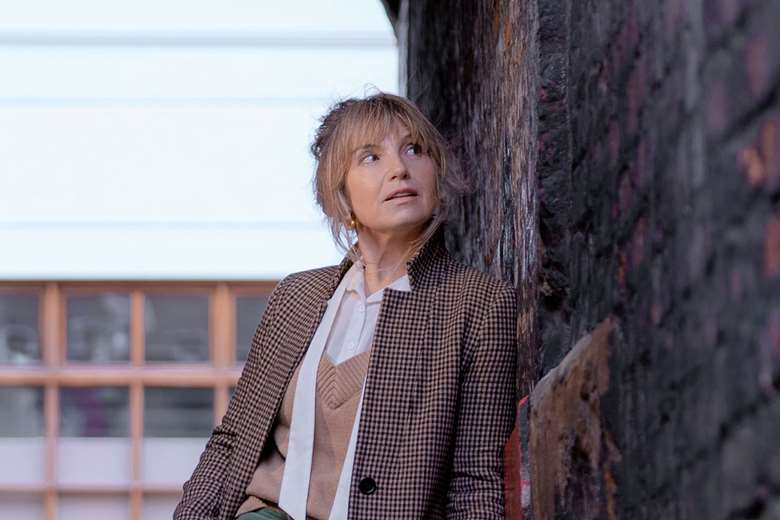
Arcana was fortunate to interview Claire Booth (above) just before the premiere of Folk, and Grime speaks warmly of her dedicatee. “She is a ball of energy! We’re very different in that way, but we get on very well. She is incredibly talented but also interested in many things. She found the book, and we both loved it, and so she approached Zoe. Obviously, I’ve known her work and singing for years. but we haven’t been working together until last year – although this project was brewing before Covid and then took a while to get it together. I don’t think it’s going to be the last time we work together, so I’m really excited about that. She’s an incredible talent but she brings such a personality to the piece, and she can just do anything. It’s very virtuosic, vocally. In Aldeburgh it will be with a small orchestra, so it will be interesting to hear that, in the Snape hall – but also with the surroundings, it’s made for that. When you’re there, and you’re amongst the reeds, it’s a magical place. You can see so far there, and whenever I’m there it always seems to be really clear skies. That time of dusk is particularly amazing.”
As a featured composer, Grime is presenting a varied body of work for the festival. “It is very satisfying. I’ve written a fair bit of music now, and I’m really happy with, for example, my Missa Brevis happening on the first Sunday. I’m really excited to hear that, as couldn’t go to the premiere in Edinburgh. To have these pieces happening in different locations around Aldeburgh is really special, with chamber music as well as bigger pieces. There is also another premiere, a piece I wrote during lockdown called Prayer which I wrote a while ago, which, again, I haven’t seen in a live performance. The Britten Pears Contemporary Ensemble are going to do that, a piece that I wrote during lockdown. It was recorded but not performed live, with the performers doing their bits separately, and Dame Sarah Connolly singing her bit. It’ll be great to be at an actual performance of that as well.”
Both of Grime’s string quartets will be performed in one recital, from the Heath and Fibonacci Quartets. They hold great personal significance for her. “It’s actually quite strange with the string quartets, because I wrote both of them partly while being pregnant. The first one was written in 2013, which was when I had my first son, so it’s weird that I then was writing another string quartet when I was pregnant with my second son! I was writing it at the beginning of lockdown, when we didn’t really know if things were going to be cancelled that summer. I was stressed out because I still had to meet the deadline, which was probably never going to actually happen – and it didn’t in the end, but I still needed to write the piece. For a lot of people that time they had lots of time to compose, but because everything was cancelled and you had a child who was then not at school, you suddenly didn’t have any time to work either, and there was no childcare of course. It was very intense, and I think the music is very intense, apart from the last movement, which is not intense in the same way and is much more of a release.”
Does it bring back vivid memories when she hears it? “Yeah, I can sort of remember how I felt, but it’s really difficult be in that moment. The Heath Quartet, who premiered and recorded that piece, I just love to hear them play, they made a brilliant recording of it and gave the most amazing premiere. So I can’t wait to hear them play it again, and to hear the other quartet with the Fibonacci Quartet, who I haven’t heard play before. It will be really exciting to hear the two pieces together and on the same program. They are sat between Beethoven and Britten, which I’m so happy about – hopefully they’ll somehow hold their own in amongst all of that! That concert is in Orford Church, so again a different venue which is so nice.”
It may seem an obvious question, but does Britten continue to be a constant presence at the festival? “Yes, and I think that’s the way it should be. I was in Aldeburgh last year, and Claire was there too, because she was coaching the young artists course. I paid my respects to Britten and Pears, at their graves. That line of history is so moving for me, and it’s something I hold close. I love Britten’s music, and it’s always going to be important to me, and that kind of continuation and line of British music is a beautiful thing. Having the opportunity to be a featured composer and to be surrounded by that is it’s a huge privilege.”
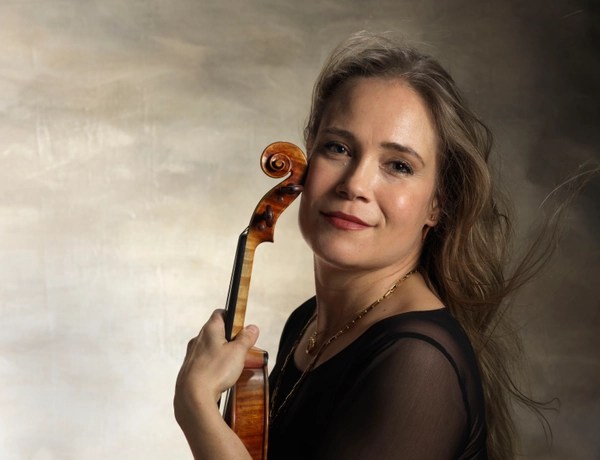
The featured artists and composers are chosen with typical care, placing Grime alongside violinist Leila Josefowicz (above), soloist in the composer’s Violin Concerto with the BBC Symphony Orchestra. “I’ve waited a long, long time for the UK premiere of concerto”, she says. “I wrote it for Malin Broman, an amazing Swedish violinist who used to be based in London and who premiered it in 2016, and then Leila took the piece on. She was supposed to be doing the UK premiere in 2020, but she’s played it a lot – in Amsterdam and in Finland. This does feel like the perfect moment, though, because Leila has that real connection with with Oliver Knussen. It’s kind of perfect that the premiere is happening in Aldeburgh. She’s an incredible artist, so the fact that we’re both featured artists is brilliant. I’m really, really excited about hearing Allan Clayton singing, and also Daniel Kidane’s pieces. We have quite a few shared concerts.”
Mention of Knussen leads us to talk about another highly influential composer, a clear influence on Grime both personally and professionally. “I have loved his music since the first time I heard it”, she says. “The first piece I heard was Ophelia Dances. My teacher at the time was Julian Anderson, and he introduced me to his music at the Royal College of Music. Every note is the right note, it’s just so beautifully crafted and exciting and powerful and enchanted.”
I was meant to meet him at the Britten Pears composer’s course, but when I was a fellow in Tanglewood he was out conducting, and he gave some masterclasses. He heard my music, and we got on well. Shortly after that, he conducted a short orchestral peace of mine called Virga, which I wrote as part of the London Symphony Orchestra scheme Sound Adventures, which is now known as the Panufnik Legacies. He was a real supporter of my music. I wrote Night Songs, which is also being done at Aldeburgh, for his 60th birthday celebrations in 2012. I really hold that dear, and I still listen to his music most weeks and days. A brilliant musician, composer, and supporter – and I think many musicians and composers feel the same way. My path would not have been the same at all without meeting Ollie.”
Looking ahead a little, Grime has an album of chamber works due for release on the Delphian label in August, a fascinating collection of works performed by The Hebrides Ensemble. “It’s coincidental to Aldeburgh, but great. The Hebrides Ensemble are one of those amazing groups who’ve been so supportive of me over the years, and they’ve given different performances. To have this portrait CD is fantastic, with a string sextet Into the Faded Air from 2007 right through to Braid Hills, a horn duo I wrote for St Mary’s Music School to celebrate their anniversary in 2022. I can’t wait for it to come out.”
Grime also acknowledges the passion and commitment of Delphian to composer albums such as this. “It’s really difficult to get these projects off the ground today, and very expensive, obviously. The commitment to new music in Delphian is absolutely brilliant, there was a wonderful CD the Hebrides Ensemble did a few years ago on Stuart MacRae, and there was a great collection of Judith Weir.”
With these projects coming to fruition, it is great to report Grime’s composition continues apace. “I’m coming to the end of my teaching turn at the moment, which means we get a bit of time for some holidays to compose. I’m writing a horn concerto at the moment, for Alec Frank-Gemmill and the Gothenburg Symphony Orchestra, so I’m completely immersed in all things horn at the moment! It’s a big piece, a big project, but I like that. I like to get my teeth into something. There are lots of various things on the horizon, too, but that’s the main thing. I’m more of a one piece at a time kind of person. Directly before this, I wrote a song cycle, Bright Travellers, which was premiered at the Leeds Lieder Festival earlier this year by Louise Alder and Joseph Middleton. I’ve been working with a lot of texts, and it’s been great in the last couple of years to work with living writers, that’s quite a new direction for me which is exciting!”
For more information on Helen Grime’s music at the Aldeburgh Festival, head to the Britten Pears Arts website
 Arcana.fm