
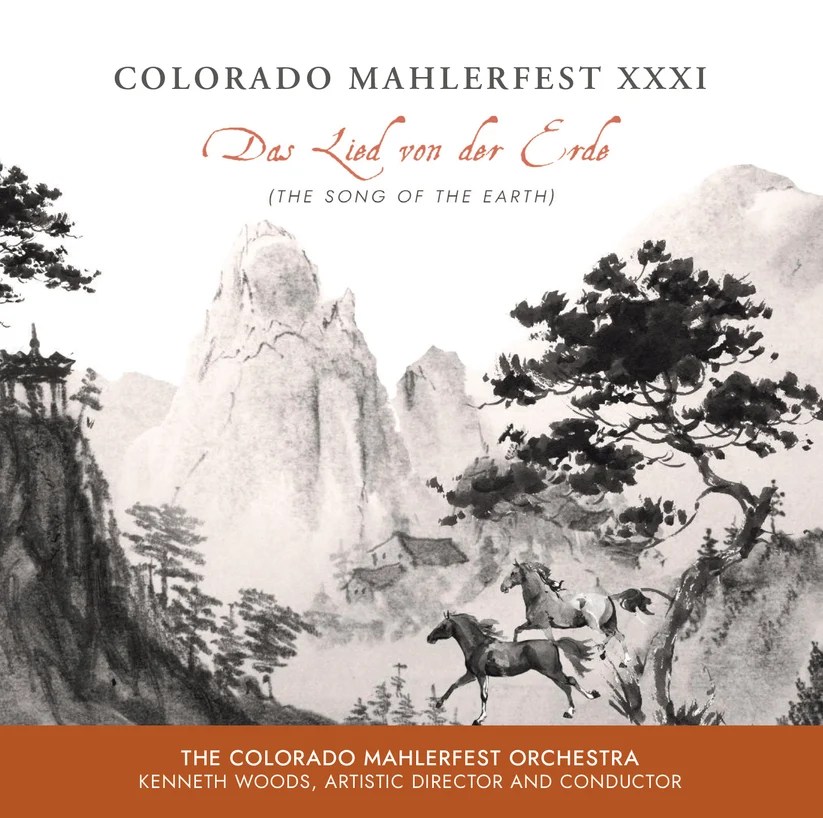
Stacey Rishoi (mezzo-soprano), Brennen Guillory (tenor), Colorado MahlerFest Orchestra / Kenneth Woods
Mahler
Das Lied von der Erde (1908-09)
Colorado MahlerFest 195269164287 [58’46”]
Producer Mike Quam Engineer Tim Burton
Live performances at Macky Auditorium, Boulder, Colorado, 19-20 May 2018
Reviewed by Richard Whitehouse
What’s the story?
Colorado MahlerFest here issues on CD the ‘official’ first instalment of its Mahler cycle with current artistic director Kenneth Woods – The Song of the Earth being heard in a performance whose attributes have been maintained as well as enhanced throughout the intervening decade.
What are the performances like?
Nominally his ‘Ninth Symphony’, Mahler’s uncertainty over so-designating this piece means it is still frequently overlooked in traversals of his symphonies. Launching his cycle thus (the Seventh and Tenth Symphonies, heard at MahlerFest XXIX and XXX, will be given again in the 2028/29 editions), Woods gave notice of his identity with a work he had earlier conducted and recorded in the chamber transcription begun in 1921 by Schoenberg then completed over six decades later by Rainer Riehn (SOMMCD0109) whose virtues seem no less evident here.
Together with Woods, both these performances have in common the tenor Brennen Guillory – his impulsive while never histrionic tenor heard to impressive effect in ‘The Drinking Song of Earth’s Sorrow’, with its constant pivoting between despair and resignation prior to those fateful final bars. By contrast, ‘The Lonely One in Autumn’ has a seamlessness and lucidity duly accentuated by the flowing tempo (rightly) adopted here; mezzo Stacey Rishoi placing equal emphasis on that inward anguish and alleviating rapture as inform this masterly setting.
There is no falling off of insight during the triptych of scherzos – with trios – which follows. Guillory resists any temptation to over-characterize ‘Of Youth’ with its myriad subtleties of orchestration and piquant harmony, then Rishoi brings alluring elegance to the outer sections of ‘Of Beauty’ with its boisterous central section ideally integrated into this setting overall. Its barbed humour all too easy to caricature, ‘The Drunkard in Spring’ evinces wit and not a little pathos as Guillory veers pointedly if always securely between escapism and epiphany.
Whether or not his greatest achievement, ‘The Farewell’ is Mahler’s most personal statement – a ‘scena’ for voice and instruments with his increasing preference for stratified textures and ethereal sonorities at its most potent. At just under 28 minutes, Woods demonstrably has the measure of a lengthy though never discursive span whose settings of fateful anticipation then ecstatic fulfilment are linked, motivically as well as conceptually, by a central interlude with its fateful processional made as tangible as is Rishoi’s serene leave-taking towards the close.
Does it all work?
Pretty much throughout. Many accounts of this work have been affected by less than ideally matched vocalists and/or at least one less than perceptive movement, but the present reading avoids these pitfalls. The woodwind principals are never less than equal to their considerable tasks, and if the playing of the Colorado MahlerFest Orchestra has gained during subsequent editions in terms of unanimity and lustre, its underlying commitment is never for a moment in doubt heard in Mackey Auditorium’s close yet never confined or unsympathetic acoustic.
Is it recommended?
It is, not just as an indication of where the association between this orchestra and conductor was headed. No-one hearing their performance could question Woods’s standing as a Mahler interpreter of distinction, or this orchestra’s ability to rise to the challenge of Mahler’s music.
Listen / Buy
For further purchase options, visit the MahlerFest website – and for more information on the festival itself, click here. Click on the names for further information on conductor Kenneth Woods and tenor Brennen Guillory
Published post no.3,044 – Sunday 11 October 2026

