San Franciscan producer Scott Hansen returns to his Tycho alias for a first long player since 2020’s Simulcast.
The aim this time around was, in his words, “about creating a space for healing and reflection, a mantra for spiritual, emotional, and physical healing. At the end of the day, all we really have is our health – both physical and mental – and we wish infinite health to our family and friends. So in those ways, infinite health is a salutation and an imperative.”
The synths and samplers still form the basis for the Tycho sound, but Hansen has looked to use acoustic topping in creating an individual sound, helped by regular collaborators Zac Brown (guitar), Rory O’Connor (drums) and producer Chris Taylor.
What’s the music like?
Tycho have always made beautiful sounds that somehow capture the wide expanse and warmth of their Californian home – and Infinite Health is no different.
This is an upbeat album, full of energizing, positive grooves and laden with hooks. Hansen’s breezy textures, helped by Grizzly Bear’s Taylor, are a treat, especially on their own favourite, the single Phantom:
The punchy groove they achieve here is used to good effect elsewhere, with breaks successfully employed alongside springy, four to the floor rhythm tracks. Restraint is a dreamy reverie, as is the lovely Green, dressed with earthy drums, while Devices and DX Odyssey are more of the electro-disco school.
For this author the best track is Totem, a really catchy acoustic-led number that is fertile in its invention and packs a good groove.
Does it all work?
It does, comfortably – with Infinite Health having all the positive energy and breezy textures of previous releases, while facing firmly forward in its musical outlook.
Is it recommended?
It is – Tycho bring a burst of late summer sunshine to the party, dressed in production you want to dive into. First class chillout music.
For fans of… Ulrich Schnauss, Explosions In The Sky, Rival Consoles, Minotaur Shock
For full repertoire list, see the bottom of this article
Monica Mancini, Rachel John, Oliver Tompsett (vocals), Freddie Benedict, Kevin Fox, Johanna Marshall, Liz Swain (backing vocals), BBC Concert Orchestra / Edwin Outwater
Royal Albert Hall, London Monday 2 September 2024
reviewed by Richard Whitehouse Photo (c) Andy Paradise
Among a plethora of centenary commemorations for composers classical or otherwise, it was good to see that of Henry Mancini marked with a Prom that featured a decent selection of his music next to that of relative contemporaries in this programme of unalloyed ‘easy listening’. The period 1955-75 was an era when such music not only flourished but was taken seriously by moguls in the music industry, witnessed by the sheer number of in-house orchestras with ‘their’ conductors who secured reputations comparable to those of their pop contemporaries.
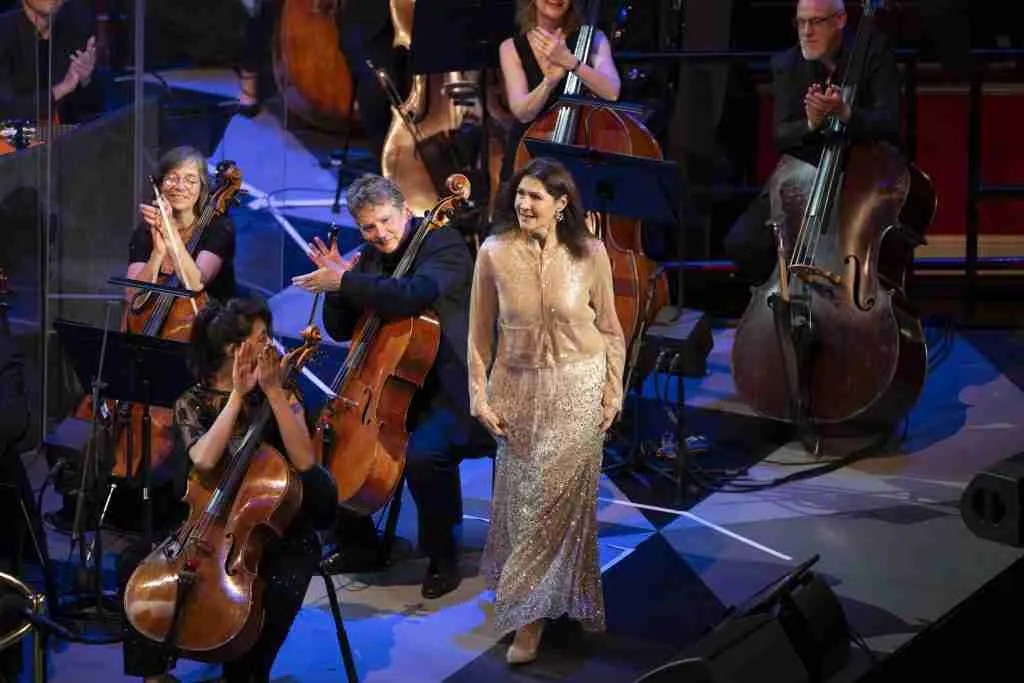
The BBC Concert Orchestra has long flown the flag for this music, as has its principal guest conductor Edwin Outwater. They launched this evening in fine style with the main title from Mancini’s Charade, its ominous allure complemented by the panache of the theme from Peter Gunn then the slinky humour of Baby Elephant Walk; a mellifluous Days of Wine and Roses bringing the first appearance from tonight’s quartet of backing vocalists. The evergreen Moon River had an elegant cameo by the composer’s daughter Monica Mancini (above), its pathos set in relief by the enigmatic theme from The Pink Panther then irresistible sleaziness of Harold Arlen’s Blues in the Night. More Mancini followed with the driven percussive of Rain Drops in Rio then sultry Lujon with its eponymous percussion instrument. Quincy Jones hit an early high with his ricocheting Soul Bossa Nova, as also Juan García Esquivel with his catchy Mucha Muchacha and Les Baxter in his stealthy Quiet Village. Burt Bacharach’s bittersweet Alfie was graced with an eloquent vocal by Rachel John, then Nicholas Roubanis’ Misirlou evocatively brought up the interval.
The late Laurie Johnson created TV gold with the suave tones of The Shake, theme from The Avengers, as did Morton Stevens with his high-octane Hawaii Five-O. Rachel John sounded a shade coy in Bacharach’s The Look of Love (memorably covered by Scott Walker), his genial Casino Royale hitting the spot as did Julius Wechter’s breezy Spanish Flea. The vocal quartet added ambivalence to Bobby Scott / Ric Marlow co-write A Taste of Honey then ethereality to Michel Legrand’s The Windmills of Your Mind or a neat line in scat to Mancini’s Party Poop. If Oliver Tompsett undersold the sassiness of Sid Ramin’s Music to Watch Girls By, there was no mistaking the faux-chinoiserie of Mancini’s Hong Kong Fireworks and suavity of Baxter’s Shooting Star. Rachel John made Bacharach’s This Guy’s in Love With You a candidate for the most perfect pop-song, with Baxter’s Saturday Night on Saturn more inane in context. Not so Esquivel’s Whatchamacallit with its quirky Ondioline (more stylophone then theremin), then Oliver Tompsett pointed the double-entendre of Bacharach’s What’s New Pussycat? before a gyrating take on Les Reed’s / Gordon Mills’ It’s Not Unusual, indelibly linked with Tom Jones.
It would have been perfectly feasible to assemble a evening devoted to Mancini by taking in his edgier film-scores to such 1950s classics as The Creature of the Black Lagoon and Touch of Evil, but making this a nostalgia-fest doubtless commended itself to a near-capacity house – not that you had to be over a certain age to enjoy what was on offer or to have seen the TV series Animal Magic whose theme-tune, Johnson’s Las Vegas, made an effervescent encore.
List of repertoire performed:
Mancini (arr. Stanley Black): Charade – Main Title (1963) Mancini: Peter Gunn – Theme (1958) Mancini (arr. Black): Baby Elephant Walk (1961) Mancini: Days of Wine and Roses (1962)*d Mancini: Moon River (1961)a Mancini (arr. Gavin Sutherland): The Pink Panther – Theme (1963)* Arlen (arr. Fiona Brice): Blues in the Night (1941)* Mancini (arr. George Moore): Rain Drops in Rio (1961) Mancini: Lujon (1961) Jones (arr. Alasdair Malloy): Soul Bossa Nova (1962)* Esquivel (arr. Sam Gale): Mucha Muchacha (1962)d Baxter (arr. Moore): Quiet Village (1951) Bacharach (arr. Les Reed): Alfie (1966)b Roubanis (arr. Callum Au): Misirlou (1941)
Johnson (arr. Mike Townend): The Shake (1965) Stevens (arr. Malloy): Hawaii Five-O (1968) Bacharach (arr. Richard Balcombe): The Look of Love (1967)b Bacharach (arr. Balcome): Casino Royale (1967) Wechter (arr. Malloy): Spanish Flea (1965) Scott/Marlow (arr. Brice): A Taste of Honey (1960)d Legrand (arr. Balcombe): The Windmills of Your Mind (1968)d Ramin (arr. Balcombe): Music to Watch Girls By (1967)c Mancini (arr. Moore): Party Poop (1968)d Mancini (arr. Black): Hong Kong Fireworks (1978) Baxter (arr. Moore): Shooting Star (1968) Bacharach (arr. Balcombe): This Guy’s in Love With You (1968)b Baxter (arr. Moore): Saturday Night on Saturn (1957) Esquivel (arr. Gale): Whatchamacallit (1959) Bacharach (arr. Balcombe): What’s New Pussycat (1965)c Reed/Mills (arr. Balcombe): It’s Not Unusual (1965)c
(All titles Proms premieres except *)
aMonica Mancini, bRachel John, cOliver Tompsett (vocals), dFreddie Benedict, Kevin Fox, Johanna Marshall, Liz Swain (backing vocals), BBC Concert Orchestra / Edwin Outwater
Today marks the 200th anniversary of the birth of composer Anton Bruckner.
Bruckner is a ‘marmite’ figure in classical music. His symphonies, the calling cards of his small but profound output, divide opinion greatly. The later works, I am sure, would appeal to those approaching from the direction of progressive rock, and are fiercely admired by a great many devoted classical music listeners. They create sound worlds unlike any other composer, ‘cathedrals in sound’ in which he uses distinctive themes, deceptively simple techniques, and extended forms that mean most of his symphonic works run for an hour or more. Other ears, however, remain unmoved, immune to the great expanses of texture and intensity.
What cannot be disputed is that Bruckner’s music is instantly recognisable as his, especially when it is one of those nine numbered symphonies. In the last year a host of recordings have appeared of the whole cycle, along with a myriad of different – if authentic – performing versions. A box set round-up of all these versions is due to appear on Naxos on 13 September, collecting all the individual volumes of Bruckner recorded by the Bruckner Orchester Linz under Markus Poschner for the Capriccio label:
My personal favourite among the symphonies is the mighty Eighth, which has received a number of classic recordings. Those by Reginald Goodall, Herbert von Karajan, Carlo Maria Giulini and – especially – Gunter Wand, have all left a mark. The latter is an incredible account, recorded in 1987 in Lübeck Cathedral:
Yet I did also want to draw some attention to Bruckner’s music for voices and for strings, in case you want to try something different. The motets for unaccompanied choir are profound and beautiful – while the Te Deum is a many-splendoured thing, as are the three masses for chorus and orchestra.
Here, too, is the String Quintet in F major, a big-boned piece with music of real poise and power. The slow movement shows how Bruckner can write delicate music, the Scherzo is an elusive dance, while the outer movements show what an unusual yet affective style he has, able to wring every last drop of power from a seemingly small ensemble:
Published post no.2,291 – Wednesday 3 September 2024
posted by Ben Hogwood – text copied from the festival’s press release:
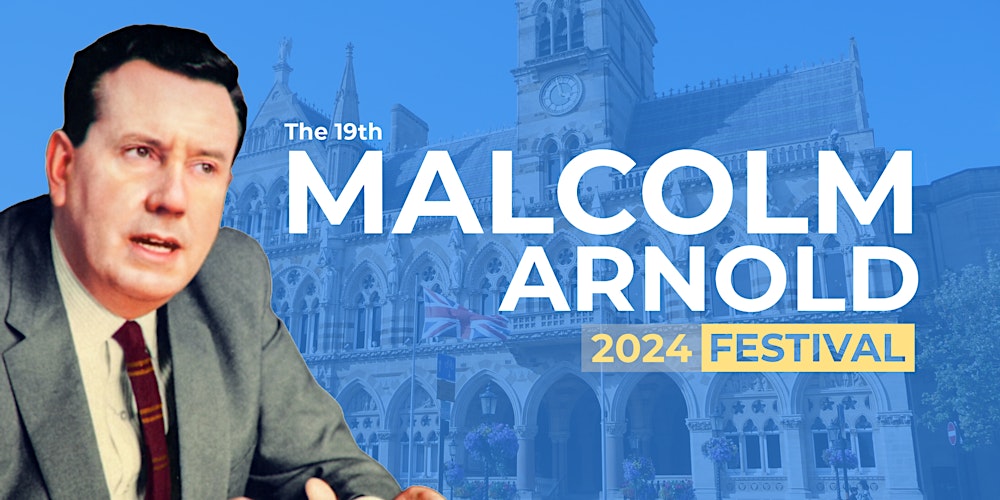
One of England’s most colourful and charismatic composers – Sir Malcolm Arnold (1921-2006) – is to be celebrated at the 19th International Malcolm Arnold Festival; an annual programme of events centred around the multi-faceted composer and his music. The composer’s hometown of Northampton will host a day of live music-making on Saturday 19 October, and a specially procured programme to attract listeners from around the world will live-stream on Sunday 27 October.
SATURDAY 19 OCTOBER – LIVE MUSIC CONTINUNES ALL DAY
Continuing his successful presentations in both live and digital formats, Festival Director Paul Harris is extending the reach of Malcolm Arnold’s music to listeners everywhere, with live concerts and a Symposium hosted in the composer’s hometown, and a specially conceived live-stream day, presenting recorded performances and talks, this year with a particular focus on Arnold’s songs and choral works – a relatively little-known area of the composer’s output.
Paul Harris says: “This year we are offering three concerts within central Northampton (Malcolm’s birthplace), all in walkable distances from each other. We are delighted that Saturday’s launch concert will take place at St Peter’s, marking the reopening of the church as a performance space.”
Launched by composer, Matthew Taylor, listeners will be able to enjoy a programme of rousing music for brass, one of Malcolm Arnold’s most popular genres as a renowned trumpet player himself, performed by Spectacle Brass Quintet lead by Nick Budd. Following this there will be a performance of the composer’s second String Quartet performed by students from the Royal Birmingham Conservatoire.
Live music continues throughout the day, transferring to All Saints’ Church, just a short walk away, with music for choir and organ to include the composer’s psalms and part songs, his John Clare Cantata, and Turtle Drum; familiar to many from school days. Also featured will be Arnold’s Organ Variations: five variations by living composers and one new variation written especially by Jonathan Whiting for this year’s Festival.
Demonstrating the exuberance of Arnold’s works and some of his finest and most popular tunes, the Festival’s Gala Concert takes place at Northampton Guildhall and will be performed by the Northamptonshire County Youth Concert Band and Orchestra (NMPAT) who are regular guests at the Festival. The Festival will end with a short Symposium hosted by Matthew Taylor discussing all things Arnold.
HOW TO BOOK Tickets are £10 per concert or £25 for a day ticket, available at the door or book in advance online. Students and under 18s are admitted FREE of charge. www.malcolmarnoldfestival.com
ONLINE DAY (FREE live-stream) – SUNDAY 27 OCTOBER
FREE-to-view and presented live by Director Paul Harris, the Festival’s complimentary digital live-stream day will take place on Sunday 27 October and features performances of some of Malcolm Arnold’s greatest solo, chamber and orchestral music as well as talks, lectures and exclusive interviews.
Paul Harris says, “The day is structured around the years that have their anniversary this year; 1934, 1944, 54, 64, 74 …etc. and what Malcolm was writing and doing in those years. We are also featuring all of his wonderful songs as the central theme performed by Claire Thompson and Scott Mitchell – Malcolm is not well-known for his vocal writing and our programme will give a fascinating insight into this genre. Also a host of Arnold specialists will be contributing through their knowledge and enthusiasm to bring together another fascinating and engaging day of music making.”
Harris himself will give a talk on Malcolm Arnold at the Royal College of Music, and there are further talks by Arnold authorities including Dr. Timothy Bowers, Dimitri Scarlato, Eleanor Fox, Gus Woodward, and BBC Radio 3 broadcaster and long-time Arnold enthusiast, Martin Handley.
Amongst the assortment of Malcolm Arnold’s chamber works will be historic recordings and specially recorded performances by students from Chethams’ School and the Royal College of Music. Soloists taking part, who will also introduce their pieces, include soprano, Claire Thompson, pianists Scott Mitchell and Lynn Arnold, and oboist Ewen Millar.
Amongst those pieces featured will beKensington Gardens for Oboe, a piece by Arnold’s fellow composer at the Royal College of Music, Ruth Gipps, known affectionally to Malcolm as ‘Widdy’. Written for Gipps’ own instrument and piano, this is an engaging short suite of three pieces named Elfin Oak, Fat Pigeon and Chestnut Trees. Alongside Arnold’s songs from his own Kensington Gardens are his William Blake Songs, which were hailed by Gipps as “the real Malcolm”.
Both dramatic and playful in tone, the Sinfonietta No. 3, Arnold’s third “Little Symphony” completed in September 1964, extends the scope of his two earlier essays in this form and is scored for a classical chamber orchestra, demonstrating all the usual hallmarks of the composer’s inventiveness in smaller scale.
From the same year, the celebratory Water Music was commissioned by the National Trust for the opening of the Stratford Canal. In three movements, the piece was written for wind and percussion to be played on a raft moored on the River Avon, and later transcribed by the composer for full orchestra.
HOW TO VIEW Live-stream FREE to view. Refer to the website for further information including the full programme:www.malcolmarnoldfestival.com
Published post no.2,290 – Tuesday 3 September 2024
Schumann Piano Concerto in A minor Op.54 (1841-5) Smetana Má vlast (1874-9)
Vikingur Ólafsson (piano), Berliner Philharmoniker / Kirill Petrenko
Royal Albert Hall, London Saturday 31 August 2024
reviewed by Richard Whitehouse Photos (c) Chris Christodoulou
This first concert in its latest Proms visit by the Berliner Philharmoniker and chief conductor Kirill Petrenko featured a complete performance of Smetana’s Má vlast as the second half of a programme that, at barely the length of an average Mahler symphony, need not be unusual.
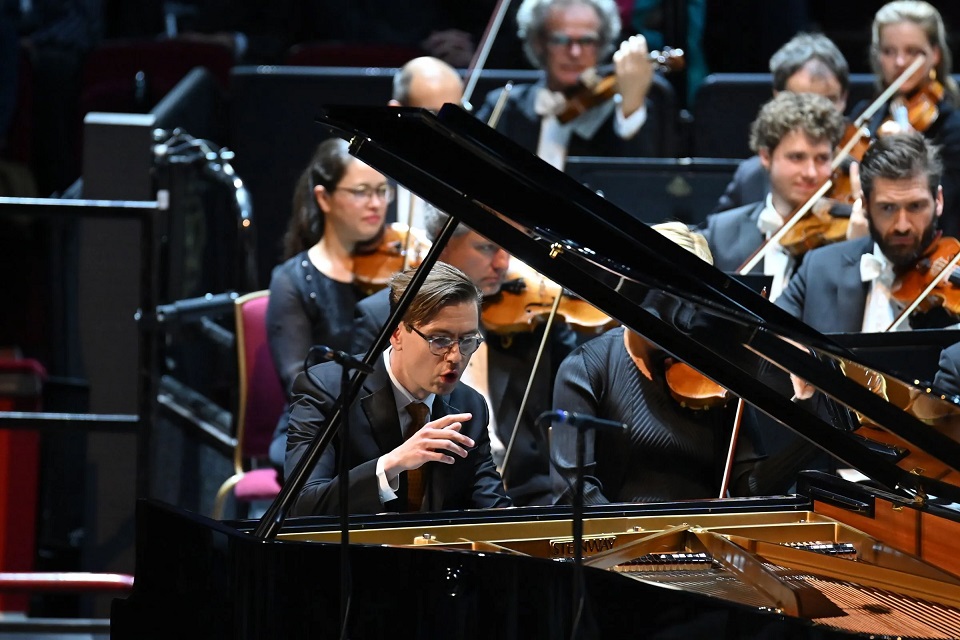
Few would, in any case, object to Vikingur Ólafsson tackle Schumann’s Piano Concerto in an account as dextrously articulated as it was unerringly proportioned. Not least an initial Allegro such as avoided any tendency to mid-tempo ‘drift’, those subtly contrasted themes building a cumulative impetus carried into the combative cadenza then a coda whose tensile energy was judged to a nicety by Petrenko. Some might have felt the Intermezzo too interventionist in its alternation of capriciousness and pathos, but absence of the cutesiness and cloying was more than its own justification and not least when that transition into the final Allegro had such an expectancy. Rhythmically supple with unwavering focus on its overall continuity, this set the seal on a reading whose technical finesse and interpretative insight ensured a riveting listen.
Ólafsson caused some stir at these concerts three years ago with Bach and Mozart concertos, and it was the former composer who provided the encore: the Adagio from the Fourth Organ Sonata (BWV528), transcribed here by August Stradel and rendered with understated poise.
More Czech music so soon after the Czech Philharmonic’s brace of Proms might have been too much of a good thing, but Petrenko’s Má vlast was very different from Jakub Hrůša’s in its lithe expression and streamlined textures. Nor was there was any lack of emotional depth – hence those earlier stages of Vyšehrad as it emerged eloquently on harps towards a fervent climax, its dramatic central section of a razor-sharp precision before subsiding into the main theme’s moving return. Vltava was scenically evocative and formally cohesive as it took in folk-dance, nocturnal landscape and treacherous rapids prior to its resplendent emergence in Prague, then Šárka unfolded its narrative of a matriarchal icon and her heroic demise with an impulsiveness that went into overdrive – without being overdriven – at its dramatic close.
It may be more generalized as to content, but the initial half of From Bohemia’s Woods and Fields is spellbinding as it conjures a pantheist ecstasy (in the process, anticipating Janáček and Minimalism) to which the BPO players were audibly attuned – Petrenko mindful not to overstate the relative blatancy of what follows. Most impressive, even so, were the final two stages whose gaunt rhetoric and granitic sound-world most often make for uneasy listening. Not here, however, as Petrenko gauged the motivic eddying of Tábor so that its underlying momentum held good through to the inevitable segue into Blaník. Emotional tension here was unremitting, the intensive interplay of Vyšehrad-theme with Hussite-chorale building to an apotheosis of Beethovenian power before letting loose for a coda of visceral exhilaration.
Its composite nature makes Má vlast difficult to sustain in performance, but there could be no doubt Petrenko managed this through his and the BPO’s acute yet never wanton control over every facet of the greater concept. A memorable performance and an impressive achievement.






 Arcana.fm