Unknown's avatar

About Arcana

My name is Ben Hogwood, editor of the Arcana music site (arcana.fm)

Switched On – Ark Zead – Niptaktuk (Glacial Movements)

by Ben Hogwood

What’s the story?

Ark Zead is an artist shrouded in mystery. Nothing is known about the composer – other than Glacial Movements head Alessandro Tedeschi taking delivery of ‘seven ethereal soundclouds that drastically lowered the temperature by several degrees’.

From Ark Zead themselves: “I am a gong and Tibetan singing bowls player, interested in vibes in a very usual way. But I felt inspired when I faced the very hostile cold in Canada. I looked for stories about exploring these lands and the people who live there. I then modified my vibe sounds with computers and synthesizers to describe the state of isolationism you have to reach to enjoy the beauty of the true North.”

What’s the music like?

In a word, chilly! The right conditions are needed to experience the best of Ark Zead – an environment where you can hear as much of the audio spectrum as possible, taking advantage of some of the low bass drones that characterise this music, and also the subtlety of movement that takes place. The press release says as much: It is highly recommended to listen to Niptaktuk at night, in a quiet environment.

The music is incredibly cold to the touch – the icy wind that blows through Unnuaq chills the bone, and shows this music as equal parts ambient and unnerving. At times there is consonant harmony, but elsewhere there is slight but lasting discord that creates a heavy atmosphere, laden with dread.

The gong and singing bowls are used to great effect on Sikinik, while by contrast Båken Nunatak is laden with thick ambience. A vast wind is summoned on the title track. Ultimately this is music of greatly immersive ambience, a chance for the listener to put all else aside and lose themselves in the slow but inexorable progressions crafted by the composer.

Does it all work?

It does – especially if you are familiar with the Glacial Movements output, as that will help prepare you for the intensity of ambience that Ark Zead achieves.

Is it recommended?

Yes. Ark Zead is able to describe the weather in musical terms, with sounds so cold you can barely feel your fingers. A truly immersive experience, and one that is both cleansing and disarming in equal measure. Just like the cold.

For fans of… Loscil, Machinefabriek, Tim Hecker, Stars of the Lid

Listen & Buy

Published post no.2,278 – Thursday 22 August 2024

New music – Jeremy Denk – Ives / Denk (Nonesuch)

published by Ben Hogwood, with text appropriated from the press release

Nonesuch Records releases Jeremy Denk’s Ives Denk on October 18. The pianist, known as a champion of Charles Ives, is acclaimed for his performances of the great American composer’s works. Ives Denk, released in celebration of the 150th anniversary of Ives’ birth, features the composer’s four violin sonatas, performed with violinist Stefan Jackiw, as well as remastered versions of his Sonatas No. 1 and 2 for piano, from Denk’s 2010 debut recording, Jeremy Denk Plays Ives. ‘In the Barn’, the second movement of Sonata No. 2 for violin and piano, is available to download and can be listened to here:

In his liner note, Denk says that Ives’ “deepest dream was to create an original musical style, a fresh and uniquely American voice. He achieved this. But it was a voice most didn’t want to hear, and still don’t. He is one of history’s least popular populists … Ives’ writing – especially the later ones, when he was in terrible physical decline – are… often unhinged with anger, full of mean-spirited nicknames and simplistic binaries, they reflect some of the worst angles of America. One thing that saves Ives’ music from these dangers is his sense of humour, and his willingness to embrace failure.”

“If there is one piece that sums up for me Ives’ difficult virtues, it is the slow movement of the first violin sonata, a jagged musical reflection on the Civil War, so eerily relevant now, with America split into red-blue madness. It is interesting to compare this kind of piece, profound yet unloved, with the far more identifiably American voice of Aaron Copland … Ives is optimistic but always messy, always falling apart at the seams. His music suggests America will just have to muddle through, and wrestle with its own failure. At this particular historical moment, Ives seems to be more right than ever.”

“‘In the Barn’ is a joyful disaster,” Denk says of the second sonata movement, above. “It starts with country fiddling, slips slyly into urban ragtime, and as time passes, every imaginable genre makes a cameo – overheated Wagnerian Romanticism, fashionable exoticism, a dizzying tour of the early twentieth century musical world.”

Ives / Denk will contain the following repertoire:

Violin Sonata no.4 ‘Children’s Day at the Camp Meeting’
Violin Sonata no.3
Violin Sonata no.2
Violin Sonata no.1
Piano Sonata no.1
Piano Sonata no.2 ‘Concord, Mass., 1840-1860’

Published post no.2,277 – Wednesday 21 August 2024

On Record – Krononaut: Krononaut II (Palomino)

by Ben Hogwood

What’s the story?

This is the second outing for the duo of guitarist / producer Leo Abrahams and drummer Martin France, pooling their considerable musical resources for four tracks of contemplation and improvisation.

The first instalment of Krononaut, released in 2021, featured guest appearances from Arve Henriksen, Matana Roberts and Shahzad Ismaily. This one is restricted to just the two musicians, and brings in a number of influences explored by Leo on this playlist for Arcana a few weeks back:

What’s the music like?

There is some rather special music making here. The sessions took place over the course of a single afternoon in Abrahams’ East London studio, and it’s possible to imagine the sunlight making a play on the studio walls, and the possibility of it shimmering through leaves as interpreted by Abrahams’ guitars.

These are intensely layered but full of melodic invention, either in short nuggets or in broad, arches. The descending motif that starts to take over in Spindle suggests an object moving down through the sky, doing so over a backdrop of rolling drums from France, before Abrahams’ guitar suggests Spanish influences in its rich harmonies. Meanwhile the rarefied atmosphere of Silver Silver gnaws at the tendrils of icy clouds high up in the atmosphere.

France’s drumming is entirely acoustic and often extremely intricate – but never overdone. He pushes the momentum forwards towards the end of Silver Silver, but contrasts with considerable restraint on Mirage, where Abrahams’ dreamy lines curl upward and take the lead.

PGC 20513 – which appears to be the name of a star in the constellation Gemini – gets an appropriately spacey backdrop, beautifully cast by Abrahams, with reverberation that sets the wide screen picture but ensures it is filled with complementary musical motifs. The longest composition here, it inhabits a far-off world, ending in a compressed cell of melodies from the guitar, rich in treble and prompted by steady hi-hats and rolling toms.

Does it all work?

Yes – it does. Moments and moods captured in sound, that would only sound this way once – which makes them all the more special.

Is it recommended?

Yes, enthusiastically. The chemistry between these two musicians is rather special, and the four meditations unfold naturally in a four-part suite that inspires the senses.

For fans of… Bill Laswell, Kit Downes, Harold Budd, Terry Riley

Listen and Buy

Published post no.2,276 – Tuesday 20 August 2024

Arcana at the Proms – Prom 35: BBC Scottish Symphony Orchestra / Ilan Volkov – Ellington, Braxton and Mary Lou Williams

Ellington orch. Gould Solitude (1934), Mood Indigo (1930), Sophisticated Lady (1932), Caravan (1936)
Mary Lou Williams Zodiac Suite (1944-6) [UK premiere]
Braxton Composition no.27 (+ nos. 46, 59, 63, 146, 147, 151 & Language Music) (1972-91) [Proms premiere]

Mikaela Bennett (soprano), Aaron Diehl (piano), James Fei (saxophone/conductor), Gregory Hutchinson (drum kit), Ingrid Laubrock (saxophones), Brandon Lee (trumpet), Chris Lewis (clarinet/saxophone), David Wong (double bass), Katherine Young (bassoon/conductor), BBC Scottish Symphony Orchestra / Ilan Volkov

Royal Albert Hall, London
Thursday 15 August 2024

reviewed by Richard Whitehouse Photos (c) Sisi Burn

Never a conductor to take the path of least resistance, Ilan Volkov centred his latest Prom with the BBC Scottish Symphony Orchestra (whose Creative Partner he remains) around jazz – not that there was anything orthodox about the repertoire or the follow-through in what was heard.

The four Duke Ellington numbers heard tonight became standards in the Depression era, their pioneering spirit stylishly offset in orchestrations by Morton Gould (the first three on 1957’s Blues in the Night and the fourth on 1956’s Jungle Drums). Solitude ranks among Ellington’s most affecting tunes, while his sultry Mood Indigo proved an inspired co-write with Barney Bigard. The present arrangement fully enhanced the teasing elegance of Sophisticated Lady, before the expressive impetus of the Juan Tizol co-write Caravan left its evocative imprint.

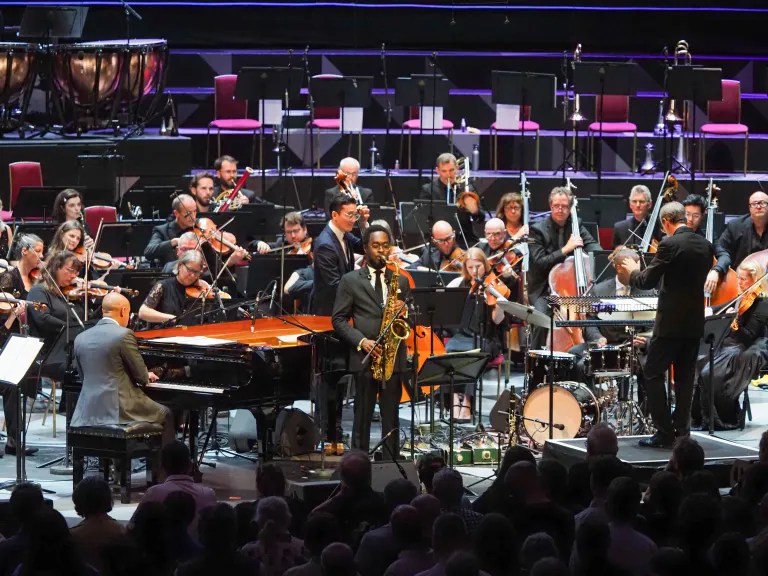
Pianist and arranger for artists from Ellington to Cecil Taylor, Mary Lou Williams’ music only posthumously came to the fore. She wrote nothing more ambitious than Zodiac Suite – a series of 12 tributes to musicians born under various star signs, as went through several incarnations at the end of the Second World War and remains a trailblazer for symphonic jazz. As realized here, each item left room for contributions by the assembled jazz or orchestral musicians: thus the incisiveness of Brandon Lee’s trumpet or mellifluousness of Chris Lewis’ clarinet and alto sax, besides stealthy interplay by the Aaron Diehn Trio (above) or a soulful violin solo by guest-leader Kate Suthers. The sequence concluded with Pisces and an agile vocal (lyrics not printed) by Mikaela Bennett – its manner (surprisingly?) redolent of mid-20th century American art-song.

From here to Anthony Braxton proved a fair conceptual leap, but a meaningful one within this context. One, moreover, for which Volkov has prepared painstakingly across almost a decade – working with several of Braxton’s longer-term collaborators (notably George Lewis), while performing several Braxton compositions duly rendered as the superimposed totality he openly encourages. What resulted was Composition No. 27 as a framework for this performance, into which elements from six later ‘Compositions’ were integrated – this whole entity underpinned by recourse to Language Music, collating 12 musical parameters in what is the codification of Braxton’s practice over six decades. The creative aspect arises at a point when the fullest extent of compositional systematization links with the furthest extent of improvisational spontaneity.

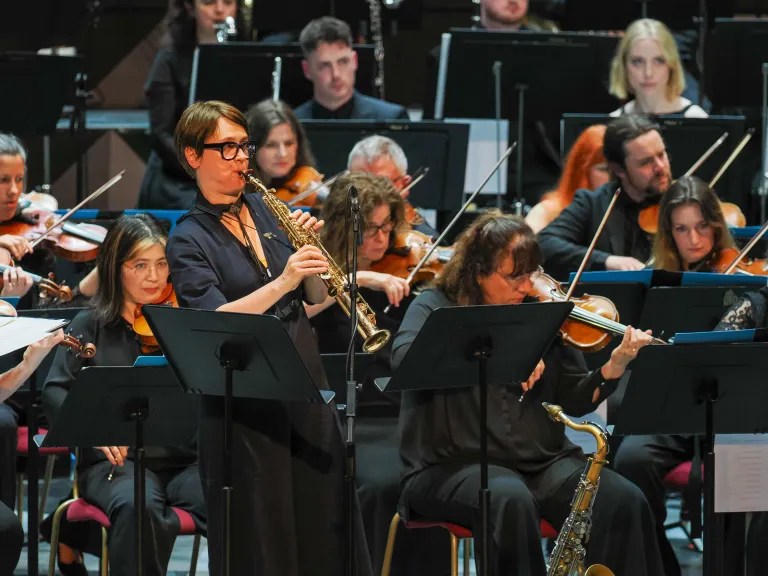
The interaction between jazz and orchestral musicians was intricate and unpredictable, so that saxophonist James Fel and bassoonist Katherine Young – but not the always inventive Ingrid Laubrock (above) – were often conductors next to Volkov in determining the overall trajectory. There were occasions when continuity felt tentative or uncertain, yet these were outweighed by the translucent allure in much of the ensemble playing as well as the resolve with which all those participating headed toward a culmination the more definite for its seeming inconclusiveness. Not that this performance commended itself to all those present, with several dozen exiting the auditorium as though insects under siege. Those who stayed were rewarded with music-making such as encouraged an active participation all too rare in present-day concertgoing.

For more on this year’s festival, visit the BBC Proms website. For further information, click on the artist names for more on Ilan Volkov and the BBC Scottish Symphony Orchestra, and on the composer names for information on Duke Ellington, Mary Lou Williams and Anthony Braxton.

Published post no.2,275 – Monday 16 August 2024

Summer serenades: Barber

If you search for Barber‘s Serenade for Strings on YouTube, the search facility thinks you want to hear the Adagio. This is not a surprise, given the popularity of Barber’s most famous music – but there is indeed a Serenade for Strings, the first published material from the American composer.

Like the Adagio, it was originally written for string quartet but transcribes effortlessly for bigger forces – as here, with the Royal Scottish National Orchestra under Marin Alsop. Lasting just over 10 minutes, it is in three movements:

Published post no.2,274 – Sunday 18 August 2024