William Doyle returns to the LP format with this response to the ‘ecstasies and agonies of the 2020s’ . On it, he is assisted by Brian Eno, Alexander Painter and Genevieve Dawson.
What’s the music like?
This time Doyle shows his musical versatility through a collection of intricate art pop songs. Drawing on late 1960s pop and psychedelia for inspiration, he updates them with cultural references for today, a kind of coping mechanism for life in the digital age.
Doyle’s lyrics show an awareness of the changing climate, and as he found nearly all the songs mention water in some way. They are clever and well written, with songs like RelentlessMelt that are knowing commentaries on modern life dressed with catchy tunes. The orchestration is bright and suits Doyle’s delicate tones.
Does it all work?
Largely – though on occasion the feeling persists that the music on this album is just a bit too bright eyed and bushy tailed, that darker thoughts below the surface are not fully expressed.
Is it recommended?
It is. SpringsEternal is an optimistic statement proving once again how versatile William Doyle can be.
Grant Doyle (baritone) and John Kember (piano) with Brian Sibley (narrator)
EM Records EMRCD082 [two discs, 2h29m17s] Producers Grant Doyle, John Kember Engineer Nick Taylor Recorded 2019 and 2020 at Porcupine Studios, Mottingham, London
Reviewed by Richard Whitehouse
What’s the story?
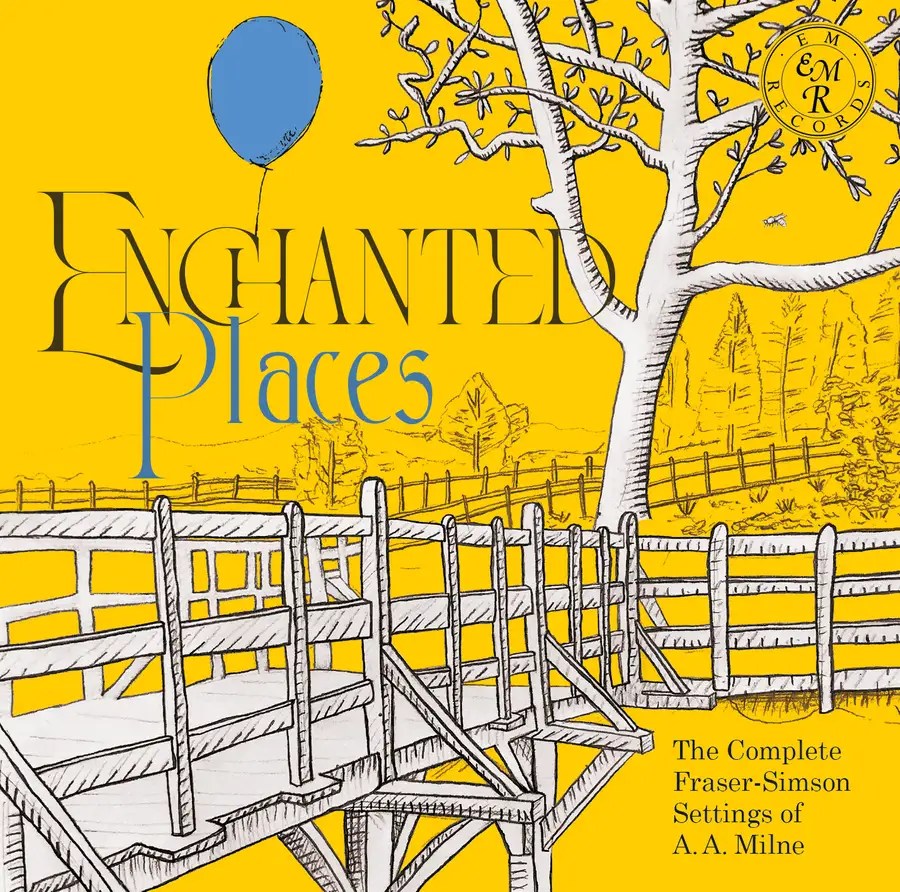
EM Records continues its coverage of lesser-known and neglected English music with this complete traversal of A. A. Milne settings by Harold Fraser-Simson, more than appropriate when this year coincides with the centenary of Milne’s first collection of poems for children.
What’s the music like?
One among a notable generation of ‘light music’ composers, Fraser-Simson (1872-1944) had a brief if successful career with his songs and musicals; his musical comedy The Maid of the Mountains enjoyed one of the biggest West End successes during the latter years of the First World War and is still occasionally revived (the complete score was recorded by Hyperion in 2006). Although Simson’s star waned after the mid-1920s, his settings of Milne’s poems from the collections When Were Very Young (1924) and Now We Are Six (1927) have kept his name alive. Along with Milne’s books of short stories, these centre upon his son Christopher Robin and the latter’s nursery toys – above all, his bear Winnie-the-Pooh. They have held their own, moreover, throughout an era when the Disney franchise has continued to grow exponentially.
The songs themselves were published in six books between 1924 and 1929, alongside Milne’s poems with illustrations by Ernest Shepard which had graced the original collections. Private recordings were made at this time by Cicely Fraser-Simson with her husband as pianist, while Christopher Robin recorded several for HMV in 1927, and they have continued to attract the attention of singers both amateur and professional. Nor have the poems lost their appeal for subsequent generations of composers (Oliver Knussen drawing on a selection of them in his 1970 opus Hums and Songs of Winnie-the-Pooh), but Fraser-Simson’s settings have retained their charm along with a pathos accrued over the intervening decades. The present recording features 10 songs recorded for the first time to make this collection complete in all respects.
Does it all work?
Yes, not least given the quality of these performances. A seasoned exponent of opera, Grant Doyle gets to the heart of these settings – his singing of a warmth and precision that offsets any risk of sentimentality. Nor can his diction be faulted – no potential purchaser is likely to be without Milne’s original books but having them to hand is hardly necessary – while John Kember accompanies with subtlety and discretion. Devotee of all things Pooh, Brian Sibley narrates his handful of texts with due feeling for their unforced and often ingenious scansion.
This might not be the only way to realize these settings (a comparably extensive collection by Volante Opera Productions (Prima Facie) features seven singers), but the consistent and characterful nature of Doyle’s approach is its own justification. Those wishing to sample this release should go to The King’s Breakfast (CD2, tracks 26-29), essentially a cantata in which singer, narrator and pianist are joined by four other musicians to deftly imaginative effect, or evergreens Vespers (1, 39) and Buckingham Palace (2, 3) which emerge newly minted here.
Is it recommended?
Yes. The sound has an ideal combination of clarity and definition, while Sibley’s booklet notes on composer, author and project could hardly be bettered as an informed introduction. Put the Disney treatment aside and enjoy these settings for the winsome humour as initially intended.
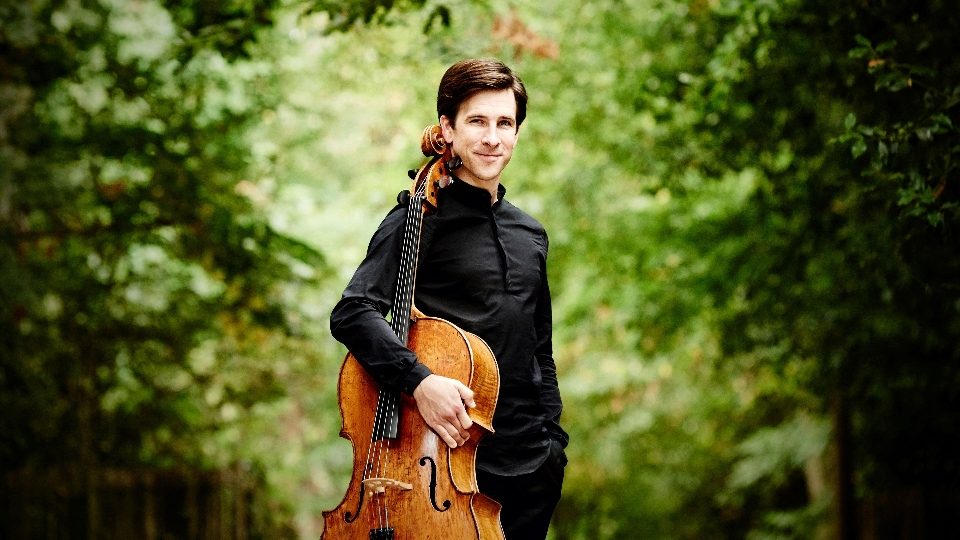
Guy Johnston (cello, above), Britten Sinfonia / Thomas Gould (violin)
Beethoven arr. Weingartner Grosse Fuge Op.133 (1826) Bartók Divertimento for String Orchestra Sz113 (1939) Tavener The Protecting Veil (1988)
Barbican Hall, London Thursday 15 February 2024
Reviewed by Ben Hogwood
The Protecting Veil is a special piece. Written by John Tavener in 1988, this musical meditation for cello and orchestra is based on and inspired by the Greeks resisting Saracen invasion in the early tenth century. They are heartened by a vision of Mary, the Mother of God, surrounded by a host of saints and spreading out her Veil as a protective shelter over the Christians.
In what is effectively a single-movement concerto, the cello represents the Mother of God, leading the string orchestra in eight prayerful chapters that respond to landmark events in which she is present. It may sound elegiac and deeply ambient for much of its duration, but to achieve this elevated state the performers require poise, concentration and inner strength.
It is hard to imagine a better performance than this one experienced at the Barbican. Guy Johnston led us in contemplation, the serenity of his upper register cello line immediately establishing a mood of calm, in complete contrast to the bustling city outside. The Britten Sinfonia responded in kind, conducted where necessary by violinist Thomas Gould but largely following the cello, a congregation responding to his prompting.
In spite of its inner serenity, The Protecting Veil is troubled by the shadows of violence throughout the world. This performance was a stark reminder of how little has changed in eleven centuries, for in the ominous falling motif that recurs for the cello it was impossible not to think of bombs and missiles raining down in the many warzones we see today. The Barbican fell largely silent as those images undoubtedly projected to many listeners, aided by a sympathetic light show that cast the distinctive markings of the back of the stage as a wooden chapel. When Johnston played alone in the central section, The Lament of the Mother of God at the Cross, he could easily have been playing solo Bach, the intimacy of his and Tavener’s thoughts laid bare.
There was, ultimately, consolation and redemption, and the lights burned yellow when the music soared back to the heights with which it began. Feverish anticipation gripped the strings as they responded excitably to the higher cello, and with a surety of tone that never dimmed, Johnston led us to the end. His was a remarkable performance of stamina and poise, those long notes held for what seemed like an eternity, their pure tones never dipping.
The musical contrast with the opening piece, Beethoven’s Grosse Fuge, was notable. Here is a piece that still sounds as new and every bit as challenging as the day it was written, the Everest of fugues. In this arrangement for string orchestra by Felix Weingartner, its angular subject is a touch smoother at the edges, though here the sharp lines were just as clear as in the string quartet original, the fugue subject escaping its restrictions. The Britten Sinfonia found its core in a well-drilled performance.
Bartók’s Divertimento for String Orchestra was lighter in mood to begin with, the ensemble celebrating the great outdoors as the folksy first tune went with a swing. Yet here too there were troubled minds, the slow movement wary of its place in history. Bartók wrote the Divertimento in 1939 in Switzerland, with Europe on the brink of the Second World War. The oppressive approach of the conflict could be felt in a profound slow movement, which began with feathery violas and reached a forbidding climax, emotion wrought from its pages. Those worries were largely banished by the finale, whose powerful unisons were led by Gould as the piece swaggered and bustled to the finish.
Guy Johnston and the Britten Sinfonia continue their tour with The Protecting Veil to Dublin and Manchester – for more details visit the Britten Sinfonia website
Published post no.2,090 – Saturday 17 February 2024
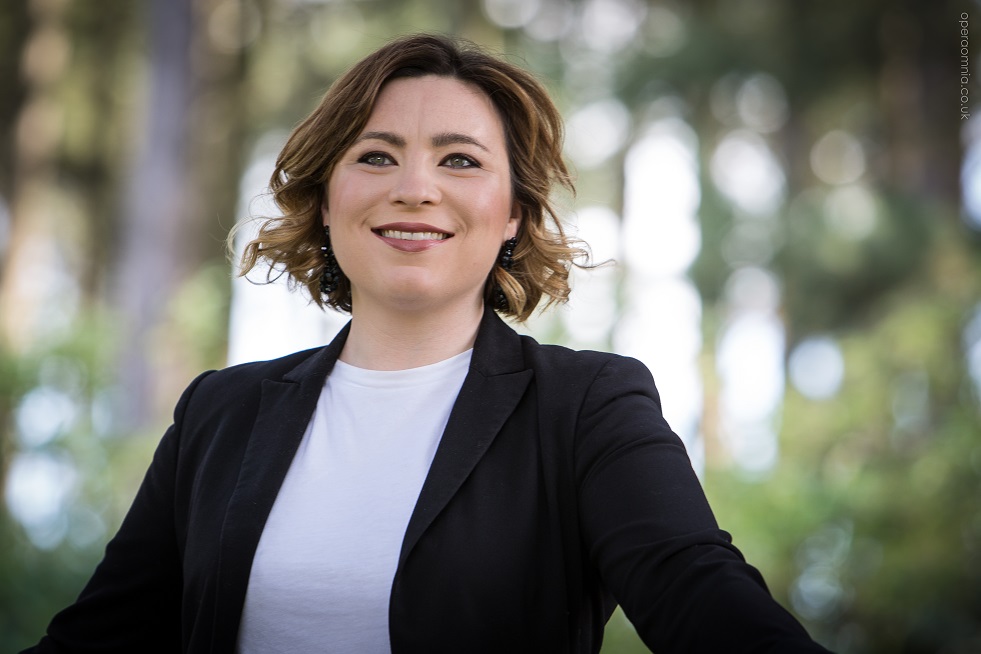
Natalya Romaniw (soprano, above), City of Birmingham Symphony Orchestra / Vassily Sinaisky (below)
Tchaikovsky Romeo and Juliet Fantasy Overture (1869, rev. 1872 & 1880) Tchaikovsky Eugene Onegin, Op.24 (1877-78) – Letter Scene Beethoven Ah! Perfido, Op.65 (1796) Beethoven Symphony no.2 in D major Op.36 (1801-2)
Symphony Hall, Birmingham Wednesday 14 February 2024
Reviewed by Richard Whitehouse
It might have been billed as a concert for Valentine’s Day and, though there was little about tonight’s programme to reinforce ‘true love reigns supreme’, it did make for a welcome new collaboration between the City of Birmingham Symphony Orchestra and Vassily Sinaisky.
Whether or not there is any more personal significance in Tchaikovsky’s Romeo and Juliet, it remains a potent encapsulation of Shakespeare’s tragedy. The brooding introduction seemed a little inhibited, but Sinaisky brought suitable incisiveness to the warring families and growing ardour to the love music. Nor was there any lack of drama as this ‘fantasy overture’ unfolded to its fateful denouement – after which, the benedictory chorale as Friar Laurence movingly apostrophises these doomed lovers brought an eloquent response from the CBSO woodwind.
Tchaikovsky’s reputation as an opera composer may have altered markedly over the decades, but Eugene Onegin has held the stage since its premiere; the Letter Scene, in which Tatyana knowingly risks all for love of a cynical anti-hero, its highlight. The Welsh-Ukrainian soprano Natalya Romaniw responded with real impulsiveness and, if her projection was too full-on to convey the emotional ambivalence and fragility of its central stages, the joyous abandon of its beginning and reckless determination at its close were duly rendered with unfailing charisma.
Romaniw sounded even more in her element as the jilted lover of Pietro Metastasio’s lyric Ah! Perfido which Beethoven set in his mid-20s. The latter wrote few such concert arias, but the immediacy of his response can hardly be gainsaid and Romaniw gave it her all – whether in its despairing introduction, the more consoling yet hardly untroubled expression that follows, or the steely resolve of those closing pages where the former ‘loved one’ is denounced in no uncertain terms. As in the Tchaikovsky, it was a pity neither text nor surtitles were provided.
Quite how Beethoven’s Second Symphony fitted into tonight’s conception was unclear, other than with its determination to defy fate and live life to the full, but Sinaisky evidently relished putting the CBSO through its paces – not least a first movement whose imposing introduction prepared for an Allegro of driving impetus and emotional fervour ideally intertwined prior to the blazing coda. Easy to underestimate, the Larghetto impressed with its lilting elegance and, in the central development, its teasing modulations – alongside a pay-off of disarming poise.
If, given its textural weight and unabashed rhetoric, this was ostensibly a performance of the ‘old school’, there was nothing portentous about Sinaisky’s take on the Scherzo – as lithe and quizzical as its trio was capricious, then the final Allegro had the character of an opera buffa ensemble refashioned for the post-Classical symphony toward which Beethoven was striving. Not the least attraction of this reading was its differentiation between soft and loud dynamics – crucial to the impact of a lengthy coda which fairly crackled with energy in its closing bars.
A gripping performance of a symphony which, while hardly unknown, is likely the least often played (albeit in the UK) of Beethoven’s nine. Sinaisky has enjoyed a productive relationship with the CBSO across the years, and it is to be hoped that this will continue in future seasons.
Carolyn Sampson (soprano, above), Joseph Middleton (piano, below)
Songs and piano music by Robert and Clara Schumann – full list at bottom of review
Wigmore Hall, London Wednesday 14 February 2024
by Ben Hogwood Photos by Marco Borggreve (Carolyn Sampson) and Sussie Ahlberg (Joseph Middleton)
This was a Valentine’s Day concert with a difference. No orchestra, no Romeo & Juliet – but rather an intimate presentation of a musical marriage, that of composer / pianists Robert and Clara Schumann, whose relationship has been increasingly under the microscope in the past few years.
This is a good thing, for when Robert and Clara married on 12 September 1840 the concept of equality within marriage, let alone classical music, was very different indeed. Robert, in the outpouring of song that he experienced in that year, completed the song cycle Frauenliebe und -leben, to poetry by Adelbert von Chamisso attempting a depiction of marriage from a woman’s perspective. It is certainly not how we recognise the institution of marriage today, which soprano Carolyn Sampson acknowledged in a Guardian article around the release of herAlbum für die Frau, the title of this concert, in 2021. In that article she put forward a strong case for continuing to sing the cycle, identifying with a good deal of the verse and even more of the music – but with her musical partner, pianist Joseph Middleton, she has recast the cycle.
Now the Schumanns’ marriage is given in four parts – love, marriage, parenthood and death – viewed through the prism of Frauenliebe but balanced through songs by Clara and Robert, or one of the latter’s piano pieces. Each song from the cycle had two accomplices, the context achieved through what must have been a painstaking selection process that, in this concert, bore much fruit. The coherent end piece was bisected by well-chosen text from the couple’s diaries and more.
With sadness inevitably looming towards the end it was a difficult structure for the duo to pitch, but they made it work through selections that made emotional sense and which, crucially, were harmonically linked. Sampson’s clarity of line was the clincher, her ability to carry not just a melody but the words with great diction, while the same could be said of Middleton’s phrasing, which as Sampson said in the introduction ‘could express what words cannot’. The postlude from Frauenliebe was the keenest example, exquisitely played.
The song cycle itself contained a great deal of emotion, especially in Du Ring an meinem Finger (You ring on my finger), where Sampson’s powerful crescendo was all-consuming. Clara’s songs proved the ideal complement, a little more Schubertian in style perhaps but harmonically more daring, often ending in suspension.
The first half included five settings of Rückert and felt slightly giddy in the intoxication of falling in love and wedded bliss, almost too good to be true – and so it proved, with the settings of Heinrich Heine bringing with them furrowed brows and family responsibilities, the music increasingly worrisome. Robert and Clara had eight children in all, and this section gave a glimpse of the weight of responsibility that would surely have left.
The masterstroke of this program, however, was not to finish with the end of the song cycle but to offer Robert’s Requiem, from his 6 Gedichte von N Laneu und Requiem Op.90, as a much-needed consolation, then the piano piece Winterzeit I, from the Album für die Jugend. Finally, as an encore, Clara’s Abendstern, a beautiful postscript with her love taken up to the stars, turned our gaze upwards once more.
It capped an unexpectedly moving account of two lives intertwined, offering a timely reminder of Clara’s torment at her husband’s untimely demise. One of the power couples of 19th century music they must have been, but this was a tender account of two lives entwined and enriched by beautiful song.
You can hear Album für die Frau, as released on BIS, below:
Carolyn Sampson and Joseph Middleton performed the following music:
Robert Schumann Langsam und mit Ausdruck zu spielen from Album für die Jugend Op. 68 (piano, 1848) Clara Schumann Liebst du um Schönheit Op. 12 No. 2 (1841) Robert Schumann Seit ich ihn gesehen from Frauenliebe und -leben Op. 42 (1840) Volksliedchen Op. 51 No. 2 (1840) Clara Schumann Liebeszauber Op. 13 No. 3 (1840-3) Robert Schumann Er, der Herrlichste von allen from Frauenliebe und -leben Op. 42 Clara Schumann An einem lichten Morgen from 6 Lieder aus Jucunde Op. 23 (1853) Warum willst du and’re fragen Op. 12 No. 3 (1841) Robert Schumann Ich kann’s nicht fassen, nicht glauben from Frauenliebe und -leben Op. 42 Clara Schumann Die stille Lotosblume Op. 13 No. 6 (1840-3) Robert Schumann Du Ring an meinem Finger from Frauenliebe und -leben Op. 42 From Myrthen Op. 25 (1840): Lied der Braut I • Lied der Braut II Glückes genug from Kinderszenen Op. 15 (piano, 1838) Interval Robert Schumann Helft mir, ihr Schwestern from Frauenliebe und -leben Op. 42 Die Lotosblume from Myrthen Op. 25 Lust der Sturmnacht from Kerner Lieder Op. 35 (1840) Süsser Freund, du blickest from Frauenliebe und -leben Op. 42 Hochländisches Wiegenlied from Myrthen Op. 25 Der Sandmann from Lieder-Album für die Jugend Op. 79 (1849) Kind im Einschlummern from Kinderszenen Op. 15 (piano) An meinem Herzen, an meiner Brust from Frauenliebe und -leben Op. 42 Ritter vom Steckenpferd from Kinderszenen Op. 15 (piano) Dein Angesicht Op. 127 No. 2 (1840) Nun hast du mir den ersten Schmerz getan from Frauenliebe und -leben Op. 42 Requiem from 6 Gedichte von N Lenau und Requiem Op. 90 (1850) Winterzeit I from Album für die Jugend Op. 68 (piano) Clara Schumann Abendstern
Published post no.2,088 – Thursday 15 February 2024