The Longing for Happiness. Left wall, detail from the Beethoven-Frieze (1902) by Gustav Klimt
Symphony no.2 in D major Op.36 for orchestra (1800-1802), arranged for piano trio 1805 (Beethoven aged 34)
Dedication unknown Duration 30′
1. Adagio molto – Allegro con brio 2. Larghetto 3. Scherzo: Allegro 4. Allegro molto
Listen
Background and Critical Reception
Beethoven’s friend and pupil Ferdinand Ries took charge of this arrangement of the Symphony no.2 for piano trio – but the very limited writings about the arrangement strongly imply that the final decisions on its construction and execution were made by Beethoven himself.
The reason for this arrangement is not abundantly clear, other than it making the symphony available for domestic, small-scale music making. Yet the nature of the scoring would mean only very accomplished players could see it through from one end to the other!
Thoughts
This is a remarkable and surprisingly effective transcription, one that fully retains the vitality of Beethoven’s invention while compressing it for the intimacy of a chamber music environment.
Inevitably the textures are very different, but having less instruments does on occasion give the listener opportunity to appreciate the bare bones of Beethoven’s melodic invention.
Spotify playlist and Recordings used
Robert Levin (piano), Peter Hanson (violin), David Watkin (cello) (Archiv Produktion)
Emanuel Ax (piano), Leonidas Kavakos (violin), Yo-Yo Ma (cello)
This is a very fine performance from pianist Robert Levin and soloists drawn from the Orchestre Révolutionnaire et Romantique. The fast music is punchy and incisive, while the slower music has more intimate moments, beautifully captured.
You can chart the Arcana Beethoven playlist as it grows, with one recommended version of each piece we listen to. Catch up here!
Also written in 1805 SpohrString Quartet no.1 in C major Op.4/1
Today is the anniversary of the birth of György Ligeti, one of the 20th century’s true innovators in music.
There are many longer pieces we could have chosen to mark this, but here are two shorter works that illustrate the range of his creativity. First up is Hungarian Rock, a short piece for harpsichord, which pushes the boundaries of what the instrument is capable of:
From the keyboard we turn to the choir, and the remarkable Lux Aeterna, which had such an effect on film director Stanley Kubrick that he used it in 2001: A Space Odyssey:
For The Grey Album, The Black Dog have gone back to basics. Inspired by electronic bands such as Depeche Mode and The Human League in their early years, they went back to much older ways of working, with one keyboard per person and a strict limit imposed on the use of the computers.
These were the confines for an album that continues a rich stream of creativity for the Sheffield trio. Proud of their heritage, they are continuing to explore music and architecture simultaneously – and this latest opus taps into both art forms for its inspiration.
What’sthemusiclike?
As its title implied, this is often an album of sombre colour – but there is also an impressive grandeur to the soundscapes The Black Dog conjure up.
That much is immediately evident from the stark outlines and imposing structure of Ghosts Of Decay, with steely synthesizer sounds reminiscent of the band’s city mates Cabaret Voltaire. As the beats arrive so too does an extra urgency, and the bumpy terrain of Let’s All Make Brutalism draws parallels with the trio’s love of 1980s architecture.
The faster tracks on this album are very impressive. Harder Times puts its pedal to the metal with an excellent, low slung groove, while the cleverly named (We Never Needed This) Fascist Groove Thang is excellent. Thee Difference Ov Girls drives forward with great purpose, as does the superb This Is Phil Talking and I Dare You. The last two are peppered with excellent riffs and generate great momentum – before the album subsides into the attractive coda, Borstal Communications sounding like the throb of steelpans.
Does it all work?
It does. The Black Dog are past masters at gauging the structure of an album and do so again here, moving effortlessly between mood and tempo and peaking with a couple of certified bangers.
Is it recommended?
Yes, enthusiastically – The Grey Album is a fine addition to The Black Dog discography, and confirmation that they are very much at the top of their game.
by Ben Hogwood Picture courtesy ALMA – ESO/NAOJ/NRAO, E/O’Gorman/P.Kervella
A report on the Guardian website today asks why the great red giant star Betelgeuse is glowing so brightly and behaving so strangely. It is a fascinating read, and its remarkable conclusion is a reminder that the light we see from the star is actually 600 years old.
It brought to mind a setting by Gustav Holst of a great poem about the star by Humbert Wolfe. This is a highly unusual song, proceeding such a slow speed that the age of the star is never in doubt. Here it is, sung by tenor Philip Langridge with pianist Steuart Bedford:
Thomas Gould (violin/director), Miranda Dale (violin), Caroline Dearnley (cello), Britten Sinfonia / Agata Zając (Maconchy)
Corelli Concerto Grosso in F major Op.6/2 (publ. 1714) Tippett Fantasia Concertante on a theme of Corelli (1953) Maconchy Symphony for Double String Orchestra (1953) Phibbs Flame and Shadow (2023) Walton Finale from Variations on an Elizabethan Theme (1953)
Milton Court, London Wednesday 24 May 2023
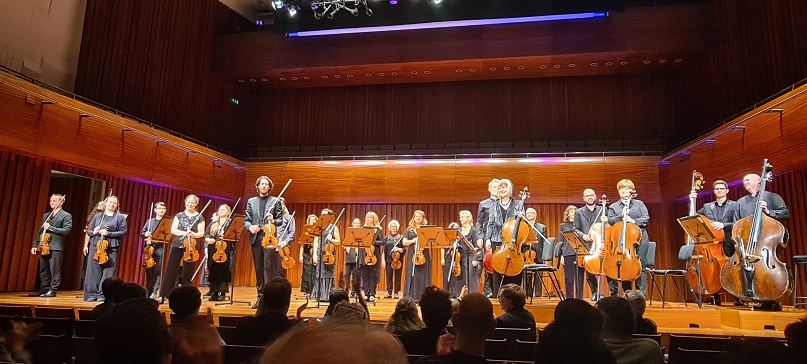
Reviewed by Ben Hogwood Pictures (c) Ben Hogwood
This typically imaginative concert devised by the Britten Sinfonia took as its starting point the events of 1953, where the United Kingdom shifted on its axis. It was of course the year in which Britain witnessed a Coronation, and in which Everest was scaled, but other than Walton’s jubilant finale to the collaborative composer project Variations on an Elizabethan Theme, no explicit musical links were made.
Instead, the Britten Sinfonia concentrated on two major works written for string orchestra in that year – one now well-known and one barely performed. The underdog, Elizabeth Maconchy’s Symphony for Double String Orchestra, made a very strong impression in this performance, brilliantly played by string players using a handwritten manuscript from 1953. The difficulty of this task necessitated a conductor, with Agata Zając joining at short notice. Hers was a dynamic presence, helping emphasise the rhythmic flair and dramatic impetus of the piece.
Maconchy’s music has often been critically coveted but is rarely heard in the concert hall – sadly an all-too familiar plight for a female composer innovating in the 20th century. Where many British composers wrote to include the countryside around them she wrote in a continental style, her music powered by fertile melodic imagination and rhythmic vitality. At times there are elements of Stravinsky and Bartók in her music but the closest parallel is Frank Bridge, with whom she shared an ability to explore the outer reaches of tonality without selling listeners short on melody.
The first movement of the Symphony grips the listener immediately, its powerful forward momentum complemented by soaring violin solos, which Thomas Gould played to perfection here. The febrile main motif bore close resemblance to Stravinsky’s Symphony in Three Movements, and Maconchy’s treatment of it was economical and engaging. Emotionally, however, the heart of the piece lay in the second movement Lento, where an eerie figure crept slowly upwards from cellos and basses, refusing to give way to the sweeter intimate melodies above. A rustic Scherzo, laden with syncopation, was followed by an equally captivating finale, initially pensive but with gathering intensity and drive. Just before the end the music broke out into a joyous country dance before returning to its more angular outlines.
The Britten Sinfonia were at the top of their game, subtly and superbly drilled by leader Gould. Each player was fully engaged, with smiles and nods of encouragement frequently passing between the team. When these qualities are natural, as they were here, a performance is elevated for the audience – and that was certainly the case for Corelli’s Concerto Grosso in F major, second in his set of twelve published as Op.6 in 1714. This opened the concert, dovetailing neatly into the work of Sir Michael Tippett, which it inspired.
Elegance and style were to the fore in the Corelli, with clean melodic lines given just a hint of vibrato for expression, and the interplay and balance between the three soloists and orchestra ideally judged. The work’s sunny countenance spilled over into the Tippett, though here the sun’s rays took on a more ecstatic quality.
The Fantasia Concertante on a theme of Corelli, also dating from 1953, is a compelling study in time travel. Tippett presents the original 18th century material unadorned, but adds his own unique musical language incrementally, so the piece becomes awash with bright colour and reaches a feverish intensity. Gould led a performance to savour, with fulsome support from fellow soloists Miranda Dale (violin) and Caroline Dearnley (cello). Together with the enhanced Sinfonia they rendered the golden textures beautifully, enhancing the elegance of the original material.
With the Tippett and Maconchy works a formidable pair either side of the interval, it says much for the London premiere of Joseph Phibbs’ new work that it was not in any way overshadowed. Though Flame and Shadow looked beyond events of 1953 for its stimulus it nonetheless bore a resemblance to the new coronation, its fresh take on music for strings revealing a busy contemporary approach.
Phibbs has an original and imaginative way with writing for strings, using audience-friendly melodic figurations but allowing them to roam harmonically, changing their perspective. The punchy rhythms of the Dance section here were a thrill, as were the combination of rapid fire and sustained open string pizzicato heard throughout the Interlude. Flame and Shadow, taking its title from a collection of verse by Sara Teasdale, was an edge of the seat piece, even to its closing Vocalise section, where a melody closely related to that found at the opening of Sibelius Symphony no.4 had a sobering effect. The contrasts of darkness and light were vivid and left a lasting impression – as indeed did the whole concert.
In twenty years of covering Britten Sinfonia concerts, and marvelling at their programming and technical prowess, this Milton Court evening confirmed their musical health to be stronger than ever. If only the same could be said for their long-term financial prospects, thrown into doubt by the withdrawal of funding in the latest Arts Council England cuts. Without the immediate publicity of similar actions levelled at English National Opera and the BBC Singers, the Britten Sinfonia have just launched their Play On fundraising campaign. The initial response has been encouraging, but it needs to raise more to secure the organisation’s future. Please do consider giving – I certainly will. This is the only way their imaginative concerts and a wealth of community-based outreach across East Anglia – where they are the only full time orchestra – can continue.