Unknown's avatar

About Arcana

My name is Ben Hogwood, editor of the Arcana music site (arcana.fm)

On Record – Ensemble Intercontemporain / George Jackson – Steve Reich: Reich/Richter (Nonesuch)

reviewed by Ben Hogwood

What’s the story?

Reich/Richter was originally written to be performed with German visual artist Gerhard Richter and Corinna Belz’s film Moving Picture (946-3). The film is based on Richter’s book, Patterns, where the author took a photo of one of his abstract paintings and scanned it into a computer. He cut the scan in half, then cut each half in two, and then reversed two of the four resultant quarters into mirror images. This process – ‘divide, mirror, repeat’ – was repeated all the way through from a half to a 4096th.

Belz helpfully described the film in terms of pixels, beginning with two-‘pixel’ stripes, while the music started with a ‘two-sixteenth’ oscillating pattern. The music then shadows the film as it moves to four, eight and sixteen stripes, at which point Reich introduced longer notes, expanding the music in response. As he then describes, the music returns to more rapid movement as the pixel count starts to diminish.

The match of visual artist and composer could hardly be more appropriate, and their resultant work was performed more than one hundred times at The Shed in New York during 2019. This recording, with the Ensemble Intercontemporain under George Jackson, was made in Paris at the Philharmonie.

What’s the music like?

One of Steve Reich’s many endearing qualities as a composer is the ability to take what sounds like a very complicated mathematical process and make it incredibly easy on the ear – and Reich/Richter repeats that trick.

As with the best ‘minimalist’ works it rewards attentive listening greatly, the ear drawing out shorter phrases and colour combinations, which prove to be every bit as vivid as the cover implies. Yet background listening works equally well, the ear and moreover the mind able to appreciate Reich’s hazy, impressionistic shades which recall earlier works such as Music for Mallet Instruments, Voices and Organ from 1973. Here, though, it is possible to appreciate Reich’s mastery of writing for wind instruments, incorporating them into the texture.

Unsurprisingly, Reich/Richter works best when experienced in its unbroken span of 37 minutes. There is some busy activity at all times but Reich’s sustained notes really stand out, giving the piece a broad scope that arches almost overhead. The ever-changing texture benefits from the lines afforded to brightly-toned violins, or crisp clarinets, but when these instruments retreat to make up the broad brushed colours in the middle background, a lovely haze ensues. This makes the piece one of Reich’s easiest to listen to, though by the time we get to the third part, Crossfades, the stretching of the notes introduces a notable tension not dissimilar to that experienced in the early Reich piece Four Organs. As the tempo recovers in Ending, the feeling is strangely exhilarating, like a flower opening out again in the sunlight.

Does it all work?

It does, achieving a very interesting blend of movement and stasis. The performance is excellent too, and intriguing that Ensemble Intercontemporain, the Parisian ensemble founded by Pierre Boulez, should now be recording his music! Boulez, it is safe to say, was not a fan of the so-called ‘minimalists’, and it would be fascinating if we could somehow know his thoughts on the recording.

Is it recommended?

Yes, enthusiastically – a compelling listen. The slightly short running time of the album release means that if you’re a Reich completist, it is worth bearing in mind that Nonesuch plan to release a collection of the composer’s complete works in 2023. Now that is definitely something for the diary!

Listen

Buy

You can explore purchase options for this album at the Nonesuch website

Switched On – Conrad Schnitzler & Wolf Sequenza: Consequenz II (Bureau B)

by Ben Hogwood

What’s the story?

Consequenz was a low-budget collaboration in 1980 between Conrad Schnitzler, once of Kluster and Eruption, and drummer Wolfgang Seidel, aka Wolf Sequenza. Its aim was to liberate music from elitist circles, and it set about this with a refreshing freedom. A sequel was commissioned and recorded in 1983/4, and Seidel takes up the story in the record’s press release:

“Certain ‘secret devices’ had materialized in our ivory tower in the meantime. Conrad Schnitzler had purchased an 8-track recorder with money he had earned from ‘proper’ art. I borrowed various bits of equipment from my band – Populäre Mechanik – including a drum computer, so we could really let rip. The little songs we made sounded much more ‘professional’ than the cheerfully low budget music of the first Consequenz. I’d taken days off work for the sessions and after a week we had enough material to fill one side of an LP.’

He continues. ‘All we needed now was music for the B-side, but our enthusiasm for the borrowed drum computer had waned somewhat. It was always the first track we recorded, which meant that everything else had to follow its lead. The beat itself was singularly unimpressed by what came next. This was an unsatisfactory state of affairs for two players (musicians?) who had begun with free improvisation, with either of the participants able to change the direction of the whole thing. Unsatisfactory, in spite of the fact that I was able to play to the beat with perfect timing, which led Conrad Schnitzler to give me the nickname “Sequenza” (hence the Consequenz title). The natural division of an LP into an A-side and a B-side lends itself to a caesura when the disc is flipped. So we decided to return to free-floating sounds on the B-side and, listening back now, I’m glad we did. Instead of competing with each other, the two sides dovetail perfectly.’

What’s the music like?

A fascinating listen to two musicians playing instinctively, Sequenza II has a fresh and incredibly modern sound. Its division into two sides is surprisingly effective too – side A has the sharp shooters, packed with riffs and incident aplenty, while side B is one track alone, Kastilien evolving over nearly 20 minutes into a work of impressive gravitas.

Before that we have Von Hand, firing on all cylinders, and the ping pong exchanges of Zack Zack. There is a friendly charm to a lot of this music, subtle humour coming through in the generation and exchange of ideas, with some regimented beats that speak of the time they were written. Hommage a Gaudi bucks the trend with its squiggly formations, Windmill operates with obscure riffing, while Erotik has a funky profile dancing around its regimented beat.

España won’t be to all tastes, with its coughed up refrains likely to panic in its Covid associations. Just as well, then, that Kastilien follows. By far the most challenging track on the album it is also one of the most liberating, its freedom expressed through increasingly restless and agile synthesizer music as its 20 minutes progress, dissolving in a wall of noise.

Does it all work?

Largely. You have to be in the right mood for Kastilien, but it works really well as a complement to the first side and its chopped up riffing, which proves to be highly enjoyable.

Is it recommended?

It is – and lovers of Krautrock or German electronic music from the 1970s will want to hear it for sure. Conrad Schnitzler continues to prove his worth more than a decade on from his sad passing, and in Wolfgang Seidel he has the ideal foil.

Listen

Buy

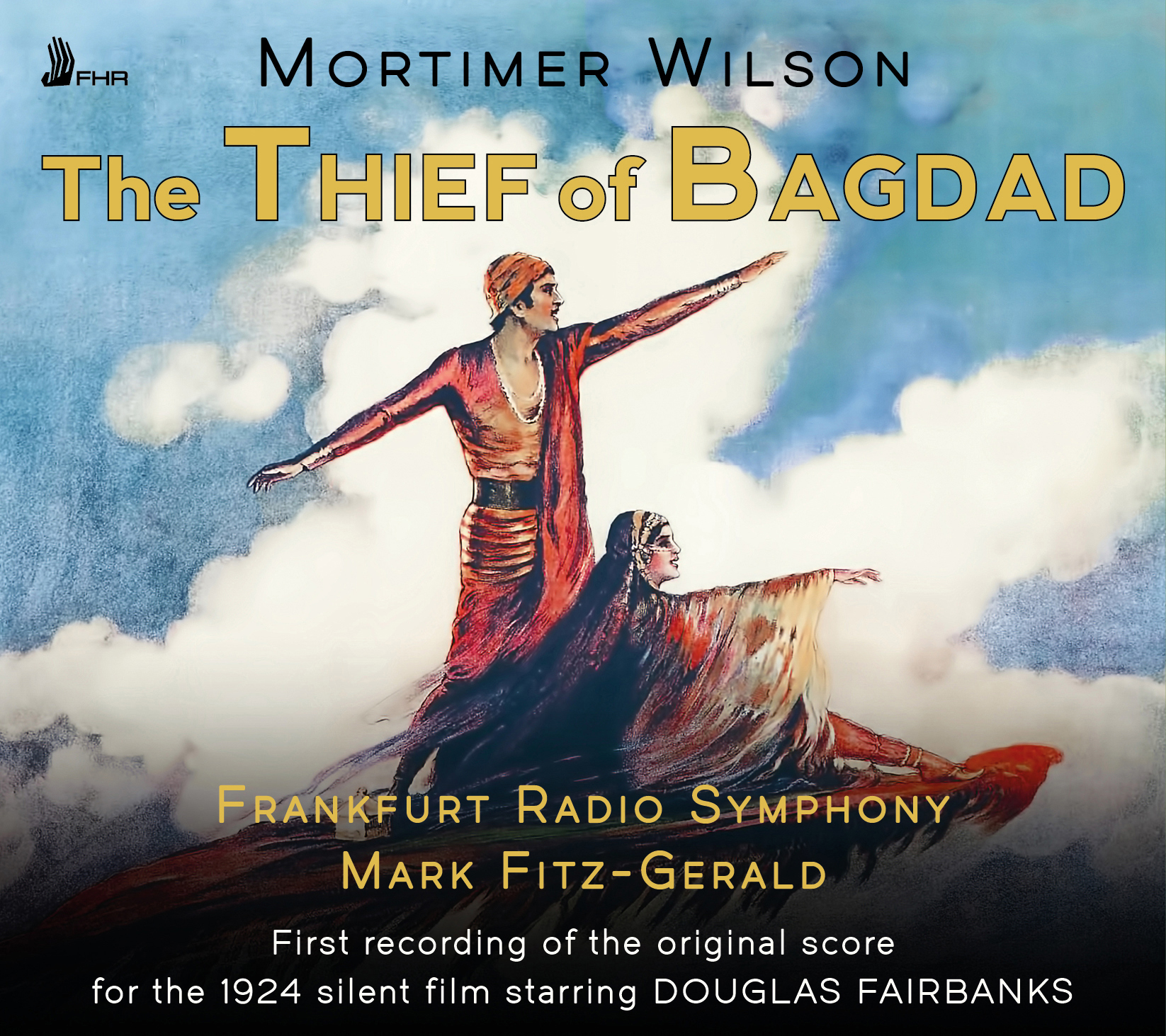
On record – Frankfurt Radio Symphony Orchestra / Mark Fitz-Gerald – Mortimer Wilson: The Thief of Bagdad (First Hand Records)

wilson-baghdad

Frankfurt Radio Symphony Orchestra / Mark Fitz-Gerald

Wilson The Thief of Bagdad Op.74 (1924)

First Hand Records FHR126 [74’45”]

Producer Philipp Knop Engineer Lisa Harnest

Recorded 11 April 2019 at Sendesaal, Hessicher Rundfunk, Frankfurt

Written by Richard Whitehouse

What’s the story?

First Hand Records comes up with another ‘first’ in this recording of the score for the film The Thief of Bagdad starring Douglas Fairbanks – one that set new standards for the ‘epic’   during the silent era, and which originally featured music to match from Mortimer Wilson.

What’s the music like?

Having starred in several major films (The Mark of Zorro, The Three Musketeers and Robin Hood), Fairbanks Sr determined to take matters to another level with The Thief of Baghdad – not least making its score an integral component. For this he turned to Wilson (1876-1932) – who had studied in Leipzig with Reger and later directed the Atlanta Symphony Orchestra, writing numerous compositions and several pedagogical books – encouraging him to create music whose symphonic aspect and panoramic expression were in themselves innovative.

Not all those involved in the project shared Fairbanks’s enthusiasm – among them impresario Morris Gest, who conspired to replace Wilson’s score with one from a higher-profile figure. James C. Bradford’s hurriedly assembled concoction almost immediately fell by the wayside, allowing the film’s highly successful first run to continue with Wilson’s music firmly in situ. Understandable, perhaps, why it had garnered praise but also attracted reservations given an emotional intensity and technical intricacy in advance of those previously attempted within a cinematic context. That said, Wilson was keen to make realization as practicable as possible – using relatively modest forces to facilitate performances in out-of-town venues, limiting the number of tempo or expression markings and even printing its parts in an easy-to-use format.

Nine decades on, its restoration was inevitably a challenge such as Mark Fitz-Gerald, having done comparable work on Shostakovich’s similarly ground-breaking scores for New Babylon (Naxos 8.572824-25) and Alone (Naxos 8.570316), was well equipped to undertake. How the music was initially reassembled and then adjusted to ensure its absolute synchronization with the film is explained in the accompanying booklet, a process which took several months prior to the first present-day showing at the Pordenone Silent Film Festival in October 2016, with the French premiere at Lyon this March. DVD presentation will hopefully be possible in due course; for now, the opportunity to hear Wilson’s superbly crafted score in so sympathetic a performance can only be welcomed by admirers of silent films and early 20th century music.

Does it all work?

Nearly always. Wilson’s music is firmly within the late-Romantic vein of Glière or Respighi, though a pertinent comparison might be Ernesto Halffter’s score for the silent film Carmen released just two years later and on which Fitz-Gerald undertook a similar act of restoration (Naxos 5.572260). In both cases, the music’s panoramic sweep is reinforced by interplay of themes and motifs which sustains dramatic tension across the whole. Moreover, the exclusion of repeated sections makes for a ‘screen symphony’ which fits comfortably onto a single disc.

Is it recommended?

Indeed. The Frankfurt Radio Symphony Orchestra responds ably to Fitz-Gerald’s astute direction, and the sound has clarity as well as presence. The booklet, featuring extensive commentaries by Fitz-Gerald and Patrick Stanbury, sets the seal on this ambitious and worthwhile enterprise.

Listen and Buy

To listen to excerpts from this disc and view purchase options, visit the First Hand Records website. To read more about Mortimer WIlson, this interesting article from the New York Times gives more information, while for more on Douglas Fairbanks click here To read more about the performers, click on the names of Mark Fitz-Gerald and Frankfurt Radio Symphony Orchestra.

In concert – Patricia Kopatchinskaja, CBSO / Ludovic Morlot: Britten & Shostakovich

patricia-kopatchinskaja-2

Britten Gloriana – Symphonic Suite, Op. 53a (1954)
Shostakovich Violin Concerto No. 1 in A minor, Op. 77 (1947-8)
Britten Peter Grimes – Four Sea Interludes, Op. 33a (1945)

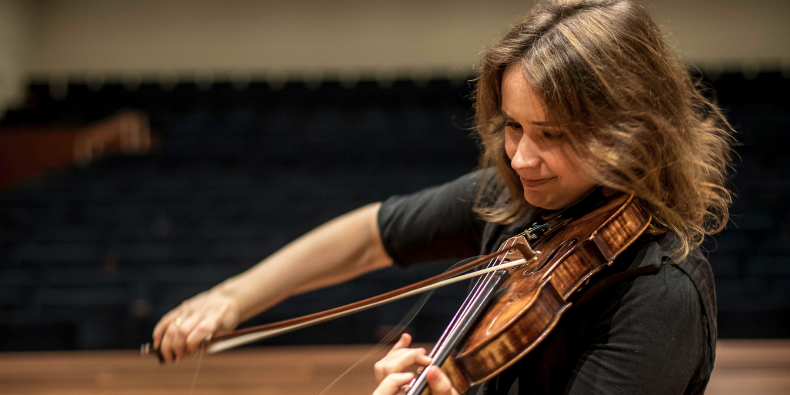
Patricia Kopatchinskaja (violin, above), City of Birmingham Symphony Orchestra / Ludovic Morlot (below)

Symphony Hall, Birmingham
Thursday 16 June 2022, 2.15pm

Written by Richard Whitehouse

This afternoon’s concert by the City of Birmingham Symphony Orchestra might largely have repeated that of the previous evening, but its inclusion of Shostakovich’s most wide-ranging concerto with suites which Britten devised from two of his operas ensured an absorbing listen.

In Shostakovich’s First Violin Concerto, it helped to have Patricia Kopatchinskaja at her most combative. Admittedly the opening Nocturne took time to come into focus, though its latter stages were powerfully shaped and with the sombre foreboding of the main climax gradually fading into silence. The Scherzo was distinguished by incisive repartee between soloist and orchestra, along with the vivid pointing up of those Jewish-derived elements which give this music a sardonic quality as becomes increasingly frenetic as the movement reaches its close.

The Passacaglia depends for so much of its emotional impact on its inexorable cumulative motion, and here Ludovic Morlot was at one with Kopatchinskaja in projecting the anguish – without undue vehemence – at its apex then forlorn manner of the soloist’s musing soliloquy. The Cadenza emerged methodically but with no lack of spontaneous expression, creating an impetus that the final Burlesque fulfilled in ample measure as it careered onwards – soloist and orchestra keeping enough in reserve for the coda fully to register its desperate defiance.

A pity last night’s UK premiere of Anna Thorvaldsdottir’s Catamorphosis (a co-commission for the CBSO’s centenary) could not be repeated, but that concert is being broadcast on BBC Radio 3 at a later date. Moreover, Kopatchinskaja had music of her own to perform when she returned to the platform for a duet with principal bassoonist Nikolaj Henriques in what was a repost to the authoritarian leaders who curtail creative expression, as have their predecessors before and after Stalin. Suffice to add that this piece made its point in notably visceral terms.

Opening the concert, Britten’s Symphonic Suite from his opera Gloriana made for a short if eventful first half – moving from the imperiousness of The Tournament, via the eloquence of The Lute Song (the tenor line of the original plaintively taken by oboist Emmet Byrne) and inspired pastiche of The Courtly Dances with its felicitous writing for woodwind and percussion, to the powerful apotheosis that is Gloriana moritura with its baleful brass and burnished strings. Not often revived, it made a suitably thoughtful impression this evening.

The Four Sea Interludes from Britten’s earlier opera Peter Grimes is more frequently heard in concert, with Morlot clearly relishing the stark timbral contrasts of Dawn as much as the scenic and temporal interplay in Sunday Morning. The highlight, though, was Moonlight whose sustained intensity and encroaching harmonic dissonance were palpably conveyed – after which, Storm concluded the sequence in vividly dramatic terms while not excluding that element of weary soul-searching as briefly ‘takes the stage’ before the dramatic close.

A distinctive programme with performances to match. Morlot is a conductor not seen often enough in the UK, and the same might be said for Markus Stenz who will be appearing with the CBSO next Thursday and Saturday in performances of Mahler’s Resurrection Symphony.

For more information on the CBSO, visit their website, and for details on the newly announced 2022/23 season click here. Meanwhile for more information on the artists, click on the names to access the websites of Patricia Kopatchinskaja and Ludovic Morlot

Switched On – Roger Eno: The Turning Year (Deutsche Grammophon)

by Ben Hogwood

What’s the story?

Roger Eno has been recording music for nearly 40 years. We first heard from him in the form of a shared credit with brother Brian and Daniel Lanois in their Apollo soundtrack, after which he wrote a series of albums for the revered All Saints Records, either in a solo capacity, in collaboration with the likes of Kate St John or Peter Hammill, or as part of ambient supergroup Channel Light Vessel.

Now he has moved to Deutsche Grammophon, Eno is taking the chance to assess some of his solo work while making new compositions too. He describes The Turning Year as, “A collection of short stories or photographs of individual scenes, each with its own character but somehow closely related to the other”. It is an album of observation, describing a natural cycle but also effectively documenting his own musical evolution. For example the oldest work, Stars and Wheels, is a solo organ piece of 20+ years, but was re-imagined for this album as Roger worked with producer Christian Badzura.

What’s the music like?

Eno is a consistent composer, and his brand of pastoral ambience is very easy on the ear but surprisingly difficult to imitate. The Turning Year captures his voice beautifully, unfolding at an easy pace. The creation of mood takes greater importance than that of melody, but the two nonetheless work closely together, with simple phrases that undergo development to produce music of subtly powerful feeling.

It is to Eno’s credit that he never crosses the line into sugary sentiment. Right from the start, the evocative A Place We Once Walked is attractively coloured and slightly wistful in its contemplation. The title track has a greater sense of purpose, while Bells is deeply personal, its slow piano revealing intimate thoughts and designs. On The Horizon is notable for a really nice clarinet colouring, while a slight chill lies in store on the autumnal Something Made Out Of Nothing.

Stars and Wheels is rather beautiful in its new clothing, panning out with some remote sounds that at the same time are extremely comforting, recreating the feeling Apollo gave of travelling slowly through deep space.

Does it all work?

Yes. Eno really flourishes in this company, and the scoring really does his keyboard-sourced music a good deal of favours.

Is it recommended?

It is. Although arguably Roger Eno’s best work remains in his earlier albums for All Saints, the move to Deutsche Grammophon has really given him the opportunity to blossom, a chance he is taking with both hands.

Listen

Buy

There are several options for purchasing and streaming The Turning Year, which you can explore here