Unknown's avatar

About Arcana

My name is Ben Hogwood, editor of the Arcana music site (arcana.fm)

Listening to Beethoven #140 – 7 Variations on ‘Kind, willst du ruhig schlafen’ WoO 75

beethoven-von-winter

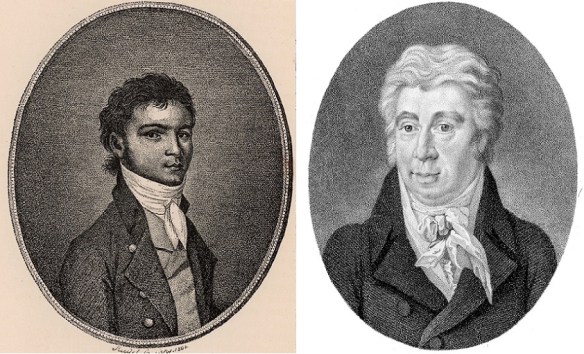
Ludwig van Beethoven and Peter von Winter (right)

7 Variations on ‘Kind, willst du ruhig schlafen’ WoO 75 for piano (1792-99, Beethoven aged 28)

Dedication unknown
Duration 11′

written by Ben Hogwood

Listen

What’s the theme like?

The theme, written by German contemporary Peter von Winter, is a compact tune, with quite a clipped melody – simple but ripe for development.

Background and Critical Reception

This set of seven variations on a quartet, Kind, willst du ruhig schlafen, from Peter von Winter’s opera Das unterbrochene Opferfest (The interrupted festival of sacrifice) appears to use all the four parts of the quartet as its inspiration.

Very little is written about this set, coming as it does in the middle of a rich vein of variation ‘form’ for Beethoven in the late 1790s. The general consensus is that he was enjoying himself and taking a feelw risks with harmony and form. This set would seem to confirm those notions.

Thoughts

Beethoven takes on the challenge with relish – so far very few of his variations have sounded routine. Having showcased the tune and a first variation, we get a glimpse in the second of a composer literally rolling up his sleeves as the piano surges up the scale. The next variation suggests a recent study of Handel, with pinpoint figuration and fluent movement.

A serious minor key diversion (variation no.6) is followed by an extended final variation and coda. Here Beethoven goes for a wander off the beaten track, moving unexpectedly into D major but with a surety and fluency that suggest this ‘surprise’ was well-planned all along. Sure enough the return ‘home’, with trills in the right hand, presents the theme in a subtly triumphant manner.

Recordings used and Spotify links

John Ogdon (piano) (EMI)
Cécile Ousset (piano) (Eloquence)
Ronald Brautigam (fortepiano) (BIS)

Cécile Ousset gives a typically characterful performance of these variations, with particularly enviable phrasing in the right hand of the chromatic fourth variation. John Ogdon is sparkling throughout, slightly drier in wit perhaps. Ronald Brautigam offers a vivid contrast on the fortepiano, played with plenty of fire and brimstone in the quicker music at the end of the coda.

Also written in 1799 Benjamin Carr Dead March and Monody

Next up Plaisir drainer WoO 128

Listening to Beethoven #139 – Romance no.2 in F major Op.50

Violin from Beethonven’s possession, one of four instruments Beethoven received as a gift from Prince Karl von Lichnowsky around 1800 (image from the Beethoven-Haus Bonn)

Romance no.2 in F major Op.50 for violin and orchestra (1798, Beethoven aged 27)

Dedication unknown
Duration 7’30”

Listen

Background and Critical Reception

After his early attempt at a concerto for violin and orchestra in 1792, Beethoven revisits the combination with two Romances – published in 1803 and 1805 as Op.40 and Op.50 respectively. The second is thought to predate the first, completed in 1798. Both Romances are thought to have been candidates for the slow movement of the early concerto, written as they are in suitable keys – but they stand alone as popular pieces.

Wolfram Steinbeck, writing for Universal’s Complete Beethoven Edition, observes that ‘Beethoven created a new genre with these two works, the violin romance, which found a number of successors in the 19th century (famous ones were composed by Berlioz, Dvořák and Bruch).’

Commentators observe that the focus is the singing tone of the violin, rather than athletic virtuosity. ‘These works by Beethoven were also to have been a stepping stone to his great Violin Concerto’, writes Steinbeck. ‘What appears there in broad strokes is tried out here on a much smaller canvas.’

Given the popularity of both Romances, there is a surprising dearth of writing from scholars of the composer.

Thoughts

The Romance no.2 is a sublime piece, and Beethoven fulfils his aims by really making the violin sing, The orchestral accompaniment is kept very much in the background but with the lovely ‘Viennese’ sound of a small orchestra.

As the piece progresses there is the opportunity for the violinist to show off, but lyricism is always the prime aim – and the tune itself is a keeper. Beethoven’s softer side is not always acknowledged, but it is to the fore throughout in this piece.

Recordings used and Spotify links

Anne-Sophie Mutter (violin), New York Philharmonic Orchestra / Kurt Masur (Deutsche Grammophon)

Thomas Zehetmair (violin), Orchestra of the Eighteenth Century / Frans Brüggen

Itzhak Perlman (violin), Berliner Philharmoniker / Daniel Barenboim

Arthur Grumiaux (violin), Royal Concertgebouw Orchestra / Sir Colin Davis

The creamy tone of Anne-Sophie Mutter may be a bit calorie-rich for some tastes, but it is an undeniably beautiful way to experience the Romance, nicely accompanied by the New York Philharmonic Orchestra and Kurt Masur. By contrast Thomas Zehetmair uses much less vibrato, playing with the Orchestra of the Eighteenth Century under Frans Brüggen in an account where less is most definitely more where emotion is concerned. Itzhak Perlman gives a special account with Daniel Barenboim and the Berliner Philharmoniker, while Arthur Grumiaux’s famous singing tone is ideal for these purposes.

You can chart the Arcana Beethoven playlist as it grows, with one recommended version of each piece we listen to. Catch up here!

Also written in 1798 Eybler Clarinet Concerto in B-flat major

Next up 7 Variations on ‘Kind, willst du ruhig schlafen’ WoO 75

Listening to Beethoven #138 – March in B flat major WoO 29 ‘Grenadiermarsch’ (piano version)

Austrian Infantry 1798 – 1805 (artist unknown)

March in B flat major WoO 29 ‘Grenadiermarsch’ for piano (1797-98, Beethoven aged 27)

Dedication unknown
Duration 1’30”

Listen

Background and Critical Reception

A piano reduction of the Grenadiermarsch, originally scored for wind sextet.

Beethoven was to write a good many marches, and this one must have meant something to him for it to be used in dual instrumentation.

Thoughts

After the wind sextet version, with its gritty sound and allusions to an accordion squeezebox, the piano sounds dry and rather foresquare as the march proceeds.

There are two versions – an original and a revision – but in all honesty there is very little to choose between the two!

Recordings used and Spotify links

Carl Petersson (Naxos)

Revised version

You can chart the Arcana Beethoven playlist as it grows, with one recommended version of each piece we listen to. Catch up here!

Also written in 1798 Wranitzky Grande Sinfonie caracteristique in C minor Op.31

Next up Romance no.2 in F major Op.50

Live review – Kile Smith, Gemma Whelan, English Symphony Orchestra / Kenneth Woods: The Art of Storytelling – The Bremen Town Musicians

eso-bremen-town

Kile Smith (music), Gemma Whelan (narrator), English Symphony Orchestra / Kenneth Woods

Wyastone Concert Hall, Monmouth
Recorded 30 July 2020, available online from Friday 16 April 2021

Written by Richard Whitehouse

The English Symphony Orchestra reaches the concluding instalment of its series for virtual storytelling with one of the most appealing fairy tales – The Bremen Town Musicians, here given in a discreetly updated version which preserves its salient narrative and robust charm.

Maybe through its specifically German setting, what is among the more life-enhancing tales by the Brothers Grimm has never enjoyed the popularity of various other such stories (those who remember an enticingly illustrated version published by Ladybird in the 1960s would no doubt disagree!). The more reason, then, why it should not find renewed currency today – not least with the assistance of this online rendering, which has been vividly and imaginatively illustrated by students from Chadsgrove School in the Worcestershire town of Bromsgrove.

The story is breezily and resourcefully told by Gemma Whelan, assuming a variety of accents and intonations to differentiate those characters – donkey, dog, cat and cockerel – who defy imminent demise to become travelling musicians on a journey to Bremen that (at least in this version) they never reach. Their travails and unlikely victory over a band of rural robbers is underpinned with a score by Kile Smith whose echoes of Stravinsky, Hindemith and lesser-known but worthwhile figures such as Walter Piston is effectively geared to events at hand

The ESO musicians play with style and assurance, while Kenneth Woods ensures poise and humour – not least in several meaningful ‘wrong entries’. The overall presentation is sure to win this story new friends and, as usual, a range of sundry material enhances the experience.

You can watch the concert on the English Symphony Orchestra website here

For more information on the English Symphony Orchestra you can visit their website here

For information about Auricolae, visit Kenneth Woods’ website here

Listening to Beethoven #137 – March in B flat major WoO 29 ‘Grenadiermarsch’

Austrian line infantry, the whitecoats, of the Napoleonic Wars 1805-1815 (artist unknown)

March in B flat major WoO 29 ‘Grenadiermarsch’ for wind sextet (1797-98, Beethoven aged 27)

Dedication unknown
Duration 1’30”

Listen

Background and Critical Reception

Beethoven has a surprisingly large arsenal of marches in his output – and this is the first we encounter. Little is known about the Grenadiermarsch, though its instrumentation for wind sextet means it could be played on the move.

Its nature suggests a military origin or use…but as Barry Cooper writes in the New Complete Beethoven Edition, ‘its original function is unclear’. The composer must have held it in high regard, as he also made a version for piano.

Thoughts

The wind sextet are ideally suited for this brief but perky march. When the wind ensemble hold the chords for longer they sound a bit like the squeeze box of an accordion – the sort of sound you might hear on a street corner.

Recordings used and Spotify links

Members of the Berliner Philharmoniker (Karl Leister, Peter Geisler (clarinets), Gerd Seifert, Manfred Klier (bassoons), Günter Piesk, Henning Trogmil (horns) (Deutsche Grammophon)

You can chart the Arcana Beethoven playlist as it grows, with one recommended version of each piece we listen to. Catch up here!

Also written in 1798 Wranitzky Grande Sinfonie caracteristique in C minor Op.31

Next up March for Wind Sextet in B-flat major (‘Grenadiermarsch’) – piano version