
Unknown's avatar

About Arcana

My name is Ben Hogwood, editor of the Arcana music site (arcana.fm)

Routes to Beethoven – The Teachers: Salieri & Albrechtsberger

by Ben Hogwood
Picture (left to right): Johann Georg Albrechtsberger, Beethoven, Antonio Salieri

In which we briefly explore the music and influence of two of Beethoven’s teachers. In their entry on the composer, The Grove Dictionary of Music and Musicians talk of how the composer initially struggled to find an appropriate teacher. “In his dissatisfaction Beethoven went to another master, Albrechtsberger, a distinguished authority on contrapuntal and sacred music who had been court organist for twenty years”, reads the article. “Beethoven’s lessons with this able teacher continued for an indefinitely recorded period that was more than a year.”

Albrechtsberger was a well respected composer but his music has rather fallen by the wayside. His best-known composition is an unusual one, a Concerto for Jew’s Harp and Orchestra. Once heard, the sound of this unusual instrument is certainly not forgotten, its friendly buzz either appealing or infuriating – a marmite instrument for sure! As you may well hear from the String Quartet included on the Spotify playlist below, Albrechtsberger’s output was extremely accomplished – but not always with especially distinctive material.

Grove then talks of how, from “about 1793 to 1794 he put himself under another specialist, Antonio Salieri, court Kapellmeister, who had for many years been director of the Opera and was himself a flourishing operatic composer.” Beethoven’s aim here was to get a greater understanding of the musical aptitudes required for the stage. As Grove points out, that may seem a bit odd for a composer looking to excel in the supposedly more rigid forms of the symphony and the sonata. Yet Beethoven built on the essence of musical drama, studying with Salieri until 1802 and maintaining strong links with him after that.

Listening to some of Salieri’s large canon of music reveals a composer capable of turning his music into a drama. The Sinfonia in Pantomima, written for Armida, gives an idea of his dramatic instincts, changing mood quite abruptly. It also acknowledges the influence of Gluck in the operatic world at the time. The Overture to Daliso e Dalmino has a rush of violins, uses timpani freely and generates quite a head of steam, which surely would have appealed to his pupil. Likewise the terrific cut and thrust to the Overture to Les Danaides, with flurries of violins.

Again, we will have to wait until the Beethoven listening starts in earnest to gauge the influence of Salieri in particular. Yet the signs are – with Ludwig a dedicated pupil – he will have absorbed important elements from both these teachers. Now to see what Haydn and Mozart could impart!

You can listen to the music of Albrechtsberger and Salieri on the playlist below:

You may also wish to try an acclaimed recent release from Christophe Rousset and Les Talens Lyriques, a thrilling account of Salieri’s opera Les Horaces, written seven years before Beethoven came to call:
Routes to Beethoven – The Mannheim School

by Ben Hogwood
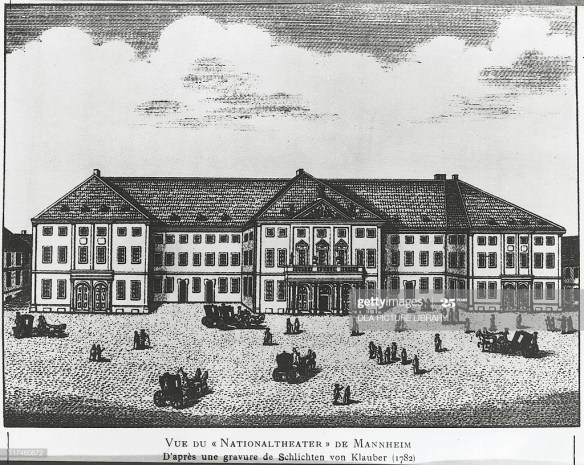
Picture: Mannheim National Theatre, 18th century (Schlichten & Klauber)

As we move towards the music of Beethoven we have so far encountered the music of three great masters – J.S.Bach, C.P.E. Bach and Handel. While all three exerted some sort of influence on Beethoven’s music, it is arguably the music of C.P.E. that was to prove the most far-reaching and original.

C.P.E.’s music went in hand with the Sturm und Drang approach, composers encouraged to bare their souls more explicitly in their music rather than (or as well as) sticking to more conventional rules.

The court orchestra of Mannheim was a hotbed for composers employing the Sturm und Drang in the mid-18th century. Its high level of musicianship was noted by Leopold Mozart and son Wolfgang, who made a prominent visit to Mannheim in 1777.

In his fantastically readable and comprehensive history Music In European Capitals – The Galant Style 1720-1780, Daniel Heartz takes up the story. He tells of how the city was incredibly well-placed for musical entertainment. Much of this took place in the palace, built from 1720 and containing the Knights’ Hall or Rittersaal, which became “the site of the orchestral academies for which Mannheim’s court music was to become most famous”. From 1742 the palace (below, depicted in 1725 by J.C. Froimon) was equipped with an opera house installed in its eastern wing, and a huge number of musicians in its employment.

One of those musicians was Johann Stamitz, described by English music historian Charles Burney as ‘the late celebrated Stamitz, from whose fire and genius the present style of Sinfonia, so full of great effects, of light and shade, was in considerable degree derived’. The ‘light and shade’ of which Burney speaks corresponds with the Sturm und Drang.

Stamitz worked at the court in Mannheim from 1743, but his fame soon spread, and Heartz writes of ‘the performance of a symphony by him with horns, trumpets, and timpani to open the Concert Spirituel in Paris in 1751’. This led to a prolonged period of work in the French capital, though soon Johann returned to Mannheim where he died in 1757, succeeded by his pupil Christian Cannabich.

The playlist below includes a number of Mannheim composers, headed by Johann Stamitz and his son Carl. Johann’s Sinfonia pastorale in D major begins the selection, quoting extensively from a Bohemian Christmas carol. Heartz writes of how ‘Stamitz’s fame rests principally on the handful of symphonies…attributed to his last four years…without equal in the 1750s’.

From there son Carl takes up the baton with the well-loved Clarinet Concerto no.3. Listening to this bright piece, brilliantly played by Sabine Meyer, gives an illustration of the positive energy Stamitz used throughout his music. The Cello Concerto in G major, later in the selection, is even more substantial, an assured piece that has a deeply soulful slow movement.

Cannabich himself wrote a large number of symphonies. Heartz writes of how his Symphony no.22, included here, contains crescendos – the idea of music changing in volume now a completely accepted one by scholars and audiences. It also includes oboes and horns in the scoring, signs that the orchestra was beginning to expand.

Mozart, however, was not impressed for a good while – until a later Cannabich symphony passed his ears in Munich in 1780. Now the story was different. ‘I assure you, if you had heard it yourself it would have pleased and moved you as much as it did me, and if you had not known ahead of time, you would not have believed that it was by Cannabich. Come soon then and hear the orchestra and admire it!’

Other prominent composers in the Mannheim court were Franz Xaver Richter, whose Symphony in B flat major appears on the playlist, as well as Franz Ignaz Beck and Ignaz Fränzl.

Did they influence Beethoven’s way of thinking in any way? We shall find out in due course. In the meantime, listen below:

Next up

Routes to Beethoven moves on to a quick look at the music of two of his teachers, Anton Albrechtsberger and Antonio Salieri.

Sound of mind – New releases

This is not a regular feature, but I thought it would be good to highlight new albums released today that fall into Arcana’s ‘circle of interest’ – the idea being that listening to them or hopefully even buying them will reward the creators in these difficult times. So, without further ado…
Víkingur Ólafsson releases his much-anticipated third album for DG today. A collection of music for keyboard by Rameau and Debussy, it has the hallmarks of Ólafsson’s meticulous presentation, and – I suspect – his meticulous and intimate approach, which has proved so effective with his albums of Philip Glass Etudes and Bach keyboard music.

Sticking with classical music but moving ever so slightly closer to Hollywood, the Sinfonia of London and John Wilson release their third collaboration on Chandos today. It sees them returning to Korngold, whose Symphony in F sharp major they played so brilliantly to celebrate their rebirth as an orchestra. This time they are taking on the composer’s glitzy Violin Concerto, with soloist Andrew Haveron stepping up from duties as orchestral leader. This is coupled with the substantial String Sextet, a work definitely worth getting to know:

Switching on the power, we arrive at Daniel Avery and his collaboration with Nine Inch NailsAlessandro Cortini, Illusion Of Time. This is an intriguing match that on first listen is a successful blend of electronic soundscapes, with Avery’s wide open perspective and Cortini’s analogue synth sensibilities complementing each other:

It’s great to see Little Dragon back. The Swedish band have changed labels, arriving at Ninja Tune – and their sixth album New Me, Same Us. It finds them rejuvenated and pressing forward, with Yukimi Nagano providing the ever-distinctive vocals.

Moving outside of Europe we come to Tamikrest. I can’t pretend to have a good knowledge of African music, but here is a band I have latched onto for their unique blend of Tuareg music and rock. Their new record Tamotaït has the same thrilling combination of propulsive rhythms and heat-soaked atmosphere:

Finally – if you’re after a good house party for your nearest and dearest – you would do well to consider including some of the new Dua Lipa album! She may not be someone who needs the investment, but you can guarantee good vibes throughout Future Nostalgia, especially when the likes of hit singles Don’t Start Now and Physical are present.

Sound of Mind 10 – Sounds of Spring

If you’ve been indoors for over a week now, the chances are you’ll be climbing the walls!

Happily there are reasons to be cheerful just around the corner – not least the imminent arrival of spring.

Classical music composers have always taken to spring in their music, from Vivaldi through to Stravinsky. This playlist celebrates their portrayals of the season, through works including Vivaldi’s The Four Seasons, Schumann‘s Spring Symphony, Beethoven, Sibelius and finally Britten.

Have a listen and harness the positive energy our composers can provide!


Ben Hogwood

Sound of Mind 9 – Holst: St Paul’s Suite

If you’ve been following Arcana for the last week or so you will have seen the regular posts in the Sound of Mind series, which is aiming to provide some sort of musical comfort for those cooped up at home in these very strange times.

Today’s post is directly inspired by the most recent episode of University Challenge. That is not a sentence I thought I would ever type, but one of the musical questions was a quote from Holst‘s St Paul’s Suite, a wholly underrated work for strings that does not get the exposure it deserves.

Holst very cleverly uses a series of folk tunes and feeds them through the medium of the string orchestra. The four movements are notable for their clever use of these melodies but also their economy of expression and surprisingly deep emotion. The opening Jig sets a bracing, early morning mood, and the following Ostinato, after a silvery start, finds a similar mood.

The emotional heart of the suite is the Intermezzo, flavoured with the sort of Eastern melodic inflections Holst uses so effectively in his music, while the suite wraps up with a Dargason, where interweaving melodies are trumped by a hefty quotation of Greensleeves.

Watch the above performance, from the New York Classical Players, and enjoy!

Ben Hogwood