Various Artists: Balance presents Vivrant mixed by Jeremy Olander (Balance)
What’s the story?
‘Melancholic’ and ‘cinematic’ are two of the words closely associated with Jeremy Olander’s music. They are often applied to the Swedish producer’s own work and his DJ sets, which often contain a lot of his own music. Time, then, for him to release one of those commercially – which he does here on the Balance label. Olander confesses to feeling a little intimidated by the prospect, with last year’s epic contribution from James Zabiela casting quite a shadow, but he nonetheless steps up with music from his own studio and those of his Vivrant label artists.
What’s the music like?
Yes. Olander goes for an expansive style in his mixing, and often stays rooted to the same pitch for ten minutes or more. This is a really effective tactic, creating wide open spaces and a pleasant feeling of hypnosis for the listener, who after a while will discover their feet are tapping automatically. The introduction of the first mix bears this out, with three tracks from J.Singh that stay rooted to one pitch before long bass notes move the music on. Marino Canal & Miguel Payda’s Hidden Eyes are excellent, with a moody vocal and soaring line.
The mix is like a single, arching structure, as is the second which has an utterly sublime beginning from Olander’s own track Akzo. This is a lovely, starry piece of music and it cuts to more spacey, beat driven material in Yoyo. Again the continuity here is more important than single standout single tracks, and Olander judges the build of intensity in the mix just right, finishing with his own Life After Death.
Is it recommended?
Yes. Olander’s mixes are in for the long haul and work best when heard in full, creating spaced out and hypnotic atmospheres. They may not always be full of hooks but the late night spell is cast to perfection.
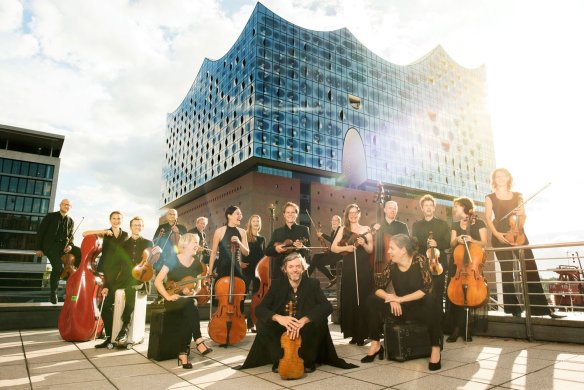
These are exciting times for Ensemble Resonanz. Presenting themselves as an ensemble that functions as a group of soloists as well as a chamber orchestra, the Hamburg-based group are Ensemble in Residence at Germany’s flagship new concert hall, the Elbphilharmonie. From that base they have established themselves as a wide-reaching musical force, capable of interpreting the music of Haydn as naturally as their latest release with Bryce Dessner, composer and guitarist with The National.
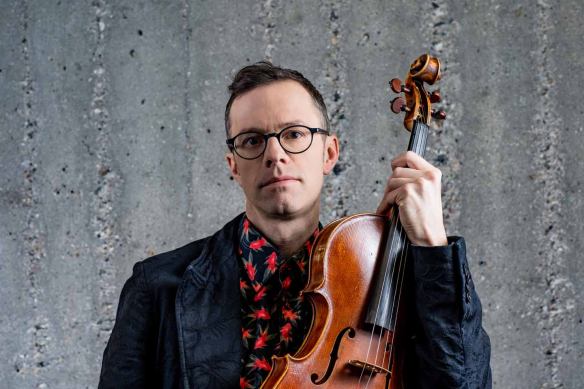
Arcana spoke to one of the ensemble’s lynchpins, viola player Justin Caulley (above), to find out what makes him – and them – tick, and how they achieve their renowned intensity in concert and on record.
As always, we began at the start, and an upbringing that brings both Beethoven and Pearl Jam into the conversation. “I grew up mostly in Kansas”, says Caulley, “and my parents were amateur musicians. My father played piano and a bit of cello, while my mother played the piano. My upbringing was sprinkled with classical CDs that my dad would bring home. I especially remember Richard Strauss’s Also sprach Zarathustra conducted by Herbert von Karajan, and Beethoven’s Symphony no.9 as well. I got started playing the violin in church, then moved to viola. My dad was the preacher there. I played in student concerts in country churches, but like every kid at the time I listened to a lot of rock and grunge music. I was pretty influenced by mixtapes my cousin would make for me, with Pearl Jam, Nirvana and Alice In Chains on them. He was in south Seattle and introduced me to them, as well as bands like Sonic Youth.”
Deciding to pursue music further, Caulley made rapid progress in both his musical attributes and his discoveries. “Having grown up in the United States I was influenced by the idea of crossing genres, or category-less music making. When you grow up in a small town all music is not the same but categories exist as much. Beethoven 9 or Pearl Jam, it’s all there. I was also heavily influenced at the Eastman Rochester School of Music, where I studied. It was there that I first encountered minimal music, and especially quite a few Steve Reich pieces. I was lucky to work with him a couple of times, and with La Monte Young, on the Dream House. We played a version of his String Trio and worked with him on it. This all happened before I came to Europe in 2003, so before Ensemble Resonanz I had a good varied upbringing!”
We move on to discuss the ensemble’s new disc Tenebre, a collection of four pieces by Bryce Dessner. “One of the challenges was to encounter Bryce’s music in the realm outside of categories”, says Caulley, in reference to our earlier points. “He is impossible to put in a box, and the challenge is to approach music with fresh as opposed to tabular thinking. The pieces are great and easy to get to, but each needs its own universe.”
There is a very powerful presence on Aheym, the album’s opening track. Originally written for the Kronos Quartet, it has been expanded by Dessner for the bigger forces of Ensemble Resonanz. “It’s one of those pieces that has such an incredible explosion of ideas and energy”, Justin says enthusiastically. “It’s easy to grab on to. It gets you worked up and very suddenly there is a groove. Some of the changes from section to section in Tenebre itself were astonishing to play, too.”
From previous experience I note Bryce has a really positive presence, softly spoken but fiercely driven. Did that transfer to the recording studio? “I think that’s very well put”, responds Caulley. “Working with him was really nice, and it was interesting to get feedback from him. We were working on this other level outside of the nuts and bolts. What I noticed was this unbelievably broad wisdom outside of the music, in a practiced way but also inside of that practicality there is something bigger going on.”
Dessner was quoted in an interview as being quite taken aback by the intensity of Ensemble Resonanz’s playing, which is surely the ultimate reference for an ensemble. “We were ultimately flattered by that! One of the nice things working with him was us working towards a common goal, our wishes were similar. It was easy to stay intense, with us all in it together.”
Ensemble Resonanz have been recording, too. “I just came from a session of Beethoven’s Piano Concerto no.4 with Gianluca Cascioli, conducted by Riccardo Minasi. We also have a great tour of our version of Bach’s Weihnachts-Oratorium (Christmas Oratorio) coming up, with quite a few concert dates before Christmas. After that we continue with our subscription concerts, with some Shostakovich and Ustvolskaya in January.”
He reflects on the opportunity to play in the Elbphilharmonie. “It’s great, really nice!” he enthuses. “It is totally larger than life, and even though we’ve toured most of our lives it’s not every day such a building opens up.” It must be rewarding moving between music by composers such as Haydn, Schoenberg, Eisler and Dessner, as the ensemble do. “It’s crazy, the breadth of stuff that we do. It’s always a great challenge, and the greatest luxury to have so many opportunities.”
There are moments of creative tension, but Caulley sees these as a sign of healthy artistic dialogue. “As in any group there is a dynamic that can have its moments of tension. One thing I’ve learned of value is the idea that any sort of tension can be resolved, and can also be used towards working for a goal. Where I grew up there was no tension at all, and it could get superficial. Now although sometimes tempers can flare the search for some sort of truth is important to people. They don’t want just to smile and nod and say that’s OK. If that’s tough, just lay it on the table!”
Ensemble Resonanz have a monthly club night, about which Caulley is most enthusiastic. “For me that’s one of the most inspiring things we do, and I’m on the planning committee so am heavily invested. We have our own space, and we do what we want. We don’t necessarily do the most crazy things but we can let our imaginations roll and see what’s possible.”
Tenebre, the collaboration between Bryce Dessner and the Ensemble Resonanz, is out now – and can be purchased here
You can listen to Tenebre on Spotify below:
To illustrate the contrast in the repertoire the ensemble records, their previous release was Haydn’s Die sieben letzten Worte unseres Erlösers am Kreuze (The Seven Last Words of our Saviour on the Cross):
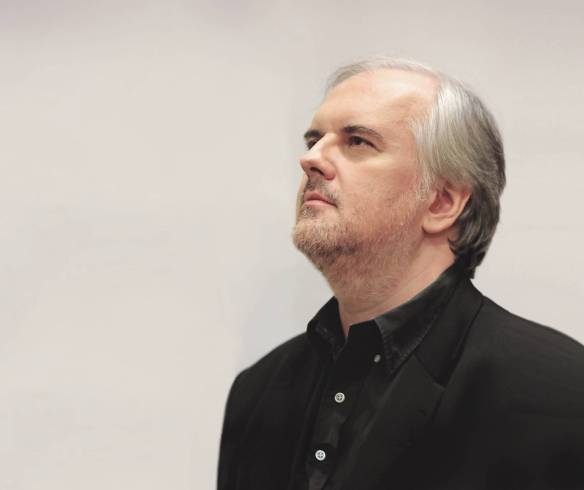
Peter Donohoe (piano), London Philharmonic Orchestra / Vladimir Jurowski (above)
Royal Festival Hall, Southbank Centre, London
Wednesday 11 December 2019
Foulds Dynamic Triptych (1929) Shostakovich Symphony no.11 in G minor Op.103 The Year 1905 (1957)
You can listen to this concert on the BBC Sounds app here, though you may wish to skip the interval of Shostakovich’s String Quartet no.8 for continuity.
Reviewed by Ben Hogwood
The London Philharmonic Orchestra’s Isle of Noises series has attracted – for me at least – some unfair criticism in recent days of the works included in its remit. Granted, the choices are all English, but the composers look beyond these shores with a willingness seemingly out of kilter with the current political climate.
John Foulds is a case in point; a composer who spent the final five years of his life in India before a tragic early death to cholera. Not only did he live in India but he actively explored its musical systems, looking to see how he could incorporate his discoveries and influences into the framework of classical music.
The Dynamic Triptych is a striking example of successful integration. Completed in 1929, its musical language is well beyond its years. In the first movement Foulds becomes obsessed with a modal scale, repeating it over and over rather like Scriabin would do with towers of chords based on intervals of a fourth. The task of playing the modal scales often fell in this performance to the muscular piano part, played with great authority by Peter Donohoe (above). The pianist has spent a great deal of time with this work, recording it with Sakari Oramo and the CBSO in 2006. He led a highly spirited performance, yet despite his brilliant passagework and percussive interventions in the fast music the soul of the work lay in the slow movement.
Here the strings’ quarter tones, beautifully played, brought added mystery to the picture when dressed with evocative percussion, adding to music already in the grip of a poignant sense of loss. Piano and orchestra regrouped for a finale that galloped ahead, Foulds letting the music off the leash to explore more far-flung tonal areas, before a silvery waltz theme was introduced to complement the quickstep. Both fused for a bold and dramatic finale, capping a well-received performance. This was forward looking music of English origin, and not in a 12-tone style either! The LPO should be praised for its inclusion and Vladimir Jurowski, who conducted with characteristic sensitivity, will hopefully explore more of Foulds’ colourful scores in the future.
The colours vanished dramatically after the interval for the opening pages of Shostakovich’s Symphony no.11. This performance took on added poignancy with a dedication from Jurowski to Mariss Jansons, sadly departed the previous weekend at the age of 76. Jansons was guest conductor of the London Philharmonic Orchestra from 1992 to 1997, and he grew up in St Petersburg, on close personal terms with Shostakovich. The Eleventh Symphony, depicting the slaughter of protestors in the city as part of the Russian Revolution in January 1905, could not have been closer to home.
What a performance it was. For an hour we barely moved as Shostakovich’s first-hand account of the action took hold in vivid, cinematic detail. The icy Palace Square of the city could not have been colder in Jurowski’s hands, with ominous timpani rolls signalling tragedy all too early on. When it came, in the second movement, the massacre was delivered by music of uncompromising and stunning power, the proud brass chorale ultimately shut down by deafening percussion before the door slammed shut. Suddenly the square was silent, save for the strings’ icy tendrils which extended once again towards the audience, noticeably holding its collective breath.
The London Philharmonic were absolutely superb. With 22 cellos and basses playing as one, digging in to the ice as though their lives depended on it, the performance was on sure foundations, above which we had special woodwind contributions, with cor anglais (Sue Bohling) and bass clarinet (Paul Richards) just two of several exceptional solos. The percussionists, a vital cog in the Shostakovich machine, judged their contributions ideally too, with sharp snare drum retorts complemented by rolling bass drum and gong.
Still the tension remained, through an elegiac slow movement where the violas’ melody could not have been more poignantly played by David Quiggle and his section. The dedication to Jansons felt most intense here, and the players were given due acknowledgement by Jurowski in their well-deserved curtain call. Yet despite the deeply personal aspect of the performance there were even sharper parallels with the political climate of today, reminding listeners of the protests in Hong Kong and the forthcoming UK election, not to mention the disinformation, code and discrimination that permeate today’s society at every turn.
This account lived and breathed all of those dreadful things, and as the performance reached its shattering climax with tolling bells, Shostakovich was communicating with ever more piercing clarity. It may not be his most accomplished symphony but the Eleventh is one of his most descriptive and emotive. As Jurowski held the score aloft afterwards it was clear he felt the same – and I for one left reeling at the impact of a memorable performance.
Further listening
This Spotify playlist gives recordings of the Eleventh Symphony from Mariss Jansons himself, conducting the Philadelphia Orchestra, and Peter Donohoe with the CBSO under Sakari Oramo in the John Foulds Dynamic Triptych:
*Kristina Hellgren (soprano), *Anna Grevelius (mezzo-soprano), *Conny Thimander (tenor), */**Jakob Högström (baritone), *Musica Vitae, */**Ensemble SYD / Daniel Hansson
Pettersson
Vox Humana (1974)*
Six Songs (1935)**
CPO CPO 999 286-2 [69’26”]
Swedish texts and English/German translations
Producer Stephan Reh
Engineers Hakan Ekman & Gunnar Andersson
Recorded 26-27 May 2019 at Palladium, Malmo
Written by Richard Whitehouse
What’s the story?
The CPO label moves a step closer to recording the complete works by Allan Pettersson with this disc of his major non-symphonic choral work Vox Humana, coupled with the first outing for an orchestration of the Six Songs which is almost this composer’s earliest surviving opus..
What’s the music like?
After prolonged illness (and hospitalisation) at the start of the 1970s, Pettersson’s priorities as a composer changed somewhat; his relatively succinct Tenth and Eleventh Symphonies being followed by the choral Twelfth, setting Pablo Neruda, then the present cantata such as makes explicit his empathy with the socially and politically oppressed through settings of poems by mainly Latin-American authors. Despite its 50-minute duration, Vox Humana is for the most part subdued and understated in its tone – with, moreover, a focus on the salient ‘message’ of those tests which recalls his approach in the wartime Barefoot Songs that constitutes his first notable statement. This is reinforced by accompaniment for strings whose reticence seems a world away from the charged and confrontational manner pursued in most of his symphonies.
Formally the cantata divides into three separate parts. The first of these consists of 14 songs after Latin-American workers’ poetry, mostly reflections on the hopelessness of those being depicted and of the injustices meted out to them on a continual basis. The second part takes in three even briefer songs after old Indian poetry, here rendered in music which reduces the sentiments expressed to barest essentials. The third and final part consist of a single, ballad-like setting of a poem by Neruda, whose death in 1973 pre-dated by mere months the brutal military takeover in Chile and so makes the ecstatic longing of his words the more poignant. It forms a fitting culmination to this work, though even here Pettersson is mindful never to overstate the emotional fervour of convictions with which he was undoubtedly in sympathy.
Does it all work?
Yes, in that the restraint and often folk-like simplicity of these settings is its own justification. It helps when the performers are evidently attuned to this music, Jakob Högström leading the way with his authoritatively eloquent baritone and Anna Grevelius underlining her claims as among the leading mezzos of her generation.
Soprano and tenor may have considerably less to do, but Kristina Hellgren and Conny Thimander both make the most of their contributions. Daniel Hansson secures a thoughtful response from Musica Vitae and Ensemble SYD alike.
The other recording of Vox Humana dates back 43 years and was one of the first recordings issued by BIS. Stig Westerberg was among Pettersson’s surest advocates in the composer’s lifetime and his account lacks nothing in commitment, nor the sound for clarity or realism, yet the greater perspective of this version does tip the balance in its favour. The coupling, Pettersson’s Six Songs as arranged with strings and harp by Steffan Storm, is itself more apposite in confirming the human dimension of this composer’s music from the beginning.
Is it recommended?
Indeed. The booklet has full Swedish texts alongside English and German translations, with detailed notes by Andreas Meyer (though some of his discussion seems to be missing from the English text). Those unfamiliar with Vox Humana need not hesitate to acquire this disc.
Buy
For more information on this release visit the Presto website
You can listen to this concert on the BBC Sounds app here (opens in a new window)
Review and guide by Ben Hogwood
A concert of the three ‘B’s, all of them greats of keyboard literature – with a fourth, Busoni, added for good measure.
J.S. Bach and Busoni make a winning combination, the Italian 20th century composer having discovered a strong affinity with his ‘ancestor’s’ work in transcribing his organ and harpsichord works for piano. These were always done in a reverent way, and the famous Advent chorale prelude Nun komm, der Heiden Heiland (Now come, Saviour of the heathens) is no exception. Nicolas Angelich ensured all was still before beginning this account, and once started he left plenty of room for musical thought and variation of tempo and phrasing. Although at times it was a little too mannered, it was a nicely gauged start to the concert.
Angelich continued without a break into Brahms’ 7 Fantasien, hailed by Clara Schumann as ‘a true source of enjoyment, everything, poetry, passion, rapture, intimacy, full of the most marvellous effects’. The seven pieces work well as a whole, with three Capriccios placed 1, 3 and 7 in the group, interspersed with four Intermezzi. The relatively ambiguous labels mean Brahms has plenty of freedom for expression, and beyond the Capriccios being faster and stormy, and the Intermezzi slower, intimate and experimental, there is little to confine his work.
The performances here were well-informed, Angelich having recorded these works for Virgin Classics back in 2006. The first Capriccio in D minor (9:51) exhibits power and authority, with the composer’s beloved triplet rhythms in evidence, and is complemented by the first Intermezzo in A minor (12:11), one of several moments where Brahms’ thoughts turn wholly inwards – apart from the slightly sunnier middle section. The third piece, a Capriccio in G minor (16:23) has arpeggios tumbling downwards, and has a central section anticipating the tonal area (E) of the three Intermezzi to come. These are the fourth piece in E major (19:23), full of subtle but noticeable questioning in its melody, and the longest piece of the set. It is followed by the thoughtful fifth piece in E minor (23:59) and a sixth, mostly chordal piece back in E major (26:56) which quickly moves away from its harmonic base. Finally the power and passion returns for the seventh piece, a Capriccio in D minor (30:21). Brahms again is in his favourite two-against-three rhythmic figuration, and this signs off the set in the major key with some aplomb in Angelich’s performance.
Fantasy is also a theme for Beethoven’s most famous piano work, his Moonlight Sonata. In truth this piece sits between a fantasy and a sonata (hence the composer’s subtitle, Sonata quasi fantasia), and the first movement, though static in the profile of its arpeggios, is pure and magical imagery, Beethoven intentionally or not evoking moonlight over Lake Lucerne as perceived by his friend, the poet Ludwig Rellstab.
Angelich brought the stillness of the moment to the Wigmore Hall (35:30), reflective and deep in a reverie, only rousing slightly for a Scherzo of relatively downbeat thoughts (41:35). Those sentiments were well and truly blown away by the Finale (44:12), the only one of the three movements written in true ‘sonata form’ by Beethoven. This was a terrifically played account, carefully thought through and played with feeling rather than a need for technical prowess – though that was present too.
Angelich returned to late Brahms for his encore, the Intermezzo in E flat major Op.117/1 (54:02) Another late work, this one is based on an old Scottish ballad, Lady Anne Bothwell’s Lament – and brought the mood and chronology of the concert full circle.
Repertoire
This concert contained the following music (with timings on the BBC Sounds broadcast in brackets):
J.S. Bach arr. Busoni Nun komm, der Heiden Heiland BWV 659 (c1748, arr.1898) (4:36) Brahms 7 Fantasien Op.116 (1892) (9:51) Beethoven Piano Sonata no.14 in C sharp minor Op.27/2 ‘Moonlight’ (1802) (35:30)
Encore: Brahms Intermezzo in E flat major Op.117/1 (1892) (54:02)
Further listening
The music from this concert can be heard in leading available versions on Spotify below. These include Angelich’s recording of the Brahms pieces, with Murray Perahia playing the Bach / Busoni and Beethoven:
Angelich can be heard in a double album of late Brahms that includes the composer’s piano pieces published as Op.117-119. They hold a unique place in the piano repertoire, written by Brahms in the knowledge that his compositional career was nearly over and looking forward to innovations by composers such as Mahler, Berg and Schoenberg:
Busoni’s transcriptions of Bach organ works repay further exploration, especially at this time of year. This album from Kun-Woo Paik brings together some of the more famous examples, including the Toccata, Adagio and Fugue:
Beethoven’s 32 Piano Sonatas remain one of the wonders of his output, but even a listen to the four published after the Moonlight sonata reveal a composer striking out for new shores. The Piano Sonata no.15 in D major Op.28, known as the Pastoral, is similarly magical – before the group of three works published as Op.31 reveal humour in the first, stormy Romanticism in the second (nicknamed The Tempest) and an openness of expression in the beautiful third. The playlist below brings together leading recordings from Emil Gilels: