Unknown's avatar

About Arcana

My name is Ben Hogwood, editor of the Arcana music site (arcana.fm)

On record: ENO Chorus & Orchestra / Martyn Brabbins – Havergal Brian: The Vision of Cleopatra (Epoch)

Claudia Boyle (soprano); Angharad Lyddon (mezzo); Claudia Huckle (contralto); Peter Auty (tenor) (all soloists in The Vision of Cleopatra), Chorus and Orchestra of English National Opera / Martyn Brabbins

Havergal Brian
The Vision of Cleopatra (1907)
For Valour (1904, rev 1906)
Fantastic Variations on an Old Rhyme (1907)
Two Poems (1912)

Dutton Epoch CDLX 7348 [73’37”]

Producer Alexander Van Ingen
Engineers Dexter Newman, Dillon Gallagher

Recorded July 5-6 2017 at St Jude-on-the-Hill, London
Recorded in association with the Havergal Brian Society

Reviewed by Richard Whitehouse

What’s the story?

Martyn Brabbins continues his series of Havergal Brian recordings for Dutton with a notable first – the ‘tragic poem’ The Vision of Cleopatra that is its composer’s largest surviving work from his earlier years, but which went unperformed for 105 years until its revival in Bristol.

What’s the music like?

Premiered at the 1909 Southport Festival, The Vision of Cleopatra enjoyed a passing success but received no further performances. Loss of the orchestral score and parts in the Blitz made revival impossible until 2014, when John Pickard (who writes the informative booklet note) made a new orchestration. The outcome is audacious in the context of British music from this period, taking on board possibilities opened-up by Richard Strauss in his controversial opera Salomé – unheard in the UK until 1910, but whose innovations Brian likely absorbed from the score.

Whatever else (and for all that Gerald Cumberland’s tepid libretto might suggest otherwise), Cleopatra is no anodyne Edwardian morality. After the Slave Dance which functions as a lively overture, the cantata proceeds as a sequence of nominally symphonic movements – a speculative dialogue between two of the queen’s retainers, then an increasingly fervent duet between Cleopatra and Antony followed by an expansive aria for the former; separated by a speculative choral interlude and concluded with a Funeral March of plangent immediacy.

Cleopatra may have fazed its first-night performers, but there is nothing at all tentative about this first recording. Claudia Boyle is sympathetic as Iris and Angharad Lyddon even more so as Charmion, while Peter Auty provides a not unduly histrionic showing as Antony. Although not ideally alluring in the title-role, Claudia Huckle brings eloquence to her climactic aria and throughout fulfils Brian’s exacting requirements. The Chorus of English National Opera sings with real lustre, and Brabbins secures a committed response from the ENO Orchestra.

The concert overture For Valour and Fantastic Variations on an Old Rhyme had already been recorded (on Naxos), but Brabbins’ teasing out of formal subtlety from expressive panache in the former and binding the latter’s (purposely) unbalanced variations into a cohesive if unwieldy whole ensures a decisive advantage. Setting contrasted poems by Robert Herrick, Two Poems receives its first professional recording: the wan plaintiveness of Requiem for the Rose then sardonic humour of The Hag make for a jarring duality redolent of Bartók’s Two Portraits Op.5.

Does it all work?

For the most part, yes. Uneven in continuity and inspiration, The Vision of Cleopatra contains the most audacious and prophetic music Brian wrote before his opera The Tigers; this account does it justice, even if the highly reverberant ambience entails a marginal lack of immediacy – notably a rather backwardly balanced chorus in its decisive contribution during Cleopatra’s aria. The orchestral playing leaves little to be desired – reinforcing gains in consistency instilled by Brabbins since he became the Music Director of English National Opera two seasons ago.

Is it recommended?

Yes. The Vision of Cleopatra is unlikely to receive regular performance (its demands putting it beyond reach of most choral societies), making this account more valuable for conveying its measure. Perhaps Pickard might follow it up with an orchestration of Brian’s Psalm 137?

You can read more about this release on the Epoch website, or read about The Vision of Cleopatra itself on the Havergal Brian Society website.

The Favourite Soundtrack – listen here

Happy New Year!

One of the most hotly anticipated film releases of this New Year 2019 is The Favourite. Olivia Colman plays Queen Anne, supported by Rachel Weisz and Emma Stone as part of a starry cast to tell a tragi-comic tale around the life of the 18th century English monarch.

The score of this colourful, moving and often hilarious film is full to the brim with classical music – so as the release of the official soundtrack is a few weeks away, here is a playlist of the musical numbers. From Purcell‘s incredibly moving Music For A While to Messiaen‘s thundering Jésus accepte la souffrance (Jesus accepts suffering) by way of small-scale Schubert and Schumann, it contains some absolute gems!

Live review – RTÉ Contempo Quartet & members of Ad Libitum & Arcadia Quartets: Enescu & Bartók

RTÉ Contempo Quartet [Bogdan Sofei & Ingrid Nicola (violins), Andreea Banciu (viola), Adrian Mantu (cello)]; members of the Ad Libitum Quartet [Remus Azoitei (violin) and Filip Papa (cello)] and Arcadia Quartet [Rasvan Dumitri (violin) and Traian Boala (viola)]

Wigmore Hall, London
Sunday 30 December 2018, 11:30am
Given in association with the Romanian Cultural Institute, London and RTÉ

Bartók (arr. Naughtin) Romanian Folk Dances BB68 (1915)
Enescu Octet in C major Op.7 (1900)

Written by Richard Whitehouse

This last of the Sunday Morning Concerts for 2018 at Wigmore Hall proved a culmination in every respect – a performance of the Octet for strings with which the teenage Enescu saw in the twentieth century, and which remains among his most innovative and impressive works.

Completed in 1900, the Octet then had to wait almost a decade for its first public hearing and subsequent performances were more likely from string orchestras; even when this piece was given as intended, the eight instruments were often coordinated by a conductor – testament to a contrapuntal intricacy and emotional intensity that ensembles have only recently felt able to take in their collective stride. Such was undoubtedly true of the present reading, in which the RTÉ Contempo Quartet was partnered by members of the Arcadia and Ad Libitum Quartets.

In his own Octet the teenage Mendelssohn had 75 years earlier hinted at an overall unity, via long-term thematic links, which Enescu takes much further by designing his first movement an extended exposition that is ‘developed’ across two successors before the finale brings an intensified reprise and climactic apotheosis. Not that this account took risks with the work’s formal or expressive audacities; rather its numerous insights were unassumingly drawn into an ongoing continuity which proceeded from an alternately febrile and languorous Scherzo, then raptly eloquent slow movement, to a finale whose heady rhetoric was vividly channeled into the culmination – a fervent augmentation of the work’s opening theme, propelled by an elemental waltz motion, that the young Enescu arguably never surpassed for sheer panache.

A technical as well as interpretative challenge, then, that was triumphantly brought off – any flaws in intonation or ensemble far outweighed by the cumulative impact of this performance. Not its least notable aspect was the tangible interplay between musicians responsive not only to their own parts but also to those of their colleagues, so rendering superfluous any need for a conductor. Certainly, the near-capacity audience responded with real enthusiasm to a piece that, if they were unfamiliar with beforehand, they had evidently taken to heart by the close.

An as entree into the main work, the RTÉ Contempo gave a fluent and atmospheric reading of Bartók’s Romanian Folk Dances – here in an idiomatic while texturally slightly too fussy arrangement by Matt Naughtin as set the scene for what followed in suitably bracing terms.

For more information on the RTÉ Contempo Quartet, visit their website. A Spotify playlist of the music given in this concert is included below, with the Romanian Dances in the more frequently heard version for string orchestra:

Live review – Leonidas Kavakos, LSO / Sir Simon Rattle: Brahms, Debussy & Enescu

Leonidas Kavakos (violin, above), London Symphony Orchestra / Sir Simon Rattle (below)

Barbican Hall, London
Sunday 16 December 2018

Brahms Violin Concerto in D major Op.77 (1878)
Debussy Images (1905-12)
Enescu Romanian Rhapsody no.1 in A major Op.11/1 (1901)

Written by Richard Whitehouse

Sir Simon Rattle and the London Symphony Orchestra tonight continued their ‘Roots & Origins’ project with a diverse programme ranging from the innate classicism of Brahms, through the refracted (post-)impressionism of Debussy then on to the unaffected nationalism of Enescu.

A change in the running order saw a first half devoted to Brahms’s Violin Concerto – easy to pigeon-hole as archetypally Austro-German, though fairly permeated with elements derived from popular and traditional sources. Nor did Leonidas Kavakos deliver a bland or uneventful account, maintaining palpable momentum across the expansive initial movement that carried through to an uncommonly perceptive take on Joachim’s monumental cadenza, followed by an easeful coda in which the symbiosis between soloist and orchestra was at its most tangible.

While there was no undue lingering in the Adagio, Kavakos brought out its gentle eloquence in full measure – abetted by playing of burnished warmth from the LSO’s woodwind, though there was no lack of agitation in the contrasting central section. The Hungarian overtones of the finale were then given full rein, Kavakos projecting the music’s rhythmic drive as surely as he propelled the coda to its effervescent close. Throughout this performance, Rattle was at one with his soloist in a work he has no doubt given many times during the past four decades.

A dynamic and vividly projected reading, then, from Kavakos (very different from the inward and almost self-communing one he gave during last year’s Enescu Festival), who returned for a predictably scintillating account of the Les furies finale from Ysaÿe’s Second Solo Sonata.


Debussy’s Images has long been a Rattle staple: his running-order differs from that published – though there is arguably no ideal sequence for such a contrasting assemblage. Certainly, the fatefully understated Gigues makes a plausible opening, its fugitive gestures and searching ambivalence more an evocation of the composer in his last years as of any English environs. Rondes de printemps is the positive corollary, its vernal freshness and simmering energy an indication of that renewal in French culture made explicit by the late sonatas. In both pieces, Rattle secured a superfine response from the LSO and if characterization in Ibéria was less acute, this may have been owing to the music’s broad-brush Spanish quality than to any lack of insight. Not in doubt was the cohesion that Rattle drew from this composite work overall.

Cohesion was also key to his performance of Enescu’s First Romanian Rhapsody. More than a medley of popular tunes, its integration is that of a borne symphonist and Rattle responded accordingly as he built momentum across the suave initial episodes before cutting loose with the bacchanal. The degree of detail lost was outweighed by the visceral excitement that held good through to the coda. A piece associated with Rattle since the early 1980s, and of which the LSO gave a memorable televised reading a decade earlier, ended this concert in fine style.

The question remains why Rattle has never added further Enescu to his repertoire. Perhaps he considers him lesser to Szymanowski, whom he has championed assiduously? Pieces such as the Second Symphony, Third Suite and Vox Maris cry out for his advocacy. Maybe one day?

For more information on forthcoming concerts from the London Symphony Orchestra in 2019, you can visit their website. Meanwhile you can enjoy Kavakos in a recent performance of the Brahms Violin Concerto below:

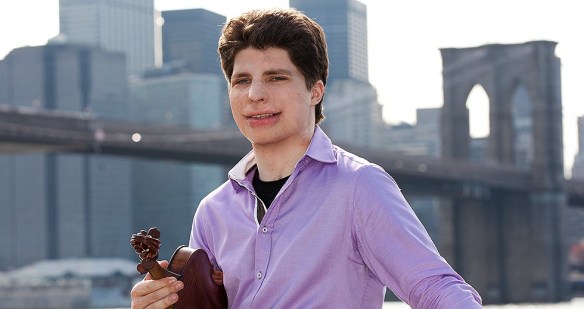
Wigmore Mondays: Augustin Hadelich & Charles Owen – Brahms, Ysaÿe & Adams

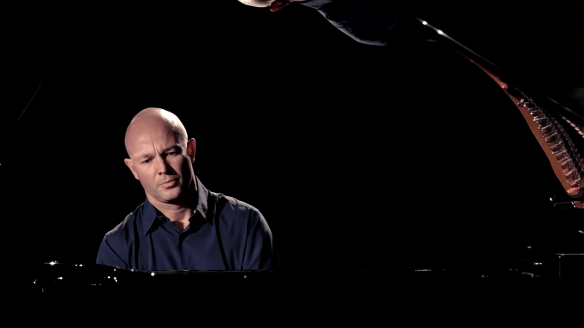
Augustin Hadelich (violin, above), Charles Owen (piano, below)

Brahms Violin Sonata no.1 in G major Op.78 (1878-9) (1:57-28:08)
Ysaÿe Sonata for solo violin no.4 in E minor Op.27/4 ‘Fritz Kreisler’ (1923) (30:31-40:44)
Adams Road Movies (1995) (43:33-1:00:24)

Wigmore Hall, London; Monday 10 December 2018

You can listen to the BBC Radio 3 broadcast by clicking here

Written by Ben Hogwood

This was the third Monday lunchtime in the last six weeks where BBC Radio 3 and the Wigmore Hall have been concentrating on music for violin and piano. This nicely constructed recital complemented the previous pair from Aleksey Semenenko and Inna Firsova, and Tai Murray and Silke Avenhaus, where we had heard two of the three violin sonatas by Grieg.

On this occasion we heard a contemporary of those works, the Brahms’ Violin Sonata no.1 in G major – a work written for his friend, the great violinist Joseph Joachim – and one also picked up by Clara Schumann. It is a highly attractive work and received an affectionate performance here, Augustin Hadelich and Charles Owen straight into the beatific air of the first movement (from 1:57 on the broadcast) With an equally genial theme from 3:24, this was Brahms at his most radiant, with a sweet tone from the violinist and flowing countermelodies from Owen. The airy role reversal at 5:20, with Owen playing the tune and Hadelich giving pizzicato (plucked) accompaniment was a lovely moment – as was the content beginning of the coda (11:35). In between this the music was passionate and animated, Brahms developing his source material.

The second movement (from 12:34) also benefited from Hadelich’s sweetly toned instrument, shaping up to be a lovely reverie until a much more animated central section blew away the cobwebs (15:00). Returning at 16:23, the main theme gained an extra layer from double stopping on the violin (playing more than one string at once), and Owen’s piano line continued as a model of sensitivity.

Clara Schumann stated that she would happily have the last movement of this sonata to accompany her on her journey ‘to the next world’, and you could hear why in this performance (from 20:05), which brought out its bittersweet quality. Brahms moves between G minor and G major, a delicate balancing act of music that sounds a bit fretful and gentler, uplifting thoughts. Hadelich and Owen caught them perfectly here, the latter’s nicely pointed piano working particularly well on the dance-like second idea of the movement. From 25:37 the major-minor tension resumed, resolved in a serene coda from 26:20, ending quietly.

Ysaÿe wrote his six solo violin sonatas at great speed, publishing them all together in 1923. The fourth pays particular homage to Bach, incorporating the dance forms that were used in his Sonatas and Suites for solo stringed instruments. It was dedicated to the violinist-composer Fritz Kreisler, one of the very greatest string players. Not surprisingly it makes technical demands on the performer but Hadelich was brilliant here (from 30:31), careful not to overdo the virtuosity at the expense of musical communication.

The three sections of the sonata moved from a dramatic first movement Allemanda (30:31) through a slowly evolving Sarabande used by the composer as a fugue (34:50) and then a bracing Finale (37:57). The Sarabande had the most striking sonorities of the three, thanks to the inventive pizzicato techniques matched spotlessly by Hadelich, but the last movement was a tour de force with which to finish!

Following this was one of the first pieces John Adams wrote for chamber forces, his evocative trip Road Movies, after a period where he admits to ‘studiously avoiding the chamber music format’. Yet, as this entertaining three movement piece proves, his music translates effortlessly to the smaller scale. The piano (played heroically here by Charles Owen!) supplies a lot of the rhythmic impetus and the bass foundations, leaving the violin to operate more freely up top.

The first movement, Relaxed Groove, is described by the composer as ‘a relaxed drive down a not unfamiliar road. Material is recirculated in a sequence of recalls that suggest a rondo form’. Both performers got to the nub of the bluesy music straight away, and also evoked the ‘solitary figure in an empty desert landscape’ in the second movement, entitled Meditative (49:11), where Hadelich had to detune his bottom string from a ‘G’ to an ‘F’. Finally the toe-tapping 40% Swing (55:19) closed out this virtuosic piece, both players smiling as they enjoyed its grooves and motifs.

We disembarked from the Adams vehicle, but an encore was waiting to see us on our way – a rather fine arrangement by Ysaÿe of the Chopin Nocturne in C sharp minor, played with appropriate tenderness by Hadelich. Owen’s flowing accompaniment, too, was finely judged.

Further listening

Augustin Hadelich has not yet recorded any of the works in this recital, but the following playlist brings together the music heard in the concert, including a version of the encore arranged by Nathan Milstein:

For those enjoying the Ysaÿe Solo Sonata, a logical next port of call would be the unaccompanied 24 Caprices by Paganini, which Hadelich has recently recorded:

For those enjoying the Adams, here is a disc including not just Road Movies but a collection of the composer’s works for keyboard: